Software
Houzz Logo Print
stripedgt66

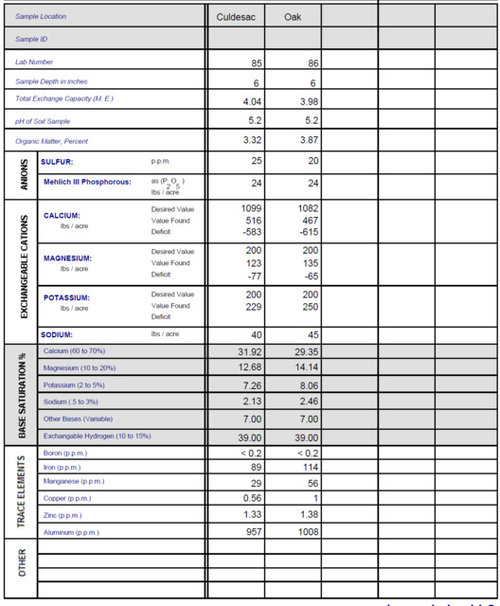
Help interpret Logan Lab results please

10 years ago
Hi all,

Lots of great info
and nice lawns on here!

I'm located in zone 8a, northeast of Atlanta, and trying to grow
seeded bermuda.

Below are my recent
results from Logan Labs. I hydroseeded princess 77 on April 27th with
starter fertilizer mixed in.

These two tests
represent soil prior to putting seed down with starter fertilizer.

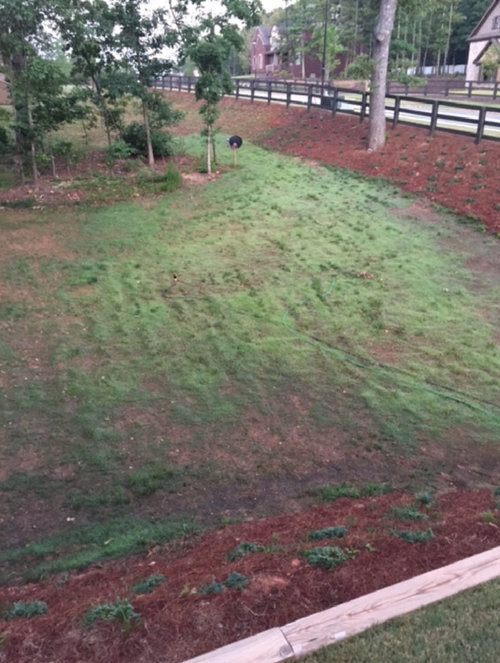
Below is a picture
of one of the areas from a week and a half ago.

I'm hoping for some
advice on whether I should be applying a high N only fertilizer soon or do
something different or in addition based on these results.

Comments (7)

  • 10 years ago

    You could apply starter fertilizer at bag rate if you can walk on it without damaging the seedlings.

    Morpheuspa is who you want to read your test. He drops by irregularly, but as you so recently seeded, there is no rush :)

  • 10 years ago

    It's not awful, not great, but we have an enforced pause due to the new seedlings. That won't be a problem.

    Both tests are very similar, so I'm going to fold them together and read the "Culdesac" tests. The places where they differ, there's no harm in using that test result.

    Sample Depth 6: We generally use 4, so I'll adjust numbers appropriately so you don't need to worry about that yet!

    Exchange Capacity 4: This is a very sandy soil, so it won't hold vast resources and will drift pretty easily. Once balanced, I'd recommend testing every other year as it'll drift pretty fast.

    OM 3.3%: In the Fair range, and certainly not a problem per se. However, more OM would retain more water, leading to watering less, and also hold some extra resources. So I'd always mulch mow, mow all your fall leaves, and import leaves from neighbors who throw them away. I wouldn't mind seeing this go as high as possible--which is not very high in an extremely sandy soil.

    Sulfur 25: On paper, a little high. In reality, not an issue in the slightest and a perfectly good answer.

    Phosphorus 24: Extremely low. I'm giving you a full month's pause before doing anything about anything, though, to give the seedlings some time to mature. They have enough of every resource to get through a month with no problems. To fix this, we use starter fertilizer (just get the cheapest), and that's detailed in Recommendations below.

    Calcium 32%: Way low, and what's pulling your pH down. Bermuda would like a lot more calcium available, but the seed contains enough Ca for a while yet. We use calcitic lime to fix this, and I target recommendations for Encap, Mag-I-Cal, or Pennington Fast Lime. Other limes are slower, require too much mass, or contain elements I don't want to add. I'm very tempted to move to an alternate calcium source here...but your shortage is severe enough that I'm not going to do that at this time. Recommendations below.

    Magnesium 12.7%: Optimal. On paper, it reads a bit low, but the deficit is not a problem at this time. Next year...well, it might be as calcium flows in. We'll see.

    Potassium 7.3%: Very high, but not a problem, and this number will drop as calcium flows in. I'm a fan of extra K, but this is even a little higher than I usually target. It's not important, though.

    Sodium 2.1%: On paper, this is getting high, but in practice it isn't a problem--your exchange capacity is low so there's no great amount of Na available at a time.

    Minor Elements: Boron is a consideration here, and I do mention iron below. The others we can ride, although I'm eyeballing copper a bit. It's workable, but if I didn't have other adjustments going I'd nudge it.

    Iron 89: Fine, but if you find that color isn't great as the calcium flows in and the pH rises, you can always use Milorganite whenever you want to slowly raise the soil iron.

    Boron <0.2: Deficient. While not a critical resource for lawns, it does influence quality (and photosynthetic efficiency), so I'd fix this. We use Milorganite as a carrier and 20 Mule Team Borax as the boron source. You can purchase 20 Mules at the grocery store in the laundry section. In a wheelbarrow or the like, dump the Milo. Spraying very, very lightly with water (I use a spray bottle like the kind people use to damp their clothes when they iron) will help the boron stick. Add the recommended amount of 20 Mule Team Borax and stir, spraying occasionally to get the stuff to stick to the Milo. Then apply over the recommended area. So if going for bag rate Milorganite (1 bag per 2,500 square feet), you'd add 12.5 tablespoons of 20 Mule Team Borax.

    Recommendations:

    July 1: Feed with starter fertilizer at the bag rate.

    July 15: Apply 7 pounds per thousand square feet of Encap, Mag-I-Cal, or Pennington Fast Lime.

    August 1: Feed with starter fertilizer at the bag rate.

    August 15: Apply 5 tablespoons of 20 Mule Team Borax per thousand square feet in Milorganite carrier.

    September 1: Feed with starter fertilizer at the bag rate.

    October 1: Feed with starter fertilizer at the bag rate.

    November 1: Apply 7 pounds per thousand square feet of Encap, Mag-I-Cal, or Pennington Fast Lime.

  • 10 years ago

    Thanks for doing some homework/research on the site.

    I would not have high expectations for the new seed until June. Oh wait, it's June already! Once the soil heats up is when the bermuda seed will hit its stride. Although the new seed will come in near the shady areas, it will not thrive there. It will thin out over the summer and you'll write back wondering what you did wrong.

    Is St Augustine a consideration for you? It will do very well in that amount of shade. One piece of St Aug sod costs about a dollar and will eventually spread to cover all the bermuda.

    Always mulch mow so you can retain as much organic matter as possible. You need all you can get. In the fall mulch mow the leaves in rather than raking them up. In fact, when your neighbors put bags of leaves out to be picked up, pick them up for your own lawn. Organic fertilizer is good, too. It can be applied any time.

  • 10 years ago

    Yeah, that Princess 77 isn't cheap--I'd give it a few seasons to spread before considering other grasses, but DC is correct that St. Aug will do better in the shade. I just resodded my entire front yard with celebration Bermuda because of my huge Oaks. Too much work trying to get the Tif to grow there. It's supposed to tolerate shade & root competition much better.

  • 10 years ago

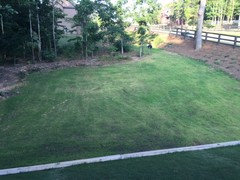
    The new bermuda is filling in since last time..

    I'm going to put down a starter fertilizer this weekend as part of the plan from Morpheus. I also put down a half rate application of milorganite a little over 2 weeks ago. Seems like I'm seeing better color in some areas from that.

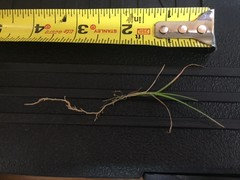
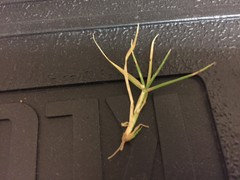
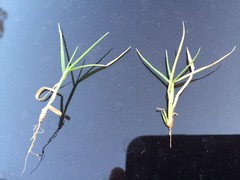
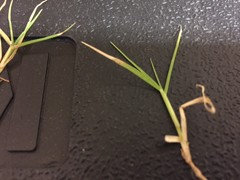
    I'm worried I might have created some brown patch or dollar spot through my watering schedule in the 2nd half of May. I was still watering a little every other day b/c I still had a lot of new germination. I've since reduced to watering 3 days a week and now twice a week. Shortly after my 1st cut on Jun 4th, I noticed some blades were brown like the picture below. A lot of the brown was on areas that were still too short to be cut.


    I'm not certain this was any type of fungus though as it presented itself to the left of the big oak in the picture. That tree seems to take up a lot of water and it's noticeably dryer testing with a screwdriver.

    I've since found areas throughout the yard that exhibit this too. The pictures below were from this morning and I'm able to find blades that seems to have a distinct spot like pictures I've seen of dollar spot.

    It seems like a lot these affected areas have good green growth coming from the center of the plant, so I wonder if the reduced watering is allowing it to work through the problem.

    We've had pretty high temps here with zero rain for 2-3 weeks. Mid to high-90's, with high 60's lows. I have't fertilized since starter fert was mixed with the hydroseed during application with the exception of the milorganite. I wonder if a boost from the fertilizer application this coming weekend will help it.

    Would you folks recommend something more proactive (fungicide or cornmeal) or let it ride for a few weeks while keeping an eye out for spread?

    I appreciate any advice for thoughts.

  • 10 years ago

    That does look fungal in the last few pics, but that first one from under the tree could be losing the water fight with the oak. Good roots though, so I think it'll grow through it if you keep an eye on that area & do some spot watering. Once it's making 6" roots, it'll compete better for water.

    Cornmeal has gotten great praise for prevention, not so much for cure. Like you said, it seems to be growing through the fungal issue pretty well now that you've reduced the water, so not sure I'd worry. I might spot spray some fungus treatment if you see it spreading, but otherwise fungus should be a non-issue on Bermuda going forward. That said, the organic fertilizer I use is cornmeal based & includes a Mycorhizical fungi supplement--Can't hurt, right?

    The princess is still in the very early stages & doesn't show any real stolons yet, but given a few weeks I bet it'll be spreading enough to knock on your front door!