Software
Houzz Logo Print
darktower00844

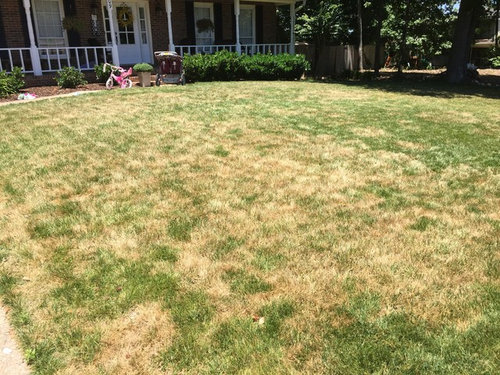
Brownpatch! Help!

10 years ago

Ok someone please tell me my lawn is not totally screwed. I'm only watering twice a week in the morning from 6-1pm (1.5 inches).

but I saw a lot of mushrooms popping up.. What do I do? Is this dormancy or definitely brown patch???? I live in Tennessee.

Comments (35)

  • 10 years ago

    I'm not sure where in TN you live, or what type of grass you have. I think brown patch looks more like a donut (a brown ring with a bit of green in the middle). I'm not sure. Maybe someone who is more familiar with brown patch can chime in.

    I have bermuda and live in middle tn. I haven't had to water lately because of all the rain recently. I did see a couple of mushrooms, but my grass is all green, and out of dormancy. I fed it in May, and it's due for another one next week. The highs where I live have been in the high 80's. I'll have to water Saturday because it will be in the mid 90's, and will be a week since it rained. Doesn't look like any rain until possibly next week.

  • 10 years ago

    I recognize your lawn from last year... the view of the street. Lawn looked great then! Is that 1.5 inches total per week, or 1.5 inches twice a week for 3 inches total? Anyway, even with warm temps that sound like an awful lot of water. I get mushrooms only in the wettest part of the lawn, although we've had a lot of rain recently and I'm seeing mushrooms pop up in other places. Seems like if you are having them it might be too much water.

    Maybe it would be helpful to take some pics of the transition between brown and green grass blades close up, like 3 or 4 inches away in the shade or on a cloudy day so the sun doesn't create too much contrast. I'm no fungus expert, but I'm sure people here can help diagnose a problem if they get a good look at the blades that are in the process of browning out.

  • 10 years ago

    Okay thanks! I'll do it tomorrow. I'm not sure really what it is either. I applied merit in early May so I don't think it's grubs. It's been really hot here and my TTTF is suffering. I haven't fertilized since March. I have slow release 20-5-10 but have been Leary on applying it due to the heat.

  • 10 years ago

    Looks like some drought stress but you really need a close up picture

  • 10 years ago
    last modified: 10 years ago

    1.5 inches a week or 3 inches a week? 6am to 1pm, assuming this is your measured time to dispense 1.5 inches of water? Is the grass in the shade brown? Or just the full sun part?

  • 10 years ago

    1.5 inches a week lawn is most sun side yard is shade

  • 10 years ago

    Is TN too far south for TTTF? seems like that would be the transition zone and i could see how with hot temps its going to suffer? just my guess, no expert...

  • 10 years ago

    My neighbor has that grass here in middle TN. His is browning a bit, and thinning. His was sodded twice too before the moved in this winter. His side yard is now dirt & weeds. He cuts it too short, and waters a little every evening. My bermuda is already taking over in some of his bare spots...ugh. I have another neighbor with fescue also. Beautiful! They don't water everyday, just after they cut it. They keep it about 4-5 inches tall even in the cooler months. They don't have alot of shade. I'm seeing how it will do with the temps coming up. It is supposed to be high 96 Saturday. Yipes!

  • 10 years ago

    So is there a formula to help brown patch? I think I've got it also, or something similar. I noticed a lot of brown blades when I mowed yesterday, but I do have a large patch of brown and green grass.

  • 10 years ago

    You will need a herbicide. Heritage G is effective but expensive. If you have a small lawn it might not be that bad.

  • 10 years ago

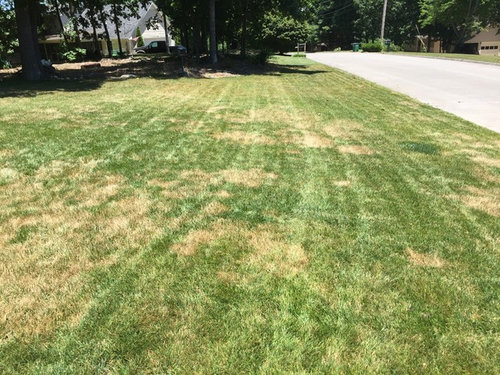
    Here are some additional photos

    this area is in the shade received no irrigation unless manually do it by hand.

    Any thoughts? Oh and some of the brown areas are dead. Grass pulls out easy. No grub activity soil is moist.

  • 10 years ago

  • 10 years ago

    Looks like brown patch to me.

  • 10 years ago
    last modified: 10 years ago

    Yeah possible brown patch on the grass that is living, but you have a lot of dead grass. The shaded area seems better, from what the pictures show. If you put two and two together...thoughts:


    Shaded area is not over watered , does not have potential fungal disease that thrives in warm moist environment.

    Sunny area over watered by 50+% a week. Has fungal disease that thrives in warm moist environment.

    Grass in sunny area dying.

    I would treat fungal disease with chemical treatment for fungal disease ASAP and cut back on watering to recommended amounts. You might be able to save some lawn and plan again in the fall.

  • 10 years ago

    what do you recommend to treat fungal disease that doesn't break the bank?

  • 10 years ago

    Thanks guys! I just bought some honor guard PPZ for the brown patch.. Suppose to be pretty good on it. fyi I did a screwdriver test and it easily sank in.. Wayyyyyy to wet. I'll update after applications

  • 10 years ago

    Is using a chemical treatment for fungal disease the only way to treat brown patch?

    Thanks

  • 10 years ago

    Yup you can try natural but it needs to started early in the season. I'm gonna do that next year. So next year it's grub control crabgrass control and fungus ughhh

  • 10 years ago

    Usually chemical fungicide for curative but there are bio fungicides for preventive. One is Serenade.....start a program early on and continue through out the summer and into the fall.

  • 10 years ago

    Can a lawn recover from brown patch without treatment?

  • 10 years ago

    It can but you may lose a lot of grass in the mean time. As the weather conditions change and cultural practices it can clear up

  • 10 years ago

    someone wrote: You will need a herbicide.

    I'm thinking more about prevention. I know some of you in the transition zone are thinking that the heat is what is contributing to stress and fungal attack. I'm wondering more about making sure your soil is balanced (get a Logan test!!). If you over water, maybe you'll get fungus anyway, I don't know, but I have to think bombing your lawn with preventative fungicides throughout the spring might not be the best thing to do. Maybe there is a biological imbalance in your lawn that needs to be addressed. As morpheus says, the fungi, good and bad, are there all the time, but the soil biology keeps them in check.

    My lawn was "new" a few years ago and I have been adding amendments to get the organics and minerals in a good range. Two years ago, in the fall, I mulched in tons of leaves. The following spring I had an outbreak of fungus gnats (who knew?). It was really bad, but guys like morpheus said it is a reaction to an imbalance. Last fall I mulched just as many leaves but this spring not a single fungus gnat. I'm thinking that the biology might be pretty balanced by now so that one particular critter cannot get out of control. (Yes, I understand there could be other factors such as weather).

    So I'm certainly a fungus newbie as it has never been an issue for me. It just occurred to me that some of you might have marginal biological activity/diversity after using blanket fungicides year after year.

  • 10 years ago

    Maybe there is a biological imbalance in your lawn that needs to be addressed.

    That is correct, the biological imbalance is the lawn itself. The fungus is mother nature striving towards balance. This grass has no business growing in the areas we're growing it in, it has no business being green in the middle of June, it has no business being as thick as it is. It's just a huge un-natural man made creation. If you stop watering, stop applying herbicides and fungicides, stop giving it nitrogen, you will find out quickly what biological balance looks like. I think that talking about biological balance in the context of lawn care is utopian. Even more so when it involves applying hundreds of pounds of sewer sludge or corn.

  • 10 years ago

    Well I'm gonna treat it with some powerful antifungal spray next week than just ride it out until next fall when I can overseed again.. Here's the kicker.. 10,000 different type of TTTF blends on the market... Which one do you buy?

  • 10 years ago
    last modified: 10 years ago

    Skip the blends and go straight to the NTEP website to see what cultivars performed well in your area. I think TN would be similar to conditions here in NC, so I can recommend Speedway, Rhambler, Bullseye, Falcon IV, Magellan, Rembrandt, Shenandoah, Traverse.

    You can buy just one cultivar, it's not all that important to blend with tall fescue like it is with KBG.

    Edit: Speedway is OOS for the year.

  • 10 years ago

    j4: I think that talking about biological balance in the context of lawn care is utopian.

    Yet it makes perfect sense in a lot of cases. Nature is great at adaptation, and time has shown that grass does very nicely being planted so close and cropped at 3 or 4 inches. The property where I live now had a lawn for 50 years that rarely got any attention other than mowing it after it had already overgrown. Never had a fungus problem, ever. So the point is there is nothing so unnatural about keeping a lawn that causes it to self destruct and go bad fungus on you. I understand you have a particular situation where no grass seems to be well adapted, and you have to struggle with it. I'm just throwing out there the idea that trying to nuke the lawn and sterilize it is one way, and maybe the best way, for your situation, but some people might not have considered that getting the soil chemistry good might be the best answer ultimately. You are taking a different tack. Maybe it'll work, maybe not. I still think you should at least get a soil test.

  • 10 years ago

    What's "good chemistry"?

  • 10 years ago

    Is Scott's fungicide effective?

  • 10 years ago

    Somewhat. Most fungicide products are effective, they're just discouraged as a routine because they do a lot of harm to the soil biology beyond just killing fungi.

  • 10 years ago

    j4: What's "good chemistry"?

    I'm sure after all the time you've spent here and learned from dchall and morpheus and me (lol) you know what I mean by that. It includes both adequate mineral levels as well as organic content so that soil structure (peds, void spaces) is good and is also capable of attracting worms and other critters good for the soil. I don't know enough about fungi to say whether this in itself is enough to prevent fungal outbreaks, but I do know that not having good soil creates stress on the grass, which can't help. All I'm saying is that in addition to considering an antifungal spray, people should think about getting their soil in the best condition they can.

  • 10 years ago

    I'm all for getting the soil in the best condition possible but I think that will do little to help with fungal issues. They actually like a nice healthy succulent plant. Here's a great article from NCSU on brown patch, great read.

    https://www.cals.ncsu.edu/plantpath/extension/fact_sheets/Turfgrass_-_Managing_Brown_Patch_in_Tall_Fescue_Landscapes.htm

  • 10 years ago

    j4: I'm all for getting the soil in the best condition possible but I think that will do little to help with fungal issues.


    That looks like a good resource... interesting stuff. I think you posted a link on another thread about fungus, but I can't find it. It was from the same site, but a different page. It mentioned that one of the contributors to fungal problems is poor drainage in the soil. They recommended aerating compacted soils. To me, this says that improving soil structure may in fact be helpful. Let's say you eventually get a soil test and find out your at 2.8% OM, which would be low. Would it hurt to get that up to 6 or 8%? According to the article, better drainage helps with fungus, and better drainage is what you'll get with healthy soil (aeration not longer needed).

    Like I said, I'm not in the problem zone like you are, so I'm not researching it like you are, but if you are in a sensitive, transition area isn't that even more reason to be sure you are giving yourself the best chance for success?

  • 10 years ago

    I just checked my last soul test in July 2015 organic matter isn't listed ( from UT ag extension) pH was 5.8 so I put 100 lb of lime per 1000sqft only other think low was potassium at 70 0-90 is in their low range.

  • 10 years ago
    last modified: 10 years ago

    @darktower: I think chicken soup is good for an acidic soul. :)

    You should consider getting a SOIL test from Logan Labs, which is what everybody here recommends as being the most consistent and thorough. It only costs $25 and morpheus will give you a great analysis for free if you post the results. Organic content is important for the structure of the soil (improves drainage, which is a factor with fungus), among many other things.

  • 10 years ago

    Okay I'll do that.

0