Software
Houzz Logo Print
dragonflyhollow

Chinese Pistache

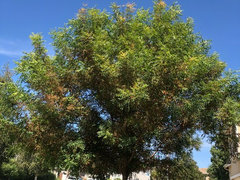
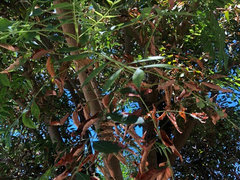
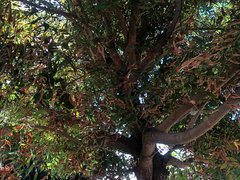
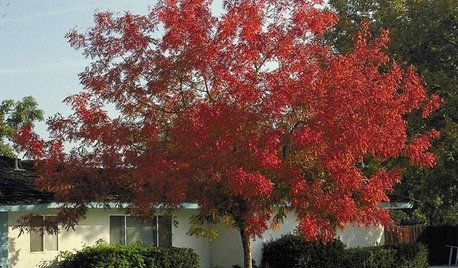
I planted a Chinese Pistache tree in the fall of 2009; I chose it because it's drought and heat tolerant, a Texas Superstar, and has nice fall coloring. During the summer of 2011, it practically burned up and lost most of its leaves (as did many plants). Every summer since then it, some of the leaves would get a bit of a sunburn and turn crispy when temperatures got over 95*. I attributed this to the drought. When it did it last year, I figured it was all the rain in May, since they don't like wet feet. Well, after the heat of the last few days, it has done it yet again. (And it was finally starting to look pretty, too.) I am at a total loss as to why. With the rain we've had, it hasn't gotten dry, and after almost seven years, it should be fine even if we did have a dry spell. Any ideas?

Michelle

Comments (12)

  • 10 years ago

    Michelle, Do you have well-drained soil? I know Chinese Pistache needs well-drained soil or a raised bed above grade level if you have clay.

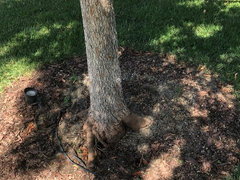
    Hmmm. When you planted it, were you careful not to plant too deeply? The root flare should show a little bit.

    Other than those two things, I have no idea why it seems unhappy.

    It is Texas Superstar, and part of the Earth-Kind program, so it shouldn't need heroic measures to keep it alive.

    Is it in full sun all day long, maybe? I know I don't like being in full sun all day long, but then I am not a tree.

    I'm going to link its Texas Superstar page to see if they say anything on that page whatsoever that gives you any ideas about what is going on with it. I am surprised it is showing leaf scorch every year. By now, it ought to be able to handle most things (though last year's rain and flooding was a lot to handle).

    Dawn


    Texas Superstar: Chinese Pistache

    Dragonfly Hollow (z7b,North Texas) thanked Okiedawn OK Zone 7
  • 10 years ago

    Thanks, Dawn.

    I have sandy loam, so that's not it. The root flare is visible. Last year I pulled some soil away from the trunk to see if the roots were circling, but nothing. It's near a mature Cedar Elm, so it's in dappled shade in mid-afternoon to evening. It's not fertilizer burn. It's not from water droplets on the leaves.

    I've tried to think of everything possible, and I'm baffled. It comes out beautifully in the spring and looks great until the heat hits. Then leaf scorch, and then leaf drop, which leads to one ugly fella.

    Okay, time to call the experts to see if they know what's going on. Thanks for the help.

    Michelle

  • 10 years ago

    That's very strange. The Chinese Pistache is highly recommended tree for Oklahoma. I was told by a tree guy that it does well in clay. I was going to use them as my main trees when we replant what we lost in the tornado. Now I am hesitant???

    Dragonfly Hollow (z7b,North Texas) thanked stockergal
  • 10 years ago

    That's why Michelle and I are wondering about it too. This tree is supposed to be just about as bulletproof as can be. I'm hoping she'll get some sort of answer from some tree expert about why her tree is scorching as much as it is. Her location south of the Red River is not that different, weatherwise, from ours or yours north of the Red River....though I think her daytime highs are worse than ours.

    My best uneducated guess is that something in the drought years of 2011 and beyond (my drought that started in 2011 didn't really end until 2015, so hers may not have either) just prevented the tree from settling in and thriving. We lost even tough native trees in 2011, 2012, 2013 and 2014, though they all were in areas where we don't water. When even well-established natives cannot overcome extreme heat and persistent drought, we have to consider that maybe those years were just too hard on Michelle's Chinese Pistache.

    Or, maybe it is a root issue. I had trouble in those years with voles eating tree roots, especially newish trees. Maybe young trees have smaller, more tender roots? Often the first sign that a tree's roots were being eaten was than it started to lean sideways because there weren't enough roots to hold it upright. I dug up my damaged trees, put them in containers, pruned them back really hard (more than 50%), put them in total shade, watered them constantly and brought them back from near-death. However, voles also can eat just enough of tree roots to set back a tree but not enough to make you realize they are damaging it. So, that sort of thing is a possibility.


    Dragonfly Hollow (z7b,North Texas) thanked Okiedawn OK Zone 7
  • 10 years ago

    I don't think anyone should be hesitant about planting a Chinese Pistache, unless they have a female tree in an area where it could become invasive. I'm sure whatever is going on with my tree is an isolated, singular issue. I've searched the internet time and time again, and if anyone else had this same problem, I would have found it.

    My husband thinks it still is stress from the drought years. It definitely did not get the water it needed during that time, so I suppose that is a possibility. I will find an arborist to see if they can tell me what's going on. I'll let you know what I find out.

    Gardening is definitely a lesson in patience.

    Michelle

  • PRO
    7 years ago

    I think I’m having the same problem as Michelle. I’m in southern california and it’s in the hot simmer months that my tree starts to burn up. Literally the leaves go from being green to red an brown. Then fall off. It’s sad. Could it be that the tree needs to be trimmed. It’s about 6 years to 7 years old. it started happening about 3 years old.

  • PRO
    7 years ago

    I could also take a picture so you can see it.

  • 7 years ago

    David, I wouldn't trim the leaves. When a tree is drought-stressed, it will drop leaves on its own in order to save itself, so if your tree is struggling to survive, it will drop the leaves voluntarily so there's no need for you to remove foliage. It needs those leaves to stay on the tree, if possible, because those leaves are the photosynthesis factory that feed the growth of the tree, so to speak.

    I think you're right that it is the drought, and all you can do is water the tree when you can and when you think it needs it and hope that the drought conditions improve. Chinese Pistache also benefits from regular feeding (per the TX Superstar document linked above) so if you haven't been feeding it, you might try a light application of fertilizer to see if it helps the tree. Young trees can really struggle in drought, and we see a lot of that sort of struggle here in Oklahoma's frequent droughts (though ours are rarely as prolonged as your droughts out there).

    Good luck. I hope your tree survives.

    Dawn

  • PRO
    7 years ago

    thank you for your comments. What type of fertilizer would yuh recommend? im so confused with this tree. All the other trees in the area look perfect. so it’s disconcerting to me that mine isn’t looking well Each summer. Then when fall hits the fall colors aren’t really that great. Due to the fact that it’s been struggling. I do have to trim it though because it’s seriously growing. I mean this tree has been growing very fast this year.

  • 7 years ago

    Fig trees generally are not real picky about nutrition and often need little, if any, supplemental fertilizer. I usually add compost to an area when planting a fig tree. That's about all I do other than mulch it well to protect the roots in winter, and grow a ring of garlic around the tree about 18" out from the trunk to keep voles from feeding on the roots. An exception would be that if you have dense, compacted clay where the density of the soil may prevent nutrient uptake or if you have poor, unfertile soil (often an issue in extremely sandy soils), then your fig may need supplemental fertilization. You shouldn't feed within the final two months prior to your first freeze because fertilizer will push new growth that will freeze easily. If you want to fertilize, do it when you first see new growth appearing on your fig trees. If you don't use organics, then any 10-10-10 fertilizer will suffice. If you prefer to go the organic route, you can choose the organic fertilizer of your choice---bloodmeal, alfalfa meal or something like cottonseed meal. Or, just feed with liquid fish emulsion. I like to use Neptune's Harvest which contains both liquid seaweed and liquid fish emulsion with the fig tree that I have in a large pot. I don't bother feeding the one in the ground---it seems to do just fine with the nutrients found in the soil. Avoid high nitrogen because that just pushes a lot of foliage which can interfere in your fig production.

    Hope this helps.

    Dawn

  • PRO
    7 years ago


    It’s not a fig tree. It’s a Chinese pistache.

Sponsored
Peabody Landscape Group
Average rating: 3.5 out of 5 stars8 Reviews
Franklin County's Reliable Landscape Design & Contracting