Software
Houzz Logo Print
blakrab

Wild Cherry Shrub?

10 years ago
last modified: 10 years ago
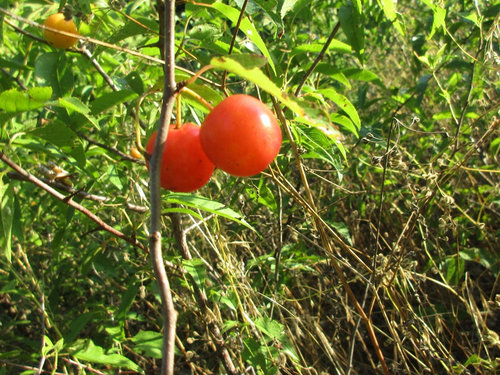
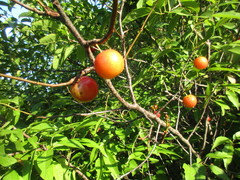
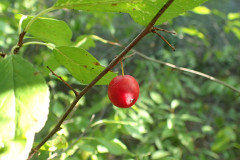
These looked like cherries, but were growing on a large shrub(s). They are about ~penny-sized.. Are they actually edible cherries, or something else?


Comments (17)

  • 10 years ago

    They certainly look like Cherries going by the foliage. Do they have a pit? If they have separate seeds they are not cherries.

  • 10 years ago
    last modified: 10 years ago
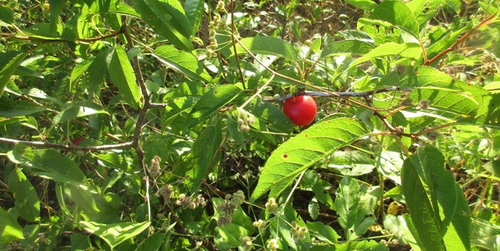
    Actually, I'm going to go with a wild plum - and more specifically (my best guess) a Prunus americana. And after sampling a few more, they ranged from extremely sour to just slightly sweet...

  • 10 years ago

    Prunus americana should have thorns.

  • 10 years ago
    last modified: 10 years ago
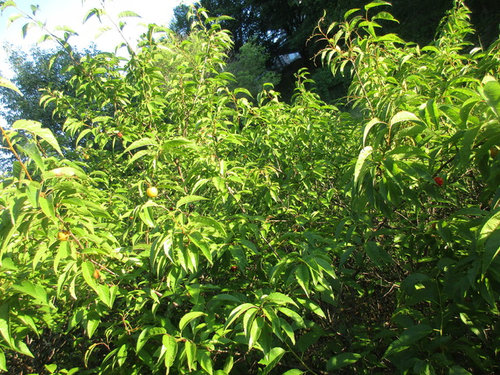
    ^ Hmm, I'll have to take another look, but I don't think this had thorns. So if not Prunus americana, then what other variety could it likely be?

  • 10 years ago
    last modified: 10 years ago

    Ok, I checked back and it is definitely thornless.

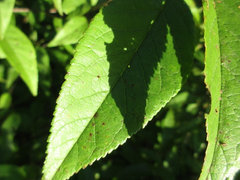
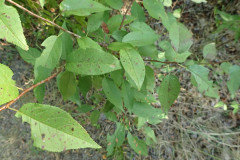
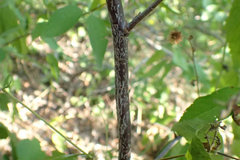
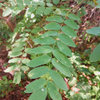
    Here's a close-up pic of a leaf, if that helps narrow down the variety?
    And with another week of ripening time, the plums are also somewhat less sour now - ranging from just sour to slightly sweet (as opposed to extremely sour to just barely sweet a week ago).

  • 8 years ago
    last modified: 8 years ago

    OK, so I now think it might be a Prunus rivularis (River Plum/Creek Plum/Hog Plum) - as it seems to fit its description and geographic locale:

    "Creek plum makes its home in calcareous clay soils or limestone outcrops along streams and river valleys in sunny sites by the Colorado, Guadalupe and Leone Rivers in the Edwards Plateau, North Central Texas, and into Oklahoma. It is another thicket-forming plum with slender stems bearing umbel-like clusters of white blossoms at the same time as its unfolding leaves. About the size of a large cherry, the fruit usually ripens to yellow with a crimson blush on one side, or less often may be a lustrous bright red, drying to black. Although it is said to be poorly flavored and quite tart, it was nevertheless occasionally eaten by Native Americans. As a species, creek plum is quite variable; rivularis refers to its preference for growing near stream banks."

  • 8 years ago

    Except the leaves are more like those of P. americana.

    blakrab Centex thanked Embothrium
  • 8 years ago

    Some scale of the leaves or plants would have helped. However, many of the leaves shown above are folded - a typical feature for P. angustifolia. P. americana is very rare in Arkansas, so not one that I've often seen. However, Internet photos seem to mostly feature flat leaves for that species. Finally, P. americana leaves have sharp, glandless teeth, while P. angustifolia leaves have blunt, gland-tipped teeth. P. augustifolia glands may be deciduous, but would then leave tiny scars at teeth tips. The photos above are not crisp enough to show glandularity or scars, if they exist.

    blakrab Centex thanked jekeesl (south-central Arkansas)
  • 7 years ago

    Hmm, according to these sites though:

    Prunus rivularis - Height: 3 to 8 feet

    Width: 5 feet, thicket-forming

    Prunus gracilis - Height: 1.5 to 6 feet, rarely much larger

    Width: 3 to 6 feet, thicket-forming

    Prunus angustifolia - Height: 15 to 18 feet

    Width: 10 to 20 feet, thicket-forming


    Now from what I roughly recall, these shrubs were probably around ~4'-5.5' tall or so... So, they would seem likelier to be either Prunus rivularis or Prunus gracilis?


    (And the native range of Prunus americana is outside of Texas, plus it has thorns. So, that is probably not it.)

  • 7 years ago
    last modified: 7 years ago

    Not arguing for any particular identification at this stage but two points to keep in mind is tree and shrub heights can vary a lot within species and a seemingly spontaneous occurrence of a kind producing fruits that humans eat can often originate with discarded fruit parts or intentional plantings including dispersal from these into adjacent areas by wildlife. As with old rose or flowering quince bushes orchard fruit or nut trees can mark the locations of former habitations long after there is any other conspicuous evidence of them ever having resided there.

    blakrab Centex thanked Embothrium
  • 7 years ago

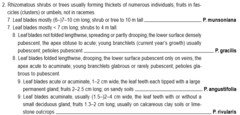
    Size isn't often the best way to distinguish between species, because some can flower when young. You should be able to use the North-central Texas key to determine ID (snip below). Since your leaves are folded, P. gracilis isn't a good candidate. If the average leaf was about 1 inch wide or if the plants were growing in calcareous soil, then rivularis seems likely. If the leaves were all less than an inch wide and the plants were in sandy soil, then angustifolia is a good fit.


    blakrab Centex thanked jekeesl (south-central Arkansas)
  • 7 years ago

    As per my preceding remarks if the above key only covers locally native species then it may not include all the possibilities.

  • 7 years ago

    Embothrium, that snip was just a portion of the Texas key that describes thicket-forming Prunus species. That key, and others such as the FNA key, would be expected to cover anything that is exotic and spread by people, birds, etc., because the area botanists would have included any such escapees from their area. Although photo IDs are always open to some degree of doubt, quite a few prunus species can be omitted from the list - i.e. those without folded leaves, those with purple or hairy drupes, those with more than 10 flowers/fruits per inflorescence, those that grow as individual trees instead of in rhizomatous colonies, etc. It seems likely to me that the portion of the key in the snip above covers blakrab's plants. Do you have another candidate in mind, other than P. americana?

    blakrab Centex thanked jekeesl (south-central Arkansas)
  • 7 years ago
    last modified: 7 years ago

    Yea, Prunus rivularis (Creek Plum) does seem like the best candidate...as its leaves were about ~1" wide, and it was also growing on a rocky, limestoney hillside. Not to mention it was also thornless and fits in its overall size range.

  • 5 years ago
    last modified: 5 years ago

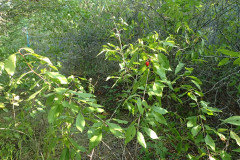
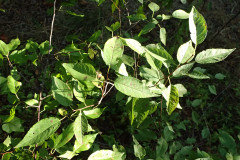
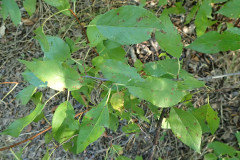
    Here's some more updated photos of this, for further verification...


    Again, this thicket was about ~4' tall, thornless, and with plums only about ~1/2"-5/8" wide and quite sour.

  • 5 years ago
    last modified: 5 years ago

    I'm going to say it's Prunus gracilis if the undersides of the leaves are densely pubescent, and if they aren't, then Prunus rivularis. They are all so similar. My google lens app said it was either Prunus pensylvanica, or Prunus nigra, but they aren't native to Texas. You have the keys. Hope you aren't losing any sleep over this. Does it really matter in the grand scheme if you have a species ID, or not?

    Is glandularity a real word.

Sponsored
Peabody Landscape Group
Average rating: 3.5 out of 5 stars8 Reviews
Columbus' Reliable Landscape Design & Contracting