Software
Houzz Logo Print
primdawg

My first conifer garden!?

10 years ago
last modified: 10 years ago
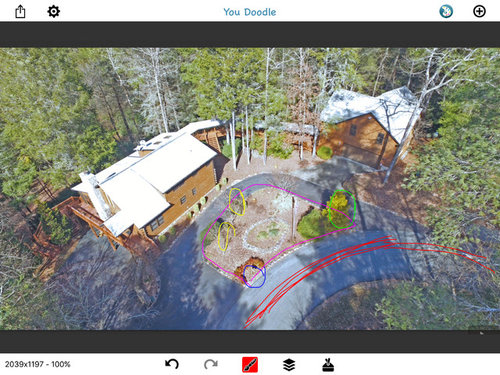
We have bought a house in the north Georgia mountains. I'm currently in zone 7b, the new place is 7a. The property has quite a few hemlocks. When viewing the house we noticed the hemlocks had blue metal tags on them. We found out that it means they've been treated for some disease. The entire garden was once obviously beloved but due to illness has been neglected for the past few years.

Anyway, there is a bed in front of the house that we are hoping to make our first rehab project. There are a few conifers already but all but one probably need to be removed. There are also a couple of Japanese maples that seem fine. The main road is right in front. We are hoping to plant some taller conifers along the road side. The length of the road border is about 40 feet. This is also the only part of the property that gets sun most of the day.

The pic shows the bed in pink, the only salvageable conifer is circled in green and the mailbox in blue. The maples are in yellow and the public road in red.

Everything but the maples, the mailbox and the one conifer can go. The flagpole is going. We may put a low split rail fence along the road side just to create some separation.

We take possession in mid August so will not get going on anything until fall. I believe that is when you wants to plant conifers, right?

Any input or suggestions will be appreciated.

Here is a pic from the inspection report taken at ground level.

Comments (9)

  • 10 years ago

    The climate of the north Georgia mountains is superb for growing a wide selection of conifers, and the higher your elevation, the better. Summertime high temperatures usually stay below 90 degrees F, and nighttime temperatures at higher elevations cool off nicely. The proximity to the Gulf of Mexico ensures plenty of moisture.


    You have a vast selection to choose from, and it's hard for me, at least, to offer suggestions given all of the options. If you are serious about conifer gardening, I would pick of a copy of "Landscaping with Conifers and Ginkgo for the Southeast" by Tom Cox and John Ruter. They cover huge numbers of cultivars for every landscape situation. For many species (like, say, Chamaecyparis obtusa) they only discuss a few choice plants, but any c. obtusa cultivar you come across will do fine. Same with things like picea abies, picea orientalis, cryptomeria japonica, many pine species, and even some firs.


    You didn't specify which part of north Georgia you are in, but if your new house is in the northeast part of the state, I would recommend driving up to Highlands and Cashiers in North Carolina. Both towns have some excellent nurseries which carry huge selections of premium conifers. I can almost guarantee you will find more plants to buy than you will know what to do with.

    Finally, the hemlock trees have been treated for hemlock woolly adelgid. It's hard to tell from the picture, but you may already have a dead hemlock or two on the property. The disease can be contained, but, in my opinion, it's probably not worth the long-term effort. Find some other ornamental trees to replace them with, unless the current hemlocks provide some critical privacy screening or other specific purpose.

  • 10 years ago
    last modified: 10 years ago

    Dean, thanks so much for the input.

    The house is in Cherry Log, which is halfway between Ellijay and Blue Ridge. The elevation is approximately 1500.

    I have been excited to do a conifer and rock garden for many years so I'm so thrilled to finally live somewhere that I might be successful <g>.

    We have heard that the hemlock treatment is expensive so I'm not sure how far I want to go to keep all of them. A quick count last visit came up with about 40 hemlocks. A few looked iffy to me. I'm glad to hear I won't be evil if I thin the herd so to speak.

    I'm also hoping to visit the Cox arboretum to get ideas and be inspired.

  • 10 years ago

    I think a visit to the Cox Arboretum is an excellent idea. You'll get a better idea there about what can work in your space than a thousand words from me.

  • 10 years ago

    I didn't know the Cox Garden was open to visitors? Good to know.

  • 10 years ago

    It is open for occasional visitor days. A good friend of mine manages another local public garden and told me she'd let me know next time they have a visitor day.

  • 10 years ago

    Well, let us know too!

  • 10 years ago

    Will do!

  • 10 years ago

    Just browsing and certainly no expert, however I do have experience with woolly adelgid beetles. Having them sprayed by professionals is very expensive. Many years ago someone I worked with had 3-4 Canadian Hemlocks and paid $1500 twice year to have them sprayed. I would have cut them down in a heartbeat.

    I had 16 and now have 9 that I spray horticultural oil from a hose end sprayer on an 8 foot stepladder and at some risk of a broken neck twice a year (hill). The spray doesn't reach to the very top of some of the trees, however the pests stay in the lower branches and don't like the exposed cold windy tops at all.

    This works very well with spraying twice a year in the Spring and Fall. Very large trees, as you probably have, would be difficult and this may not work for many of the trees you have. They may not find the tops of the trees as inhospitable in your zone either. For me it is an inexpensive (less than $10 a spraying) solution. Commercial spraying is probably cost prohibitive, however you might want to spray and save some of the hemlocks that would be easy to spray with horticultural oil. I don't know of any homeowner friendly, high pressure device that could reach high into the trees. I wish I did.

    It is safe for children and pets when dry. It is basically a very fine mineral oil that smothers the little buggers.

    Jon

Sponsored
Custom Home Works
Average rating: 4.6 out of 5 stars10 Reviews
Franklin County's Award-Winning Design, Build and Remodeling Expert