Software
Houzz Logo Print
webuser_423380

Different colors in grass

10 years ago
last modified: 10 years ago
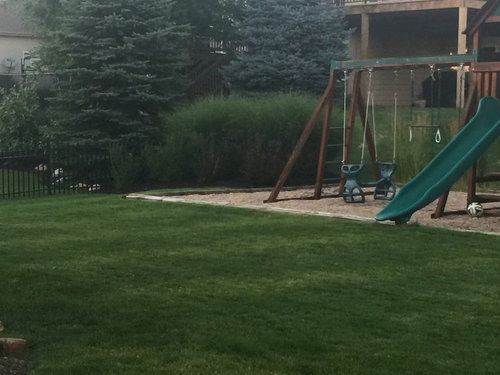
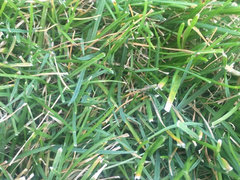
Hi everyone! Just wondering if anyone can help us out. Every year, our grass gets to where there are different shades of green in the grass. Some of it is dark green and some is light green/yellow. It's almost in a striped pattern in spots. Can anyone tell me what might be the cause and what we can do about it? Could it be a fungus? Thank you!

Comments (30)

  • 10 years ago

    Thank you for your response! I had another person say it might be from uneven fertilizer but based on the close up picture, he thought it was a brown patch fungus. Any thoughts?

  • 10 years ago

    That doesn't look like brown patch, and the stripes of lighter grass in the lawn imply misses when fertilizing.

    Don't worry about it now, summer's a bad time to feed on northern lawns (I'm guessing this is northern). Next time you feed in fall, set the spreader lower and make the passes closer together.

    I actually set mine pretty low on an EdgeGuard broadcast spreader and walk about 4' apart on each pass. I get perfect coverage, a nice walk, and get to intimately inspect the whole lawn!

    HU-423380 thanked User
  • 10 years ago

    I live in the shallow end of the pool. I can guess at really simple stuff to help rule in/out minor things. Fungus talk is walking towards the deep end. For that some of the senior/expert contributors will give input. To help them they will need more info. Where do you live (city/state)? What type of grass do you have? What is your watering routine (how often, how much)? They will also need closer pictures. If you can get some shot about 3-4 inches away from the grass that will be helpful. The pics need to be in shade/shadows/cloud cover, no direct sunlight sunlight or flash please.

    HU-423380 thanked hawksster .
  • 10 years ago

    Take a 6 inch long screwdriver and start poking around in the areas that are light green. Does the screwdriver easily penetrate the soil all the way? Do you hit any solid objects that may be hiding under the surface? Is there any difference in how easy it is to insert the screwdriver in affected areas vs not affected areas? Report back.

    HU-423380 thanked User
  • 10 years ago

    We live in Nebraska. I did the screwdriver test and though I didn't hit any objects, it was easier to poke holes in the unaffected areas vs. the affected areas. Here is a closer picture of the affected area.

  • 10 years ago

    Anymore thoughts?

  • 10 years ago

    I'm not a "super expert" either, but nothing in that close up photo says you have any significant fungus issue.

    It sure looks like fertilizer rows to me. How do you fertilize? Are the light patches in the same place every year? Are the light patches in high or low spots. In other words, does water run away from the light spots and settle in the greener areas?

    How do you water, and could there be some water pattern problem?

    When you fertilize you should do two passes perpendicular to each other at half the rate rather than one pass in the same direction.

    HU-423380 thanked danielj_2009
  • 10 years ago

    I think it's fungal. I would spray some Bayer Fungus Control on the areas and see how it does.

    HU-423380 thanked User
  • 10 years ago

    Thank you everyone for the replies. Is it possible that it's a combination of a fungus and uneven fertilization?

  • 10 years ago

    Is it possible that it's a combination of a fungus and uneven fertilization?

    Maybe, but it is kind of hard to tell when we don't know anything about your fertilization practices. We don't know:

    1. what kind of fertilizer you used, how and when,

    2. whether these spots were there before your first fertilization. If not, how long after ferts did they show up,

    3. how much and when you water.

    It is hard to diagnose something with only a photo and nothing else. The simplest and most common answer is spots missed when fertilizing. j4c11 suspects fungus. He knows better than I, but that close up doesn't show anything to worry about, to me. A close up photo of a green area for comparison would be nice. :o)

  • 10 years ago

    Is it possible that it's a combination of a fungus and uneven fertilization?

    You're probably best equipped to answer that. Do you have reason to suspect you did that poor a job fertilizing and basically missed about half your yard?

    If so, there are fungal diseases which are a result of poor fertilization. If this was just lack of fertilizer, I would expect to see lighter green but otherwise healthy grass. Instead, I see plenty of orange dead grass blades and fungal lesions on the ones still standing.

    Do you have a TTTF/KBG mix or just KBG? Any reason the mix wouldn't be even across the yard (e.g. more fescue, different cultivar in the lighter areas?)


  • 10 years ago

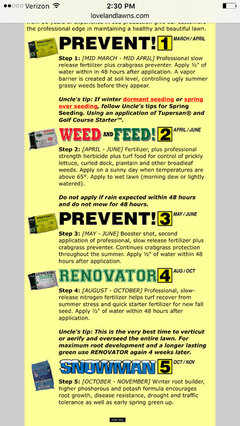
    We water 3x/week in the early morning. The lawn gets a little less than 1/2 inch per watering. We use the Grass Pad fertilizer program. I believe we have a TTTF/KBG mix. There is no reason to suspect that it wouldn't be even. We have no reason to suspect that we missed 1/2 the yard when fertilizing. We have been thinking about switching from our current program to Milorganite, but have read mixed reviews as far as safety.

  • 10 years ago

    Ok so first thing would be to cut the watering to twice a week for a few weeks and then to one whole inch once a week. Based on your watering schedule, no indication of uneven fertilizer and the fungal lesions in the pictures I'm going to say it's probably fungal. You can wait it out to see if it gets worse or apply a fungicide.

    HU-423380 thanked User
  • 10 years ago

    I just think there is more to the story, here. Nature doesn't do things in nice even rows like in the photos. Why would a fungus attack in neat, evenly spaced rows?

    Also, webuser, that Grass Pad lawn program is about as bad as any I've seen. I'm not trying to be a jerk, I'm just saying that either they are just trying to sell more "professional" fertilizer at the expense of your lawn (which admittedly is very nice overall), or they really don't know what they are doing. For instance, they recommend a high P and K fertilizer for winterizing. This is totally wrong, and if anything, is a formula meant for warm season grasses like bermuda or zoysia. You should be using a fast acting high N fert only after growth has stopped. This is what stores carbohydrates over the winter, not P and K.

    Did that store also recommend the watering schedule you are using?

    There are probably a million other reasons not to use this Grass Pad program, but if you are interested in learning more, I suggest you start a new thread looking for advice on a comprehensive lawn care schedule for your northern grass. A couple of the experts in the forum will give you everything you need to know for free! Warning: the first thing you'll need is a $25 soil test from Logan Labs, which is about the best soil testing company in the US.

    Regards.

  • 10 years ago

    Thanks for the response! We will definitely research different fertilization programs. This is what a lot of people in Nebraska and Kansas use, so I guess we just don't know any differently. They did not recommend the watering schedule. I just read on other forums that the grass should get 1-1 1/2" of water a week, spread over 2-3 waterings. We will look into the soil test that you mentioned and maybe we'll have better luck next year! Thanks again.

  • 10 years ago

    I just think there is more to the story, here. Nature doesn't do things in nice even rows like in the photos. Why would a fungus attack in neat, evenly spaced rows?

    I agree, it's odd.

  • 10 years ago

    I'm thinking that it's a combination of the fungus and fertilization. Upon closer look of the greenest spots in the yard, there are visible fungal lesions on some of the grass blades. We will decrease the watering to 2x/week, put down a fungicide and look into a new fertilization program. We will also be more careful when fertilizing, making sure to apply it more evenly. Thanks again for all of the tips.

  • 10 years ago
    last modified: 10 years ago

    webuser: Just get the Logan test done and post your results to this forum. People here will recommend a good program for you. In the meantime, mow your lawn at the highest setting you mower will go, and water 1" at a time and only when the grass starts to looked stressed.

    Also, a lawn will have some small amount of fungus all the time. If your soil is biologically healthy, the fungus will stay in check.

  • 10 years ago

    That stripes definitely look like uneven fertilization. As others have said, measure out the amount of fertilizer you need for the area and spread on a low setting with passes closer together. Then do a second pass of yard with lines perpendicular to the first.

    HU-423380 thanked dmt4641
  • 10 years ago

    Even my drop spreader can't make lines evenly like that, I'm going with the septic theory

  • 10 years ago

    We do not have a septic tank.

  • 10 years ago

    way too big of an area for a septic issue.....if they had one :)

  • 10 years ago

    Well so much for that idea!

  • 10 years ago
    last modified: 10 years ago

    As far as I can tell it's the fescue that's affected, the KBG appears to be ok. So if for some reason there's more fescue than KBG in those areas, they would appear more yellow. Shade would do it, say 4-5 tall skinny trees/bushes casting a shadow where the lines are.

  • 10 years ago

    This is what stores carbohydrates over the winter, not P and K.

    Actually, studies have found that carbohydrates actually drop in lawns that are winterized and don't increase again until the following Spring.

  • 10 years ago

    yard: I recall that winterizing with N benefits the grass come springtime, but it is not a straight line effect as far as carb storage. Do they really understand exactly how it works? Clearly, though, adding more P and K to soils that already have sufficient amounts is not the right thing to do.

  • 10 years ago
    last modified: 10 years ago

    Do they really understand exactly how it works?

    In my opinion, after years of reading, not really. Over time, there is more data and greater understanding, but much of what gets stated is really logical or presumed conclusion and opinion rather than the result of controlled study. I've never seen a study that measured an increase in carbohydrates in the turf plant until after Spring green-up. In fact, some have have reported a reduction in stored carbohydrates during winter measurement. Nor have the majority of studies found improved root mass over the winter. The studies aren't coordinated and lack consistency, yet we are left to draw conclusions based on these unrelated studies done in different climates, soil types and crops/grasses. Some done in fields subject to the whims of mother nature, some done under laboratory conditions. Some of the data is ancillary to the subject of the actual study. That's not to say that there aren't some generally applicable conclusions that we can make with the acceptance that there could be a lot a variability in final results. Our case in point, although not attributable to increases in carbohydrate storage over winter or increase in root mass over winter, every turf program, turf scientist and even our own observations support the conclusion that winterizing with fast acting N results in earlier Spring green-up and healthier appearing, fuller stand of turf the following year.

    So, I whole heartedly agree with your advice to winterize.

    Clearly, though, adding more P and K to soils that already have sufficient amounts is not the right thing to do.

    I think the term "right thing to do" might be an overstatement. Excessive amounts (whatever that level is as pundits/authors aren't clear) of phosphorous and especially potassium has not been shown to have any known adverse impact on turf plants, even taking into account their adversarial properties. However, this would be discounting any detrimental impact they may have on the environment (phosphorous) or soil structure (potassium chloride). One must also consider replenishment. Plants use NPK in a 4:1:2 ratio. If bagging, some amount of P and K is being removed from the soil in that ratio and will need to be replaced. This would be much less, if any, of an issue for those of us who mulch. I think there are times when P & K (even when adequate amounts are present) can be applied to the advantage of the turf, but late Fall wouldn't be my choice.

  • 10 years ago

    It is my understanding that plants which have been "winterized" actually have lower carbohydrate reserves in the winter months due to energy it takes to assimilate the nitrogen in late fall, and also because nitrogen increases respiration during winter. However, they have been shown to have higher carbohydrate reserves in spring months than non-"winterized" plants due to the fact they green up up to 6 weeks earlier and begin to photosynthesize. The biggest drain on carbohydrates is early spring fertilizer, which depletes all reserves by causing shoot growth.

  • 10 years ago
    last modified: 10 years ago

    The biggest drain on carbohydrates is early spring fertilizer, which depletes all reserves by causing shoot growth.

    Do you have a study citation for that? The only studies I've ever come across compare winterized only turf vs turf that was not winterized, but did receive an early Spring N app. I've never seen a study that compares winterized only vs winterized and spring app or Spring only vs unfertilized.

    Edit: I guess I should flesh out the story. As I recall, the studies that were made were for the purpose of determining the effect of N timing on root mass, but I do recall that as an aside they mentioned the finding that carb storage did not increase until after green-up and that it had actually fallen in a winter measurement. Once again, as I recall, the study found that winterized turf had greater increase in root mass in late spring measurements vs Spring fertilized turf root mass. Interestingly, it appears that this has somehow been interpreted (not by the study authors) to mean that Spring fertilization creates top-growth at the expense of root development. I don't see that as a logical conclusion of the study. Maybe I'm just getting to old to put 2 and 2 together. On the other hand, not knowing what the control was, maybe even the fallen measurement in carb storage is greater than the carb reserves in an unwinterized turf. Go figure.

Sponsored
Peabody Landscape Group
Average rating: 3.5 out of 5 stars8 Reviews
Columbus' Reliable Landscape Design & Contracting