Software
Houzz Logo Print
hzdeleted_19755260

Trying to kick the RoundUp habit

10 years ago

I posted this over on "Going Green", but thought maybe I'd get more responses on this forum, so here goes:

Having learned how harmful RoundUp actually is, I'm trying to kick the habit. I'm fine with pulling up poison ivy by hand (well, with gloves on!!!) and so on. The one thing that leaves me perplexed, though, is my wildflower bed. Every year, I have a big bed that I sow in spring with poppies, larkspur, cornflowers, silene - all kinds of annual wildflower seeds. It makes a spectacular show! But in order to get this effect, every fall I mow it down, and then spray the bed with RoundUp to kill remaining weeds (stubborn ones like matricaria and pokeweed). Can anybody suggest an eco-friendly alternative? For example, would it work if I filled my sprayer with undiluted white vinegar and sprayed that instead? Or ...? Any thoughts or suggestions most appreciated! Also - on a related topic - do any of you used those flame things to burn weeds in stone paths? It sounds maybe a little dangerous, but ...?

Thanks in advance!

Comments (15)

  • 10 years ago

    Smother with cardboard and mulch.

  • 10 years ago

    Or use a clear plastic drop cloth to solarize the weeds. (Two weeks in the summer sun burns just about everything.)

  • 10 years ago

    Solarizing needs to be done by mid summer in New Jersey and does not fit in with frances time line of mowing that bed in the fall. To prevent unwanted plant growth solarizing would need to be done every year, effectively putting an end to that wild flower garden.

    Laying down some cardboard, or newspaper, might be of some help, except that may well kill off the wild flowers as well. Tilling will do the same unless the wild flowers are seeded every year. Keep in mind though that many of what we call "weeds" are really wild flowers.

    Vinegar, horticultural vinegar (20 percent Acetic Acid) would work as well as the glyphosate products. Some people report that the vinegar sold for cooking (5 percent Acetic Acid) works just as well. Application of the vinegar is important, a bright sunny day during the hottest part of the day.

    kimmq is kimmsr

  • 10 years ago

    Thanks for all the responses! MrClint, I do use cardboard/mulch to smother weeds in creating new beds - but you kind of need to let them sit for a year or so, so the timing doesn't work for a wild flower bed that blooms til Sept. and then has to be re-seeded in Feb. Same goes for solarization, though its a great technique for other purposes. Kimmq - thanks for the suggestion of horicultural vinegar! I never heard of it. Where would one find such a product, at a garden center/Home Depot type store, or in a grocery?

  • 10 years ago

    Some garden centers would have it but I am not sure of the big box stores. Due to Asthma, Emphysema, and allergies the garden sections of those stores are off limits to me since the synthetic stuff they stock triggers bad reactions.

    Horticulture vinegar is available on line.

    kimmq is kimmsr

  • 10 years ago

    Kimmq, thank you SO much! This was just the sort of info I was hoping for. I'll check a few garden centers and my local farm co-op, but if they don't have it, I found some online sources, as you suggest. Wow, I never heard of such a thing as horticultural vinegar, and how wonderful! I was really starting to think that I'd have to give up on my beautiful wildflowers, which I love so much (and its gorgeous to watch the goldfinches enjoying the seeds!) It was the one thing where I just didn't see how, given the timing required, I could do it without RoundUp - but thanks to you it now looks like there's a way!!!

  • 10 years ago
    last modified: 10 years ago

    Absolutely - instead of using that god awful planet killing liquid, instead, cover your beds with a thick layer of leaves. Mulch mulch mulch. You'll not only kill off basically any plant life in the beds due to lack of sunlight penetration but the mulch will break down, add nutrition and organic matter, attract worms which will create pathways throughout the rhizosphere for water and nutrition to travel and which will naturally fertilize your beds.

    Easy peasy - free and effective and SO much better for all involved.

    j


    edit: I agree about the horticultural vinegar. In order to be effective the vinegar needs leaf contact with the plant you are trying to kill and should be done during the heat of the day. Multiple applications will probably be necessary. VOE.


    another option would be black EPDM sheet rubber which is used for flat roofs. If you can get your beds covered with the black rubber as soon as possible in September it will get very hot under the rubber and cook everything below it. I use pieces of it out in my vegetable garden and within a couple of days everything underneath it is dead.


    gl


    j

  • 10 years ago

    Yes, well, not using the planet-killing liquid is the idea here! I think I'll start off by trying the horticultural vinegar with multiple applications (its still plenty hot and lots of growing going on in early Sept., so the weeds will definitely still be in active growth). If that isn't very successful, then maybe next year I'll try out the sheet rubber. I also certainly can and will do some hand weeding, but its a very large patch and I'm just one woman with, sadly, a limited amount of time for the garden, so I'm trying to find ways to be efficient with my time AND environmentally responsible. So thanks for all the suggestions, I do appreciate the help!

  • 10 years ago

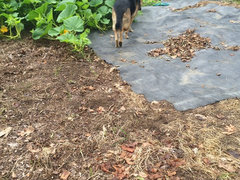
    Frances_in_nj, take a look here. I actually was just out in my veggie garden this morning earlier and took a couple pics - including one which just happened to show how effective the sheet rubber is.


    I work a lot and simply don't have time to weed. I hate it anyhow - I've just got way better things to do w my time. This is an area which just didn't get planted this summer, and if I hadn't covered it with the rubber it would have been a snarled and tangled mass of waist high weeds.


    This black rubber just cooks anything below its surface.


    Anyhow, just wanted to show its effectiveness. Best of luck!


    J

  • 10 years ago

    The sheet rubber and heavy mulching will also prevent the wild flowers ... you are trying to suppress things with the same growing habits as the things you want to encourage.

    Pokeweed is a perennial with spreading roots - you'll have to dig it out or kill it with something that will kill the roots.

    Marticaria is an annual - prevent it from flowering and you'll eventually get it under control.

    Unless you prevent the weeds from going to seed they will keep coming back. Hand-pulling or selective spraying early in the year and throughout the summer will do more than anything you do in the fall.

  • 10 years ago

    Thanks for the picture, Jerry, what a nice veggie garden (and a beautiful dog too!) I do this kind of thing when I am creating new beds for say, roses (I typically use layers of cardboard and then mulch on top). I let them sit for a year, and after a year they are in beautiful shape for planting. (Though I confess that being impatient, I sometimes cut a hole in the cardboard and pop in a rose right away!) But this doesn't really work for the wildflower bed because, as lazy_gardens points out, it also prevents the wild flowers. Though I wonder if it would work if I put down cardboard, covered the cardboard with soil, and sowed the wildflower seeds on top?

    Anyway, who knows if the horticultural vinegar will kill pokeweed and matricaria, but a girl can dream, right? I'm going to find out! In any event, I'm no perfectionist - my wildflower bed doesn't have to be weed free, it just has to have a few more flowers than weeds, lol! So this will be an interesting adventure. Now that I have sworn off the RU, I'll just keep experimenting til I find a way to grow my wild flowers that is earth friendly and also kind of works (well enough, anyway).

  • 10 years ago

    Yep - I completely forgot and didn't think about the wildflowers. I had assumed you were going to plant in the spring.

    It isn't, but if it was my bed and I was trying to plant the flowers weed-free, I think I would use the sheet rubber which would kill everything off first, then mulch super heavy using alternating layers of leaves and hay/straw. Let this sit and flatten out into a thick mulch which would prevent future weeds and then simply move the mulch aside in specific planting spots in the spring for flower planting.


    Anyhoo, good luck and thanks for not supporting the worst company in the world, Monsanto.


    j

  • 10 years ago

    " I wonder if it would work if I put down cardboard, covered the cardboard with soil, and sowed the wildflower seeds on top?"

    Nope, because windblown weed seeds would be there within a year.


  • 10 years ago

    Anyhoo, good luck and thanks for not supporting the worst company in the world, Monsanto.

    FYI - Using Glyphosate does not necessarily mean support of Monsanto. The patent on Glyphosate ran out several years ago and there are several other manufacturers of Glyphosate now that sell it far cheaper than Monsanto's Roundup.

    It still has it's uses but not around the garden. I still use it 2 or 3 times a year to rid my 500' gravel driveway of the weeds that I am not about to pull by hand.