Software
Houzz Logo Print
brucebanyaihsta

redoing Sagae bed after late Winter freeze

10 years ago
Some of you may recall the late Spring freeze that wrecked my 10+ year old Sagae bed. The freeze went all the way into the living roots!

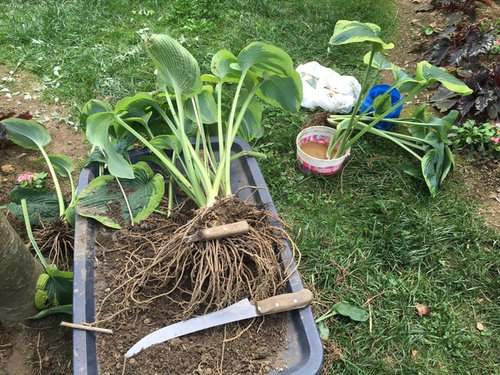
Last weekend I finally dug them out, divided the clumps, cleaned out the rot, bleached the divisions and replanted. Took photos for those that do not grow their hosta in the ground - sure was a lot of work but now have 250 Sagae divisions to grow out for more beds! And tilled some new beds to put them in!

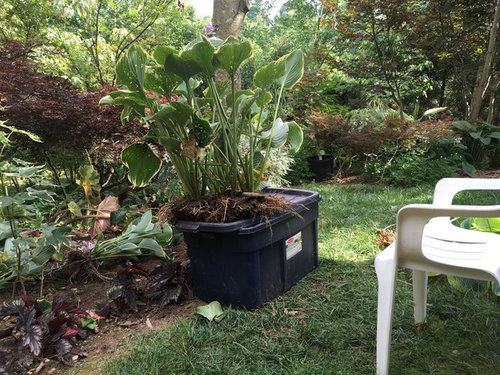
The bed had some Francis Williams clumps which I went ahead and cleaned up as well - here is a clump with my knives and bleach solution in the small plastic containers. The big knife is to break the clumps and the smaller knife to cut the rotten/old root tissue away. I refresh the bleach solution when it gets dirty and no longer can smell the bleach to my nose.

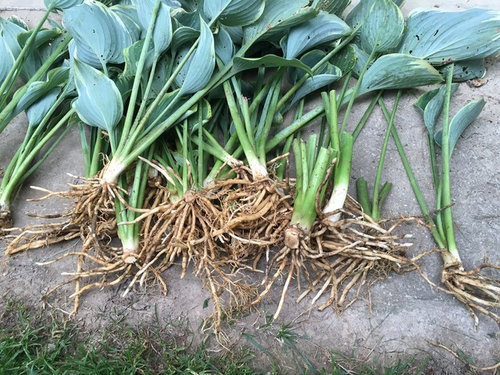
Here is a Sagae clump - even with the freeze damage some were about 3 ft tall and the roots were very woody

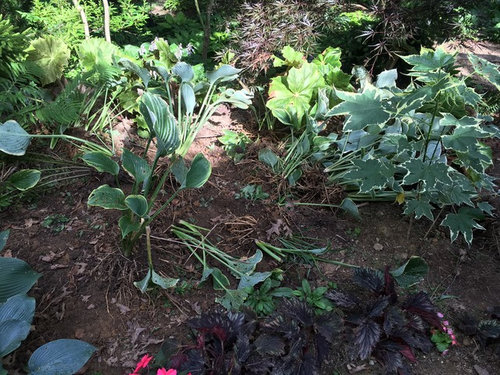
Digging out the 25+ clumps out of hard clay was bad enough but had some rain recently which helped a bit

More digging

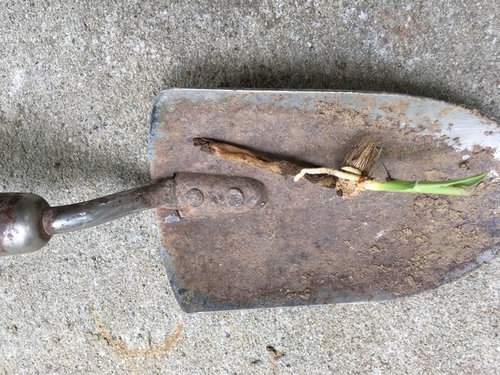
While cleaning the roots found an interesting answer to a previous list posting on whether hosta can leave small root starts in the ground after you remove a clump ( diseased or otherwise): this old rotten Sagae root tip had produced a crown which had died but then this year a new bud formed somehow on the old dead rotten crown and started growing. I cleaned the new growth and replanted it - it is surely interested in growing, so will see if it continues!

Here are the finished products of my cleaning/dividing: bleached Sagae roots that were soaked in 10% bleach for ~ 15-20 minutes.

If you wondered if Sagae is stoloniferous, look at the white root tips! Very aggressive plants!

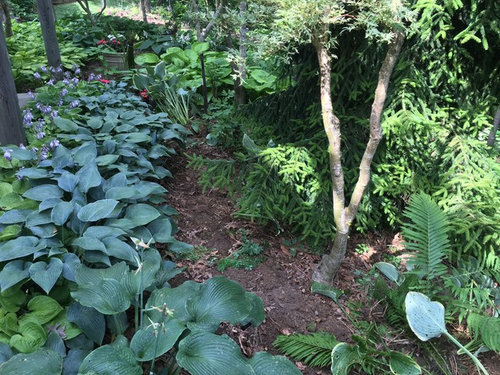
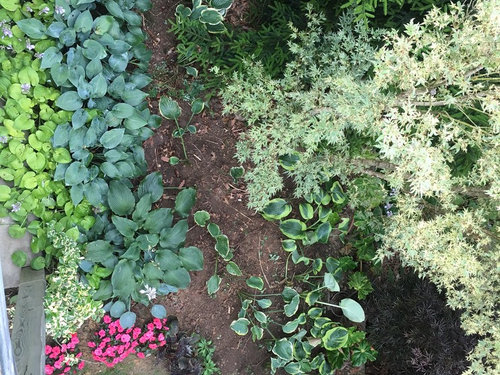
Final view of replanting from upper deck! Spacing about 18 inches, which is tight for large hosta but I like the full look,

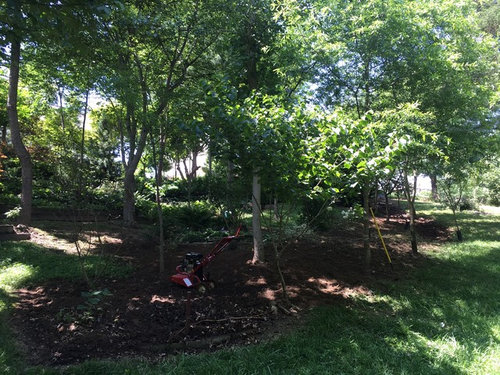
New beds for future fun!

Be glad to answer any questions on cleaning root bound hosta or bleaching them.

Bruce

Comments (32)

  • 10 years ago

    Wow, one huge job! I'm sure your hard work is paying off.

    Jon

  • 10 years ago

    Great work Bruce.

    I thought I had it hard when I divided my huge one in a pot.

    No comparison there.

    Dave

  • 10 years ago

    Oh, my, 250 divisions! Can you stand up straight after all that?? I too am a sucker for saving those "determined to grow" bits. How big is that knife?

    -Babka

  • 10 years ago

    I have seen bleaching mentioned before, but can you explain it for me. Is it simply to prevent spreading disease? As an addition to also cleaning your tools? The bleach doesn't harm the hostas? Do you do this every time you divide or was this because you had rot to deal with? Thanks in advance.

  • 10 years ago

    Big knife is 15 inches long.

    Sue, old technology using bleach - my grandparents used bleach back in the greenhouses to keep disease under control.

    Bleaching in horticulture is similar to biology; it kills the pathogens or bad bacteria and fungal organisms. Why it is used in cleaning up hospital areas where fluids have spilled which may contain bad actors..

    It prevents disease spread by killing spores, doesn't harm most plants or tools but will burn your skin or eyes even if you dilute it.

    Do wear glasses or goggles to keep it out of your eyes; I have used it to clean my gardening hands/skin for years and it does roughen up your skin texture after repeated use.

    I have left hosta plants and roots both undivided and divided in 10% bleach with cool water (not lukewarm) overnight without a problem. I have "cooked" hosta plants in warm bleach water - lukewarm or warmer, leaving them in that temp for > 2 hours. So need to keep the water temps down - the warmer water softens the plant tissues.

    I bleach all my divisions and many new potted hosta when I open the root ball. Why our hosta are hardy, probably because they withstand my bleach techniques or die!

    Great questions!

  • 10 years ago

    250 divisions, that's too much for me :-) I would like to see a picture of your Sagae bed when it was still intact...I bought ONE and will have to see where to put it in my small garden.

  • 10 years ago

    I'm tired just looking at all your hard work. Great job.

    tj

  • 10 years ago

    The glimpses of your beds are awe inspiring. Any idea how many hostas you have - not varieties, just total plants?

    Tip of the hat for sheer effort, too. This was the year I realised the garden was getting to be too much for me. Nice to see someone with the energy to keep creating.

  • 10 years ago
    last modified: 10 years ago

    Bruce, I can certainly appreciate all the hard work - must have felt so good to see it done while taking the photo! I have always rinsed the bleach off before planting...guess I don't need that extra step? (Not sure why I rinsed, just did.)

    Nice to see you saved that little determined shoot - 251! ;-). Mind boggling to think of all those divisions....

  • 10 years ago

    Great respect for your work and great explanation. Thank you for sharing!!

  • 10 years ago

    Bruce, this is really overwhelming, thank you so much! I have BA, she was my very first hosta and I know how big she is now. To imagine a bed of hostas like yours with BA and Sagae and Halcyon on top...If I could visit your garden I would surely have tears of joy in my eyes.

    This year will end with 100 different hosta in my garden and then I will be patiently waiting for them to grow. I have also managed to infect some friends with hosta so when it comes to dividing my precious plants will still be under my eyes :-)

    I only soak them in water after I divided them and as I put most in pots I take them to the total shadow for at least two weeks and that has been ok for every one of them.

    50 years with hosta, must have been a real pleasure :-)

  • 10 years ago
    last modified: 10 years ago

    I too can't get over the fact that you had 250 divisions! That will never happen at my place (unfortunately) as my garden is small. I appreciate your posting the process you went through to divide your Sagae and also the tools you used. Interesting that you use the bleach method for all your divisions and your new hosta pots. A very good lesson your grandparents taught you---"my grandparents used bleach back in the greenhouses to keep disease under control." Thanks so much for sharing that information.

    My question are: Do you ever cut your hosta roots after dividing? If so, when and why would that be necessary? AND When you soak in ammonia, do you soak the roots and crown or just the roots?

  • 10 years ago

  • 10 years ago

    Thanks, Bruce for answering the question on rinsing. Your rain had perfect timing. 20-25 beds with 50-100 in each... oh the luxury of land. It is always interesting to find out what's going on in your gardens! Thanks for sharing. :-)

  • 10 years ago

    newhostalady, I do come back if time permits before planting and cut of all the damaged/rotten roots and especially root tips, once they have been bleached. I soak in bleach (not ammonia) the crowns and roots - gets all the slugs and eggs out of the big leaves at the base.

  • 10 years ago

    Good to know Bruce, thank you. I was unaware that slugs and/or eggs could be harboring at the base and would benefit from a bleach soak too.

  • 9 years ago

    A few more questions for you Bruce:

    (1) So bleach water can be reused? What if I unknowingly soaked a virused plant and then reused the bleach water for a healthy hosta?

    (2) Looks like you cut quite a bit of crown off the plants. Does the hosta come back smaller because of the smaller crown? How long will it take to recover?

    (3) I can see cutting the roots of hosta planted in pots, but why if they are being planted in the ground? If the cut roots of hosta do not grow in length anymore, is that then a good thing?

    I would love more detail on these points!

  • 9 years ago

    I have had limited experience with virused plants over the years: if any plants show much signs of weakness I dig them, check the roots and if healthy might bleach them but if something is rotten or infected it is best to throw it away.

    When I say I reuse bleach water that gets dirty I must be able to smell and feel on my skin active bleach in the solution or I replace it with fresh stock.

    I do cut off a lot of dead tissue - they will come back SLOWLY if they are healthy - otherwise I don't want them anyway. May take a year or two to regrow to some size.

    Always good practice to remove dead or diseased or woody ( non-productive) tissue from hosta crowns.

    Hope that helps.

    Bruce


  • 9 years ago
    last modified: 9 years ago

    Since both bleach and ammonia were mentioned in this thread (although not necessarily together)...just wanted to send out a friendly reminder to be very cautious having these two chemicals "near" each other. So as to avoid anyone in the family (kids included) ever accidentally mixing them together, I wouldn't even recommend having both in the same household (or if you do, keep one in the house and the other in the garage). And be mindful of which one of those your other household cleaners are *based on* too. To be on the safe side, it's easiest to remember not to mix any cleaners/disinfectants (whether bleach-based, ammonia-based, or strong acids such as toilet cleaners). At the very least, if you use ammonia on your plants (or tools/gloves), make sure not to use bleach on them too soon after, and vice versa (especially if you are doing any of it indoors). Don't know if the bleach dilution/concentration matters or not, but wouldn't test it.

  • 9 years ago

    Great reminder to use common sense and limit personal exposure - especially your eyes and skin. They are quite safe when used correctly but unsafe if not

  • 9 years ago

    Bruce, nice to know that my Twist of Lime is off to a great start. If you come to DE next September, bring your knife. :) Oh, by the way, I would love to see your gardens, also.

  • 9 years ago

    For me, as an amateur, I would not reuse the bleach water. I wouldn't know the correct smell nor would I want to have it on my hands. So fresh bleach water for me!

    "I have had limited experience with virused plants . . ." Good for you Bruce!

    After removing dead tissue, "they will come back SLOWLY if they are healthy." Makes sense! Thank you!

    I would like to note here that the concentration of bleach can vary depending on what brand you are buying. It would be good to check that out.

    You know what I would love? I would love to be there when you Bruce are dividing and/or redoing some of your hostas. I think that that would be a real education for me! But I will dream on . . . well, that's part of gardening, don't you think . . .


  • 9 years ago

    So how close are you to Wheatley, Harrow or Chatham? Where my family is from....

  • 9 years ago

    Sadly the dollar stores bleach does not label their strengths anymore but it is not what Chlorox has on their label. Buy your bleach on sale by label contents.

  • 9 years ago

    I have had a number of good remarks on my division threads - you have read those in the past few weeks, correct?


  • 9 years ago

    Donna, have always loved visitors to our garden - 3 miles off I-81 exit 118 in far SW Virginia. To see the garden is 1 hour max. To enjoy garden discussions and stories is endless,,,,,

  • 9 years ago

    I am not sure if you were addressing me or Donna, but sadly I am not close to your location at all.

    Well I have absolutely read your division threads! I love them! And I am so glad you were willing to share that information with all of us.

    You say to Donna that it would take one hour to see your gardens. That would never be the case for me! I love looking and generally have lots of questions! And, then of course, as you say, there would be the garden discussions and stories. I'd have to camp out!

  • 9 years ago

    So are you near Wheatley, Harrow or Chatham? Windsor? Leamington?

  • 9 years ago

    I visit those area to see family

  • 9 years ago

    newhostalady, you reminded me why hosta are the plant that keeps giving and giving, although plant people in general are giving sorts, otherwise they wouldn't put up with all the aggravation!!

    Friends and friendly stories about growing conditions, weather, plant histories, who shot Jon after he divided his rare hosta and stole it, etc

  • 9 years ago

    Near Toronto.

    And my bottle of Clorox original doesn't even have the strength provided on the bottle! (But it used to.) Makes it so difficult to compare products.


Sponsored
Haus Studio
Average rating: 4.8 out of 5 stars28 Reviews
Franklin County's Preferred Custom Cabinetry & Design Studio