Software
Houzz Logo Print
sgt_nyanko

Persimmon trees infested with pests

10 years ago

My persimmon trees have been badly infested with pests/mites. I'm not sure about their species, but black ones (marked with red circles in the attached photo) seem to be eating the leaves. There are also white ones in the soil. They come up to the surface whenever I water the plants and it's so creepy, so I save the pictures for the latter (they are very tiny).


Could there be any way to save the plants from these pests? I've never dealt with pests, so I'll try some soap solution first, and if it doesn't work I'll go buy some pesticides at a local store. But if anyone know any idea on the pests' species, or better yet how to treat the plants, please let me know.


Comments (16)

  • 10 years ago

    It's far too little damage to use pesticides.

    Perhaps thrips. So if you must spray, try direct hits with insecticidal soap. Commercial, not home-made.

    Ken Shinoda thanked Jean
  • 10 years ago

    Leaves look good, persimmons are usually pretty good against bugs. I wouldn't do anything.

    Ken Shinoda thanked Kevin Reilly
  • 10 years ago

    Hard to see in photo but try to get mosquito bits or dunks which are made with Bacillus Thuringiensis. It doesn't harm plants in water. Put in gallon jug and let sit for 24hrs then pour off some to use as soil drench a few times, it should kill larvae which eat at roots so plant can recover strength. I think maybe the larvae eating the roots are causing the leaves to react and the adults may or may not be eating leaves. I have potted fuyu persimmon and my leaves have suffered when I got similar problem.

    Ken Shinoda thanked samsaraedu
  • 10 years ago

    I found the "recipe" for fungus gnats larvae:

    Mosquito Dunks are more concentrated than Gnatrol (about double),
    which is recommended to be used at 1-3 teaspoons/gal. However the dunk does not
    release all of it’s active ingredient immediately.
    Crush the dunk with a hammer BEFORE opening the blister pack
    Use about 1/4-1/2 dunk soaked overnight per gallon of water and you can re-soak
    the remaining solids again, or just water them on thus allowing a constant
    release over time.
    Thorough soaking of the media is essential, as well as controlling all nearby
    breeding areas such as under benches and other places organic matter
    accumulates.
    Cleanliness and 3 weeks of follow up are very important as only the larvae, not
    adults, are controlled.

    Hope it works for you.

    Ken Shinoda thanked samsaraedu
  • 10 years ago

    Holy smokes. If that was as bad as the leaves on my persimmons looked... it would be incredible. Ma Nature never intended for ANY plant to remain totally pristine and never have a nibble from some passing bug or critter.

    Really... go take a nap or have a drink and don't worry about that.

    We don't know where you are, but in a couple of months, they'll all be falling off here - with holes, tatters, and black spots... and they'll grow a fresh new batch next spring.


    Ken Shinoda thanked lucky_p
  • 10 years ago

    It is thrips know them well. There is not much you can do, they are extremely hard to get rid of. They will put holes in the leaves but the worst thing they do is distort the fruit and this is only at blooming time. More than likely they are on other plants and they just blow in the wind. Read up on them and you will under stand what I am talking about. I am really sorry, we fight them every year. Some years it better than others. This year they attacked the nectarine blooms and the fruit tastes great but looks bad.

    Ken Shinoda thanked campv 8b AZ
  • 10 years ago

    Thrips don't make holes in leaves. They scrape off the green surface and, then, lap up the oozing sap.

    Ken Shinoda thanked Jean
  • 10 years ago

    Thanks for comments and detailed instructions. I live in Kanagawa (a prefecture adjacent to Tokyo), Japan, and since mosquito dunks/insecticidal soap do not seem to be in gardening stores, I tried regular bath soap solution but it does not seem to be working, but thanks for the tip anyway.


    Well, the comments from everyone seem to suggest that pesticides are likely to be an overkill, but some of the leaves have been damaged badly, and these pests tend to scrape off green surface rather than put holes.


    In the meantime I'm also (perhaps more) concerned about what's going on underground; I see pests/mites come out in numbers whenever I water them (these ones are whiter as opposed to black ones on the leaves, and they are even tinier so it's had to take photos of them). I recently noticed that some of the trees are failing to grow new leaves (leaves stopping to grow bigger just as they come out of the buds), and if it's because of the in-soil pests eating away the roots underneath, I have to get rid of them before they completely obliterate the roots.


  • 10 years ago
    last modified: 10 years ago

    Use the sticky traps in both yellow and blue to capture adults to reduce breeding. I purchased on eBay from international sellers so that shouldn't be problem for delivery.

    I have seen both the dunks and the gnatrol powder available on ebay and amazon. On Amazon.co.jp, check Gnatrol WDG by Valent The ASIN is B017MT035I

    Message me if you need a copy of IPM bulletin which lists resources worldwide.

    Ken Shinoda thanked samsaraedu
  • 10 years ago

    Trees can slow/down stop growing in the heat of summer.

    Ken Shinoda thanked Kevin Reilly
  • 10 years ago
    last modified: 10 years ago

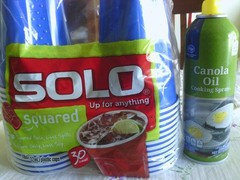
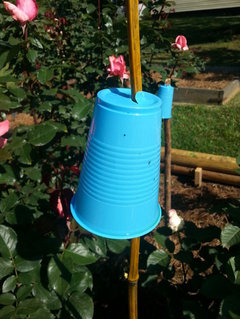
    Jean..... sorry but Thrips do put holes in the leaves, my privet leaves eventually looked like Swiss cheese. ...............................There is one thing you could try which seems to work for gardeners with light colored roses( includes me) which Thrips also like. Red plastic party cups(beer size) impaled upside down on a stake coated with Pam or similar food cooking spray. For some reason thrips are drawn to them and stick to the inside and out. Place several around your tree. Mine are placed about 2 feet from my rose bushes. When the cups are covered w/thrips rise off and re-coat. Wasps love thrips, I think its their favorite food.

    Ken Shinoda thanked campv 8b AZ
  • 10 years ago

    Campv - would you be able to post a picture of your cup? I wonder if yellow cups would work too since a lot of the sticky traps are yellow. Thanks.

    Ken Shinoda thanked Die (pronounced Dee) Oma (7b - VA)
  • 10 years ago

    Although I only see a couple now, I'll try the cups too, just to check for future.

    I admit the sticky cards are a little annoying to work with.The yellow cards were full of gnats when I started, then I saw thrips are attracted to the blue so I added those and they filled up also. Both reduced the flying ones but the mosquito dunks stuff killed the larvae so even if they had bred they never surfaced. Basically elimination thru attrition.

    Ken Shinoda thanked samsaraedu
  • 10 years ago
    last modified: 10 years ago


    I have heard that the blue cups also work. Though I have know experience with them. I am starting to wonder if it is the Pam/oil spray more than anything else. These photos are from the rose site and are not mine, but are very good examples.

    Ken Shinoda thanked campv 8b AZ
  • 10 years ago

    Such a great idea. Thanks for posting the photo.