

Odd light green grass sprouts
Okay, so here it is mid July. We have had a decent summer with normal rain/storms, temps in the 80s and several stretches of hot 90+ degree weather in upstate New York. I have been doing a decent job of lawn care since we moved in three years ago. Watering, fertilizing, etc. I even did a dormant over-seed late last winter with Scotts Sun and Shade. It is hard to tell but it certainly looked up until now, that that it worked and I have a thiscker decent lawn.
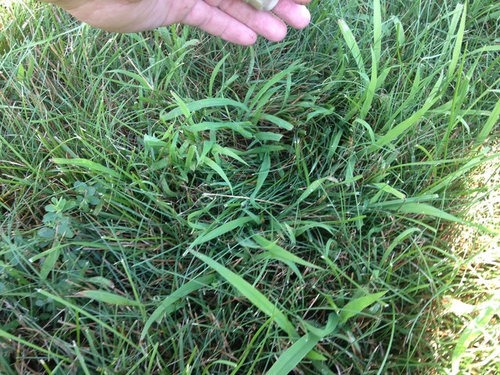
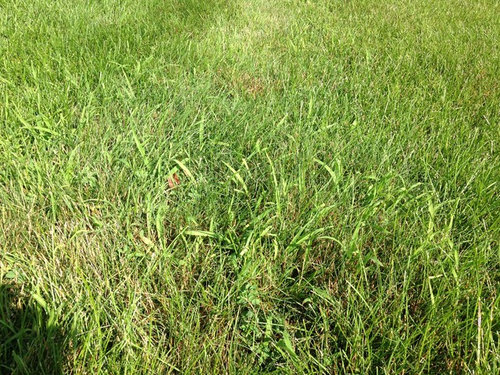
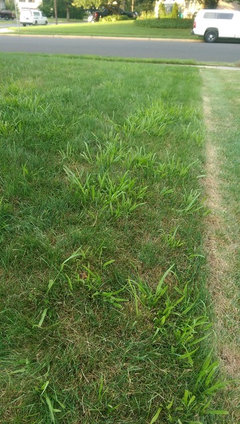
However, over the past week, I am beginning to see individual sprouts and patches of light green grasses popping up. They seem to grow faster than my normal darker grass. They look like new sprouts as though they are just now germinating which I find odd. What grass takes this long to germinate after many weeks of very warm and sometimes hot weather? I don't think it is crabgrass as I put a pre emergent down in April and I have not seen any crabgrass up until very recently. I now see some coming up the past few week in some bare spots and near the sidewalk. I am surprised it is germinating this late really.
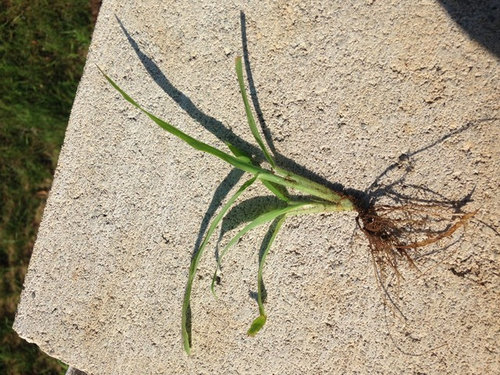
I was wondering if someone could identify this odd grass, advise me if it is a problem grass, and if so how to get rid of it. It really doesn't look that nice honestly.
Below are some photos I took this AM.
Thanks a ton!!

Comments (46)
 10 years agolast modified: 10 years ago
dog it looks like crab grass the temps might of just been right for it to come this year. The seeds can stay around for 7 years. to fight it you might not need to you're lawn looks pretty thick but on the safe side one of these home boy's will tell you about a herbicide.
- 10 years ago
Looks like crabgrass. Pre-emergent from big box stores only lasts about 3 months. Hit it with quinclorac asap, doesn't matter how thick your lawn is, it will outcompete it in the heat.
Related Professionals
Washington Landscape Architects & Landscape Designers · Tampa Landscape Architects & Landscape Designers · Bowling Green Landscape Architects & Landscape Designers · Danville Landscape Architects & Landscape Designers · Clarksburg Landscape Architects & Landscape Designers · Grand Junction Landscape Architects & Landscape Designers · Ontario Landscape Architects & Landscape Designers · Longview Landscape Architects & Landscape Designers · Athens Landscape Contractors · Clarksdale Landscape Contractors · Philadelphia Landscape Contractors · Fargo Landscape Contractors · Westerly Landscape Contractors · Jacksonville Home Builders · McAlester Home Builderspfarrelli
Original Author10 years agoI had a long conversation (chat) with Scotts this spring about this exact problem and asked why it looked like I got crabgrass mid to late summer. They insisted that one application was fine and continue with the four steps. I just put down Turf Builder with Weed Control on July 1. Plan on Step 3 in early August and Step 4 in mid September. Asside from this four step program, Is there a time do a second application of pre-emergent so I don't have to crisis manage like this? Is it now okay to treat as described above even after recent Turf Builder application?
FYI, I have fairly sandy soil so it is possible my applications leech off faster than average..
So ... quinclorac? I will look for it. Any other suggestions?
Thanks again.
pfarrelli
Original Author10 years agoSo this sucks. I had Drive XLR8 in my garage from last year and plan to use that today but taking a closer look and I find that my front yard alone is moderately populated with this problem. The front yard alone is 5000 sq. ft. All I have is a hand sprayer. So should I .. 1, hand spray what I can though it will take me FOREVER, 2 Buy a pull behind sprayer? 3, Wait til next season and be more aggressive with preemergents? 4, Perhaps apply Tenacity (mesetronone) as a post emergent?
When I apply pre emergents for next year, I have no idea how or when I would continue to apply throughout the year to keep the crabgrass at bay other than the usual spring aplication.
I noticed around the neighborhood that others seem to be dealing with this "late season" crabgrass issue as well.
- 10 years ago
dont spray your entire yard with quinclorac, use a hand sprayer and target spray it. its not cheap stuff, and spraying the entire yard would be wasteful. is the entire yard covered in it, or is it just in spots? i find it easiest to mow the yard, wait 3 days and then spray it. i find its easier to spot the crabgrass since it grows a bit faster than the lawn and it seems to stand out better for locating.
pfarrelli
Original Author10 years agomowed three days ago. It is still same height as grass but texture makes it easy to spot. I am hand spraying as spotty as I can. It's going fairly quickly. There are patches and then there are the rogue individuals. I am going to just wing it and hope for the best. I am trying to keep the application very light. No idea "how much" when spraying to hit ti with really. douse or mist? Such a science ay?
I REALLY need to learn how to use preemergent over the entire summer. This sucks. LOL.
Thanks !!- 10 years ago
you are using a sufactant/spread sticker with the herbicide, correct? if not the herbicide is going to just bead up and roll off the blades of crab grass. for herbicide application, you just want to lightly wet/mist the weed. make sure you are getting the entire plant, including all its runners, etc. i would then plan on a follup application in 2-3 weeks. quinclorac works very slowly, you probably wont see yellowing of the weed for a week, and dying in 2-3 weeks. hit it again to get the ones you missed.
- 10 years ago
also, if you have any really large heads of it, you probably arent going to have much luck with herbicide, at least in my experience. gotta hand pull and then finish it off with the quinclorac. its really effective against smaller/newer growth.
- 10 years agolast modified: 10 years ago
There's a great article on turfrepublic called "how big is my Crabgrass?" & it's worth a read of this is a persistent problem for you. Scott's phone line is just a way to keep selling their products with this 4 step junk. My preM goes down every 4 months like clockwork.
Edit:Agreed with pulling large heads, anything over a few inches will require 10 seconds & a shovel
- 10 years ago
I would recommend prodiamine as a pre-emergent for next year. It doesn't leach like dithiopyr and a single spraying can last up to 6 months. That should get you through the summer without having to worry about it anymore.
pfarrelli
Original Author10 years agoYes, used a surfactant. Most are shoots and not large spread out heads. There are areas with a whole bunch of shoots in large clusters. There are areas where there are shoots spaced apart by inches, and there are other shots all by themselves. There are ares with nothing as well. Most just appeared a short time ago rather quickly. Like a week after applying Scotts Weed and Feed. Perhaps teh bag said Feed your Weeds, I don't know.
Reeljake, what PreM do you use every four months? And do you need to coordinate it with application of other stuff or does it not matter what and when you applied otehr products? I will look into Prodiamine.
I really do wish I had a program to follow, such as, if not Turf Builder with Halts crabgrass preventer in the spring, then what? What is a good program for the North Ease?
Added note, it rained unexpectedly two hours after applying on most of my lawn and forty five minutes after apply on a small strip along side of house. I hope it doesn't weaken the effect. Supposed to be rainfast in one hour.
Overall I used about 5 gallons over 5000 square feet with spot applications not complete, although there were a lot of spots.
Thanks again all. I will report back with results in a week.- 10 years ago
I use dimension which is dithiopyr, but prodiamine is just as good. Halts is OK, but honestly the best preM is whichever one you can buy reliably repeatedly every time. You want to keep the active ingredients consistent if possible, but anything is better than missing an application.
In addition to the preM, I use a weed killer concentrate called Sedge Ender to spot spray about monthly. That product just happens to work on my 3 most pesky weeds (crab, nutsedge, spurge) & has a shot of preM prodiamine included in it for extended control. But I still have to pull 3 or 4 rogues each year as well...
- 10 years ago
There's a significant difference between dithiopy and prodiamine: dithiopyr will leach while prodiamine will not.
pfarrelli
Original Author10 years agoNeed opinion here. So I applied Quinclorac (XLR8) as described above with spot application (some really big spots too). I thought I was being VERY dliberate and careful but apparently I wasn't Looking at the instructions to see how much the 5 gallons I applied should cover (I was pretty accurate in my application), I noticed that I was to put 3 tablespoons per gallon. Well ... Uhhhhh .. I put 3 ounces!! That equals 6 tables spoons so I about double the strength it should have been. The instructions on most of this kind of stuff makes it sound like you are handling highly enriched uranium, so my question is, should I be seriously concerned, moderately concerned, or not so concerned from a health perspective? I am not too concerned about lawn. After three days now there seems to be no adverse effect. Actually, I have yet to even look closely at crabgrass to see if it is beginning to suffer. It is possible the little bit of rain we received two hours later may have diluted it further a bit.
Thoughts?- 10 years ago
Light green blades are usually caused by the weed grass being stressed by herbicide or disease. Just a tiny, tiny bit of herbicide can make the blades a light green or yellowish-green. They are usually growing very fast, and usually survive... unfortunately. Your lawn grass may not be as sensitive, and show no yellow blades.
- 10 years ago
if you accidentally doubled the dosage, well nothing you can do now, but you will probably be ok. just depends on what type of grass you have and what is damage is. check the label, it breaks out the types of grass and how safe it is. I have zoysia, and have doubled before with no issue. if you had one of the more susceptible types of grass, might have an issue.
- 10 years ago
If you mow high every 3 days the crabgrass never has chance to grow or spread. If you'd rather go the chemical route I'd put crabgrass pre emergent down in march then again in june and summer. The reason you have to keep applying it is because crabgrass emerges late some times. And if you apply pre emergent too early it won't be effective , when it does emerge.
I'll let you in on a little secret normally you can't seed when applying preemgents , so the work around is apply it to your whole lawn, then any area you need to reseed just change out the soil in that area. Then send as you normally would in those spots. pfarrelli
Original Author10 years agoHi all, Thanks for these last few comments. I didn't see these until now. I want to post an update. It seemed quinclorac was very effective. I am now getting another round of crabgrass though!! The accidental double dose didn't hurt anything. Should I hit the new stuff with the proper dose of quinclorac again?
I haven't fertilized since July 1 and I need to do it now so as to keep my program (if that is what it is) going. So far this year I have done the spring Turf Builder with Haltz around Mothers day (forsythis bloom), and Turf Builder Weed and Feed (July 1). It seems to be that I am applying these late but I am trying to base it on the bloom. Supposedly the next application should be Turf Builder Lawn Food if I stay with Scotts. I am not married to any brand so any advice would be great. Also, I have never aerated or dethatched in the 3 years living here and I was hoping to do that with an over seed this fall.One thing that exacerbates my issues is that we are traveling for two weeks starting Sept 4. By the time we return the weather will definitely be getting cool and I won't have time to do much of antyhing before growing season ends. I am not even sure I can get someone to mow my lawn while I am away. If I fertilize, it will be super long when I return. If I don't treat the crabgrass I am sure it will be very happy.
Given my crabgrass issue and all these other things, what is the best plan of action? And for sure I would like advice on how to apply pre emergent for the crabgrass throughout the year in coordination with my fertilizer applications (if they are at all related).
I know this post is a bit random (no coffee yet) and is a lot but thanks for any input.
- 10 years ago
The herbicide should have a max yearly app rate, usually indicated as per 1k sqft or per acre. If you haven't reached that then I would treat the new crabgrass. You need a preemergent applied immediately if you haven't already. Most people recommend prodiamine it seems. Dithiopyr should work too, just put something down. You can revisit the pros and cons of each some other time. Just try and stop new crabgrass while you are on your trip.
I would apply pre-em immediately, treat or hand-pull what I can, water the yard before you leave, have it watered once while you are gone if you can, and enjoy the vacay. I don't know about the fertilizer, but I doubt it's a huge issue.
Caveat: I'm no expert... but I hate crabgrass.
- 10 years ago
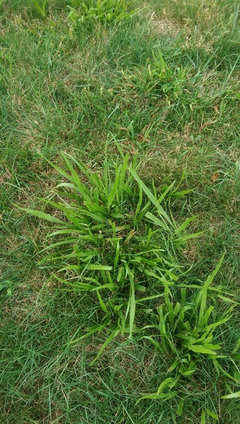
This isn't crab grass it's called QuackGrass, i have it it in my front lawn too. It grows quicker than the other grass, it's a bit rough (ridges) on the blades. Crabgrass is smooth on the blades normally. The only way to get rid of it is kill it with RoundUp, which of course kills everything. Tonight i am using round up to kill that quackgrass and then i am going to re apply after a few weeks to the same areas, then cut the lawn very short then re-seed entire lawn. Here are some pics of may lawn you'll see it's the same thing.
pfarrelli
Original Author9 years agoHi, It's me again (LOL .. that reminds me of the Central Scrutinizer). So, I wanted to post to this thread as it is kind of a a continuation of my crabgrass problem I had last summer.
It's spring (yay!) and it is time to think pre-emergent. After reading everyone's comments, reading articles, and viewing videos I decided on the following strategy and wanted to see what those who know think. My goal is to have an effective crabgrass barrier while continuing to feed lawn regularly as needed. I would also like to have a window of opportunity to overseed. Thus I don't want to have 12 month pre-emergent effectiveness. Does that make sense? (actually we have snow here mid-November til late March). As such I want to use Prodiamine applying it after Forsythias lose their flower and right about when crab apples start to bloom (late April?). Forsythias are starting to bloom the past few days. I was thinking either do a split app with Prodiamine or switch to Dithiopyr in .. ohhh maybe Late May, mid June?? The strategy in switching to Dithiopyr is so it leeches out by mid August so I can over seed and perhaps also to be able to max out the yearly usage of each chemical.I am also curious how and when I would apply lawn food/fertilizer with this program? In the past I used Halts and Weed and Feed which did both in one shot. Since I am new to this kind of program rather than the usual Scotts stuff, what product should I use.
Finally, I have never really used liquid applications before other than spot spraying with a pump sprayer. I saw two types of sprayers I thought might work well. One by Chapman which is a battery powered backpack type sprayer. I also saw a push liquid sprayer. Does anyone have experience with these? Any pitfalls I need to be aware of? I do use them much like a broadcast spreader? Is there an easy way to see where you have applied.
Last question. My lawn wasn't so bad but wondering if I should expect better results with this new strategy.
Thanks all for your input.
- 9 years ago
I was thinking either do a split app with Prodiamine or switch to Dithiopyr in .. ohhh maybe Late May, mid June?? The strategy in switching to Dithiopyr is so it leeches out by mid August so I can over seed and perhaps also to be able to max out the yearly usage of each chemical.
Just do prodiamine at slightly lower than 3 month rate, no need to do both. It should wear off in time for seeding.
I am also curious how and when I would apply lawn food/fertilizer with this program?
End of May is a good time. Apply 1 pound of N per thousand, use any lawn fertilizer without herbicide. Scotts Green Max is good, Lesco 24-0-11 is good also, they both have iron to boost color.
Does anyone have experience with these?
I have and use the Chapin quite a bit. I highly recommend it.
Is there an easy way to see where you have applied.
There's a blue marker you can add to the spray. You have to add quite a bit to be able to see it if the grass is deep green.
My lawn wasn't so bad but wondering if I should expect better results with this new strategy.
When applied correctly, prodiamine is super effective. Get a $10 digital scale and measure out the amount precisely. It doesn't take much. It will take care of your crabgrass problem, as well as most other annuals(I haven't see anything survive it yet). From here, with your weed problems resolved, you may want to get a soil test to see if you can address any nutrient deficiencies and take it to the next level.
pfarrelli
Original Author9 years agoHi and thanks so much for the response. Very well explained! Of course I would have follow up questions.
On my original post last year I explained that I had crabgrass popping up in mid July after applying Halts in mid April. That is three months. I guess it wore off and up came the crabgrass. Can I expect that if I wait til say May 1, and apply Prodiamine as per your instructions, that I will have a similar situation where I may see crabgrass in early August (three months later). It seems to me there is a fine balance to effective length of pre-emergent and the start of the over-seeding season. However , I also suspect that Prodiamine is better than halts, so perhaps it will be more effective and for a longer period. I may not even seed/over-seed until September.
This may be a dumb question. So we discussed the annual weed problem such as crabgrass and other. We discussed a bit of feeding as well. Is there also a strategy for perennial weeds? I have used weed and feed in summer for dandelions and that seems to be pretty effective, but if there is a better way similar to Prodiamine being better than Halts, then please advise.I guess what I am asking for is a TOTAL comprehensive, summer long program along the lines we have discussed, if one who lives in the Northeast has one.
Is there a more lengthy feeding schedule I can be advised of? So far I see Scotts Green Max at the end of May. Any additional? And isn't end of May a little late?
Thanks again. Looking forward to replies and then more follow up questions! LOL!
I love this forum.
P
P.S. I have sandy (partially loamy) soil. When large bare spots get really dry it will get very loose and sandy, but if you dig down under that, you will find a reddish moist soil that will hold together when squeezed.
pfarrelli
Original Author9 years agoOne last question. As someone claimed above, after all this talk, is it possible I am dealing with quackgrass and not crabgrass? Just wondering.
- 9 years ago
Can I expect that if I wait til say May 1, and apply Prodiamine as per your instructions, that I will have a similar situation where I may see crabgrass in early August
It's possible, but it is what it is, it needs to wear off so you can seed. Typically though the crabgrass will germinate in July as usual and get killed by the pre-emergent. That's another nice thing about pre-emergent, it depletes the seed bank.
Is there also a strategy for perennial weeds?
Spot spray as soon as you see them. Each weed may require a different herbicide, there's not one herbicide that will kill them all like prodiamine. I guess glyphosate would, but it would also kill the grass.
I have used weed and feed in summer for dandelions and that seems to be pretty effective
Use a liquid herbicide instead and spot spray. Add some dish soap to the mixture to help it stick. No fertilizer needed until August.
And isn't end of May a little late?
It doesn't need fertilizer during the spring growth flush. You'll just be mowing 3 times a week. How did you fertilize last fall?
TOTAL comprehensive, summer long program along the lines we have discussed
- Lawn fertilizer at 1 pound N/thousand by end of May.
- Spot spray weeds as they come up through summer.
- Lawn fertilizer at 1 pound N/thousand mid-August.
- Lawn fertilizer at 1 pound N/thousand mid-September.
- Urea at 1 pound N/thousand mid-October or when grass stop growing in late fall.
- If you're overseeding substitute one of the apps above for starter fertilizer applied at seeding time.
- Watering: apply 1" of water when you see signs of drought stress. Then wait to water until you see signs of drought stress again. No drought stress, no watering.
is it possible I am dealing with quackgrass and not crabgrass?
It's possible, but it doesn't change things, still need to put down pre-emergent to prevent further seed germination. If it's quackgrass you'll have to spot spray with glyphosate and repair in the fall.
pfarrelli
Original Author9 years agoThanks so much. I suspect that I can insert prodiamine in your comprehensive list above as discussed? What does 1 pound N/thousand mean? and Urea?
- 9 years ago
Yes, apply prodiamine as discussed.
1 pound N/thousand means 1 pound of Nitrogen per thousand square feet of lawn area. The first number in the N-P-K analysis listed on the bag of fertilizer is the percentage of Nitrogen. A 20-0-11 fertilizer, for example, contains 20% N and so to get 1 pound of N per thousand sq ft you'd need to apply 5 pounds of the fertilizer per thousand sq. ft.
Urea is a nitrogen fertilizer with a N-P-K of 46-0-0. It is cheap, water soluble and fast acting, but also easy to burn the grass with if over-applied. You would typically find it at agricultural supply stores or SiteOne. If you can't find straight urea, you can substitute for Scotts Winterguard.
pfarrelli
Original Author9 years agoCool, thanks. Looking at the Chapin 4 gallon sprayers now and I see many models. Any idea on which I might want to use? What model do you use?
- 9 years ago
I use this one:
Amazon is having some sort of malfunction on my end.
pfarrelli
Original Author9 years agoOh Nooooo! Why do you say this? Ya know, when I do get this stuff and hit it with Drive XLR8 (quinclorac I think) it does kill it as it should with crabgrass. Does that help in determining? The good news is that if it isn't crabgrass then I am not getting any crabgrass and killing this once and for all should yield good results for the future..... assuming it is perennial and doesn't seed out like crabgrass.
- 9 years ago
Crabgrass is a lightweight, put down a good pre-emergent and your bottle of quinclorac will be collecting dust for the foreseeable future. Your major nuisances are probably going to be the Poas once you get your lawn renovated.
- 9 years ago
Well the picks don't look like crabgrass to me, based on when I had it, and the interwebs... Perhaps the pics above shows juvenile crabgrass and it turns into what I am used to later? Or maybe there are different varieties. What's in a name, anyway? If your crabgrass killer (Drive) kills it, then it's crabgrass (or not) - so long as it's dead crabgrass (or not)!
pfarrelli
Original Author9 years agoMy pics are way at the top. Someone posted some quackgrass later down toward the middle that alsos looks like what I have .. but then again, to me it looks like crabgrass as well. LOL! When I took my pics I pulled one out and put on sidewalk. Looked crabby to me. Anyway a lot of folks, I assume who know their stuff say crabgrass .. some don't though. Makes for tough decision making. But I will still use the Prodiamine for sure as it seems to be the right thing for crabgrass in general over Halts. Thanks for the input. One thing for sure, if I used Prodiamine and this stuff pops up, well then I'd say that it's final proff that it isn't crabgrass... I guess.
- 9 years ago
Yeah, maybe it is. If it was going to seed in your pics it might be more obvious. The prodiamine will help, but there are so many variables it could still come back... Hopefully not.
- 9 years ago
I'd say if quinclorac killed it chances are high it's crabgrass and not quackgrass, since quinclorac doesn't list quackgrass on the label, not even as suppressed. If it is quackgrass, and quinclorac provides control, that would be news.
pfarrelli
Original Author9 years agolast modified: 9 years agoAgreed. I will keep you posted if something comes up. (pun intended) :-)
pfarrelli
Original Author9 years agoI may be a bit behind but with a cool spring soil temperatures seem to be just right to lay down my Prodiamine. I just received the Chapin 20v sprayer. I probably should have asked this a long time ago but can anyone recommend any accessories I might want to use and in particular, is there a better sprayer tip than what comes packaged with the sprayer? Prefer a retail outlet such as H'Depot, Tractor Supply, or Harbor Freight. I suspect I prefer a fan tip.
Thanks
 9 years ago
pfarrelli: wow. Just looked that sprayer up--very nice and not too expensive either! Please give a review after you use it a bit. I'd be interested.
Yes fan tip is nice to have. Tractor supply has a very extensive sprayer parts selection. You might have to find an adapter to fit the standard tips they sell. That or you can even buy one of their universal spray wands which are very good. If memory serves, I use a 80* blue teejet-type spray tip for herbicides that do not require a lot of volume.
pfarrelli
Original Author9 years agoWill do. Out of the box it seems very nice. The handle alone is superior to the one-gallon hand held pump sprayers.
pfarrelli
Original Author9 years agoFirst impression using the Chapman 20v is that it was really great. Performed as expected. Not too heavy when full. Straps seemed strong. It was comfortable on the back. Quiet. One disappointing thing that I experienced and that I have read somewhere else before is that the cap is really difficult to deal with. Cross threading with a bad seal is easy and even if you think you have a good seal nice and tight, well, product splashes and leaks from the top. You need to be VERY careful. I used blue dye and when I took the backpack off, the back of my shirt was wet with blue dye. Luckily the Prodiamine didn't make it through to my undershirt, but I rushed off to the shower regardless. Be careful of that cap!










User