Software
Houzz Logo Print
taylorjonl

Newly planted perennials

10 years ago

I planted some perennials about 3 weeks ago. It was mostly Bee Balm, Coneflowers, Flea Bane and Shasta Daisies. The plants were watered every day to every few days, depending on my schedule using a watering wand.

The plants looked sickly at times but it has been very hot the past 3 weeks, above 95 degrees. I know it is a bad time to plant them but the big box stores have them on sale at that time, and I planted a lot.... More than a hundred plants. It takes a long time, like almost an hour so to water all the plants.

It has been very hot this month, most days above 95 degrees. At times the plants looked droopy, I would water them, they looked better.

At this point the foliage of most the plants are pretty green and healthy looking but the flowers are very sickly looking. My thought and goal the whole time has been to keep them alive this year and expect the benefits next year. With this in mind, if the flowers look bad but the foliage is still green and healthy, am I doing ok? Also should I deadhead them? Will this make them look a bit better?

At this time most the flowers look pretty ugly.

Comments (14)

  • 10 years ago

    Zone 5b here. I bought several flowering perennials from the recent big box sales. The foliage and stems were droopy so I picked off any flowers (I left buds intact...mainly because I was short on time). They've bounced back.

    My thought is right now the plants need to focus on building up their root system and energy stores to deal w transplanting and the coming Winter. Flowers are secondary. I'd pluck off the flowers if you can. Healthy foliage is a good sign. Were the flowers/plants droopy when you bought them?

    Based on your plant selection, I'm guessing they're in full sun. That would also add stress to new transplants in mid summer.

    Mainly just wait and see what happens next Spring.


  • 10 years ago

    you arent a real gardener .. until you have 100 pots sitting in shade.. in the heat of summer.. waiting for fall planting ...


    i suspect you realize that already ... i learned the hard way also ...


    the only problem i see here .. is that you bought a future garden .. and your expectations were for an instant garden at planting ...


    start inserting your finger.. and watering WHEN THEY NEED IT.. i highly doubt it is everyday ...


    when i went large on scope .. i liked watering every night ... but i broke it down by maybe.. fifths ... so i went out there and watered for 15 mins.. and did a fifth ... each night.. my finger indicated that in my soil.. in my garden ... there was plenty of available water for 4 days... etc .. you have to figure it out for your garden .. but i am positive.. it wont be everyday ... ore water is not going to change the way they look right now ...


    just keep in mind.. you are growing perennial ROOTS ... it doesnt matter what the plant above looks like right now.. as long as it stays green ... you are gardening for the future ...


    and the other thing .. when you plant in bulk .. dont sweat the loss of a few ... thats what happens when you plant 100 ...


    live and learn.. thats how we did it.. before the web ...


    ken

  • 10 years ago

    You do not say where you are, but in the east, when it is very hot, it is also usually very, very humid. So plants don't move a lot of water because there is nowhere for it to go. Since at this point in time, watering information tends to be geared towards the arid west, it is very common for people to overwater new plants in places where it usually rains. You really need to water by what is going on in your garden, with your soil and your plants.

  • 10 years ago

    Thanks for the words of encouragement.

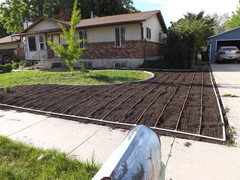
    Camp, the plants are already mulched. Actually in May I cleared the bed of weeds, then spread 1"-2" of compost on the surface, then 4"-5" of shredded bark. Here is a photo of the bed with the irrigation before the bark.

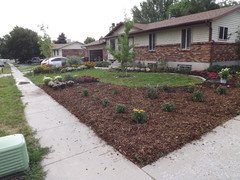
    The irrigation is some Rain Bird XFS drip tube with 18" spacing. Here is the bed 17 days ago all planted:

    The Coneflowers look the healthiest, they are still flowering and I can see them growing, not much of a concern with them. Both the Bee Balm and the Shasta Daisies have green foliage but the flowers are all wilted compared to 17 days ago.

    Ken, I actually have another 50 or so plants sitting in pots in my back yard that I am waiting for fall to plant. I wasn't expecting the plants to perform great this year, mainly trying to make them look better than they currently do.

    mad, I am in northern Utah, it is hot and dry. We haven't had rain in a month or so. When I step outside it feels like I am in an oven with wind, it has been pretty windy lately.

    When you check the moisture with your finger, do you check it at the base of the plant in the middle of the plant or just surrounding the plant? I am pretty sure I am not over watering, the first few days into this heat spell a lot of the Shasta Daisies had yellowing leaves and were drooping a lot, the past few days they are greening up and not drooping even at 6 PM when the heat is the worst. We have been over 95 degrees for a week or so and the next 4 days will be over 100 degrees, we normally average around 91 degrees in July. Gonna be hot and dry for at least the next week.

  • 10 years ago

    I can't see how they would be better in pots rather than in the ground - the temperature is easier to stabilise in the ground and you can always employ the temporary shading tactic - umbrellas, shade cloth, windbreaks - all would be better than keeping new plants in hot, hot, presumably plastic containers. Temporary poles with shade cloth or fleece stretched over would be sufficient to protect them from the blazing noonday sun.

  • 10 years ago

    The biggest benefit I get is that it is easier to water them in the pots. I probably won't wait until fall but I am not planting them in this 100 degree weather.

  • 10 years ago

    taylorjonl, we're in the same USDA Zone (6a) but I'm in Southern New England whereas you're in Utah. Normally we have plentiful rain where I am. This year there was NO snow over the winter and there's been NO rain this summer. I began designing & cultivating my numerous garden beds in 2006 and they've been planted in my slightly acidic sandy loam ever since & received normal rainfall in succeeding years. This year is an extraordinarily harsh year weather-wise but my established perennials continue to survive, giving me hope for next year.

    One thought to help with watering is to set the containers of perennials in shallow plastic bins, add water and let them bottom water themselves. I would definitely deadhead since both you and the plants are focused on survival at this stage as opposed to future blooms/performance. I wouldn't expect them (or my own) to look "nice" as they struggle to survive the current conditions. My goal is to keep them alive.

    I don't use a watering wand. I use a recycled gallon milk jug for containers and just glug the water in each one until the soil is moist. For my perennials already planted I set terra cotta 'Plant Nannies' into the soil at the base of each plant, upend a 1-liter bottle filled with water into each. The plants get supplemental water via osmosis. Bottom line = whatever works.

    I had no luck growing Monarda/Bee Balm, have never tried to grow Flea Bane but Shasta Daisies & Echinacea/coneflower are apparently content in my garden soil conditions as are nearly 1,000+ others. Guess I'm doing something right. Best of luck to you.

  • 10 years ago

    Wow! That's an impressive undertaking. Looks very nice.

    A bit of unsolicited advice: if I were you, I'd trim up that sapling asap. What kind of tree is it? If you let it get big, will it shade all your nice new sun-loving flowers?

  • 10 years ago
    last modified: 10 years ago

    You've got 4" of bark mulch piled up to the base of the plants, and that prevents water from reaching the roots. You spread 2" of compost on top of the soil but did you mix it into the soil?

  • 10 years ago
    last modified: 10 years ago

    The mulch won't prevent water from reaching the roots.

    Good job, OP, very nice set-up. I was in the same situation recently--got perennials on sale I couldn't pass up. Planted them here in Texas in 100+ heat and full sun. I've been watering every 3rd day, and like yours, mine aren't flowering strongly, but are staying healthy.

  • 10 years ago

    littlebug, are you talking about that tree in the center of the grass? It is a Ginko tree, I was letting the lower limbs stick around so it could get more sugars from the leaves, at least until it gets bigger, is this a bad idea?

    I know it will shade my plants but that probably won't be for 10 or 20 years, when that happens and the sun loving plants can't survive I will plant shade loving plants. Getting some shade on my house is my priority. The tree in the left of my picture in the middle bed is a Autumn Purple Ash tree, then on the side yard I have a Bur Oak tree growing.

  • 10 years ago

    mayflowers, I didn't till in the compost this time, a couple years ago I did till in around 3"-4" of compost. At this point I am trying not to disturb the soil life as much as I can, the top dressing will melt into the soil over the winter. The soil has plenty of nutrition.

    I also don't have the mulch going right up to the plants, it tapers off around an inch from the plants. When I hand water them I stick the watering wand into the center of the plant and give it a 5-10 count. I read that water on plants in intense sun can burn them so I make every effort to avoid getting the leaves wet.

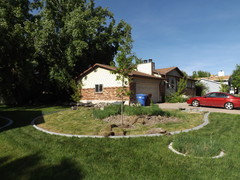
    Thanks MizGG, this is my next project in fall:

    Need to clear the grass and lay down some drip irrigation, then I have another 1000 sq/ft of flower bed. Waiting for it to cool down first.

  • 10 years ago

    Yes, I was referring to the tree smack dab in front of your house. Its placement seems ill-advised to me (but I'm no expert) for its effect on your flowers, because it seems awfully close to your house, and because its going to blocking the view from your house.

    I have only a bit of experience with gingkos (at my place of employment) and they seem very slow-growing here in north Missouri. I would at least remove any branches that I couldn't walk under. I'm 5'2".