Software
Houzz Logo Print
andy331313__

Hydronic heating? is it worth it?

10 years ago

Hello,
Im going to start building a house soon. It will have an exposed basement. (Note: 1300 Sq ft home in Wisconsin, We will be using basement as living space) One of the builders I looked into is really pushing for hydronic heating in the basement and a regular forced air furnace for the main level. Is it worth it or is he trying to upsell me for things I don't need nor should I even want?

Comments (24)

  • PRO
    10 years ago

    Hard to know with incomplete view of your situation but it's generally more cost effective to concentrate on making your building envelope efficient and sticking to one primary mechanical system. Seeing how most people are including heat pumps for cooling, it makes sense to squeeze as much work out of it as possible for heating. Will you be including propane or natural gas infrastructure? Does 1300 include basement?


  • 10 years ago
    last modified: 10 years ago

    The key issue is air conditioning. AC is possible with a hydronic system if the boiler serves an air handler instead of radiators or in slab tubing. Perhaps the contractor is responding to the need for AC above grade and no need for it below grade. Its impossible to say without knowing what you want.

    I would question the wisdom of no AC in the basement since often the most important aspect of AC is humidity reduction.

    But first, tell us what you want.

  • 10 years ago

    I am by no means a heating/cooling expert but I chose to do the hydronic radiant in floor heat in my homes lower (basement) level. A regular forced air unit will heat and cool the upstairs as well as provide some heating and cooling for the basement through ceiling drop down vents. It seems to me that basements are really difficult to keep comfortable in the winter without radiant heat. At least in the midwest. If my basement was going to be used as recreation space rather than housing 3 children I may have opted out as it was very expensive. I did my garages as well.

  • 10 years ago

    Yes, for a basement, in a colder climate, it's worth it. Upstairs, radiators or convection heaters are likely enough. Make sure you insulate under the slab, and don't oversize the boiler.

  • 9 years ago

    I'm planning on building a new house in Minnesota. I had hoped to get in-floor heating in my 1850 sq. ft. basement and 1000 sq, ft. garage.

    The plumber said he would run heat ducts to the main floor as well as the basement with or without if-floor heat, mostly for the AC, so there would be no savings there. I to had planned on laying down the foam and pex when the floor is poured, but wait to connect everything up when funds were available. Install of just the pex and foam was more than I had guessed so I now am not sure I will do it at all.

    Here is the bid:

    Pex and foam install for the basement floor: $4,850

    Pex and foam install for the garage: $3,160

    So I would have $8,010 sitting in the concrete.

    To connect this up (either now or in the future), the boiler and connection to the basement: $6,000

    To connect this same boiler to the garage: $650.00


    So the grand total for working in-floor heat would be: $14,660. I'm not sure this would be worth it and I may just skip the whole thing.


    Hope this helps anyone looking into if-floor heat.


  • PRO
    9 years ago
    last modified: 9 years ago

    Go with the underslab foam, it's probably required by code anyways. With a good envelope and well designed forced air, radiant floors are totally unnecessary.

  • 9 years ago

    Great!!! you may have just saved me ~ $12,000. :-)

  • PRO
    9 years ago

    Well, the heating source and system have a lot to do with it. Is the heating source electricity, natural gas or propane? Will the system source be a heat pump, forced air furnace, boiler with separate cooling equipment, or something else? As an example, heat pumps (whether ground source or direct exchange) are only efficient to around 20-25 degrees F or so, thereafter, supplemental electric heating is required to maintain interior temperature.

  • 9 years ago

    We are planning to have an air to air heat pump and LP gas forced air furnace. Might even consider adding an electric plenum incase LP prices get out of hand again. FYI, we are in Zone 6.

  • PRO
    9 years ago

    I don't think you want to be heating your whole house with electricity for the duration of a Wisconsin winter...the heat pump will certainly cool it efficiently in summer.

  • PRO
    9 years ago
    last modified: 9 years ago

    It depends on the heat pump. Some mini splits can efficiently heat in sub-zero temperatures. I think people are using them as primary heat sources in colder climates than WI.

  • 9 years ago

    I agree. My Sister and brother-In-Laws works down to something like 5 degree F.

  • 9 years ago

    I'm in WI also - natural gas is the way to go if you have city hookup. I'm also investigating hydronic in-floor, not sure if the price is worth it to me yet. Waiting for a formal quote for my basement/garage concrete and then under a bunch of hardwood

  • PRO
    9 years ago

    When it comes to heating in very cold winter climates, it really pays to compare the costs of electric heating (a heat pump and backup resistance coils); propane fired furnace; and a natural gas furnace. A super tight and insulated house in these climates makes all the sense in the world.

  • 9 years ago
    last modified: 9 years ago

    I too am in Wisconsin (Oconomowoc) and went through the same thing. Keep in mind the heat in the basement will not only heat the basement, but will rise and heat the first floor as well. It is more efficient than forced air as well.

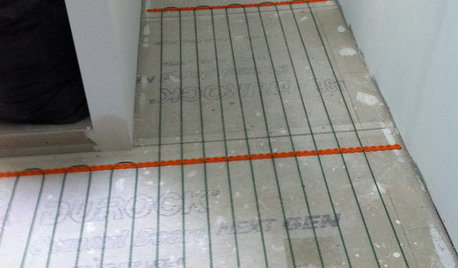
    Make sure any bids include laying poly over the stone base, insulating with 2in foam, stapling the pex to the foam, and pouring the concrete over that. I purchased and laid the foam myself and did the pex runs and stapled it all down at night. I then left the pex stubbed out in the mechanical room for a few years before I bought and installed all the mechanicals. It only cost me like 2k or so to have the pex in the slab. At the time of the build, I thought the option to have radiant heat for only 2k was well worth it. I spent about 1800 in the mechanicals a few years later. I installed it all myself.


    Edit: my basement is 1200 sqft. I did 4 loops of pex all equal lengths. I purchased pex and foam online and the pex seller blueprinted the layout of the pex for free. I just told the foundation guy to prep it with the poly on a friday and that the foam and pex would all be installed by monday.

  • 9 years ago

    Thanks for the info. If I do go forward with this, I may lay the poly, foam and Pex myself as well. I am concerned with having time to do it. I am away from home during the week 13 hours a day and plan on doing the electrical, flooring, insulation landscaping and now possibly the in-floor heat as well. Wish me luck!!!

    I'm not sure on the forum rules, but I would love to hear who you got the layout design and components from.

  • 9 years ago

    message me here or email me..speed51133@ymail.com

  • 9 years ago

    I have hydronic heating in my house, love it. I also have a forced air system (mostly for airconditioning, but it's handy for when you get that first cold snap and you've not got the floor heat going).

    I don't know about where you are, but we do not "staple pex to the foam." We put down the foam, vapor barrier and then the reinforcing mesh. The pex is tied to the mesh on the slab.

    On the upper floors we do staple the pex to the disoriented strand board prior to pouring the gypcrete.

  • 9 years ago

    Michael- The e-mail does not work, I get "undeliverable mail". I also can not figure out how to message you.

  • 9 years ago

    speed51133@ymail.com

    you sure you put Ymail and not Gmail? Keep in mind it is not yahoo.com either...

  • 9 years ago
    last modified: 9 years ago

    Ron, tying the pex to the mesh is pretty labor intensive. Not to mention you want to lift the mesh up from the bottom of the slab so it is more in the middle during the pour. I would not want my pex so close to the surface and risk damage during saw cuts or tapcon driving.

    Stapling pex to foam is very common. Just google it. The pex manufacturers even sell specialty staple guns and staples for it.

  • 9 years ago
    last modified: 9 years ago

    ***you sure you put Ymail and not Gmail?***, Ahhh, I think that was it. E-mail sent.

  • 9 years ago

    responded. just in case it is allowed, http://www.blueridgecompany.com/ is the company that did my pex loop layout (for free).