Software
Houzz Logo Print
acarsme

Wood retaining wall advice needed..

10 years ago

Hello, we are wanting to build a two level retaining wall on the steep hill that we have on the north side of our house. I have gotten quotes for a railroad tie wall, which is coming in at just under $9,000. To do a boulder wall was quoted at $14k, and a segmented block wall was $16,000. It seems insane to me to spend the kind of money on a block wall, especially if I have doubts that this will be my permanent house. My wife also thinks rail ties would look better given our semi-wooded setting in our backyard.

I asked the landscaper about the longevity of these railroad ties, and he said he gives them 25 years, give or take 5 years on either side, and that he uses Grade A rail ties.
I was concerned about termites possibly destroying these things sooner than that....we live in the south and I know we have what are called Formossan termites....I thought I read these little bastards will even eat right through railroad ties.

He told me that the ties would have a barrier of crushed drainage stone behind them. I got to thinking later though about the deadmen they would install......those certainly would have no barrier protection from crushed stone like the front of the wall, correct? Won't those be in direct contact with the ground?

I can live with a rail tie wall if in fact I'll get the 20-30 years out of them. I just don't want to drop $9,000 and then have them get destroyed in just a few years.

Any thoughts on this matter? Thanks.

Comments (24)

  • PRO
    10 years ago

    Compromise by doing a single wall higher and backfill the slope behind to lessen the steepness. Compare the cost using dry stacked concrete gravity wall like Keystone. Can go up to 4 feet without engineering (using geofabric reinforcement sheeting).

    Pay a little more for peace of mind. What's it worth to you vs. worrying about termites over the years?

  • PRO
    10 years ago

    are we talking actual railroad ties, like the nasty creosote-soaked 8x8 timbers that used to hold up train tracks? Or are we talking pressure treated timbers, typically 6x6s? Two totally different animals here.

  • 10 years ago

    Yes, I would like an answer to that question as well :-) It was my understanding that it was no longer legal to sell railroad ties, which have been treated with creosote. In fact, in my state they are considered a hazardous waste material and must be disposed of through highly regulated channels.

  • 10 years ago

    I can buy actual, treated railroad ties at my local feed store here in central CA.


  • 10 years ago

    I guess us tree hugging environmentalists up here in WA state are just a bit more preemptive when it comes to including hazardous materials in our landscaping :-)

    According to the EPA: "Creosote is not approved to treat wood for residential use, including landscaping timbers and garden borders. There are no approved residential uses of creosote treated wood. The Agency is aware that creosote-treated railroad ties are
    being used in the residential setting for landscape purposes and as a
    border around gardens. Such uses in residential settings are not intended uses of creosote. If you have creosote-treated wood in your yard, consult the handling precautions outlined in this document."

    The creosote treated railroad timbers are indeed nasty, messy things and will continue to leach creosote indefinitely. If given a choice, go with the pressure treated landscape timbers or the interlocking masonry blocks as described above.

  • PRO
    10 years ago

    yep^^. What a lot of people (including some of my brothers and sisters in the industry) don't realize is that in many locales, if you rip out a RR tie wall (creosote) you can't just landfill them. They have to be treated as hazardous materials.

    Just for fun, here's a PT wall at a client for whom we did a planting consult. According to the homeowner, they put that wall in during the mid-80s.*

    Back then timbers were marked CCA, treated w/ arsenic. Now it's copper quat (ACQ), and I have no idea if they have the same longevity, given that CCA lumber was phased out in the early 2000s. But one can hope.

    *-disclaimer: this was probably THE perfect site for timber - on a slope so water drains away, full to part sun to keep the timbers dry, frequent light/constant breezes. Your mileage can definitely vary

  • PRO
    10 years ago

    Another alternative to consider - what makes these more costly and labor intensive is trying to get the fitted stone look. However, if you use smooth river rock of mixed sizes, no need to hand place each stone.


  • 10 years ago

    In my opinion, down south with a wet warm climate, nothing beats a good poured in place concrete wall. And low walls of less than 4 ft are within what a homeowner can build himself at a fraction of the cost a contractor wants.


    After 10 years a concrete or masonry wall will add to the value of the property. Any wood wall will be seen as a soon-to-be liability. In the long run, wood ain't cheap unless you live in a very dry climate.

  • 10 years ago

    Landscape company will design and install. They use "Grade A" ties according to the landscaper. There is a place in Memphis called Bobs Tie Yard where they get them supposedly.

    I think wood walls would look better with our semi-wooded setting, but I do worry about the longevity. If I can truly get 20 years out of them, then that's not a big deal. I just don't want to put them in and then either they rot from weather or termites within just 5-10 years of having them.

    There's a good chance I will sell my house in the future, so I'd like to save money and not sink a ton into a house I may not keep....but at the same time I understand pls8xx's comment about wood walls maybe being seen as a liability. Any potential home buyer might see that as something they'll have to spend money on someday. But it's better than what we currently have, which is nothing and just a very steep, weed-filled hillside.

  • 10 years ago

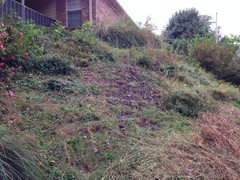
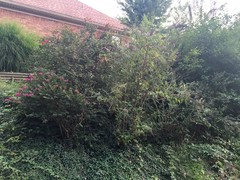
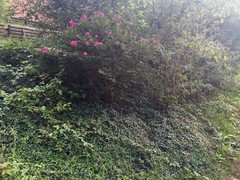
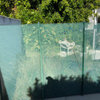
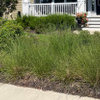
    I am not sure how tall the hill is from bottom to top, but it's pretty big and steep. Here are a couple of pics to get an idea of what we're working with.

  • PRO
    10 years ago

    "But it's better than what we currently have, which is nothing and just a very steep, weed-filled hillside."

    Don't be surprised, but a retaining wall is not going to cure a weed problem. That is a whole other set of dynamics.

    Because of the expense, one usually uses a retaining wall if conditions will not function properly without it (you need to keep earth off of a building or out of the way of a circulation path, etc.) Your picture is not of a wide enough view to see if any of those conditions are occurring here, but I doubt they are since you haven't mentioned it and you've been living there for some time. If you don't actually NEED a retaining wall in order for things to FUNCTION, why not just cure the planting/weed problem for less money and probably better appearance?

    "I think wood walls would look better with our semi-wooded setting ..." I have to disagree on this. IMO, the overall look is generally industrial or camp ground with a weathered-barn texture and color ... not cultured and refined (regardless of whether the surroundings are semi-wooded or whatever.)

  • 10 years ago

    It looks like a very steep drop and would take several moderate walls to stair step the slope. A few specimen trees and evergreen ground cover would go a long way to making the slope look better.

  • 10 years ago

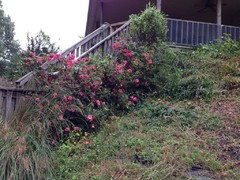
    So this is looking from the front of my house towards the back. Not sure if you can tell, but the ground immediately starts to slope away pretty sharply from the side of the house. The only somewhat flat level of ground is where that crappy landscape timber raised planter is next to the house. You can also see on the left side that there is a timber wall made of just nailed together small pressure treated landscape timbers, but it is rotting away, and really wasn't securing much of anything. You will be able to see it in other pictures I took from below the hill. The problem with this area is the grass doesn't grow well here #1....#2, it's very cumbersome to get the mower back there due to the slope. In the winter, the ground is a goopy mess and is very slick and dangerous. Do I probably need retaining walls? Maybe not....that is debatable. I don't have any noticeable erosion per se, but I personally want a more level area of ground next to my house. I ideally want that lower wall you can see to be raised up more to be able to raise the level of the ground to a more flat area for my house to be sitting on that side.

    As you will see from the other pics as well, I realize the hill looks like a mess right now. That's one part I'm trying to fix. It currently has a mix of plants and it is like a jumbled mess. The top part of my hill has Liriope Spicata growing on it.....below that is Vinca Minor.....scattered throughout is Daylily plants. And lots of weeds in between. It's not consistent. I'd like a more consistent theme, and something mostly maintenance free. The vinca minor looks good a lot of times, but it still gets grass and weeds that will grow up through it, so it still takes some work.

    Sorry this is such a long post, I just thought the better descriptions and pictures would help everyone understand what I'm working with and what I'm trying to achieve.

    If you kick away some of the dirt from the planter next to the house, you can actually see part of the slab that extends out from the house a little. I mean, my house really has no flat ground on this side that it's sitting on. That bothers me. It's harder to tell some of the things I'm describing since everything is in bloom right now.


  • 10 years ago

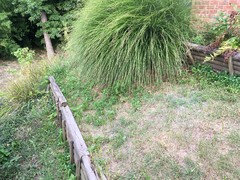
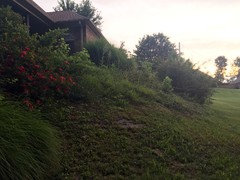
    A better shot of the lower "wall". Ideally, if I could save money by doing it, I would love to just put a stone wall in place of this current timber wall, but making it higher to raise the ground area above it. But I'm not sure if a retaining wall can be built in just the middle of a hill like this???

    Shot from below hill looking front to back. As you can see, I have a few trees, rose bushes, butterfly bushes, and vinca minor growing on a lot of the hill. I would like to dig out the dirt and level the area between my hill and my neighbor's fence there on the left side. Next spring I want to install my own privacy fence, so I think it would be nice to have this portion between my hill and his fence more flat and level. This is also why I think a retaining wall would come in handy and look nice.


  • 10 years ago

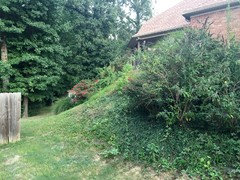
    Panorama of my hill

    Looking up towards the house. You can see part of that lower timber wall near the top 1/3 of the hill.


  • 10 years ago
    last modified: 10 years ago

    Looking from back towards front


  • PRO
    10 years ago

    In order to solve all the problems your yard offers, you need a complete plan which includes retaining walls and planting. To be sure, it is much easier to care for a yard that is organized and has organized plantings, as opposed to one which is hodgepodge. Personally, I think you would do yourself a favor to hire a landscape designer or L architect in order to determine the complete concept for the property: walls/planting and whatever else that's needed we don't yet know about. (Here, we're looking only at piecemeal images. It's very difficult to grasp the existing conditions of the property and understand the extent of what is needed.) You probably need some walls, but in some places, slope will probably work fine. It's a matter of determining how it can all work together.

    If you have DIY skills, I would suggest you pursue the comment of plsx88 ... "... low walls of less than 4 ft are within what a homeowner can build himself at a fraction of the cost a contractor wants." Even so, you would probably need a designer to help you determine their design.

    A timber wall would probably suffice if you just want someone else to come in and do it. But it will not be as nice and enduring as a concrete wall. Given that you got some prices, I'm thinking that you've either had some design work done, or you're getting prices based on some vague suggestion by a contractor. If it's the latter, abandon that idea. You can only get a price based on a plan and specs. Otherwise, you will not know what you are getting until it's too late.

  • 9 years ago

    I am right now researching the replacement of a 25+ year old railroad tie retaining wall. I need about 75 6" x 6' x 8' beams, and I'll reuse the steel stakes. I'm planning to use non pressured-treated lumber that I'll seal with Pine tar, tung oil or Eco Wood Treatment whichever comes in easiest to use and cheapest.

    Here are the locally available woods I have researched and priced:

    • Hemlock: $18 / beam
    • White Oak: $33 - 38 / beam
    • Black Locust: $48 - 60 / beam

    I have also read that Juniper is a great wood if you live in the northwest, and that came in at $26 / beam with a hefty delivery charge to the northeast where I am.

    I am hoping to do this myself with some teen labor contracted from my second floor. ;-)

    Hope this is useful info.

  • PRO
    9 years ago

    what is your reasoning for not using p/t timbers?

  • 9 years ago

    "Juniper is a great wood if you live in the northwest"

    I think you must mean northeast :-)) Juniper as a timber species is not at all common in the PNW. In fact, I have never seen it available in this area.

    I would also question why one wouldn't use some sort of p/t lumber for this purpose. 4"x4"x8' or 6"x6"x8' p/t landscape timbers are widely available for this sort of usage. Otherwise I would opt for some sort of naturally rot resistant wood like cedar (Thuja plicata in the west; Juniperus virginiana in the east) or redwood or black locust, but those will be typically a pricier option.

  • 9 years ago
    last modified: 9 years ago

    I recently had to rip out a 25+ year old railroad tie retaining wall on my driveway and replace with a Keystone like 8" x 18" block. It had been slumping for several years and it was just a matter of time, with the increase in delivery truck traffic (thanks Amazon), before the driveway gave way. Commenters are right about a wood wall being viewed as a potential liability, regardless the age.

  • 9 years ago

    @gardengal48, no, I've only found it through a northwest supplier and to your point, was surprised not to find it here. Black Locust would be great, but outside my budget. @RevolutionaryGardens, not using p/t as I don't know what's in the preservatives being used, and I'd rather choose my own preservative.

  • PRO
    9 years ago

    If you're buying from a local lumberyard, any p/t products sold are often coming from fairly close by. At that point you can find out the exact process used, and the wood preserver generally has their safety data (what's in it, etc) online for each process. As an example,this is the page from the wood preserver that supplies my local lumber yard. I've done projects where we've had to supply safety data sheets for EVERYTHING, they're not hard to get your hands on.

    So you can still know exactly what they're using, the price per unit will be way lower, and the timbers will be treated with a process that drives the preservative deeper into the wood, vs just brushing it onto the surface. If you really want to go down a rabbithole and you're worried about copper quat leaching out of p/t wood in soil contact, a quick google search turns up a few recent studies on exactly that (found them when I was evaluating whether or not p/t could be used near a koi pond).

    Or you could keep it simple and go w/ cedar and then you don't have to do anything to it.