Software
Houzz Logo Print
maackia

Scots Pine

10 years ago
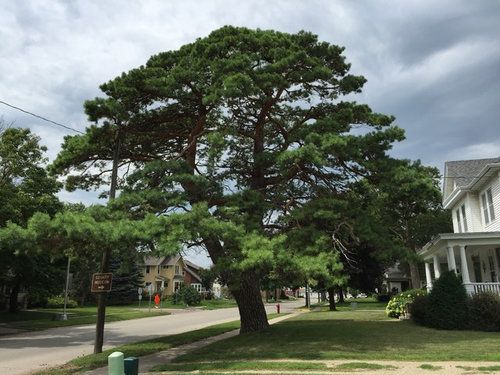
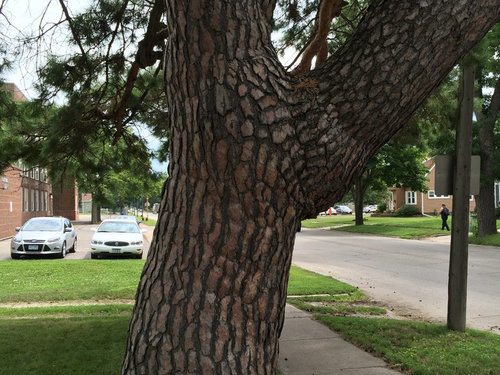
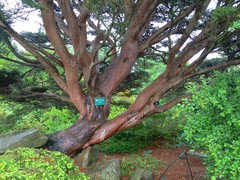
Over the years my job has taken me all over the upper Midwest, and there are several trees that have stuck in my memory because of their grandeur. When I return to these areas I make it a point to visit them, as if to say hello to an old friend. Unfortunately, I’ve lost a few of these old friends, including an American Elm that had a 7’ diameter trunk and a canopy spread of about 150’. It succumbed to DED a couple of years ago, and I’m wondering how long this Scots Pine will hang on. It’s grows along a busy street near downtown Waseca, MN.


Comments (24)

  • 10 years ago

    That is a dandy. Thanks.

    tj

  • 10 years ago

    Beautiful specimen, it must be an oldie. I guess you don't have pine wilt nematode up that way. No Scots or Austrian pine left around here.

  • 10 years ago
    last modified: 10 years ago

    This is one of those Midwest towns that has some very nice trees. Beautiful Bur Oak mainly, but there's Sugar Maple and few exotic gems along the way. Why is it that some towns seem to have a bounty of majestic old trees, while others are drab in comparison? Soil of course has something to do with it, but there does seem to be something else at play.

    I can't say we're completely free of PWN, but Scots and Austrian are doing OK. I do see the occasional mature P. sylvestris dead or dying, so I worry about it. I'm interested to know if TJ sees it in Milwaukee Land, which about 200 miles to the SE.

  • 10 years ago
    last modified: 10 years ago

    Maybe far enough north to escape the typical diseases? Don't know, but shows how majestic a Scots pine can be w/o the diseases. An occasional, exceptional Table Mnt or pitch pine can look like that here.

  • 10 years ago

    Foliage color is really good one this one too.

  • 10 years ago

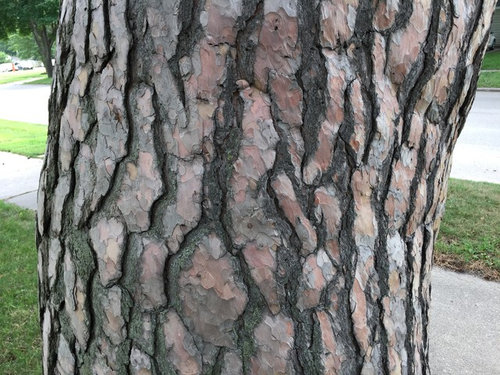
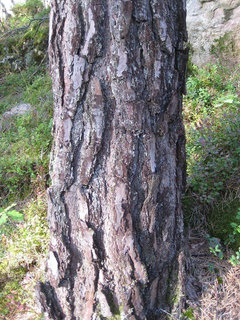
    That bark is gorgeous.

  • 10 years ago

    that trunk is too nice to be real

    ron

  • 10 years ago

    The bark is Pinus nigra for me not Pinus sylvestris

  • 10 years ago

    I suppose before I wax poetic we should identify the tree. I have to admit I've never seen bark on a Scots Pine quite like this one, but I've also never seen one quite this old or with such thick plating. The branches show the classic orange color that P. s. is noted for, and I've assumed all along it was Scots Pine, which is a very common tree in the upper midwest.

    I would expect P. nigra bark to be more grayish, but I'm hardly an expert. Maybe it's a very old P. densiflora. Wouldn't that be something?!

  • 10 years ago

    I agree, not P.nigra.

    When I first looked at the picture, I thought that that was a very healthy, LUSH Scots pine, and left it at that.

    Then you remarked maybe densiflora. I've seen lots of P.d., but none so old.

    So I perused Google Images, and guess what? Several images of old trees in Japan look VERY much like your image, except the old bark low on the trunk doesn't have quite the orange, but not by much. Otherwise...

    I guess the only way to know for sure is a closeup of a cone, and maybe foliage.

    Whatever it is it's certainly a keeper.

  • 10 years ago

    Ken, you seem like someone who enjoys a nice densiflora.

  • 10 years ago

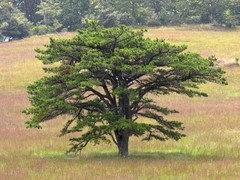
    Table Mnt pine in NC:

  • 10 years ago

    I enjoy any conifer, especially OLD ones!

    I've always wanted to grow Table Mountain Pine, but never did obtain any.

  • 10 years ago

    One clue that this is not P. nigra is the fact it is alive! Most Austrians looking very poorly in the upper midwest these days.

  • 10 years ago

    Austrian Pine gets lovely plated bark that is grey w/black...that's P. sylvestris.

  • 10 years ago
    last modified: 10 years ago

    kentrees, here's one of my Table Mnt pines:

  • 10 years ago

    Pinus sylvestris has bark like that sometimes, normally when it has that low, wide shape. Don't know why.

  • 10 years ago

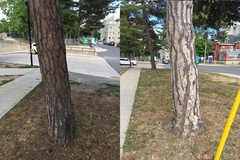
    A good comparison of Pinus sylvestris versus P. nigra bark on mature trees.

  • 10 years ago

    I've got brown eyes. My wife-same species as far as I can tell-has hazel/green eyes. Some natural variation is baked into all species, folks!

  • 10 years ago

    Is it possible that soil conditions would have some influence on this growth habit? I see this shorter & wider form of P. sylvestris growing in the rich soils of southern Minnesota, while those growing in sandy, lower fertility soils of northern MN and WI tend to be taller and narrower. The trunks of trees growing in rich soils are noticeably wider than what you'd expect considering the height. It makes for a very picturesque tree, and there are beautiful specimens to be found in southern MN. The Scots Pine I posted is in a very rich agricultural area with excellent soils.


  • 10 years ago

    Not sure of the veracity of that, Maack, but I do know that Pinus sylvestris is one of those species where mankind has been tinkering with it relentlessly for centuries. Too many variants out there to really know what you've got......without significant research!

    Here in my middle of the road east-central WI, I see all manner of Scots pines, big, little, squat, tall, blue-green, dull green, yellow green..........you get the point, I'm sure!

  • 10 years ago

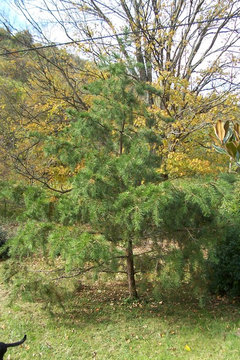
    This is what the bark look like at my place, quite distinct from the other trees in this topic. And my pines are totally wild, no one has ever tinkered with them. They grow straight and tall, not like the tree in the starting post even when growing in an open, windy field. Unfortunatly, I like low, squat pines more. Mine are better for timber though.

  • 10 years ago

    Toms remarks are right on for Scots pine in my area, one of every possible shape and size and usually not far from one another. There are no native pines in this area but these self seed and spread from planted trees where the area is left undisturbed

Sponsored
Peabody Landscape Group
Average rating: 3.5 out of 5 stars8 Reviews
Columbus' Reliable Landscape Design & Contracting