Software
Houzz Logo Print
bahram03

Help: Tomato leaves curling and flowers drying up

10 years ago
last modified: 10 years ago
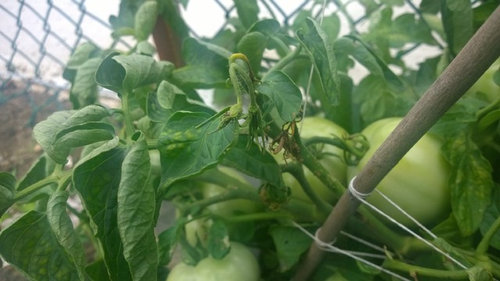
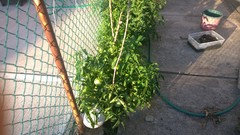
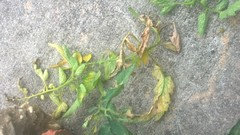
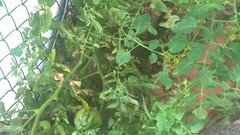
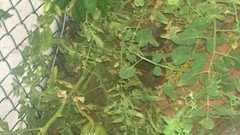
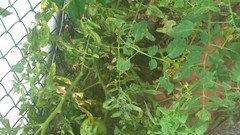
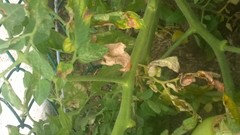
Is this a disease or pest? I am I'm zone 7 and they are in the ground.


Comments (33)

  • 10 years ago

    Hard to tell from those pictures, but it's most likely physiological leaf roll, a response to stress. If you also have blossom drop, I would guess that temps have been high lately? I would also check the undersides of leaves carefully for sucking pests like aphids. They can cause leaf roll, and many sap-sucking pests explode during hot, dry weather.

  • 10 years ago

    I forgot to mention, a lot of the of the lower leaves and stems have turned yellow and shriveled up. I try to cut them off when I see them.

    I haven't seen any bugs on them. I can check closer. I think I need to prune it back.

    Should I take more pictures or a video of the whole plant?

  • 10 years ago

    Could be:

    - nutrient deficiency.

    - drought stress

    - fungal disease (are there lesions/spots?)

    - soilborne wilt disease

    Pictures would help, but if you've already pruned off the damage, they may not tell us much. In general, both detailed close up pics and pics of the entire plant showing symptoms before they're pruned off is the best way to document a problem.

  • 10 years ago

    I haven't pruned everything off. I can take a more pictures when I get home.

  • 10 years ago


  • 10 years ago
    last modified: 10 years ago
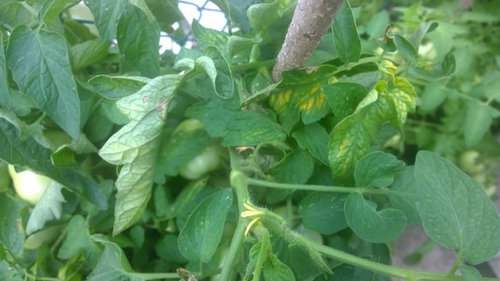
    I think the most likely culprit is drought stress or nutrient deficiency. Those plants don't look diseased to me. What/when are you feeding the plants and how do you determine when to water/how much to water? It must be difficult to gauge moisture levels when the plants are in a strip between paved areas like that.

  • 10 years ago
    last modified: 10 years ago

    i don't feed the plants. When I planted them, I side dressed them with two handfuls of miracle grow. I didn't mulch them. Was only able to get some grass clippings last week that I am drying to mulch. I think my compost is close enough to being ready to side dress them before I mulch.

    I water them every other day, unless it rains. We have had some very heavy rains this past week. When I water, I turn on the hose and let the water run from the driveway onto the soil (so nothing splatters up as much) and I just wait till it looks like a good amount of water pools there and has started to move down the line. Then I move it to the next plant and so on.


  • 10 years ago
    last modified: 10 years ago

    They need fertilizer. Compost isn't really enough (it's more of a texture amendment and for adding good microorganisms than a source of sufficient nutrition for tomatoes), and anything that you gave them at planting out is long used up by the time they're fruiting. The yellowing is almost certainly one or more nutrient deficiencies. I mix a general-use granular fert into the soil at plant-out then start to feed my plants weekly with liquid tomato fertilizer when they put on a lot of flowers and start setting fruit. Last year, I did the same except instead of liquid tomato fertilizer weekly, I side dressed with granular tomato fertilizer every 2 weeks once they started setting fruit.

    Plants in the ground may not need daily watering. Check moisture levels a few inches down with your fingers to determine when to water. Excess watering can also cause yellowing due to 2 potential causes: the excess water can strip away nutrients, especially nitrogen, which is very readily dissolvable and washes out of soil quickly, and soil that is constantly too wet does not allow the roots to breathe, which can make it harder for them to take up nutrients as well as make them more vulnerable to soilborne diseases. Don't water as long as soil a few inches down is still nice and moist. Once it starts to feel dryer, water slowly and deeply. Do not water shallowly too often. Water when they need it, and water really well at that time. How often you need to do so depends on the weather you're having and how well your soil holds on to moisture. A sandy soil will need more frequent watering than soil with clay content.

  • 10 years ago

    I do also water them with, when I do water changes from my fish tank.

    Is there a specific fertilizer you would recommend?

  • 10 years ago

    I don't have specific recommendations, as I've only used a handful of products in my own garden (Espoma TomatoTone (granular), Jobe's Organic Tomato and Vegetable (granular), Urban Farms' Texas Tomato Food (liquid)) and all have been fine. I would just recommend you get something specifically for tomatoes, as general plant fertilizers are usually too high in nitrogen for fruiting tomatoes, and tomato formulas will have important minerals, etc. for tomatoes.

    Ideally, what you want to do is get your soil tested and then make adjustments from there. But in the meantime, using a tomato formula should be fine.

  • 10 years ago
    last modified: 10 years ago

    Im going to try buying and using the miracle grow fertilizer for tomatoes.


    My assumption is that if I mix in a bucket of fish tank water, with some instant coffee and sugar it can't hurt to water all my vegetables with it.

  • 10 years ago

    Why instant coffee and sugar?

  • 10 years ago

    I read coffee is good for tomatoes. Sugar is suppose to feed the soil.

  • 10 years ago

    IMO, the instant coffee is a waste of money. Whatever miniscule effect it might have is way overshadowed by what actual fertilizer will achieve. And sugar can cause an imbalance in microorganisms (feed harmful or useless molds, make microorganisms multiply beyond the capacity of organic matter in the soil to sustain them long-term, etc.), attract nuisance critters, and mess with plants' root functioning. These folkloric quick-fix remedies tend to mostly make one's wallet lighter and can cause their own problems.

  • 10 years ago

    I didn't do it. I only used the fertilizer.

    When I do use instant coffee and sugar, its less than a spoon in 2 gallons of water.

  • 10 years ago

    It's not going to hurt anything at that dilution, but I doubt it has much of an effect, either.

  • 10 years ago

    Might not. It can't hurt so I do it. Im hoping the fertilizer will help.

  • 10 years ago

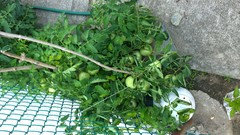
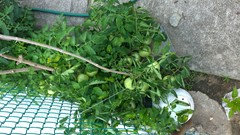
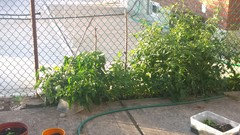
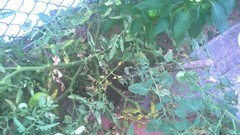
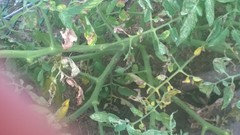
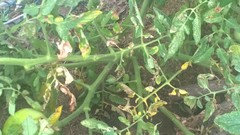
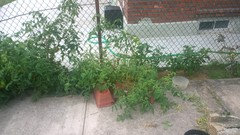
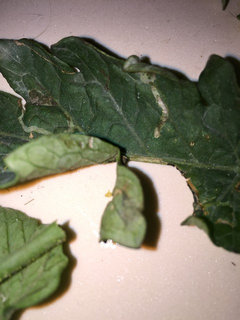
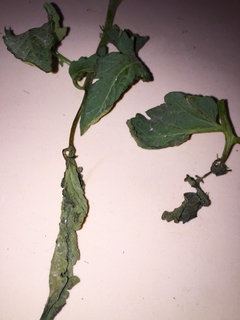
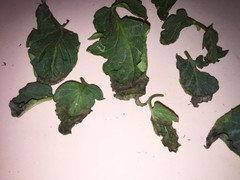
    I have been using the Miracle gro tomato plant fertilizer every week to help the plants. I can't tell if it is actually helping or not. It can be helping for new growth and the old growth was too far gone to save. Here are pictures of a tomato plant from last night and some stems that I cut off. (Tomato in pictures is the one on the right in the last picture)


  • 10 years ago
    last modified: 10 years ago

    Old foliage damaged by nutrient deficiency often does not recover. Foliage damaged by drought stress will not recover.

    You seem to have a watering issue. Are you sure water is soaking down into the root zone of those plants and not just running off?

    And most concerning is that I see signs of mites, which is a problem that can get out of control very quickly. That white speckled damage is very typical of a mite problem. Take a magnifying glass and look at the underside of some of those leaves with the white speckled damage. Or you can put a piece of paper under those leaves, give them a good tap, and then look at what falls down onto the paper with a magnifying glass. Mites are tiny and not visible to the naked eye for many people. If you find mites, it's not good.

    Where are you located? Zone info is a bare minimum of information for cold hardiness. It doesn't tell us much else about your growing conditions.

  • 10 years ago

    I am in zone 7 (NYC)

    My assumption is that the water does go down to the roots. One of the tomato plants is doing really well.

    if i do find mites, what should I do?

  • 10 years ago

    Ariel: I am in zone 7 (NYC)

    If possible, go to the advanced settings in your Houzz profile and put your location information in the zone field. That way, it will appear next to your username (the way mine says 6b/7a | Sunset 32 | SE PA next to my name). This lets people know right away without having to dig through old posts in a thread to remember the information.

    My assumption is that the water does go down to the roots. One of the tomato plants is doing really well.

    It's good to check by digging down into the root zone and feeling the soil there. It's possible you're not watering deeply enough/using enough water. Also, unless you're using a slow irrigation method, it's possible that the water does not penetrate down well in the soil, which can be pretty clay-heavy in the area, and runs off.

    if i do find mites, what should I do?

    Nothing else causes damage that looks like that, so it's almost a certainty that you have mites, probably spider mites.

    Mites are tough. The first thing you can do is to prune off all the affected foliage (speckled, yellow, and dying foliage--yes, you will lose a lot of leaves), bag/seal/discard the prunings, then wash down all the remaining surfaces of your plants with a vigorous and generous spray of water to knock some of the mites off. This physically removes many mites from the plant and slows down their explosive population growth and may give you more time to deal with them.

    Some chemical options are: insecticidal soap, neem and other insecticidal oils, permethrin, and sulfur. I know someone who swears by a combination of diatomaceous earth, insecticidal soap, and permethrin. Whatever you choose, you need to treat every few days for a while to make sure you're disrupting their life cycle and then, even if you get the problem under control, you'll have to monitor your plants very diligently for any signs of population regrowth.

    There are biological options like predatory mites but 1) they take time to arrive when you order them, and your infestation is far enough along that you kind of need to act right now and 2) if you use chemical options, they will kill the beneficial mites you release along with the pest mites.

    It's interesting--I've noticed that spider mites aren't a big problem for outdoor growers, normally, in the NE, but that people growing in heavily paved areas and on rooftops do tend to have problems with them when the weather conditions favor them. Probably something to do with creating the hotter, dryer conditions the mites favor and fewer natural predators in those environments.

    So for future years, learn the early signs of mite infestation so that you have more options if it happens again. And drought-stressed plants are especially vulnerable to mites, so figure out if you have a watering problem and find a solution.

  • 10 years ago

    Oh, and spray all your tomato plants, including those that are not showing mite symptoms yet, as mites will spread.

  • 10 years ago
    last modified: 10 years ago

    Thank you. It is mites. I have been spraying them with the hose in the morning and after work daily. Friday I trimmed the plants back heavily. Anything that had white spots, was yellow, or dried up got trimmed off. I am hoping it will slow down their growth and give me new fruit.

    I did the white paper test to see if I have mites. There was another bug that fell, can anyone identify it?

    Video of the white paper test: https://www.youtube.com/watch?v=ZADDs8PoJuo&feature=youtu.be

  • 10 years ago

    Thanks for the quick reply. I tried my best to take the video. It was windy and hard with one hand to focus the camera.

    Crab spiders match the basic shape of the spider. I ended up killing it because I wasn't sure if it was good or bad.

  • 10 years ago

    Crab spiders eat mites, IIRC. But one crab spider is unlikely to make a difference on its own. I pretty much always leave spiders alone if I can, even though they are often indiscriminate and eat beneficials along with the pests.

  • 10 years ago

    I read that after you said it could be a crab spider. Its too late now. Im hoping the daily spraying and trimming will help.

  • 10 years ago

    Note that spraying twice a day with water opens you up for fungal disease. That might be a good tactic in a desert environment, but I wouldn't do it in Queens. A wash-down at first is great, then I would spray something like neem or permethrin. Then repeat that every few days for a while. If your plants survive the next couple of weeks, the problem should subside as the weather gets less conducive to the mites.

  • 9 years ago

    Hi there, I'm having a very similar problem and I'm close by in Brooklyn New York. I'm a container gardener on my rooftop (pavement). My leaves are having similar issues and is really love your advice. Please note I have sprayed with davonil and dusted with diamiteous earth (which are the white spots)

  • 9 years ago

  • 9 years ago

  • 9 years ago
    last modified: 9 years ago

    I can't see very much in your photos, but that doesn't look like mite damage to me. It looks like fungal disease. It would be more helpful to see a photo of the entire plant, plus some details of damaged leaves before they're pruned and in better lighting.

  • 9 years ago

    Looks different than the damage to my plant.


    I still have mites on my plant. What helped was to really to prune the plants. I cut off almost every stem and leaf that had any sign of damage. It allowed new leaves and suckers to regrow the plant and develop new fruit. It helped alot and I try to spray it with a hard stream and check some leaves to physically squash some bugs.

Sponsored
More Discussions