Software
Houzz Logo Print
hzdeleted_24200779

what is rose gall,precisely?

10 years ago

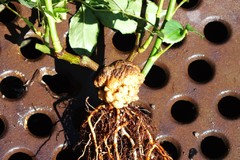
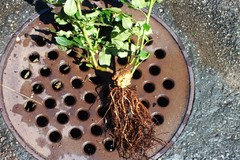
Yesterday I noticed that one of my Excellenz Von Schuberts wasn't looking too "excellenz". I started pruning out a lot of weak and dying branches, removing old canes from the base, and found that one of these had what looks to me like two galls right at ground level. Naturally I sawed this off,galls and all,as deep down as I could easily go without actually digging down. Now, here's the thing: what exactly IS rose gall? is it a systemic disease; i.e.,is the entire cane to be considered as potentially contagious/poisonous with disease, or is only the icky nubby galled area potentially "poisonous"? That is, I know to throw out the actual galled part of the stem, but can the rest of the cane be composted? More importantly, should I consider the entire plant to be a goner and just get rid of it immediately? There are several canes that seem perfectly healthy...

Comments (10)

  • 10 years ago

    Its a critter called argobacterium that causes tumors (galls).

    User thanked Patty W. zone 5a Illinois
  • 10 years ago

    I think it weakens the plant. I had a Jeanne Lejoie (sp?) that thrived in my garden for about 3 months & then began a steady decline. Upon digging it up we saw one gall on it, I said to toss it & my gardener wanted to take it home with her. Now, 3 years later it's still alive but the very opposite of vigorous & I know she's babied it. Perhaps some other varieties can handle it better but that's my experience.

    Jane

    User thanked smithdale1z8pnw
  • 10 years ago

    what Patty says plus some insects lay their eggs in rose canes & this also can cause a gall-----common on some rugosas.

    User thanked wirosarian_z4b_WI
  • 10 years ago
    last modified: 10 years ago

    Bart, Patty is right! Agrobacterium tumefaciens - Rhizobium radiobacter, as I understand it, is a bacteria present in the soil and can infect a plant if there is damage to the root or stem. Just google it as I have done after I discovered this....


    There is a product in the US 'Galltrol' to treat it but there is nothing on the market here in Europe so I dug out the entire plant and quite a bit of the soil and got rid of everything - nothing on the compost - not taking any chances!!!

    User thanked User
  • 10 years ago

    Thanks, all. No, it was nothing near as horrid as that in the photos posted by sutekesh! I'll have to look at the plant again,digging a bit around the base,( though in the heat I find it difficult to even think),but I think it was only two little blobs at the base of one cane,each one no bigger than the finger-tip of a middle-aged woman (me). And, yes, there was a tiny round hole in the base of the cane, a little bit above the galls-pretty obviously an insect. I'm thinking/hoping this might be more a case like that of which Seil writes: that none of the other canes are galled,and the plant has just been too neglected and needs a bit of biffing up.

  • 10 years ago

    Cane galls in old plants can be common if infected dull shears are used for pruning. Always make sure you take time to disinfect your shears and sharpen them at least once per pruning season, depending on how many roses and conditions on the garden.

    User thanked Jeannie Cochell
  • 10 years ago

    The only gall I have ever discovered in my roses was a root gall. It (there was only one single gall), was the size of walnut and hard as a rock. It was attached to one of the main roots about ten inches out from the crown. I was surprised to discover it since the rose I was digging out on which it was growing was the picture of health. The bush in question was discarded with the household trash.


    User thanked Moses, Pitt PA, cold W & warm/humid S z6
  • 10 years ago

    I've found galls twice before: once,last fall, on Mme. Berkeley;I'd dug it out to move it and there was a gall at the base, but as in this case of ExVS,it was only one area of a large,mature root mass,so I cut it out and re-planted the Madame in a different spot; so far it looks ok; only had one flower, but it was just moved. Brise Parfum was a different story: the plant clearly wasn't growing at all,just dying off,and when I dug it up, it looked sort of like Sutekesh's picture,in the sense that the whole base was galled. That got thrown away in the trash. In both cases, the plants didn't have proper soil at all. What makes me perplexed about this case of ExVS is that I wasn't planning on moving it,so I can't really see what's going on below the soil surface. So I guess what I'm asking is really : will it be safe for the surrounding roses if I just leave this ExVS where it is and see how it goes, or should I dig it out? Seems a bit paranoid to dig it out, I guess...

  • 10 years ago

    Galls can infect virtually any rose, but here in California, it seems the most susceptible are multiflora and wichurana hybrids and most of the "landscape" types. Flower Carpet (all); Ballerina; Sally Holmes; Bonica; almost all of the Meilland landscape shrubs; most of the "Hybrid Musks" have had extreme gall problems all over here. I've encountered them in gardens and nurseries both as a shopper as well as while working. The McGredy "Hand Painted" roses are also highly susceptible in my observations.

    User thanked roseseek