Software
Houzz Logo Print
segal3

New citrus trees, need advice to cure yellowing

10 years ago
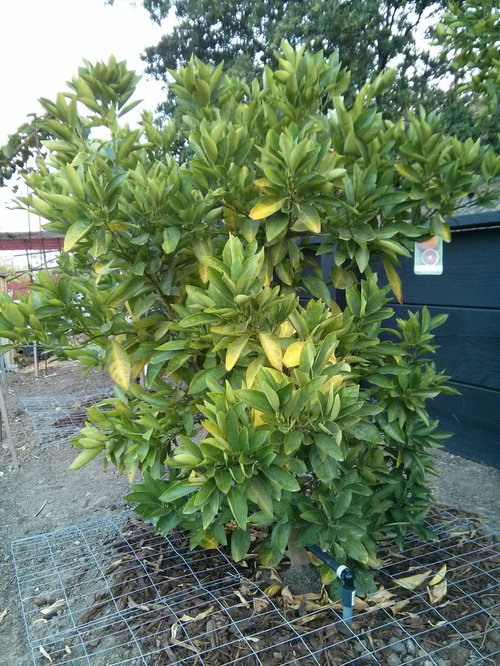
I need help curing ailing citrus trees that were recently
planted. The darkest green they've ever been was when they arrived in
their boxes two months ago. Since then, they've turned ever lighter
green/yellow-green.

The five citrus trees were planted in
early June -- a standard Meyer lemon, and four semi-dwarfs: two moro
blood orange, a page mandarin, and a tangelo. They all came in 24"
boxes.

I'm in the coastal Los Angeles area, and the trees are on
two tiers on a slope that, as far as I can tell, is alkaline clay-ish
soil. It drains well but also holds a lot of moisture, so I've tried to limit my watering to no more often than every 12-14 days.

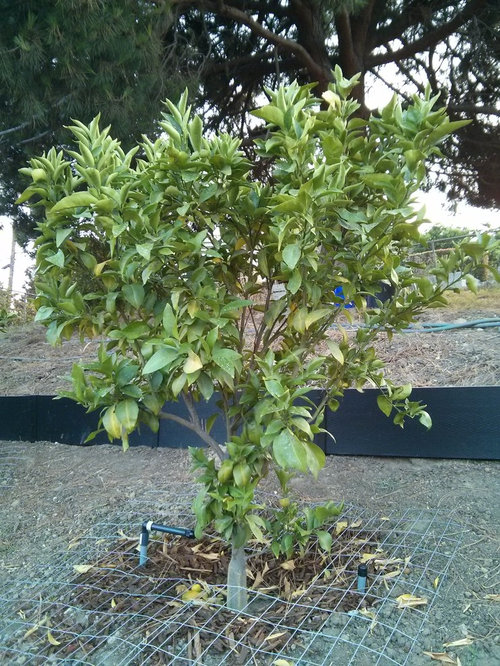
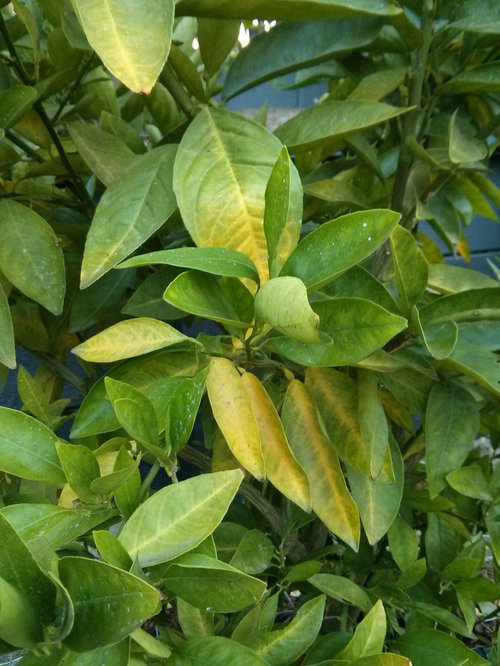
Even with this, I'm seeing lots of yellowing of inconsistent types that I don't know how to treat. Does anyone have suggestions to improve the health? The Meyer lemon is actually staying the greenest (maybe due the standard rootstock?) so far.

Pictures of a few of the trees (I can take more if needed):

Blood Orange #2 (Camera pointing ~north)

Citrus · More Info

Page Mandarin (camera pointing north-north-east):
Citrus · More Info

Blood orange leaf detail:

Citrus · More Info

Comments (10)

  • 10 years ago

    Any thoughts?

  • 10 years ago

    Matt, I'm not an in-ground citrus person, but they look nutrient-deficient to me. I know citrus need lots of nitrogen...I think some around here have used chicken manure. I hope someone else chimes in who has more experience.

  • 10 years ago

    There's the expert! Listen to John!

  • 10 years ago

    I have lots of citrus in the ground and also have to deal with alkaline/clay soils. I think your main problem is lack of fertilizer. While citrus do best in slightly acidic soil, I have found they tolerate alkaline soils fine if given enough fertilizer. I never acidify my water. It is too much of a pain. I do fertilize them with a fertilizer that acidifies the soil to some degree. A little trick I learned from the cloudforest site is to use fertilizer made for Azalea, Camellia and Rhododendrons. Evidently this is more acid promoting than the standard citrus fertilizer.


    -Brett

  • 10 years ago

    I believe John is correct. I was fertilizing my citrus every month to the day. Babying them and I could not get them to turn dark green. I talked to my local nursery here in Northwest Florida and they suggested Iron supplement. It took double treatments over 2 months but they are luscious green now. I used the liquid iron.

  • 10 years ago

    12-14 day watering schedule. Not enough for a tree trying to establish.

    micronutrients.

  • 10 years ago

    Listen to john

  • 10 years ago

    Thanks everyone for pointing me towards some major causes, specific comments below:

    Tim - I hear you on the watering. I wish it drained better. The soil is incredibly dense clay. When it's dry, it's rock-hard, and it takes some effort with a mattock to slowly chip away. It holds moisture like nothing else (the opposite of sandy, fast-draining!). I can brush away the thin layer of bark mulch after two weeks and the soil is still damp underneath. I'm worried about root rot if I water more often, and not providing deep soaks if I cut back on the quantity to match the increased frequency. Thoughts?

    John - I think you are right on. The alkalinity is having a major impact. Interestingly, the iron deficiency will cause foliar absorption of other micronutrients to suffer as well. I was reading up more, and I need to find out what semi-dwarfing rootstocks these trees are on. The Meyer lemon is on a standard rootstock, and it appears really healthy and pushing out new growth (with nothing else different from the other trees). The standard rootstock tolerates slightly higher pH and salinity. The trifoliate rootstock (if that's what they're on) wants sub-6 pH if the literature is accurate, but the soil around the rootball is up around 8.5 (and the tap water is pushing 9.5). Have you connected fertigators into your irrigation system to inject vinegar at some consistent rate?

    Brett - Good suggestion with the Azalea/etc-type fertilizer. Long-term, I'd really like to move to almost fully organic approach to tending the trees. In the near-term, I recognize I might have to correct some serious imbalances. I'm working some Azalea fert., elemental sulfur, and (recommended by a horticulturist acquaintance who deals with the local landscapes) soil conditioner in the form of humate (which should add more sulfur/iron).

    Michael - I'm also planning to pick up some EDDHA chelated iron to use as a soil drench to help get the trees through their current struggle while I work on adjusting the soil. Seems the other, more common, forms of iron chelate are less effective (EDTA, HEDTA, DTPA all get bound by soil above pH 7 according to http://edis.ifas.ufl.edu/m/#publication?id=SS423 ). And long-term synthetic usage is a challenge to soil ecology.

    Again, thank you everyone. I'll update as things adjust from these attempts to improve the conditions.

  • 9 years ago

    The Meyer lemon on the standard rootstock is continuing to do great. After speaking with the nursery, all of the semidwarf trees are on a trifoliate rootstock (wants consistently moist soil, not too acidic, not too alkaline, salt-sensitive, slow to establish, shallow roots). The blood oranges have done somewhat better since application of the chelated iron and Citrus Tone fertilizer. Still a challenge getting the watering dialed in on the clay soil.

    The Page Mandarin orange (2nd photo in the thread) is still in a "failing to thrive" state -- more yellowing/falling leaves and no noticeable growth. I'm not sure what to do at this point?