Software
Houzz Logo Print
jonelison

Repair stair tread in encased stringer?

10 years ago
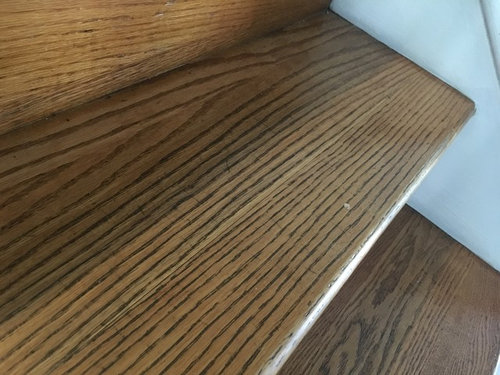
Hey all,

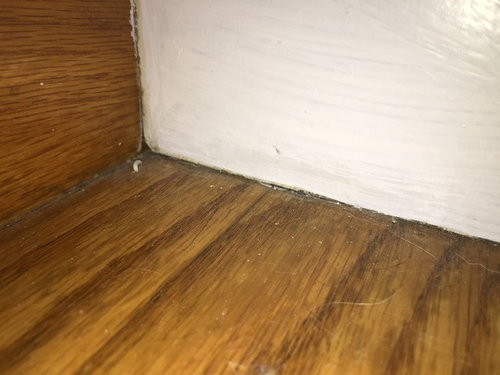
I have a cracked stair tread that I'm unsure how to fix. The tread split clean across about 3-3.5" from the nose. I've considered the tapered, wooden joinery dowels, but I'm not sure the length I need exists, or would even work (probably be too thick for the tread).

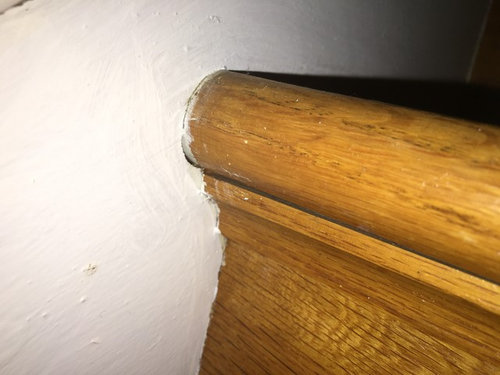
The other thought is to just replace it, or reinforce it from below. However, as you can see in the photos, the treads looked to be encased in the stringers. I can't tell quite how deep. The stringers appear to be cut around the treads and I don't have access to the stairs from below unless I remove drywall.

What would be the best course of action to fix this? Thanks in advance!


Comments (8)

  • 10 years ago

    Can you remove that cove molding between tread and stringer? That might expose a void large enough for a flat bar to pry tread up. I doupt the crack present's a safty concurn so it might not be worth fixing.

  • 10 years ago

    I agree with the others - don't mess with it unless you have to.

    If necessary, you could get long screws, drill and countersink. Don't use drywall screws.

    Construction Screws

  • 10 years ago

    I agree that geoffrey_b's idea is an option if you want to try to repair it in place, especially if the crack is near the front edge (I couldn't tell from the photo). If the crack is pretty far back, it may be harder. In any case, you would also want to glue oak plugs in the screw holes and try to stain them to match. Again, a fair amount of work for a limited benefit.

    Is the tread loose at all, or squeaky?

  • 10 years ago

    Thanks for all the feedback. Overwhelmingly it seems the best advice is do nothing! Boy, this was an easy one. :)

    The tread has been like this for a while and although it does have some give if you step on it right (or wrong), it doesn't feel unsafe by me measure. There's only two stringers, so you can get some small flex in the middle, but it seems like the best course of action is to just simply tolerate it. Fair enough!


  • 10 years ago

    There is a way to fix it. However, it is rather labor(and experience) intensive.

    First, a clarification in terms. The trim boards on the sides are called skirting(here in the Midwest, anyway). Stringers are the supporting boards on which the treads are installed(underneath the treads).

    Getting the old tread out is the first challenge. That is the labor part. Once that is done, installing the new one is the experience part.

    Buy a new tread several inches longer than than necessary. Make sure the thicknesses are the same(old tread to new). Cut the new tread to length, cutting off the right side of the tread. Now comes the gotcha part. Cut a scarf joint about an inch from the end of the right hand side. It should be a closed joint(meaning you look at the end of the joint on the surface as in the link and the rest of the joint is slanted towards the center of the tread).

    Now, glue(or use short finish screws) the short piece on the right hand stringer. Insert the left end of the tread in place and line up with the other piece. Use wood glue to assemble.

    To securely affix the two pieces, drill 3/8" holes about 3/8" deep in the end of the tread so you can use longer trim screws to screw the two pieces together at an angle towards the wall and into the stringer.

    Now, using the excess tread material, cut out plugs(using a plug cutter), from the scrap(where the grain pattern is identical to the end of the installed tread) and glue the new plugs in the holes.

    Cut off the excess plug material, sand to 150 grit smoothness and apply stain/finish.

    The glue joint will be stronger than the wood and there is enough of the top of the scarf joint resting on the stringer to support the weight as well. As well as the support the riser provides.

    See how easy that was?? :-)

  • 10 years ago

    HandyMac-

    I think you've done the best job of all of us convincing him to leave it alone :-)

  • PRO
    10 years ago
    last modified: 10 years ago

    Cut a piece of scrap to act as a fence for a router and place it against the riser. Plunge half way through at the split with a 1/4" straight cutter and make another pass to get all the way though. The router base will keep you from cutting the full length, but so what? Rip a slightly tapered strip on a table saw and after it's fitted into the slot, glue it and tap it snugly into place but not to flush. Belt sand it flush after the glue has set up and finish with a random orbital; stain and finish to match. No step removal required.