Software
Houzz Logo Print
drentom

Soil test advice

10 years ago
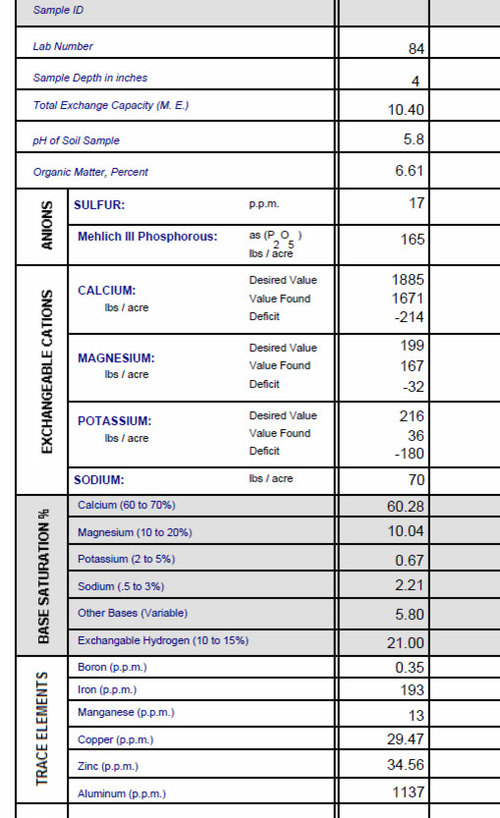
This is near Boston, MA.

Some of the lawn is thin or patchy whereas other spots look pretty good. I think it's mostly fescue and rye grasses.. I've been trying to use organics, corn or most recently Milorganite, but am open to other suggestions.

I was hoping to overseed soon, but watering restrictions may delay or prevent doing so.

Any advice would be appreciated.

Thanks!


Comments (11)

  • 10 years ago

    This is pretty good for a first test--it has some weaknesses, but it's certainly workable. I arranged the recommendations below as if you were unable to overseed this fall, as we're already in the window for that and the weather doesn't look like it's going to change enough.

    However, if it turns out you can, let me know. Most of this doesn't need much adjustment, but a bit of a shift might be in order depending on when you seed.

    ME 10.4: A mid-range soil, which is nice. It holds good levels of resources, but doesn't resist change too much. If you made me guess, given your locale, it's probably a moderately silty soil.

    pH 5.8: Textbook, somewhat low, but nothing extremely severe. We'll fix this below.

    OM 6.6%: Excellent! With your ME, no special effort needs to be made to raise this, but I'd certainly mulch mow and mow all of your fall leaves just on general principles. You can certainly feed organically if you wish.

    Sulfur 17: Normal, and a perfectly good answer.

    Phosphorus 165: My target on your soil would be 200. This, while a bit low, isn't severely off, but improving it should also improve your grass quality a bit. We use off the shelf starter fertilizer to fix this, and just get the cheapest. They all work the same. Recommendations below.

    Calcium 60%: Right on the line of optimal, but it's a bit low given your soil and the fact that we want to kick your pH up a bit. To adjust this, we use a high calcium lime like Encap, Mag-I-Cal, or Pennington Fast Lime. Those work more quickly, require less mass per area, and don't contain elements I either don't want to add or want to add in other ways. Recommendations below.

    Magnesium 10%: Again, right on the line of optimal. This one is arguable, and I've tagged it optional in the recommendations. Personally, I'd tap it a bit, but if you don't, it's no big deal. We use Epsom salt to adjust this, available from your grocery store or drug store, and the store brand is fine.

    Potassium 0.67%: Very low, borderline deficient. We use potassium sulfate (sulfate of potash) to fix this, which you can get from some garden or landscape stores, or they'll order it for you. Recommendations below.

    Minor Elements: Zinc is very high, but fine. Copper is also very high...avoid copper sources, although this won't cause too many issues. Boron is discussed below.

    Boron 0.35: Low-ish, and something I'd adjust. While not the most important element, I'll always work to move your lawn into the most optimal range on everything. Me? I'd fix this. We use Milorganite as a carrier and 20 Mule Team Borax as the boron source. You can purchase 20 Mules at the grocery store in the laundry section. In a wheelbarrow or the like, dump the Milo. Spraying very, very lightly with water (I use a spray bottle like the kind people use to damp their clothes when they iron) will help the boron stick. Add the recommended amount of 20 Mule Team Borax and stir, spraying occasionally to get the stuff to stick to the Milo. Then apply over the recommended area. So if going for bag rate Milorganite (1 bag per 2,500 square feet), you'd add 10 tablespoons of 20 Mule Team Borax.

    Recommendations:

    Labor Day: Feed the lawn with starter fertilizer at the bag rate.

    September 15: Apply 4 pounds of Encap or Mag-I-Cal per thousand square feet. Apply 4 tablespoons per thousand square feet of 20 Mule Team Borax in Milorganite carrier.

    October 1: Feed the lawn with starter fertilizer at the bag rate.

    October 15: (Optional) Apply 1 pound of Epsom salt per thousand square feet.

    October 15: Apply 3 pounds of potassium sulfate per thousand square feet.

    April 1, 2017: Apply 4 pounds of Encap or Mag-I-Cal per thousand square feet.

    April 15: Apply 3 pounds of potassium sulfate per thousand square feet.

    May 15: Apply 3 pounds of potassium sulfate per thousand square feet.

    June 15: Apply 3 pounds of potassium sulfate per thousand square feet.

  • 10 years ago

    Wow. Thank you morpheuspa.

    It looks like I have my work cut out for me... This isn't my 1st soil test, though. I have a UMass test from last year, but just googled around for what to to with the results and didn't do a good job of correcting all the deficiencies.. If you're interested or it's helpful I can dig it out and post it.

    For calcium I found something called Sta-Green Rapid Lime that looks similar to your suggestions:

    I'm still looking for the rest.

    Again, thanks!

  • 10 years ago

    Go ahead and use the StaGreen. It might or might not be as fast, but it's low enough in magnesium that I'm OK with it.

    If it doesn't correct quickly enough, we can fix it next year, and you're not that low in calcium that I'm at all worried about it.

  • 10 years ago

    So after some thought I've decided I would like to overseed next weekend (Labor day), but only the problem areas, maybe ~20% of the total. The "starter" fertilizer I've got is the Espoma organic one (3-6-3 - Ingredients: bone meal, chicken manure, sulfate of potash magnesia).

    morphuspa, how would this change your recommendations?

    Also, when buying seed, the garden center lady cautioned that germination might be low in full sun as it's still pretty hot. Is that right? From threads I've read here I thought it would be OK as long as I can keep it damp. But then again, the forecast for next week is 90+ highs and upper 60 lows.

    Thanks!

  • 10 years ago

    With those recommendations, go ahead and reseed whenever you like. They're pretty gentle!

    It might be a bit too hot right now, but keep it damp. At worst, it'll sprout when temperatures finally drop--and quickly, having gone through pre-germination before that.

  • 9 years ago

    It looks like morpheus isn't posting anymore, but maybe someone else could chime in... When should I start applying a regular fertilizer again?


    I ended up using Espoma Organic Lawn Starter (3-6-3) at their rate (12#/1,000 sq ft) last September and October.


    Do I really not need any N this spring?


  • 9 years ago

    You need N. Apply one pound of N/k around May 30/June 1. I believe that was an oversight that it was not listed. Then start the Fall regimen around Sept 1.

  • 9 years ago

    Thanks Ridgerunner. I did apply 1# of N/k late May as you suggested.


    Here is this year's update:


    This was sampled 8/6, at least 6 weeks after the last application of potash. I did change the sampling technique based on a suggestion I read elsewhere: I discarded the top 3" of each sample, so all the soil comes from a depth of ~3-4" instead of 0-4".


    It looks like most things have improved following morpheuspa's advice. I think the continued low phosphorous (is it low? there's no 'target' listed) is because "bag rate" applications of the organic fertilizer I used is much lower than conventional rates. To get 1# of N in May I had to apply triple the amount recommended on the bag. Last fall I only applied about 0.7# of N and 1.4# P between both starter applications because the recommended rate is so low.


    Potassium is better, but also still low, should I continue applying potash?


    I'm also not sure why some of the metals continue to rise.


    I started applying alfalfa last weekend, ~17#/k, which should be 0.5# of N. I was planning to do a similar application early September, but it looks like I should have waited for the test results.


    Should I switch back to a starter fertilizer again? I can use a conventional (18-24-6?) starter if anyone thinks there could be issues with the Espoma stuff aside from just too low of an application.


    I also saw this "Coop Poop" product locally (http://www.coop-poop.com/ 2-4-3, but also 8% Ca, 0.6% Mg). I think it was much cheaper than the Espoma 3-6-3, but hadn't done the math yet. Does it look like a good fit, or is that too much calcium now that Ca and pH look good?


    I would welcome any further advice.


    Thanks!

  • 9 years ago
    last modified: 9 years ago

    Sorry Dave, but due to the change in sampling depth a competent analysis is not possible. Just as it is important to take representative samples distributed throughout the yard, it is important to sample the whole depth of the root zone. This is particularly important during amending as some of the additions of nutrients likely have not moved down to the 4" depth, but they are there in the upper levels.

    If you followed the recommendations then you have added enough P and K to reach sufficiency levels of P and K. No need to add more although you don't need to avoid either of them in small quantities or during an overseed.

    Nutrients from Organic fertilizers become unavailable once temperatures fall into the 50's and bellow. Best to use chemical/synthetic fertilizers as we move later into Fall.

    Your Cu and Zn levels are unusual. Those kind of levels (unless you're in some areas of the western midwest, would indicate some kind of contamination- e.g. your homesite was built near a mine or a factory, etc). The most likely source of contamination is due to using copper, brass and or galvanized tools/buckets during sampling.

    Regarding the "Coop Poop" and Espoma: The "Coop Poop" at 2-4-3 is going to provide 1/3 less N and P per pound of product, so unless it is more than 1/3 less cost per pound, it's not actually cheaper.

    Sorry, that's all I've got.

    Epilogue: I try to no longer do recommendations for Logan. I think Becky may still be doing them tho.

  • 9 years ago

    Thanks Ridgerunner.


    I'll consider resampling correctly, or maybe earlier next spring instead of waiting a full year.


    My concern is that I underapplied phosphate by about a third because the "bag rate" on organic products is pretty low. As an example here's a typical conventional starter from Lesco :

    http://www.kellysolutions.com/erenewals/documentsubmit/KellyData/ND%5CFertilizer%5CProduct%20Label%5C200116160_6_23_2016_1_09_20_PM.pdf


    It's 18-24-12 and the the 50# bag is for 12k sq ft. So two applications would be 2# P per 1k sq ft. What I actually applied last fall was 24#/1k sq ft of 3-6-3, so only 1.4# P.


    Contamination is a possibility. I constantly find bits of broken glass and ceramics in my topsoil so suspected it wasn't all that great.


  • 9 years ago

    Sounds like a plan.

Sponsored
Bella Casa LLC
Average rating: 5 out of 5 stars17 Reviews
The Leading Interior Design Studio in Franklin County






