Software
Houzz Logo Print
doodlelou

Why isn't my dryer drying my clothes?

9 years ago

I just posted on the appliances forum in response to someone else (http://ths.gardenweb.com/discussions/3901289/need-help-buying-a-washer-and-dryer) but thought I would check in with you guys as well. This is cut-pasted-expanded-and-edited from the other thread.

We recently moved to a new (to us) house, where of course the previous
owner had replaced the WD before they sold. It is a Maytag Centennial TL
set (one year old) and I hate it. I have always prided myself on being a total laundry genius and I'm seriously frustrated. The clothes are wrinkled and tangled
in the washer but that isn't the biggest problem except for things that have to hang dry. In fact, the problem with my dryer helps with the clothes being wrinkly out of the washer because they have to run 2-3 cycles in the dryer to get dry. And the drying is not a spin issue. Kids were in camp, we moved, and we had lots of house guests and now school starting so I have had many opportunities to test. :) I have had the vent cleaned, the vent tubing replaced, cleaned
the sensor, and have tried every setting and every level and every size
of load (I'm a scientist IRL). High is better and sometimes works on the first try (except with towels and sheets) but medium and low are a joke. I don't want everything to shrink so like to use low on many things if possible and turned to medium in desperation, but why have multiple heat levels if only high works? I have done everything suggested in the owner's manual and
online except replacing the sensor, as it is the same story
when I use timed dry (which I have timed, and actually is pretty on-point), but is the sensor tied to the timed dry? Shouldn't be, right? I have
to plan drying to make sure I am home long enough to to start it again
because otherwise it is sitting damp and warm and gets mildewed
smelling, so now I can't dry things overnight which is a real pain. I have kids and I don't have
time for this kind of nonsense. It's a shame because we left behind a
30-year-old Maytag set that worked like a charm.

Am I doing anything/everything wrong or is this just a piece of junk? TIA.

Comments (17)

  • 9 years ago

    It could be just a piece of junk, or maybe it's the heating element. It should last longer than a year, but one of my friends had their element go in 6 months.

  • 9 years ago
    last modified: 9 years ago

    There's very little difference in actual functionality between "cheap" and "expensive" dryers. High-end units have more cycles, features, bells-and-whistles but operate exactly the same regards to the process of drying clothes.

    Clothes dryer operation depends on two factors: heat and airflow. There can be heat out the wazoo and the clothes won't dry if there's insufficient airflow, the moisture can't dissipate. Lots of airflow and minimal heat, the clothes will dry but take a long time.

    Vent tubing replaced. Do you mean the length of duct between the dryer and wall? There may be more to it than that. What is the configuration and distance from the wall to the exhaust hood outside the house? My initial guess is there's still an obstruction somewhere. Go outside to the vent hood and check how much airflow is there when the machine is running.

    Also make note of what's the arrangement of the "tube" behind the dryer. The duct can be crushed/kinked/obstructed if it's too long. Take a picture, post it here.

    Disconnect the duct from back of the dryer and check the airflow there for comparison.

    You can check the exhaust temperature (at back of the dryer) with an instant-read kitchen meat thermometer. Slide the ducting slightly off the dryer outlet and place the thermometer into the airflow. It should reach between 150°F and 165°F on high temp. Clothes in the dryer (can be dry clothes) when checking the temp helps moderate the swing between the heating element (or gas burner) cut-in and cut-out points.

  • 9 years ago

    Voltage. Check the outlet with a volt meter and be sure your voltage is 240.

  • 9 years ago

    I would clean the sensors with rubbing alcohol and make sure the lint trap is cleaned with soap and water as well. If at all possible, take it apart and sweep it all out. I do these things about once a year, and my old Kenmore dries pretty damn good still.

  • 9 years ago

    I overlooked a third factor in my reply above ... mechanical motion, tumbling. Clothes won't dry lying stationary in the drum. The one or two items on top may but the rest of the pile won't. A broken drum belt will cause this problem, but many dryers nowadays have a safety switch that prevents operation when the belt breaks so it's obvious when that happens.

    Moisture sensors don't come into play on timed drying so that's not the cause if poor performance occurs on both auto-sense and timed cycles. However, a bad temperature sensor can come into play, which affects all cycles. An electronic temp sensor (thermistor) can fail to register correctly on a particular range and correctly on a higher (or lower) range. Checking the air output temperature on all the temperature settings should reveal if that's the case. High temp typically targets around 155°F, medium 145°F to 140°F, low 135°F to 130°F, ex-low 125°F to 120°F (maybe low as 115°F on some machines). The output air reading will swing above and below the target temp when the heat source cycles on/off during operation. As I mentioned above, dry clothes in the drum retain heat and helps moderate the swing range.

    Yes, check the voltage at the outlet (if it's an electric dryer) as MRB advises. An electrical problem on the circuit can cause low voltage.

  • 9 years ago

    Going along with what Dadoes said, you could also remove the duct from the back of the dryer, place a nylon stocking over the vent and dry a load of washed clothes as you normally would. If it dries you know you have a blockage somewhere down the pipe. If you don't mind just a little lint in the floor for one test load just skip the stocking.

  • 9 years ago

    sparky823, your suggestion is only for an electric dryer, right?

  • 9 years ago

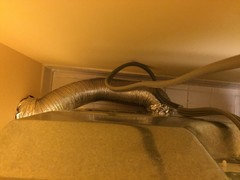
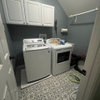
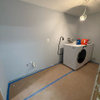
    Ok! Good thoughts, thank you. So I did already clean the sensor (i.e. that chrome equal-sign item in the drum) with rubbing alcohol. Tumbles fine; had a very clattery quarter in there the other night and I know that's working. :) When I had the dryer vent cleaned and the vent tubing replaced, the dryer vent guy sucked out the machine as well and checked it with clothes running and said I had good air flow. And yes, when I said vent tubing I meant that the previous installer had put in that chintzy mylar looking stuff and I had it replaced with aluminum flex. The vent goes out to the roof (2nd floor) and I think that is because the laundry room is in an awkward corner where the main part of the house meets an ell (pic below; laundry room is in the main part of the house to the left of the dormer). Interior vent pic attached also.

    I'm going to guess then that it's a coil or temp sensor or voltage problem then. Will report back.


  • 9 years ago

    That duct arrangement behind the dryer looks OK. No sharp bends or crushing.

    So .... your vent-cleaning-guy went up on the roof and checked the airflow at the end? He examined/cleaned the ducting inside the wall, through the attic, to the exit-point? Or no?

    (Friend has her laundry room on the 2nd floor, ducted to the roof. She found upon moving into the house that the ducting was disconnected inside the attic so all the lint and moisture had been blowing in there. There wasn't an obstruction ... just a bunch of lint in the attic ... fire hazard and the moisture exposure is also b-a-d.)

  • 9 years ago

    Ok so that question just sent me scurrying up to my attic. I didn't see a blessed thing up there. The technician wasn't able to find the vent on the roof because the roof is really steep but I wasn't able to see anything internally. So I found the inspection report from when we bought the house (we moved from California to Virginia and I wasn't involved in the inspection on site) and found the exterior dryer vent, which is on the other end of the house and goes out the basement wall (because that makes sense). So I would guess that the dryer vent is about 40 feet long. So I just called the dryer vent people back. We'll see if that does the trick! And maybe I will have to re-run the line to a less attractive location to save my clothes. Sometimes it's easier to blame the robots. :)

  • 9 years ago

    Basement wall ... sounds like the exhaust hood is accessible at or near ground level. Turn the dryer on and go check the airflow so you have a reference before the vent-guy gets on it again. :-)

  • 9 years ago

    When we bought our house 16 years ago, it had a vent something like that. The vent was never going to work well, and was going to waste a lot of time and electricity, as well as posing a fire hazard. An electrician found an alternate venting path. The replacement vent runs into the floor, along the ceiling of the unfinished basement, and out near the bottom of an outside wall. The outlet is really too close to the ground, but we've lived with it. If I had that situation now, I would seriously consider Whirlpool's full-sized heat pump dryer, which is unvented. From what I've read, heat pump dryers aren't so bad. Whirlpool's also has a fast mode, which supplements the heat pump with a heating coil. This isn't an endorsement, as I have haven't used the product myself, but I like the idea. Will probably get one the next time I need a new dryer.

  • 9 years ago

    Your duct line might be too long. Each 90 degree turn of ducting = 5' of run. Add up the turns + the straight runs + the exit vent (another 5' or so IIRC) and you have the adjusted length of run. Your dryer book should state what the max adjusted run for your dryer should be. My Miele maximum length is around 33', and the dryer only sits about 8' from the outside wall vent. My duct has 3, 90 degree turns (= 15'), without even advancing towards the exit. If your situation is a run that is too long for your dryer, then you can get a heat pump as Suburbanmd mentions (or condenser dryer), or get an inline fan to help assist the vented dryer. I offer this as a point to consider, and admit I am not an expert.

  • 9 years ago

    I would see about getting a booster fan for the vent. They make them just for this need and will blow everything out better. Used to, there were some dryers that had "long run capability" but haven't seen one advertised in a while. I think it was GE that had one model, there may have been other brands too. I would just add a fan somewhere down the line for the extra push.

  • 9 years ago

    I miss the fast drying time of my vented dryer, and in the pit of the summer I don't exactly love adding more heat to my bathroom, but the feel of clothing and towels coming out of a condenser dryer is really much better (as Larsi says). I've cut way back on FS use, and probably could get eliminate it entirely if I didn't like the fragrance.

  • 9 years ago

    I have the Fantech booster to hasten my drying times, and I really like it. With that long run of exhaust, I think you might need it. They are inexpensive and easy to install. There are two electrical options. It comes ready to hardwire, but I had my electrician put a plug on it, and install an outlet nearby. With these modern dryers that don't get as hot as they once did, it really has helped.