Software
Houzz Logo Print
ryan_calhoun

Replacing Bradford Pear

I am in zone 9a. I have two 20 foot tall Bradford Pears in my front yard that I am planning to remove after much debate. I am looking to replace them with another shade tree of moderate to fast growth. I was thinking about red maple (acer rubrum), I have two of them in my backyard and I love them because they grow crazy fast, but I'm worried that their surface roots will wreak havoc on my larger underplantings (1 large glossy abelia and 4 pittosporum). I was also considering one of the red oak species like quercus texana, quercus nutallii, or quercus shumardii. So I'm looking for some input. Does anyone know if red maple can deal with that much competition? Has anyone planted any of the red oaks? What is there growth rate truly like? How long would it take for them to reach the height of my Bradford's (20 ft) if I started with 3-4 ft saplings? Are there any other species I'm maybe neglecting?

Comments (13)

  • 10 years ago
    last modified: 10 years ago

    Red oaks are a great choice. As far as growth rate, it will depend on a few factors. I planted two, from 10 gallon containers, 12 yrs ago ... they're a little over 20 feet now. Great shade and fall color.

    Bur oak is my personal favorite. It's taller than my reds (planted the same year), and is such an easy keeper. No fall color to speak of, though, if that's a consideration.

    My Bur is planted in an island bed with several shrubs, including two large Cenizos, and perennials ... everyone gets along great. :)

  • 10 years ago
    last modified: 10 years ago

    Maples aren't very suitable for under-planting, once they reach enough size. And the two shrubs you mentioned are sun lovers.

    There might be something for you here:

    http://texassuperstar.com/plants/index.html

  • 10 years ago
    last modified: 10 years ago

    Your shrubs listed would be fine with some shade from our brutal Texas sun, Ryan. I have abelias and pittosporums -- some in mostly shade, some in full sun. Both happy and thriving. My Edward Gouchers bloom just as much in shade as in full sun.

  • 10 years ago

    I think I've ruled out maple in favor of a red oak species. Any opinions on Shumard vs. Nutall? I've head Nutall grows faster but Shumard seems to have a little bit slimmer of a profile,

  • 10 years ago

    Never met a quercus i didn't like and you certainly have many choices. I think my main consideration would be visualizing as best as you can how it would look at maturity. A tree that gets so big or wide that you can't see the house is no good. A tree that produces a Gillion seedlings, encouraged by moist soil would be another consideration. TAMU website such an excellent data source.

    I grow pittosporum in bright shade and shrub doesn't get enormous and looks good. Also grow it in full sun and grows well w/o burning but needs pruning based on my plantings in that specific area, unpruned it would swallow nearby plants.

  • 10 years ago

    I'm not as worried about shade as I am about roots. I have plenty of neighbors with pittosporum growing just fine in the shade of their taller trees, and if I limb them up when they get a bit larger, the shrubs will still get light on my south facing lot. I need something that can withstand root competion and not damage existing underplantings. The two trees would be placed fairly close to each other and very close to the shrubs. (And yes I realize this will limit their growth, but it will help to maintain the aesthetic.) I just want something that can grow tall, is a medium-fast grower, and has a fairly upright growth pattern.

  • 10 years ago

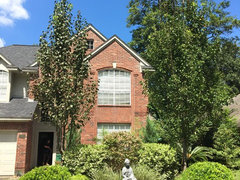
    Here is the sight. The Bradford's are 12ft apart.

  • 10 years ago
    last modified: 10 years ago

    Many oaks are somewhat marcescent, but some in the red group in Texas can be especially so. Our Shumard holds its dead leaves until the live oaks start dropping theirs... and relatively few are knocked off by winter wind, rain, snow, or ice. A couple Shumards in our neighborhood are like this, but others not so much; so degree can vary by tree.

    Just a potential characteristic to consider. It's one I've come to appreciate, but bothers some - especially if they're expecting to catch more light when leaves are supposed to be down over the winter. Might be able to avoid depending upon where/when you select your specific tree.

    Don't know how strong this runs in Q. texana or buckleyi.

  • 10 years ago
    last modified: 10 years ago

    I don't like Bradford pears but as I see your pic, all I would do is remove one by front door and not add anything. I may also remove green shrub in front of b. pear to increase front door visibility, at least prune to 1/2 its present size. The other one looks nice and goes well w/ what you have.

    Im one of those people that do not like landscaping that blocks windows, it robs me of interior light. But if it doesn't bother you, then neither here nor there.

    ETA: B. pear is not an "investment" tree so I can understand your desire to replace it with an oak. But I still think you only need ONE.

  • 10 years ago

    Both keep getting fungal infections each season and drop leaves very very early, growth has been stunted and the one on the right has lost its shape.

  • 10 years ago

    I agree with bossy. Regardless the type of tree you chose, I would keep only one (on the right). It would frame the house instead of obstructing the view of it. Just an opinion.

    Omar

  • 10 years ago

    As for the blocking the house. This is not a problem. In fact in my area this would be seen as a plus. My community is nicknamed the livable forest, and the appeal of the area is the effect feeling like you are living among the trees. My next door neighbors on each side have 4 and 6 mature oak, sweet gum, and ash trees respectively. Loblolly pines grow in abundance up and down the street, and some of my neighbors down the street have as many as 12 trees in their front yard. I am one of 3 houses on my street that does not have 2 or more mature trees in front of the house. It is the aesthetic of the area. Most houses hide behind the trees.

Sponsored
Haus Studio
Average rating: 4.8 out of 5 stars28 Reviews
Franklin County's Preferred Custom Cabinetry & Design Studio