

Should I pot-down an overpotted Schefflera?
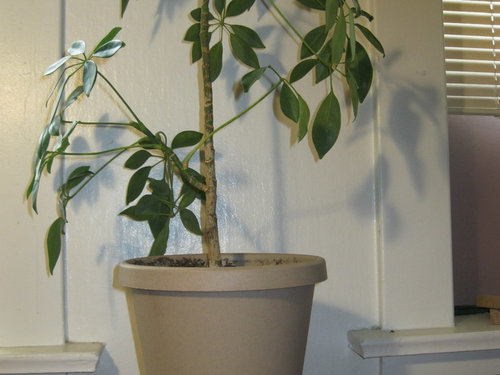
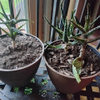
Edited to add another pic of the pot.
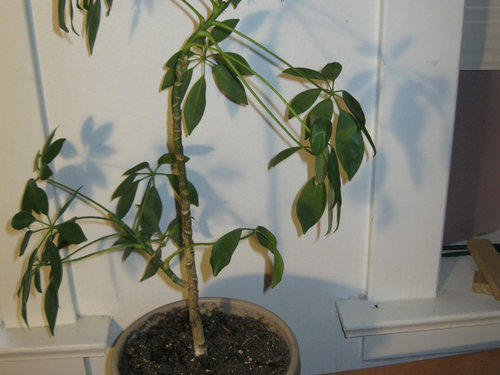
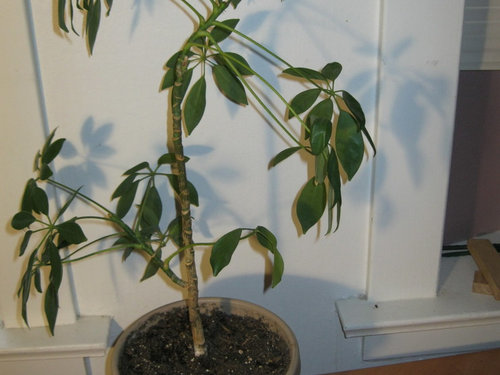
The patient is a small leggy neglected Schefflera grown from a cutting in a 6" pot that was about 1/2 filled with standard Miracle Grow. Don't ask why; let's just say I have many amends to make for the inhumane treatment I've given my plants for the past few years.
Anyhow, about 10 days ago, before I found these forums, I decided to try to do something about it. I thought the roots must certainly be crowded, so I moved it into an 8" pot with the same MG. It turned out the poorly developed roots only took up maybe 1/4 of the 8" pot, but I blithely potted up anyway, not even spreading the roots out, and wet the MG down. As of today there's no sign that the plant even knows that anything happened.
The problem is that ten days later the bottom of the pot is still extremely wet (doh!!), because the little guy's little roots aren't taking up nearly enough water to let the soil dry out and get any air at all in there (double-doh!!). And I've learned here that the plant's energy reserves are probably very low from neglect; even if more light and some fertilizer help it through the winter,
it's going to be a long time before it's big enough to use all that
empty wet space around it.
I'm tempted to move the plant back to
the 6" pot, which is almost surely big enough for its current growth. I
didn't mess with the roots when I potted up, just plopped them into a
hole in the potting mix. As of today the leaves look just fine, so I
think I could move it back, so long as I didn't disturb its nether
regions.What do you think? Am I deluding myself? Should I leave
it be, cross my fingers, and hope my little guy makes it through the
winter and spring? Or should I down-size the pot--and still have to
cross my fingers and hope for the best?
Lenore
Comments (38)
 10 years ago
I think it's a fine sized container, although I'd recommend a more porous potting mix.
Josh

litterbuggy (z7b, Utah)
Original Author10 years agoIt looks like a big plant, but if you look closely you'll see that all the branches are mostly bare, and the roots take up maybe 1/5 or 1/4 of the pot. That means a lot of wet water-retaining soil just sits there blocking air from getting to the roots. At this rate it could be 3-4 weeks before the soil is dry enough to water again, which makes root rot a real probability.
I can hardly wait to get rid of the MG. As I said in my post, I'm repotting everything into 5-1-1. The thing is I don't want to do that until in early summer because from everything Al says, now is just about the worst time to repot, and this plant is already stressed. That's why I'm trying to find an interim measure to give the plants a chance to build up reserves before repotting..
Related Professionals
Wilmington Landscape Architects & Landscape Designers · Springfield Landscape Architects & Landscape Designers · Albuquerque Landscape Architects & Landscape Designers · Salem Landscape Architects & Landscape Designers · Rome Landscape Contractors · Gary Landscape Contractors · Bozeman Landscape Contractors · London Landscape Contractors · Dalton Interior Designers & Decorators · Hopkinsville Interior Designers & Decorators · Lafayette Interior Designers & Decorators · Florence Interior Designers & Decorators · Norfolk Interior Designers & Decorators · Grand Forks Interior Designers & Decorators · Pocatello Interior Designers & Decorators 10 years ago
I've not had good results from waiting to improve the conditions of an unhappy plant. Fixing an unhealthy circumstance is totally different than disturbing a happy plant to keep it that way.
litterbuggy (z7b, Utah) thanked Tiffany, purpleinopp Z8b Opp, AL 10 years ago
Second what Tiffany said. When it seems something is wrong, I've learned to act immediately. Mainly because I figure that if I can see it at the surface level, there is probably a lot going wrong down below that I can't see.
 10 years agolast modified: 10 years ago
Yeah-24 hours can make the difference between a saveable (savable)? plant and a dead plant. Fast and immediate action is most important in attempting to rescue a sick plant. If it's getting sicker and sicker where it is, it probably won't just magically get better if you decide to leave it to its own devices. You're going to have to get to the plant, find out what's wrong, and correct the mistakes. (From experience and from posts I've read)
 10 years agolast modified: 10 years ago
Salvable would be my word ...... ;-)
I have to go against the grain and say I'd wait. That you know your plant is potentially over-potted is half the battle, empowering, actually. While it's true you can't water correctly w/o the likelihood of the soil remaining wet long enough that root function/health might be jeopardized, you CAN water in sips and flush the soil a few times before repotting at a time that is more favorable.
If you DO prefer to water correctly each time you water, the plant's not so cumbersome you can't water/flush the soil at the sink. If you employ a wick through the bottom at the edge of the pot, and tip the pot at a 45* angle until water stops dripping off the wick, you shouldn't have any significant water retention issues.
The way I look at it is, if I was the plant, would I rather be repotted now so everything is great in the rhizosphere - my home, but recovery slowed due to timing; or would I rather remain undisturbed until a better time to repot, knowing the grower can fix for the short term the tendency for my home to remain too wet for my own good?
Since either course 'fixes' the water retention issue, I look to what effect either action would have on the plant. I'd bet that, repotted now, the plant will have much less mass come June than it would have had if you waited and resolved the water retention issues temporarily by means other than repotting.
Many would expect that I'd be all gung ho about anyone itching to move a plant into 5:1:1 or gritty mix, but I don't think that way. It's your call. It's not like I'm saying repotting now presents a serious risk, only that I think your plant would be better served by addressing the issue at this time by stratagems other than repotting, and repotting next early summer when recovery time is more likely to be measured in weeks than months.
Edited to say: Crap! I should've paid more attention to what you said instead of scanning and hoping I caught the gist. Moving the plant back to the pot it was in (I missed the 10 day part) represents no issues of any significance at this time, as a repot would. If you want to, go for it. However, you might consider leaving it in the pot it's in and replacing most (but not all) of the soil in the bottom 6" of the pot with ballast. This remedies any over-potting issues and still gives roots plenty of room to run. Your plant will like it.
Al
litterbuggy (z7b, Utah) thanked tapla (mid-Michigan, USDA z5b-6a)- 10 years agolast modified: 10 years ago
LB - Given tons of light, the response may or may not be favorable. Jane and I have had this "hot button issue" conversation over and over - at least 100 times (not an exaggeration) by now, covering at least 8 years and multiple fora. If a scarcity of light is the most limiting factor affecting vitality, MORE light will be beneficial. If lack of light is not the most limiting factor, more light cannot produce favorable results until such time as the most limiting factor has been eliminated and lack of light has again taken up the position of most limiting factor. More light can't cure limitations imposed by nutritional deficiencies, soggy soils, lack of water, herbicides, temperature extremes, phytotoxicities, insect predation, or herbivory; shingles, gout, and leaf aches are out too, as are other factors with a fitting place on the list ..... just ain't gonna happen. So to suggest giving your plant tons of light is sure salvation, or even that it will respond, simply can't be supported by science or reason.
More light is not a wholesale cure-all for every ailment that might befall a plant. Again, I'll refer readers to Liebig's Law of the Minimum, which essentially states that vitality or growth is not limited by the total amount of resources available; rather, it is limited by the scarcest or least available resource, whether that might be light, water, nutrients .......
Al
litterbuggy (z7b, Utah) thanked tapla (mid-Michigan, USDA z5b-6a) litterbuggy (z7b, Utah)
Original Author10 years agoAl said, "However, you might consider leaving it in the pot it's in and replacing most (but not all) of the soil in the bottom 6" of the pot with ballast. This remedies any over-potting issues and still gives roots plenty of room to run. Your plant will like it."
"Watering in sips" will feel weird, because just about the only thing I've done right has been to water only when a pot is dry all the way through (my cheapo analog moisture meter helps a lot). I can do it if it's a temporary measure, though.
I think you mean I should keep the schefflera in its current 8" pot and just replace the soil on the bottom of the pot with ballast...? It makes a lot of sense to me. Believe it or not, I was thinking along those lines last night. I'm glad I didn't get around to doing anything today.
So, what's ballast in the world of container plants? I picked up a bag of pine and fir fines at HD. It's not very chunky and has a fair amount of shredded stuff in it, but it should surely retain less water than that miserable Miracle Grow if I spend some time picking out the really fine stuff. What do you think-- should I use that, or would something faster be better?
As far as light goes, more is on the way because I've finally admitted to myself that this apartment doesn't have nearly enough light. Plants just need a lot more than they can get from the partly shaded east facing windows in the living room, which is the best indoor natural light I have. The plan is to mount swing arm lamps with bright CFLs to shelves running across the windows unless I can think of something as cheap that won't look industrial.
- 10 years agolast modified: 10 years ago
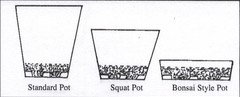
I don't think I'd ever used the word 'ballast' as part of the guidance passed to those growing stuff in pots until it became important to make clear that whatever word was used, it was meant to represent something quite different than a drainage layer. When we have a soil that holds more water than we like, drainage layers work against us and ballast works for us. All 3 images below show clearly that the ht of a perched water table will be the same, using any given soil that supports perched water and no matter what the size or shape of the container. Some of the images also suggest ways excess water can be forced out of the soil by utilizing simply physics. In the second image, tipping A to position B removes at least 2/3 of the excess water. Figure D is a form of ballast. Ships take in water as ballast to displace air and make them heavier/more stable. In our case, we use objects or material that don't hold water to displace soil located below the upper limit (ht) of the PWT at container capacity (CP = when soil has been completely saturated and has just stopped draining). In the 3rd image, you can see the 2 bricks reduce the volume of (displace) soil that would normally saturated at CP, which means they have reduced the volume of excess water that is certain to be limiting. The idea is, to use ballast to reduce the amount of soil in the part of the pot that CAN hold perched water. We can effectively reduce the volume of soil that CAN hold perched water in any pot to practically (but not quite) nothing.
If we filled the bottom of the pot completely with material, as in a "drainage layer", or ballast, water would simply perch in the soil above as represented by the middle pot, 3rd image; but, if we leave only a single continuous soil column (it could be a crack between bricks or plastic blocks or whatever we're using as ballast), as long as it's a continuation of the main volume of soil, extending from the lower level of the main soil volume to the bottom of the pot in an unbroken/continuous column, we've essentially eliminated all but the tiniest volume of PW, which will reside ONLY in that tiny column.
Imagine a doughnut-shaped, hollow piece of plastic, that fits snugly against the sidewalls at the bottom of a round pot, flat on the top and bottom, a .5" hole in the center, and tall enough that it equals the ht or is taller than the PWT the soil being used supports. With that disc or doughnut in the bottom of the pot, the ONLY soil capable of holding perched water would be the soil that settles into the .5" hole, so almost none.
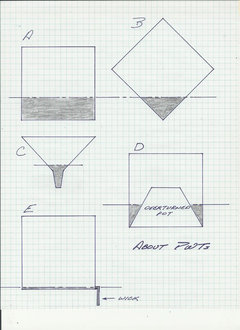
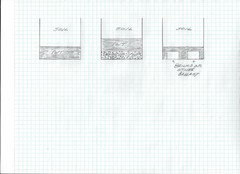
Judicious use of ballast (not "drainage layers") has the potential to save millions of plants by turning practiced killers into growers. ;-) It doesn't resolve issues like reduced aeration due to small particle size or soil compaction, but those issues aren't usually as immediately life-threatening as a continuously soggy soil.There you have it - a cure for the common water surfeit in container media.
Allitterbuggy (z7b, Utah) thanked tapla (mid-Michigan, USDA z5b-6a) litterbuggy (z7b, Utah)
Original Author10 years agoGot it! I've read that piece at least three times but failed to put two and two together. I'll pick up some tall paper cups to figure out how deep the PWT, and hunt for something appropriate for the bottom of the pot.
I was surprised how much water drained from my plants when I tipped them as much as I could. The MG still stays wet, just not as soaked as before, but the plants with better developed roots and crowns are taking much less time to dry out after being flushed, which is what made me realize that this plant might need help.
Meanwhile, after almost two weeks of attention, the other plants are responding well to being flushed and getting some diluted fertilizer, pinched growing tips for the two ficus, and being by the windows. The big rootbound ficus is trying some backbudding, the little less-rootbound one is putting out a ton of tiny new leaves, many a few inches behind the ends of their branches, and the dracaena is pushing out its long ribbony leaves about as fast as I can count them. Neither of the two schefflera shows a dramatic change (and may not until they've been repotted), but they stopped dropping leaves a few days after being moved to a window, and I can almost hear them sucking up light and nutrients. Soon enough I'll be pruning frantically the way I had to when they tried take over in the bright sunlight of my old apartment.
So thank you, thank you, thank you, Al and the other wise GardenWeb-ers who've helped me with my little green friends.
- 10 years ago
I'm not sure if you made a lot of progress in a hurry once here or if you arrived already equipped with a good set of tools, but I can see you're well positioned for results you're sure to be happy with. It'll be fun watching you grow if you hang with us for a while.
Al
litterbuggy (z7b, Utah)
Original Author10 years agoI think it's a willingness to admit that what I'm doing isn't working and being able to visualize how new information fits with my own experience and observations. For instance, knowing that my plants have done best when their soil gets dry before watering makes the idea that fast draining media is excellent for most plants pretty persuasive.
The willingness to be wrong is probably the main thing, though. There's a saying to the effect that you can't pour water into a full cup...or something like that.
litterbuggy (z7b, Utah)
Original Author10 years agoOh, and I think a background in the sciences doesn't hurt.
- 10 years agolast modified: 10 years ago
I agree that the willingness to be wrong, when wrong, is very important to anyone who wants to learn OR teach. Lol - if I'm wrong, I only want to look stupid once. In settings like this forum where someone is interested in helping, credibility is our main selling point, so there's little sense in destroying it by being wrong over and over - especially on a singular point.
Al
litterbuggy (z7b, Utah) thanked tapla (mid-Michigan, USDA z5b-6a) litterbuggy (z7b, Utah)
Original Author10 years agoOkay.
But of course!
I've been the expert in the room, I've been the rank beginner learning first principles, and I've been the expert who gets schooled when what I knew didn't work.
As time goes by I find that what really appeals to me is learning--which includes being able to decide when a 'teacher' is reliable and when it's time to find a new source. As you can tell by now I love to share what I know to help others out, but I don't miss the weight of the responsibility that came with exercising my expertise.
I think you strike a great balance, Al, and I hope to learn more from you in my quest for a greener life!
Lenore
- 10 years ago
Of course I was teasing you. I enjoyed some of the nimble-witted stuff you've come up with and look forward to more when/if our paths cross. Actually, I'm noticing an influx of of bright people over recent weeks that are certain to add extra fun to the the plant parlance we share.
Al
litterbuggy (z7b, Utah) thanked tapla (mid-Michigan, USDA z5b-6a) litterbuggy (z7b, Utah)
Original Author10 years agoFinally got around to 'repotting' the schefflera today. This consisted of removing the plant and soil from the pot, placing three 3 1/2" tall jars upside down in the bottom, adding soil between the jars to create columns that reached the bottom of the pot, and replanting the schefflera above the layer of jars. Afterwards I watered it thoroughly with the diluted fertilizer solution I gave all the plants a few days ago and tilted the pot to drain as much water a possible. Hopefully this arrangement will be enough to keep the PWT below the roots.
Here's how wimpy the roots are, especially considering that the schefflera was in its previous pot for about three years. The shiny thing in the picture is the bottom of a jar. There's no root ball, only a long thick root and the newer white roots lying below it.
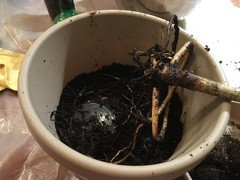
Doesn't it remind you of all those "after" pictures of pruned roots? I almost regretted not having any 5-1-1 to put it in, but by that point I could hardly ask it to wait a day for me to sort out enough bark from the mediocre bag I picked up and pick up some perlite and peat.
I wish I could fast forward a couple of months to see if I get a visible response right away! Sure, it'll take some time for the roots to colonize the soil, and it's still in that nasty potting soil, but I've been so worried about the little thing that it would be amazing if it popped a leaf or two for me.
Thanks everyone, and especially Al, for all the advice and encouragement!
litterbuggy (z7b, Utah)
Original Author10 years agoIt turned out the plant was top-heavy and root-poor enough that it wobbled all over the place. This was a problem because it will get moved to and from the window regularly until I have another source of light for my plants. Instead of packing the soil down around the stem as I've done in the past I got advice on supporting it by briefly hijacking another thread. Here's the result:
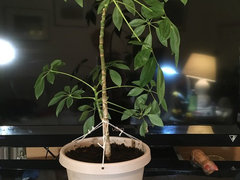
It doesn't look like much, but the stem is completely stable now, even though the string stretched out a little. I may replace the string with some static nylon cord that's been cleverly hidden in the garage, but I feel much better now that the roots will have some peace and quiet to stretch out a bit.
I do need to work on my knots, though. I went through a ton of string just working out how I used to tie things down with a few simple knots.
litterbuggy (z7b, Utah)
Original Author10 years agoThanks again, Al. That's pretty much what I did, except that I've never been able to remember the bowline knot, probably because a loop with an overhand knot is such a great cheat. I need to find my nylon cord, though, because that limp slippery string is fine for tying a roast but makes my fingers feel like sausages when doing just about anything else. Grr!
But back to plants. Because my little schefflera was flushed and probably got more water than it should have while being replanted twice in the past three weeks, I'm eager to dry out its soil as quickly as possible.
Now that the weather is cooler the temperature in here will usually be 65 degrees at most, so I was thinking of putting the plant on a heating pad, at least at night, assuming I can find one that doesn't turn itself off after half an hour. Do you think it would help dry the soil above the ballast? Or would it encourage bad things to happen if it got a little steamy inside the pot? And do you think that the apartment's temperature will be a significant limiting factor for my plants (dracaena, ficus, and schefflera)?
Anyway, I always appreciate the way you freely provide practical advice to those of us who are bumbling along toward responsible plant stewardship. So thanks once again for being there!
Lenore
- 10 years ago
I appreciate the kind words, L. If I can muse a moment - lots of people pass through the forums. For a number of quite varied reasons, the personal rewards associated with helping different people vary, too. For instance, it's much more rewarding to try to help you than it is to try to help the grower who wants to be spoon-fed information and then turn the exchange into a debate. Lately, this and the container gardening forum have attracted several new participants who many of the rest of us are at least a little more inclined to go out of our way to help. I wish I knew if this was something people who help actually think about, or if it occurs in the subconscious for the most part. I do know that it does occur - we're profilers all, at least on some level. The short of it is, you offer kind words to me, but it's people with enthusiasm and a need to learn, not just be told what to do, that are the most fun to help.
You shouldn't have to worry about moisture above the ballast because there shouldn't be any perched water that high in the pot.
It's easy to get rid of excess water in established plantings that are root bound. Just depot the plant and set the soil/root mass on a few newspapers, paper bag, or an old towel or two folded in halves or thirds or whatever it takes so you maximize the layers but the end product is still larger than the soil/root mass. For less established plants that have soil/root masses that won't hold together as a unit when removed from the pot, using a wick and tilting the pot is your best bet - unless the pots are small enough that you can hold them in your hand(s) over the sink & move them up and down after watering. This works remarkably well for small plants and will get rid of all the perched water in the pot. I would urge everyone who hasn't tried it, to try it - just so you can see how well it works if you (ever) need it. Hold onto the pot, move it down toward the sink, then sharply reverse directions so the pot is moving upward. At the transition between moving down to moving up, the water in the soil will want to keep moving downward (Newton's First Law of Motion), so it will exit the soil. After a few repetitions, no additional water will exit the hole which is indication you're pot is drained of excess water or you're not being forceful enough. The sharper the reversal and faster the movement of the pot - the greater the volume of water removed.
A heating pad would be helpful, but brings with it a much greater potential for mites because of the local drop in RH. The distance between molecules of the warmer air becomes greater as they are excited by the warmth. This leaves more room for moisture between molecules, which is the same as saying it lowers RH. Mites like dry air, so be thinking propagation mat + a room humidifier if you want to reduce potential for a mite issue. Too, plants do significantly better if the dark period temps are at least 10* lower than day temps, so make sure you put it on a timer that roughly coincides with day length; or, if you're using supplemental lighting, the mat should go off about an hour before lights go off and back on about the same time supplemental lights come back on.
Allitterbuggy (z7b, Utah) thanked tapla (mid-Michigan, USDA z5b-6a) litterbuggy (z7b, Utah)
Original Author10 years agoWow, Al, what a great idea for pulling excess water out of rootbound plants! I'm going to try it on my big ol' schefflera ASAP. I didn't appreciate its condition until I tried to get a wick in a drain hole and found that the soil on the bottom has been replaced by a mass of roots. Erck!!
litterbuggy (z7b, Utah)
Original Author10 years agoIt's going to take a while to get used to the idea that a plant can be okay if its soil stays damp. I totally get the science behind it; I'm just habituated to worrying about wetness in MG. Funny how those habits of mind hang around!
- 10 years ago
I learned about wicking from Al, and it has been a lifesaver for an overwaterer like me. I wick all my plants now.
litterbuggy (z7b, Utah)
Original Author10 years agoI got to practice my pot-drainage skills after fertigating last week. Tilting them (which worked well because the pots have holes all around the perimeter) and doing the gravity trick over the sink produced a lot of water. Then I inserted wicks into some of the pots that still seemed heavy, and they got soaked but didn't drip at all. I assumed that meant the PWT had drained off; I hope i was right!
- 10 years ago
Hiya litterbuggy,
i think the wicks should drip water. If they get soaked, they should start dripping water immediately. What did you use for wicking?
L
- 10 years ago
If the wick has greater capillary attraction than the soil, the wick can become moist or soaked. Whether or not water drips off the end of the wick depends on whether or not the weight of the vertical water column acting as a downward force is greater than the capillary attraction (adhesion + cohesion) of the soil.
Al
litterbuggy (z7b, Utah) thanked tapla (mid-Michigan, USDA z5b-6a) litterbuggy (z7b, Utah)
Original Author10 years agoI think that's what happened, Al. I don't know what my synthetic mop is made of, but the strand I cut off instantly soaks up water, so I doubt the material was the issue. Like I said, tilting the pots made them give up a lot of water--at least three cups from the largest one--while they were tilted at 45 degrees toward one side and then the other, so it wouldn't be surprising if the downward force of the water column after tilting was greater than the capillary action by just enough to soak a wick, but not to drip.
Next time I water I'll wick before tilting to see whether one is more effective than the other. Science!
- 10 years agolast modified: 10 years ago
J - Imagine a potato in a lever-operated French fry slicer. The cutting blades are akin to the forces that want to hold water in the soil (adhesion of water to substrate surfaces and cohesion - the force that bonds water to itself). Together, these 2 attractions make up capillarity and are why your bath towel or face cloth remains wet instead of all the water falling on the bathroom floor after your post-shower dry-off.
If it takes 5 units of force pushing down on the lever to overcome the resistance of the potato-cutting blades, 4 units won't cut it because the blades resist that amount of force. Increase the force on the lever to 5.1 units and slicing of the potato will begin and continue as long as the amt of resistance doesn't change. The potato, being slightly round, will soon resist slicing as the linear pressure on the blades exceeds the downward force on the lever (because the potato is wider in the middle, it takes more force to cut through the middle than the rounded beginning or end parts).
Perched water is like that. If the resistance of capillarity is 5 units, and the weight of the water column pressing down is also 5 units, water stops moving downward. Adding a wick or a second pot increases the distance from the top of the PWT to the bottom of the soil or wick, so water moves into the wick and is forced downward by the gravitational force of the PWT, and the wick won't stop draining until stasis is reached (the forces are equalized). Once stasis is reached and drainage halts, adding more water to the pot increases gravitational flow potential and the water starts to flow again.
Al
- 10 years ago
Wow, thank you, Al. I had to reread it through my flu-filled haze, but the visualization really, really helped a lot.
And thank you for taking the time to explain that to me so patiently.
litterbuggy (z7b, Utah)
Original Author10 years agolast modified: 10 years agoA brief update: with its small root system I really didn't expect this plant to do anything until it had some time for the roots to grow, but I just found a tiny little leaf at the tip of the taller stem. It just happens that this was the first plant to get fertigated with the FP I got from Amazon five or six days ago--coincidence? Because of the ballast the soil takes less than a week to dry, so I'm watering it just like the rest of my plants. I also put up two more daylight bulbs so each plant gets even more supplemental light.
No pics because the incipient leaf is too tiny to capture with the iPad. It's cute as a button, though!
litterbuggy (z7b, Utah)
Original Author9 years agolast modified: 9 years agoOops, my before picture didn't make it into the post, so I'm adding it to make it easy to compare.
Time to share before and after pics of Baby Scheff. Just a few months ago I thought I'd be lucky if the poor sickly thing got healthy enough to take cuttings from, but now it's clear this will be a lovely plant after a repot and some judicious pruning.
Before:
And after:
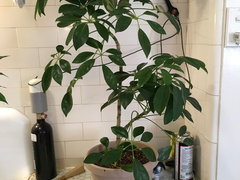
I can't recommend Al's ballast technique strongly enough. With it the Miracle Gro Moisture Control soil drains and dries up as fast as the pots with 5:1:1 mix, and given that tilting the pot after watering produces no drainage, it appears that the pot retains almost no perched water.
Between late March and a few weeks ago there were at least three tender new leaves at a time on each branch, but growth slowed down this past few weeks while I've concentrated the supplemental light on Big Scheff and a frail ponytail palm. Still I'm delighted, and can't wait to get to business next month!
Thanks again to Al, Dave, and everyone else.












tapla (mid-Michigan, USDA z5b-6a)