

Advice needed for Eastern Hemlock.
7-16-2016
Hello,
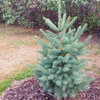
I purchased an 18" container grown Hemlock with the hopes of growing it into a yard tree. Planted middle of last July in black sandy loam of my back yard. It's very healthy looking and has grown nicely.
After further review, I think it was started as a shrub as there is one main leader and a competing leader half it's diameter and a couple of smaller ones splitting off at about 6" off the ground. The main trunk is about 3/4" dia. with the main leader at 1/2" dia. and all the branches are bushy like it's been pruned a lot at the nursery.
I tied up the main leader to a dowel and it looks like it's hardening off for the winter.
My question is: Can I prune off the secondary leaders, next spring, with hopes that this plant can be redeemed to grow as a tree? I'll try to attach a picture of when I first planted it. It is quite a bit taller and wider now (over 2ft high).

Comments (56)

User
Original Author10 years agoI really have no idea. It looks a lot like "Beehive" but it's grown so much already I'm thinking that it's faster growing than a bush that only gets 3'x3' after many years.
Usually, the cultivar name is on the tags from the places you buy them. All mine says is Tsuga Canadensis.
This all started with the wild idea to plant only trees that are native to Minnesota in my new yard. So after planting specimens of Northern Red Oak, , Pin Oak, Norway Pine, Black Spruce, Northern White Cedar, Balsam Fir, Eastern Red Cedar, White Pine, Paper Birch, Red Maple, White Spruce, Black Ash, Sugar Maple, Bur Oak and Green Ash, I saw on the DNR site that Hemlock was also considered "native". Then After I read how rare they were and fussy about where they grow, I kind of gave up on the idea. Then I saw these beauties for sale at Menards the beginning of July and figured I hit the jack pot. LOL. Oh well, It seems to like it here.
I'll try to post some close up pics later today, if the rain stops.
Thanks for all the expertise opinions!
 10 years ago
If I were to guess I'd say it looks like Tsuga canadensis 'Monler'/'Emerald Fountain'. I see them at Stein's and Menard's quite often. The $19.95 price is very good if that is what it is. On the other hand, if the leader was cut it may look more dwarf than it really is and will sort things out later.
tj
Related Professionals
Orange County Landscape Architects & Landscape Designers · Saint George Landscape Architects & Landscape Designers · El Dorado Landscape Contractors · Bainbridge Landscape Contractors · St. Louis Landscape Contractors · Fort Dodge Landscape Contractors · Grand Forks Landscape Contractors · Amherstburg Landscape Contractors · Jacksonville Home Builders · York Home Builders · Chicago Home Builders · Lewiston Home Builders · Kalispell Home Builders · Honolulu Home Builders · Chatham Home BuildersUser
Original Author10 years agotj, that would be cool if it was straight species and it would make my day, probably my whole year! lol
 10 years agolast modified: 10 years ago
The very tops of hemlock-growth always "weep". That will straighten up next year, but the new growth will again "weep".
User
Original Author10 years agolast modified: 10 years agoI think it's the straight species.
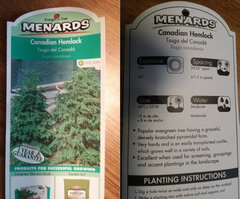
It's still raining but I found the tag from Menards out in the garage.
1) The front the tag has a picture of 2 trees in front of a house with the wording "Canadian Hemlock" (no other description).
2) The back side of the label has a height of 40'T x 25' W. and to plant 20'-25' apart.
But I can't get too excited because we can get very cold here during certain winters. The last several winters have been somewhat mild but we always have the possibility for the temps to hit -25 and possibly colder during January. That's hard on shallow roots. It helps if we get snow cover before December.
 bill_minn_3b · More Info
- 10 years ago
I've seen hemlocks in places that have seen -40*. Mulch well, keep the mulch from the trunk, protect it from rabbits and deer and it will be fine.
tj
User thanked tsugajunkie z5 SE WI ♱ User
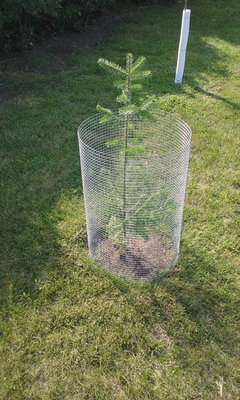
Original Author10 years agoWell thanks everyone! I just wrapped the bottom 6" of trunk with HD Aluminum foil, just in case some mice get an idea to chew the bark. And recently spread the mulch out from 4" to about 3" thick and left it a few inches out from the trunk. The mesh cylinder is 1/2" hardware cloth 24" high, staked down, to keep the cottontails at bay. I also can put a "lid" of hardware cloth over the top for deer. We live on the edge of town but we do get an occasional light deer browsing on some of the trees, so far nothing very destructive. And I think I'll wait until it gets colder before I add the burlap fence.
That's the challenge of having lots of small trees, it's keeping them thriving and undamaged for the first few years. Good to have some voices of experience to learn from about these things.
 10 years agolast modified: 10 years ago
Do you live in the Park Rapids-Wadena area? Headwaters of the Mississippi?
I have no doubt you'll keep that tree thriving for the first few years, but the test will be when it gets beyond the protection of its gardener. That is an open, wind swept setting that I'm not sure T. c. is well equipped for. It can handle the cold, but the combination of long stretches of bitter cold, drying NW winds, and bright sunshine may not be kind to it. Do you see T. c. thriving in similar conditions around you?
BTW, that is one awesome structure you've erected. :)
User
Original Author10 years agoYes, lived in the area for most of my life.
Haven't noticed any TC but have heard of some at the Brainerd Arboretum.
I recently visited the Hemlock Ravine by Jay Cooke park and got to see some mature specimens there.
I'm probably getting too long in the tooth to be planting trees. what happens to them down the road I'm not too worried about. Maybe by then the place will have recovered it's tree population and my windbreaks will have matured in size.
- 10 years ago
"I'm probably getting too long in the tooth to be planting trees."
Welcome to the club...and keep on planting! It will be a sad day when I'm too old to plant a tree. Hopefully my grand (great?) kids will wheel me out and put a spade in my hands. I used to quickly pass on articles in hort magazines about gardening when elderly, but I'm starting to pay attention.
- 10 years ago
If anything, planting trees well into your life may enhance your lifespan. I think it does, in that you have given yourself something to keep track of. And the other thing is, trees grow fast. This constant drumbeat about how "I'll never live to see.....blah blah blah...." is false. Trees we planted as recently as 2010 are making good size now up at our land. 50 Scheuttes oaks planted at a stormwater site, looked terrible, having accidentally dried out shortly after receipt in our holding facility, must have had good starch reserves in the roots. Through a long, fairly hot summer-we did have plenty of rain most of that time-these trees went from dead-looking to fully leafed out with a reserve set of leaves. They should now be set to go. Hundreds of tamaracks and white cedar also planted in and around some of our stormwater practices are up and growing. Everywhere I look, there are trees that I planted! This is too much fun.
User
Original Author10 years agolast modified: 10 years agoI agree. I still own land in the countryside and it's where I got almost all of the trees that I planted here. Talk about cheap entertainment! :^)
When we bought the place, there was 2 existing Arborvitae, one at each corner of the house and one small red maple that started from the side of a stump from the big storm of 2010. This Tsuga c. is the first tree I paid money for.
I'm now witnessing the 4 red maple, that were plant last spring, turn a brilliant orangey, reddish, peach color. Each of them put on new growth of 6"+ even though they were new transplants from the woods. Also there's small slip of a birch tree I planted 3 years ago at 2' tall that's now several feet over my head and the bark starting to whiten on the lower half. The balsam fir I moved from the woods last spring was a 2' high spindle, caused by the deer pruning the new growth off as fast as it could grow. The stubby branches are now bristling with many fat new buds ready to put on new growth next year. Yah, it's fun.
Here's a picture taken end of June of small spruce during it's 3rd summer here. I believe it's stretched out even more over the last few months. You can see the black ash in the left upper background and one of my "whip" red maples, recently planted (w/white tree tube) in back of that.
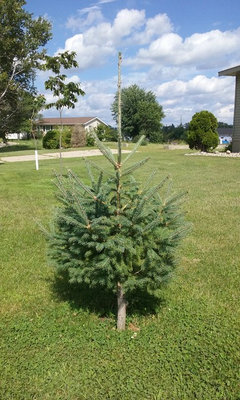
Balsam Fir earlier this summer 7/24/16.
User
Original Author10 years ago@maackia,
you said: "It can handle the cold, but the combination of long stretches of bitter cold, drying NW winds, and bright sunshine may not be kind to it. "
How does that go in areas that grow Hemlocks and have cold, like north east Wisconsin? Don't the trees get large enough to be above any protection of the surrounding trees? Do the tops suffer from winter die back?
The reason I ask is because when I was in Enger Park in Duluth MN. There was a 6" dbh Tsuga c. about 25' tall, partially shaded by a larger red maple. This tree was a stones throw from the lake, which I'm sure gets very cold and windy during the winter months. This tree looked great.
I'm kind of dumb about Hemlocks so forgive me if this is a stupid question.
User
Original Author10 years agoFrom what I can tell, Black Spruce. This particular one was maybe 12" tall and very full looking, growing as understory with mature Jack Pines. It grew 3" the year I transplanted, 8" the next and over a foot this year. They are the most abundant type of spruce in this area. We also have some White Spruce but they have a lighter green color, longer needles with cream color bark on new branches.
- 10 years agolast modified: 10 years ago
Bill, in discussing the hemlock tree in Wisconsin, you almost have to consider pre and post-logging era. Originally, hemlock was a primary, key species in this state. To cut a huge chunk out of this story, nearly all of this standing timber was felled and the bark was stripped off to be used in the huge leather tanneries in Milwaukee and surrounds. So what we see today is a remnant, nothing more. Nevertheless, in NE Wisconsin, hemlock is very numerous and in some cases becomes a super-canopy tree, overtopping most or all other species around it, often in the company of super-canopy white and/or red pines. Cathedral of the Pines just north of Lakewood is a great example of this type of stand.
You are right I think to be concerned about sweeping dry winter winds. It may winter-burn the foliage and depending on how bad, could seriously impact the development of the tree. I said I commonly see hemlock coming up on the forest floor where a shaft of light is streaming down, but these are nevertheless heavily wooded regions and wind is nearly a non-factor. I guess anything you can do to soften up the area-over time-will help too, such things as other plantings helping to cut the wind, that sort of thing.
User thanked wisconsitom - 10 years ago
"...often in the company of super-canopy white and/or red pines."
As usual, Tom expressed my thoughts better than I can. I think the key words are "in the company of." I just don't see this tree doing well on windy and exposed sites, especially in harsh conditions that your neck of the woods can throw at it. I may be entirely wrong about this, and I hope that I am, but the pictures you've shown looks very open. It will be very interesting to see how it does for you and I hope you'll provide us with updates as this tree progresses.
User
Original Author10 years agoWell, I'm into it for the long run now! lol:
Tree planting has been underway here with the city even providing free trees. Quite a few empty lots in the corridor but we're seeing houses pop up slowly as time goes on. I've been helping the neighbors with additional trees for their yards, maybe I can talk then into planting a few more. :)
Thanks again for all the information!
User
Original Author10 years agolast modified: 10 years ago" It will be very interesting to see how it does for you and I hope you'll provide us with updates as this tree progresses"
Thanks, I will.
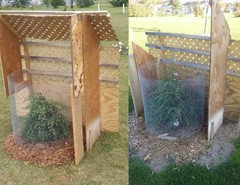
It's hard to take decent pictures with the sun angle getting so low. But just for fun I took these today, be 3 months tomorrow it was planted. Looks like it's ready to climb out of it's cylinder! Pressing on the sides all the way around.
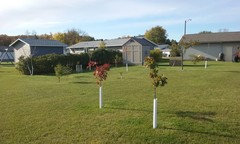
I measured the black spruce too, that new spire is over 16"L. Total height is 47", that's 3ft of growth in 3 seasons!Next is the south end of my yard, trapezoid shape makes the east side quite a bit longer than the west side. Lilac hedge full length of east and west sides. I planted about 1/4 length of the south edge, 2 years ago with 5 Red pine, one died this spring so I replaced it with the larger one at the right. Then added several more this year. I'm over half way across the south end with rp. Then a white birch and a couple different color lilacs.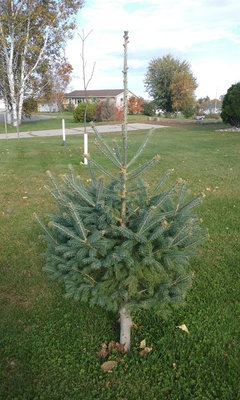 A couple Red/Pin Oaks after that, then a space to drive into the yard. A couple more spruce and an assortment of the other trees I listed earlier above. Probably be a "mini" woods someday.
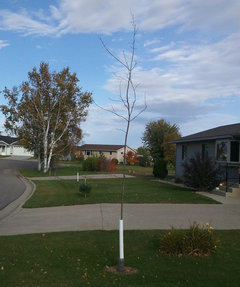
 This is the Green ash I planted 2 weeks ago between the neighbors driveway and mine. It's a little taller than the other trees I've dug, maybe 12-13ft? Hopefully it will provide some late afternoon shade during the summer.
 That's all for this year.
- 10 years ago
There are also a couple of large hemlocks on the east side of Lake Mille Lacs. They are near a fire tower, so I am not sure if they were planted or not, but they have been there a long time. I've been to Hemlock Ravine by Jay Cooke - cool places. There are planted ones in Duluth doing fine.
- 10 years ago
I'd have a back up plan for the green ash btw. EAB is killing all of them in the Twin Cities and moving fast.
User
Original Author10 years agoI've heard of the ones by Mille Lacs, seems like I read somewhere that they were planted. Eloise Butler planted Tc. in her famous Minneapolis gardens around 1911. I think they are some of the same ones that are by Theodore Wirth park and one of them is now the State Champ Tsuga.
I'm thinking that the biggest detriments to Tsuga c. this far west is a combination of precipitation or lack of and soil type & depth. The eastern (north) part of Minnesota has shallow topsoil, more silt/clay loams with bedrock underneath. It's also more "rugged" with ravines, valleys and hence more surface springs and seepage. It's not suitable for farming on a grand scale so it's heavily wooded. It's also an area that gets more misty, foggy, snow/rainy weather during the year. BTW: It was careless logging/slash fires that put an end to the Tsuga glory days in St. Louis county and other places in that area, not weather conditions. And these areas were considered "outliers" from the main native range in the first place.
Where I live the soil is deep, sandy loam with sand underneath. If we don't get significant rain fall every week in the hot weather, it starts getting very dry. And we'll get spells of several weeks without rain sometimes, usually in July & August. September tends to be dry but it's usually not as hot by then. Further east of me is sandy loam/clay loam with coarse clay underneath (better moisture reserves) but being these types of areas are suitable for farming, we have vast areas without trees. So we get hot and cold windy days with relative humidity during the winter cold almost 0%.
Add to that our high deer and rabbit population and old Tc. has a tough row to hoe.
I think there are urban plantings where the tree gets taken care of but large scale plantings on a forest level will never happen here.
Back up for green ash? Remember this one? "Que Sera, Sera, Whatever Will Be, Will Be" :) So far we've been a little too cold for those guys, same for the HWA's but it's been unusually warm winters lately, Global Warming?
User
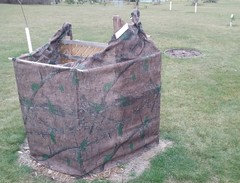
Original Author10 years agoThe yard is about as ready as it's ever going to be for winter. The last thing to do was put up the wind barrier for the Tsuga c. Not the most high quality burlap I've seen but I'm thinking it will soften the wind and hopefully hold up all winter.
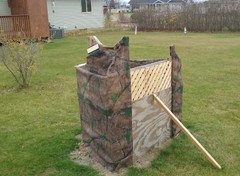

 10 years agolast modified: 10 years ago
"It can handle the cold, but the combination of long stretches of bitter cold, drying NW winds, and bright sunshine may not be kind to it."
Yes, probably reason being why I've failed with these. I planted two specimens (about eight years ago) and both suffered a slow demise despite their somewhat protected sites within a birch grove, conditions are just a bit too harsh here. Occasionally, I have seen relatively healthy dwarf types situated in protected yards, though never have come across an established tree form. I am forced to stick to our native Balsam fir (which is a beautiful tree) and to Serbian spruce, I have a thriving weeping specimen in my protected backyard that has only once shown a bit of winter browning. Oh, and the small concolor fir seedling planted several years ago has now reached 6 ft tall without problem.
Bill, I hope your tree thrives, it's a great looking specimen you're starting out with!
User thanked FrozeBudd_z3/4User
Original Author10 years agolast modified: 10 years agoThanks twros!
When you say 'demise', what exactly is happening? Browning? And if you don't mind me asking, what type of soil do you have?
This September, they measured a Tsuga c. in a yard in Brainerd MN. The house in the yard was just over 100 years old but they don't know if the tree was planted when the house was built or if it was there before. Anyways, as of Oct 2 2016, it's now the reigning MN state champion. I live about 50 mi west of Brainerd. http://www.brainerddispatch.com/news/4127761-its-official-brainerd-hemlock-locks-record
Hopefully, if I can get this one through the next few years, my yard will start to become more protected as the many evergreens I've brought in are progressing well.
- 10 years agolast modified: 10 years ago
Winter / spring desiccation of needles and even outright death of branches above the snowline. My region now experiences fewer extreme winter lows as in the past, though unless possibly situated in an ideal microclimate, this species appears to be just a bit too tender for my at times angry zone 4 climate. I have easily workable silty grey wooded soil that otherwise favors conifers. Please keep us updated on how your young tree manages the coming winters.
User thanked FrozeBudd_z3/4 User
Original Author10 years agoThanks! Very interesting thread you linked to. Dry is bad. Most of the northern hemlocks in MN grow near where water abounds, lakes, swamps and rivers. Also more snowy winters with not much wind.
I think the worst problem for me is lately we have been having very little snow early in the winters and the ground freezes too deeply. But we'll see. I am a little more west than the area that abounds with the moisture loving cedars, balsams firs, spruce and even Tsuga c. But I can take care of the moisture part and have been adding trees for windbreaks. I enjoy the challenge so am not out too much other than time & trouble but I enjoy doing it.
User
Original Author10 years agolast modified: 10 years agoHey, Twros, Those 3 ft specimens of T.c. you planted, were they a containerized tree? Or maybe B&B? If so how big was the root ball? & Where did you get them?
- 10 years ago
Bill, I picked up the trees from a local nursery, I think they were in three gallon pots and I tickled the roots apart upon planting and watered them as needed and soaking deeply before freeze up. You know, I just might try again in a new area of the yard that was opened up in which is both well sheltered and havng deep moist humusy soil,
User
Original Author10 years agoI think it would be worth another try. Sounds like you have an excellent spot for it.
Would smaller trees have a more seasons to get roots established before the top gets too exposed above the snow? Just a guess on my part.
- 10 years ago
Yes, it might be a good idea for me to begin with some smaller specimens. Though, my first 3 ft tree had two entire growing seasons to establish and was doing fine before the severe winter of 2010 had severely stuck both trees back. Next attempt it to try another location and to erect a sun / wind screen.
User thanked FrozeBudd_z3/4 User
Original Author10 years agoAnd possibly plant in a cluster or with some other evergreens to keep it company. Next spring I plan on moving a 5ft. black spruce just to the north of mine, to help trap snow and diminish the wind a bit.
- 10 years ago
Agreed. This one is best grown in the company of other trees and thrives in moderate conditions.
User
Original Author10 years agolast modified: 10 years ago'thrives in moderate conditions.' This is the caveat. We've had fairly mild winters for at least the last ten years. But...I've lived through some real hum dingers. I guess time will tell but according to the scientist, we should be in USDA zone 5 by the year 2025, so not to worry. :)
User
Original Author9 years agoHere we go. I'll leave the wind shield up one more winter. If it can't make it on it's own after that, then it's not in the cards. Put on nice growth this season. I still have my burlap and have a round wire frame to wrap it around so I'll do that too and add some mulch also. Next spring the plywood is coming down. :-)

- 9 years agolast modified: 9 years ago
A local nursery here is a fan of snow fencing draped with white plastic sheeting, installed around the plant without touching it, with open top, for the first 2 winters. You get a Care Sheet with such a note every time you purchase a marginally hardy plant, stapled to the receipt. It is not clear if it has to do with the 1 year warranty that you get with the purchase nonetheless, it is not spelled out in the Care Sheet. I paid $135 for such a purchase this spring, but I do not feel like hiding the precious green conifer in winter, exactly when I need it to liven up a corner in the white desert. If the darn thing dies on me, well, so be it.
User
Original Author9 years agoI thought about letting this one go unprotected last winter. One reason I didn't was that a tree that is not established would be a lot more likely to suffer winter damage, even if it is zone hardy.
Another reason, even though Tsuga c. is zone hardy here, conditions have been unusual due to an F4 back in 2010 that cleared a quarter mile wide swath for 30 miles including the entire length of the portion of the town where I now live. So no mature trees at all for a mile south of me and a house and a mile of farm field to the north, making for brutal winter winds at times (one of two things that are major Tsuga c. nemesis).
I'm hoping after next season, some of the things I've done to soften the winds and catch more snow, will be effective in normalizing the climate in my yard (the wind would actually sweep any accumulated snow right down the bare earth).
I've planted a 25 tree windbreak along the south end of the yard, mostly spruce and pine which are getting some size to them, with some shrubs and a new utility shed on the north end (blocking the wind funnel between the neighbors house and mine).
If it can't survive after all that, there's no point in continuing.
User
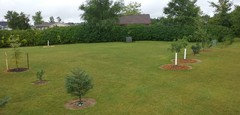
Original Author9 years agojfwiw: This is what it looks like on the south side of the plywood barrier. Not much but considering there wasn't hardly a weed growing between me and the houses (looking SSE in the pic) I've made some progress. The neighbors row of Lindens are visible across the alley way. The two white rabbit tubes are my Pin Oaks. Trouble is it will take several more years before these conifers will make any difference for wind protection. I'd be wrapping a 16' Hemlock before then. So you just have to accept reality at some point and call it good enough. :-)
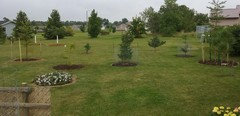
Next picture is to the left of the first and looking the other way toward the WNW. Two rows of Norway pine and a paper birch and a couple of common lilacs. Again, a good start but several years before any of this will really help other than trap some additional snow. Pin Oaks visible far left.
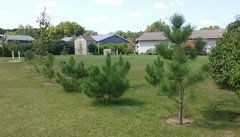
Another view, for perspective, from the pin oaks looking East toward the Norway. The pin oaks tend to hold their leaves all winter which will help some day. These have been mulched for the winter since pictures were taken.
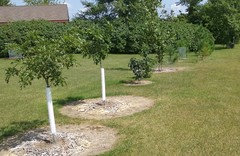
Another shot looking NNW. I have a utility shed ordered that will fill the gap where you can see the white garage across the street between the garden shed and the house.
So, a lot of work in this yard the last 5 years. Maybe we'll get some tame winters the next few years. I just don't want to focus that much attention on one particular tree. It will be fully established after next season so I say let her buck. :-)Oh, as long as I'm at it, this it looking North from the Norway pines. I put a section of fence between the lilacs and the house to cut down on wind from the NE. Burr oak left, small spruce, two red maples and Japanese lilac tree in the corner. There's a Paper birch to my back not in the picture. Now you've seen all I've done in the back yard since we moved here. :-)
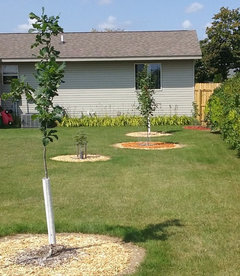
- User thanked maackia
 9 years ago
Looking great Bill. Looks like you will eventually have yourself a nice shady grove. Ooh, then you can start underplanting planting hostas! =)
User thanked Garen ReesUser
Original Author9 years agolast modified: 9 years agoJust might do that! lol I may later on do more in the way of 'islands' around some of the trees and add something or other under them. Something to think about next winter.
I'm leaving the center of the yard open, so when the grand kids come we can throw foot ball etc. As viewed from the deck almost directly SSE.
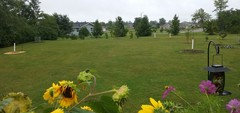
The wife decided we should leave things so we can 'drive through' past the house in to the front yard for furniture/appliance moving etc.
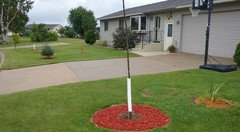
Front yard not so big but I had to move the lily station because after we added the bb hoop, we couldn't drive around that side of the house without running them over. You can see in the grass where it used to be. It was so root bound it hardly bloomed anyways. I'm standing in the neighbors driveway to take this pic. My yard ends several feet this side of the green ash in front of me.
All this and my deer farming in the countryhas been quite enough for this year. I just finished my third week of full retirement.
Well at least I got everything I wanted done for this year. Sometimes our Autumns can be quite wet so not much gets done.
User
Original Author9 years agolast modified: 9 years agoWeather forecast says windy all week with gusts in excess of 40mph. Temperatures dropping with low 20'sF at night and low 40's daytime highs. Snow possible this weekend. Last item on the yard 'to do list' was burlap the cage around Tsuga c. You gotta love zone 3. :-)
It was easy to apply the burlap and it's a foot taller than the tree is now, so I could burlap this again next winter. The fence will stay on next summer anyways to keep away deer. Now I hope we get some snow for ground cover by end of next month.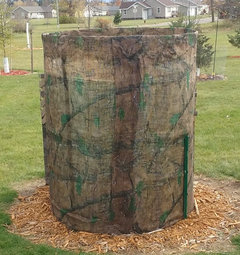
User
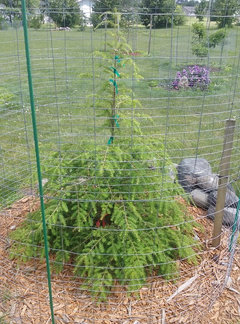
Original Author8 years agoAfter a long tough z3 winter, the Tsuga c. came back looking a little worse for wear and I thought it would have some die back or at least some needle loss. I was surprised when warm weather came, buds swelled and it took off growing rather nicely. The top looks a little thin after taking a twin leader off for cuttings last winter. I increased the cage diameter to over 50" to prevent branch tips from rubbing on steel. Never used fertilizer on this one, only water. It likes to stay moist at the roots so watering every 3-4 days in sandy, silt loam.
- 8 years ago
Looking good, I'm envious :)
Still am thinking to attempt this one again in a very protected location.
User thanked FrozeBudd_z3/4 User
Original Author8 years ago"Still am thinking to attempt this one again in a very protected location."
That's the nice thing about Eastern Hemlock, you could plant it as understory in a brushy or woodsy location, where it would be protected from winter winds, then as it became established, you could gradually thin the woods and brush to increase sunlight, leaving surrounding protection.
I might put the burlap on this one more winter, being I already have it. A single layer of burlap won't completely stop the wind but should soften quite a bit.
I noticed the pine and spruce trees I planted caught more snow than previous years, so there was nice snow cover and the windy conditions are improving here annually. Might just have to let it go next season and see if it survives.
Last month Menards had several Tsuga c. for sale that looked like twins to mine. I wonder if they were from the same batch that I bought two years ago? $19.95 but I resisted. I'm reserving the limited planting spots left in the yard for other things.
- 8 years ago
Bill, okay, yes, gonna soon check if any local nurseries are carrying eastern hemlock. I've got a nice sheltered spot with deeep moist soil, if it doesn't thrive there, I'll just have to concede defeat!
User thanked FrozeBudd_z3/4 User
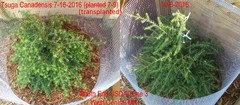
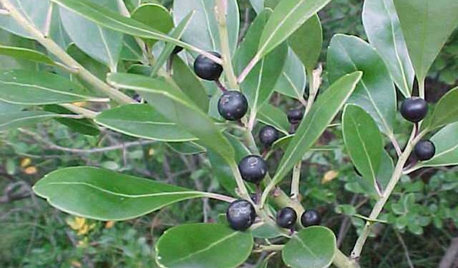
Original Author8 years agolast modified: 8 years agoI think you're right beng, they don't seem to have the problems with HWA in the northern range of hemlock, out east, as they do further south. At least from what I've read. And yes, these things like water, reminds me of my Birch trees, the more you give them, the more they suck it up and the more they grow (remembering this is fast draining sandy loam here).
FB, sounds like you have the right set of physical conditions. Do you ever see any Eastern Hemlock around that area at all? Makes me wonder if the geographical location might have something to do with it. They like moisture but not continually wet. They take wind great, just not winter winds when the roots are froze and they can't replenish branch moisture. I've read when they counted growth rings on a large EH, they could tell the tree had went through extended drought long ago, of coarse this was a larger, well established tree even back then.



bengz6westmd