Software
Houzz Logo Print
alameda_gw

Question About Blue Cypress Root System

Just bought a blue cypress and read that its root system is twice the height of the tree. This is an Italian looking tall plant, like the Leyland cypress - tall and skinny. I have some roses planted nearby. Now am wondering if this will interfere with their growth and if perhaps I should rethink planting the blue cypress nearby. I have the roses planted along a fence edging my driveway - I wanted the one cypress planted at the end of the fence. The roses are mulched with compost, mulched again with bark mulch and watered well when there is no rain, and are healthy and growing well. Any advice on this - will it be OK to plant the blue cypress near the roses? Thank you........

Judith

Comments (20)

  • 10 years ago

    If this is Cupressus sempervirens 'Glauca Stricta' then it is like C. sempervirens 'Stricta' but silvery-blue. C. s. 'Stricta' produces a quite large tree in time. For example one in Sacramento was 94 ft. high with a trunk 8 ft. 10 in. around in 1989.

  • 10 years ago

    If this is really a cypress it will get bigger. The tree won't mind as much as the roses at some point. How close together are they? True cypress (not bald cypress) generally need well-drained soil.

  • 10 years ago

    yes.. it might be a problem in 10 to 20 years .. as with any tree ...


    and dont forget.. roses are absolute full sun ... and as any tree grows shade.. the roses might suffer ...


    when thinking about conifers.. which are trees.. you have to think in tree time ..


    ken

  • 10 years ago

    There are quite a few roses that can tolerate shade - Heirloom Roses in Oregon publishes a list, I think, and locals can give you input as well.

  • 10 years ago

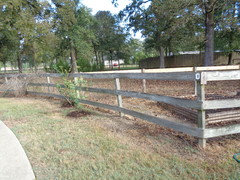
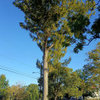
    Here is the spot, at corner of fence, where I had thought to put the cypress 'glauca'. It is in full, all day sun.


    Maybe I would do better putting it in a large pot? I wanted an accent tree at the corner that didn't provide that much shade as I have raised bed gardens on the other side of the fence. Perhaps someone could offer another suggestion if the cypress didn't work? Thanks!

  • 10 years ago

    The roses need for water and the cypress's preference to have drier soil conflict. As mentioned earlier, well-drained is right. Do not overwater this one. If it wasnt for that Id say go for it(maybe you could plant it somewhere else?. I tried to grow an Arizona blue cypress in very wet soil. It died within 2 years. I would not put it in a pot as it will probably outgrow it unless you want to spend big bucks on a huge pot.

  • 10 years ago
    last modified: 10 years ago

    Rectilinear fence corner would look much better softened by a rounded shrub than emphasized by an exclamation mark tree that will also grow quite out of scale in time. All the more so with that pastoral landscape scene behind, which will clash thematically with the rigid formality of a narrowly vertical shape placed at a corner.

    If you are still sold on this look then what you should do is plant multiple cypresses at consistent points all along the fence so that the scheme becomes a feature unto itself. Rather than having just one cypress at one point, standing there out of context, by itself, like somebody wearing a tuxedo to a picnic.

    Notice that even the nursery that may have produced the specimen you bought (correctly 'Glauca Stricta') admits it often shoots up to the neighborhood of 80 ft. high.

    http://www.monrovia.com/plant-catalog/plants/2418/blue-italian-cypress/

    And that the "tiny" alternative they offer for smaller planting sites is still described by them as growing as much as 30 ft. tall.

    http://www.monrovia.com/plant-catalog/plants/1028/tiny-tower-italian-cypress/

  • 10 years ago

    I appreciate the suggestions! I can do something else with it [or return it to Lowes]. My house is nearby - have 2 column youpons that I keep squared off at the top on either side of my entryway - cannot find another one of these so thought about the cypress and had planned to square the top off as it got older. Another thought I had was a wax leaf ligustrum made into a standard - I have 2 of those at the other end of the house in front of a wrought iron fence and they look good. I could keep this in bounds - trimmed, made into a standard and it would still have the same continuity of look. Also open to any other suggestions....I have a "tree ghetto" with crepe myrtles, oaks, a couple of ginkos that I plan to plant around the property [have a lot of room] so have several things to choose from. Always open to suggestions!

  • 10 years ago

    Roses may be "absolute full sun" in a "cold z 5" but the OP is in zone 8, in Texas,where most roses can-probably WILL- really enjoy some shade, which could also cut down on their need for water. In my garden, everybody (except for new implants) has to get by on rainfall, established-roses included (I'm in Tuscany, Italy, meditterranean climate , around a "zone8/9", if we must put things on these terms, lol).So, I'd say go for it. But I do take Embothriums's point,that aesthetically a lone cypress there could look a bit...maybe, lame? How about the cypress, with a group of lower-growing, rounded shrubs at it's feet? Create a grouping? I gather that the roses are planted in a line along the fence, right? so only the last few-well, really, only the last ONE, max, two... in the line could possibly resent the presence of the new guys. Roses accept being moved very, very graciously, as long as it's done when they are dormant. In Texas, probably in the fall.My experience is mostly with roses,in a very,very tough situation, and in my experience, they are extremely resiliant plants.

  • 10 years ago

    Italian cypress are very common here and I've never seen one close to 80 feet. They probably wouldn't do better in east texas than where I live in central texas. Actually, I'd wager most true cypress will die of disease there.

  • 10 years ago

    If I were in east texas I'd go for American beech, southern magnolia, long leaf pine. There is a dwarf of loblolly pine in cultivation. Parsley hawthorns are very pretty trees. And those are all texas natives, native to your region even.

  • 10 years ago
    last modified: 10 years ago

    Italian cypress are very common here and I've never seen one close to 80 feet.

    Consistent with that I see that all the Texas Big Tree Registry has is one (in Hidalgo) a piddling 28 ft. tall. If that's the best you've been able to do - and it may not be, of course - then either they've all been dying prematurely or the tree was seldom grown in Texas until recently.

    http://txforestservice.tamu.edu/uploadedFiles/TFSMain/Learn_and_Explore/Conservation_Education_Resources(5)/BTR-Ornamental1-4.pdf

  • 10 years ago

    I've seen larger than 28 to be sure, you can buy them almost 20 feet tall. I'm sure no one bothers to nominate specimens for the registry. I could probably find one larger than that driving around my bexar county neighborhood for a few mins. I recall some largish oldish ones in cemeteries in new Braunfels and west texas probably approaching around 40 feet

  • 10 years ago
    last modified: 10 years ago

    Likewise Seattle had a few in the neighborhood of 50 ft. 10-11 years ago. California lowlands have the right combination of Mediterranean climate and people planting decorative trees there a long time to result in towering specimens of kinds like this (examples listed as the typical species 164 ft., 150 ft., and 110 ft. high with planting dates ranging from the mid 1800s to early 1900s had been reported from Greece and Italy by the 1990s).

    The original point remains that it wants to be a big tree and is therefore likely to overwhelm the planting site asked about. Probably even one only 28 ft. high is much taller than was being visualized. I mention record sized examples during such discussions to show what genetics are present in kinds being considered, as one reaching even less than half the size of these is very often way more than what was wanted.

  • 10 years ago

    I get it. I'm not much of a garden design type. I do like trees. I'd advise against any true cypress (cupressus) in humid hot east texas. Southern magnolia is beautiful native tree. So much that if it doesn't work with the fence I'd lose the fence. A couple little parsley hawthorns would like nice. If she wanted the upright conifer I'd recommend a cultivar or eastern red cedar (J. Virginiana) although sure those can get big.

  • 10 years ago

    The reason I thought of the cypress is that I had thought to put 3 in a row alongside a driveway on the other side of the house - thought it might be a visually good balance. I actually like the formality of topping the trees off - I have 2 column youpon trees on either side of the front entrance I keep topped off and like this look. However....hearing about the eventual girth of the cypress - I might be better off with it in a pot on the deck where I could keep it under control. I have seen several yards with rows of these trees and they look good and have been thriving there many years. The fence needs to stay - otherwise, in my "tree pot ghetto", I have a lovely vitex tree and a standard wax leaf ligustrum. On a plant shopping trip Thursday, I found the arbor I wanted so that will be on the inside of the fence, where the raised garden beds are. Got 30 bags of rock put for the walkways - it will need about 30 more. Magnolia trees are notorious for losing leaves so have to nix that one. I don't want something that will get huge, like an oak - just an accent tree. Have 2 climbing Crepuscule roses that will go on either side of the arbor. However......if I could keep the cypress in bounds by topping it off, might this work?

  • 10 years ago
    last modified: 10 years ago

    You're going to start having to shear the entire specimen all the way around at some point, as it won't work to keep topping each of them (whatever kind they are) without also shearing the rest. Also with all types of formal shearing (including giving something a flat top) you have to let them grow a little bigger between each pruning or you end up with stubble and gaps.

  • 10 years ago

    Thank you for that comment! That settles that........will go with another choice. Am leaning toward the standard wax leaf ligustrum - they are easy to keep in bounds, slow growing and stay green all winter.

  • 10 years ago

    Ligustrum? Privet? Most people who become plant enthusiasts eventually start to lean towards native plants. There are lots of native plants out there you might like more. Just my two cents good luck

Sponsored
Kuhns Contracting, Inc.
Average rating: 5 out of 5 stars26 Reviews
Central Ohio's Trusted Home Remodeler Specializing in Kitchens & Baths