Software
Houzz Logo Print
donna_torguson

Ceilings that are falling apart

13 years ago
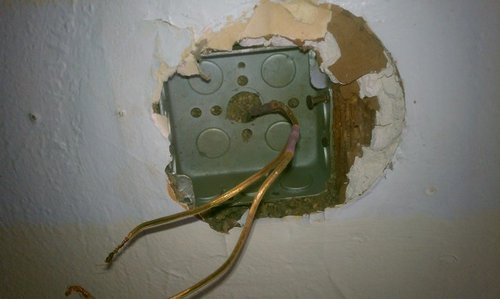
A year ago I purchased my very first house, and this year I finally had the ability to begin upgrading some lighting fixtures and ceiling fans. The house is older (built in 1961) and as I'm discovering (the hard way), the ceilings are a bit fragile. I managed to switch out one ceiling fan and one light fixture, but they're not pretty. I'm curious, aside from replacing the ceilings, what can be done about this kind of issue?

Comments (26)

  • 13 years ago
    I'm more concerned about the state of your wiring. I see a splice there, and no ground. Have you had an electrical inspection? I'm sure the pros (who know a lot more than me) will chime in on this one.
  • 13 years ago
    From the picture, the wiring looks like lamp cord. If it is just spliced, I would remove the splice and get the proper wire installed (14/2) with wire caps instead of the splice. Depending on where you live, wiring without a ground may be ok per electrical codes. Any new wiring would need to have a ground. I also noticed that the wire is coming in to the junction and there isn't a collar around the opening, this could lead to cutting the wire if there is movement. I'm no expert, so you may want to get a professional to look into this as they will know the local codes. Do the ceilings just sag, or are they crumbling. If they sag, you would want to add additional screws to shore up the ceiling as the nails may have "popped". This will take a little bit of effort, but isn't beyond a DIYer. If they are crumbling, then you have 2 options. Remove/replace the ceiling or cover the old with new drywall. The Box stores have some thinner drywall that is designed to go over old drywall. While you will still have all the taping of seams and mudding, you won't have as much mess to clean up. The advantage of removing the ceiling is that you would be able to assess the wiring and make any changes you would like (addition lighting for the room, etc.). My wife and I are working on our 3rd home to remodel and we've found that if we take it slow, we can do many projects ourselves. If you mess up, then you are only out the material costs and can afford to redo the area. Hope this helps and good luck!!
  • PRO
    13 years ago
    Yes, yes, get a certified electrician to check your wiring and someone to help you determine where the dampness is coming from. Those are important issues that need to be addressed before you do anything else.
  • PRO
    13 years ago
    Huge issues...electrician...STAT!
  • 13 years ago
    Before I bought the house, I did get an inspector in there who did say that much if the electrical is original to the house. Although this was not particularly comforting, he assured me there were no immediate dangers. I hope to redo the while kitchen (including the ceiling) within the next year. The other challenge I have is the blown insulation in the attic. That makes seeing things a bit tedious. I think I have opened up a can of worms here, lol.

    Thanks for the replies! Now to find someone qualified who can help me without charging an arm and a leg.
  • PRO
    13 years ago
    A licensed electrician will be more thorough inspecting the electrical than a home inspector, I could comment further about that subject, but that's another discussion entirely.
  • 13 years ago
    Regarding your original question, there are ceiling medallions you can purchase -I find them pricey,but if you don't want to wait until there is time for your re-do, they're an option.
  • PRO
    13 years ago
    A home inspection is not the absolute- many times they are just an elected official. Agree completely with above comments get an electrician. The little bit that it will cost you is more than worth the piece of mind. And if you hire him.her to do the work they may not charge you for the inspection. Are the boxes mounted to a support beam correctly? Can they take the weight of ceiling fan? Can they handle the wobbling that occurs when the fan is on? So many factors to consider. We are restoring a home that had a fire in the wall because the stove was not wired correctly- someone had spliced into the wire in the wall, covered it with a non working outlet to hide the 'fix', and used the incorrect wire. You never know what is behind the wall but a qualified electrician can figure it out easily.
  • PRO
    13 years ago
    Also...as far as charging an arm and a leg, I feel that most pros with good reputations aren't out to gouge anyone. In Chicago, and electrician is going to make $125 an hour or more. Someone may think that is ridiculous, but think of other professions and how much they charge--auto mechanics, lawyers, doctors, etc.
  • PRO
    13 years ago
    last modified: 13 years ago
    Since we have already derailed this thread. It would be nice if the amount charged by a construction professional was pure profit. After liability ins., workers comp, commerical liability ins. on vehicles and number other indirect and direct overhead items there is not a huge amount left. Most contractors go out of business in the first year because they don't know their costs. Bidding jobs low just to keep busy is suicide. It's the veteran contractor's that then hear, "why do you charge so much". Well mainly so I will still be in business to honor your warranty.
  • 13 years ago
    I put in a support for the ceiling fan when I did the one, and it (much to my surprise, lol) doesn't have much wobble to it. So in that case, I'm not as worried. I am not particularly comfortable with the rest of it though, and for now am not using it. I've got some inquiries out to see if I can find someone in my area to help. You all are right...I'd be much more comfortable knowing there is no chance of a fire hazard somewhere in this house. I also would feel better, years down the line, knowing that when I sell the house the people after me will be safe as well.

    It'll be interesting to see what a single mom, on one income, can accomplish with this house. ;)
  • 13 years ago
    That's great, Donna. I'm sure this isn't what you wanted to hear, but I'm glad to know that your home will be a safe place for you and your family. Good luck!
  • PRO
    13 years ago
    Good luck Donna. Do it in little chunks and do each chunk right and when you are done you will feel good knowing that you are all safe.
  • 13 years ago
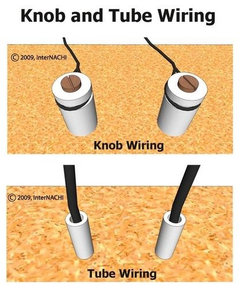
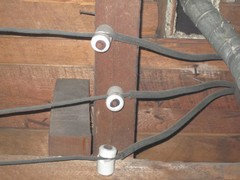
    When it comes to the wiring, I would check if it is knob and tube or aluminum. I think your house is young enough not to have the knob and tube and if your inspector was any good at all he/she should have mentioned this in the inspection report. Might have to research the aluminum aspect, as I am not sure when that would have been installed. I would turn off the electricity, and visually inspect some of the easier to reach wires (attic or crawl space is good place for this as the wires are exposed and lend to easier inspection than opening the ceiling or wall). If they aren't cracked or wire isn't showing through, then I wouldn't be as concerned. The concern with the knob and tube is that it can overheat (same with the aluminum). However, you must do what you feel is safe for your family. Hope this helps. Included are a couple of pics of knob and tube wiring incase you need them.
  • 13 years ago
    When I was in the attic...I didn't see any if those knobs, and my inspector (which...don't really get me started on him) did mention that he didn't see any aluminum. I think I'll still sleep better at night knowing what's really going on in the house. There are a few outlets that don't work and one switch that does nothing.
  • PRO
    13 years ago
    last modified: 13 years ago
    I'm not sure that knob and tube is that big of an issue anymore. Insurance companies won't write a policy anymore if a house has knob and tube. If the homes age is a red flag for insurance companies they usually inspect for this before writing the policy. There are still alot of aluminum feeds to the panel out there and what happens is the wire expands and contracts causing them to loosen at the lugs, an electrician can tighten the lugs in the panel. A telltale sign of this when the lights dim when something else is turned on, most likely a loose neutral.
  • 13 years ago
    thanks Norm Walters. I am not familiar with the aluminum. The first house I bought had knob and tube wiring and as did all the houses in the neighborhood I lived in. We replaced the wiring in the first year we lived there. During the time we lived in that neighborhood, 6 houses caught fire. The main concern is that the knob and tube just can't handle the load of modern appliances.
  • 13 years ago
    Well shoot... There is minimal dimming that occurs upstairs when something else turns on or off. That's not comforting at all.
  • 13 years ago
    That doesn't automatically mean it's aluminum wiring, may just mean too many appliances are on the same breaker/fuse....does your panel have fuses or breakers?
  • 13 years ago
    Previous owners have moved the panel from inside to outside and it now has breakers. Although, they are not marked very well.
  • PRO
    13 years ago
    I'm assuming the previous panel was over a laundry tub in a garage or some similar configuration as codes now require a minimum clearance around them. You would be better served to ask some friends for recommendatons for a licensed electrician rather than a hit or miss search.
  • 13 years ago
    First... Thank you Norm for all of your helpful replies! I very much appreciate it (and everyone else as well). The old panel used to be in a bedroom, that has since had a wall knocked out to expand the kitchen and the bedroom was turned into a dining room. The just flipped it to the outside. I've got a few calls into friends and hopefully I can come up with something soon.

    I'm now confused as to how to handle my ceilings with the blown in insulation above them. From what I did with the two fixtures...it is apparent that the insulation is directly on top of the drywall (possibly plaster) ceilings. Meaning, if sections are removed, the insulation will fall right down. I hear that blown in is better than fiberglass...but how do I (or rather an electrician) get up there to see what's going on with it in the way?

    This feels a bit like a Pandoras box...lol.
  • PRO
    13 years ago
    The blown in that falls down can be collected in garbage bags and reinstalled, but you probably don't have enough insulation in the first place. You can either add more blown in insulation to what you have, or you can have them vacuum the existing insulation and reinsulate with all new. Electricians are used do digging around in the insulation, not happy about it, but they do it. Skinny, young guys fare better 8-).
  • 13 years ago
    Haha! Ok...thanks. Good to know.
  • 13 years ago
    You can always bag up the insulation first if you are choosing to gut the ceiling. Less mess on the floor and less "stuff" floating in the air....Although when it comes to drywall, dust will be everywhere. Can use clear plastic taped to doorways to minimize the spreading of drywall dust throughout the house. Also, from the pic it looks to be drywall and not the lathe and plaster.