Software
Houzz Logo Print
alirazapk2424

Soil not retaining water

10 years ago

Hi,

I am a newbie and trying to grow some gardenias in clay pots on my terrace garden.
I
recently shifted some of my plants in clay pots and I used a mixture of 50%
sandy soil and 50% leaf compost. Problem is that I think I used too
much of compost because after I water my potted plants, the soil mix gets dry too soon. I have to
water plants frequently probably because my soil mix is not retaining water. I don't want to replant my plants once again but in summer it
will be a nightmare because I will have to water them multiple times a
day. Temps in summer here reach 110F for many weeks. Please tell me what can I do now?

One more question. Some
of my plants are not put in pots deep enough so that when I water to the
full, water does not reach to bottom unless I wait for water to go
down then water again and then repeat it. Is it over watering?

Thanks.

Comments (22)

  • 10 years ago

    sandy soil tends to hold a lot more water than people think it will. In fact it can hold so much water that roots have a difficult time finding air. That is one of the reasons why a lot of people recommend that you not use field soil in containers. Try lushing a stick into the container, leave it there for a few minutes, and then remove it and look to see if it is wet. Waterlogged field soil in containers can often be mistaken for being too dry because the plants can't grow enough roots to maintain the top growth.

  • 10 years ago
    last modified: 10 years ago

    @Nil13, i tried your suggestion. I put a stick in container 4 days after watering, left it for 5 minutes and checked it was not wet. It was moist at the end but dry on most top. I had always thought that adding compost will make soil mix less soggy.

    I also put out one of the the whole plants out of pot by holding main center stem, the root ball remain intact, it did not break. I saw lots of white roots coming out of the root ball. Roots should be of brown color if they are not getting enough oxygen in water logged soil, right?

  • 10 years ago
    last modified: 10 years ago

    Do you know how to take pictures? Let's see what the mix looks like up close..Your question makes no sense to me..

    This one..

    "Some of my plants are not put in pots deep enough so that when I water to the full, water does not reach to bottom unless I wait for water to go down then water again and then repeat it. Is it over watering?"

    Pots not deep and then water does not reach the bottom? You sure you are watering?

    Compost should hold water..It makes no sense..What;s the compost made of? How sand are you talking about and how big are the sand particles?

  • 10 years ago

    watering every 4 days in 100f heat sounds pretty good to me. A lot of white roots throughout the pot sounds pretty good too. Most people here use a soilless potting medium but if the ingredients are hard to get you have to use what is available and be careful when you water. It sounds like you are being very careful with how much water you are using so as not to create a waterlogged situation. I would just warn that frugal watering can lead to a buildup of salts in the soil that can be a problem. This can be mitigated by an occasional thorough watering where a substantial amount of watet flows out the bottom of the pot.

  • 10 years ago

    @Nil1, these days temp is not 100F, its 70-80F these days, its winter approaching here. My bottom leaves of some gardenia are wilted which in my opinion indicates lack of oxygen. Let me show the pics in a day or two.

  • 10 years ago

    @mikerno_1micha, i will upload pics in a day. Actually some of my plants have large rootball but the pots were not large enough. As a result the top surface of rootball is close to the rim of the pot so not enough space for water to accumulate on top, water flows out from top, so what i do is, i water again and again until water seeps out of the bottom of the pot, i am not sure if it is considered over watering.

    I am using one year old, pit prepared leaf compost, it is very fine. Sandy soil is actually river soil with very fine sand particles.

  • 10 years ago

    Would you consider introducing a fistfull of earthworms into each pot for aeration?

  • 10 years ago

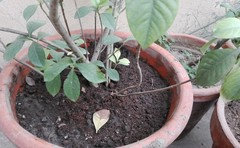
    @mikerno_1micha here is the pic if it helps.

  • 10 years ago

    Put a healthy squirt of any clear shampoo in a half gallon of water and water the plants with that. My wife did not believe me that that would work. After trying it once she's telling everyone about it. Now she squirts the soil itself and waters into the shampoo.

  • 10 years ago

    Ali, I've never heard of treating soil with shampoo or any other commercial soap. It would profoundly change the soil's chemistry, and could have very, very bad consequences.

    There are several people on this forum who have a solid grasp of the practical science behind growing plants in containers. Unfortunately I'm pretty new to this and am not sure what you should do, so I hope you'll wait for advice from some of those tried-and-true members before lathering your plant up.

    Lenore

  • 10 years ago

    Actually any clear, non-detergent dish soap or shampoo (like baby shampoo) makes an excellent surfactant that will help to hold and retain water in the soil. It is a common practice in lawn care :-) And since the potting media the OP is using is much more like garden soil than it is 'potting' soil, it should work very well.

    You don't need much for a single plant - just a few drops in the watering can is sufficient. It will not adversely affect the plant or significantly alter soil chemistry.

  • 10 years ago

    That actually sounds reasonable, gg. "A few drops" of clear non-detergent dish soap or shampoo in a watering can sounds much more reasonable than "a healthy squirt" of anything. That could be 2-3 ounces of goo, which just doesn't sound right.

  • 10 years ago

    He blinded me with science!

    Adding a surfactant to the soil sounded strange, but although I couldn't say for sure that it's never appropriate, I couldn't even analyze the question because there's so much I don't get about how plants and soil interact.

    Even if soap is okay for a specific application like pest control, every time someone talks about using soap and not detergent I wonder how many people can say which of the sudsy products in their homes contain one or the other.

  • 10 years ago

    Very few household products contain vegetable oil soaps. Castile Soap and Murphy's oil soap are the only 2 that come to mind. All the others contain various detergents AND phytotoxic dyes/perfumes, and other ingredients. That includes Ivory products which for some reason seem to be recommended as safer than other products containing ingredients plants would rather you didn't use.

    Al

  • 10 years ago

    Thank you guys on this valuable discussion however i would really appreciate if you could confirm one of the following after looking at the picture of my plant/soil above:

    1- Is it too much moisture? because soil is moist and bottom leaves drooping which means too much moisture to deprive roots of oxygen?

    2- Water not retained, too fast drainage which is not enough moisture so roots getting drought?

    Is there any simple test to check my soil mix is in perfectly lying in between these two?

  • 10 years ago

    Check the first response to your post; I could write more about it, but I really couldn't say it any better. Using a dowel or other thin unsealed piece of wood is by far the best way to get an accurate reading on soil moisture.

    I hate to say it, but I think your soil combines the worst of all worlds. Sand drains poorly, leaving roots without oxygen and probe to rot and death, and although compost in general may drain fast and leave the soil too dry when it's hydrophobic, it retains too much moisture when it does get wet, again leaving roots without air. From your descriptions, it sounds like the result is dry areas where the roots die of dehydration, and saturated areas where the roots drown.

    What you want is a growing medium that 1) has particles that are large enough to drain quickly, and 2) holds the remaining moisture inside the particles, not between them, so that roots always have access to air.

    I live in Utah, which is a desert with heat and low humidity in summer, and stays pretty dry for much of the winter, so I need a mix that holds a bit more moisture than is needed in more humid parts of the country. I just repotted a plant and some cuttings into Al's 5-1-1 mix, except that I left out the peat and left in more fir bark fines to keep it from drying out too fast.

    I think it's working, because from what I can tell so far, I should be able to water my indoor plants every four days in moderate weather and every two or three days in low humidity or if they spend much time outdoors in the heat or direct high altitude sun. If I added the peat and kept the fines, I think outdoor plants could go three days between watering, but I'd prefer to keep it as is and water more often. It will be much more flexible because unlike a water retentive mix with fine particles, it stays well aerated even right after a good soak, so I can water any time I want if I know I'll be busy.

    Sorry about the long post, and I hope it wasn't too confusing. I'll post again shortly with a link to an article about container soils that will explain what I'm talking about.

    Ali Raza thanked litterbuggy (z7b, Utah)
  • 10 years ago

    litterbuggy (z7b, Utah) Thank you and i understand that. We have few months of dry extremely hot summers and then monsoon heavy rains for two months followed by a dry mild winter. Can you or someone else prepare me a general mix out of these commercially available components: 1- Perlite 2- Vermiculite 3- coco peat 4- peat moss 5- sandy soil 6- clay soil 7-leaf compost 8- sugrancane press mud

    Thanks.

  • 10 years ago
    last modified: 10 years ago

    Info to help you understand how water behaves in containers. Trust me, not all of it is intuitive! Near the bottom of the original post Al gives the basic recipes for the two mixes he uses. There's are dozens of great posts, but this is a great place to start.

    Trees in containers-water movement and retention XXII

  • 10 years ago

    LitterBuggy, thanks for the article, i read it and i guess i am doing it in reverse order i.e. Starting to improve a soil that is already extremely water-retentive (Major portion of my soil is compost and peat). I will need to start with the foremost fraction of the soil being large particles, to ensure excellent aeration. Unfortunately i do not have access to pine/conifer bark here so i am missing the major ingredient of this mix. What can i replace it with?

  • 10 years ago

    Sorry I missed your earlier post on soil ingredients, but here are my thoughts. I'll just talk about how your list might fit into the 5-1-1 mix because you don't have the ingredients for gritty mix.

    I'll apply what I understand of the principles behind Al's mixes, and I hope someone will straighten me out if I'm way off base.

    Basically, it's not possible to improve drainage in a water retentive soil, although in some cases you might be able to use a little bit of water retentive soil to your final mix. Sadly, your sandy soil is worse for this than peat-based potting mixes because it has absolutely no structure to start with, but fortunately there are other options for a faster draining medium.

    However (I use that word way too much), check out Al's posts in this thread, especially the drawings halfway down the page, for a short term solution you might try while you figure out which way to go. Read Al's instructions very carefully to make sure it works.

    See Al's posts and drawings about halfway down this thread

    1- Perlite: good for drainage, doesn't absorb water, but retains a film of moisture on the nooks and crannies on its surface. Use coarse perlite possible and sift to remove fine qdust.

    2- Vermiculite: not great. Large particles create air spaces when dry but get soggy and squishy when wet and break down much faster than perlite or bar. would. May be okay if you repot every year or so, but because you have few options for durable large particles, I'd avoid it if you can.

    3- coco peat: not recommended by Al, even if it's treated to remove harmful salt, but I've seen posts by people who use it if they can't find sphagnum peat.

    4- peat moss: I'm assuming you mean sphagnum peat. Generally, Al recommended20% peat in a mix of particles between 1/16" and 3/8", with most around 1/4", is goodany more than that and the mix will retain enough water to create a PWT that endangers root health. However, in your situation I could see using more because of the few usable ingredients you have access to. Try to find peat that hasn't been screened into tiny little bits.

    5- sandy soil: 1/16" to 1/8" particles of inorganic material will drain as well as the grit recommended in gritty mix. Screen to remove particles smaller than 1/16" that would impede drainage and suffocate roots.

    6- clay soil: no; its extremely fine particles will fill up the spaces between the coarser particles, reducing available oxygen and blocking drainage.

    7-leaf compost: I doubt it. Some leaves decompose slowly because they contain nasty stuff like tannins that you don't want in the soil; others might as well be clay because they break down into fine particles very quickly. Remember, the reason composted bark works is that it's pretty non-reactive in soil and is full of slow-decomposing lignin that supports soil structure longer and doesn't release by-products as quickly as composted wood or leaves.

    8- sugarcane press mud: I don't know what's in it, but mud is the same as clay--it negates all the benefits of a fast draining mix.

    Your workable ingredients add up to coarse sand, peat, and perlite. Coarse sand, if you can find it, holds little to no water, and perlite only holds a little, so you'll want to increase the peat and perlite in your mix. This might come out to something like 3-2-2 coarse sand-peat-perlite.

    Geez, Ali, you seem to inspire some long posts! Hopefully I didn't repeat myself to much. I know your rather not change out your mix, but I can't really see a way to improve your situation without it.

  • 10 years ago

    I just stumbled on this from Al about sand and compost while reading up on stuff:

    "Note that there is no sand or compost in the soils I use. Sand, as most of you think of it, can improve drainage in some cases, but it reduces aeration by filling valuable macro-pores in soils. Unless sand particle size is fairly uniform and/or larger than about ½ BB size I leave it out of soils. Compost is too unstable for me to consider using in soils. The small amount of micro-nutrients it supplies can easily be delivered by one or more of a number of chemical or organic sources."