Software
Houzz Logo Print
elissa_norris

fiddle fig ficus help

10 years ago
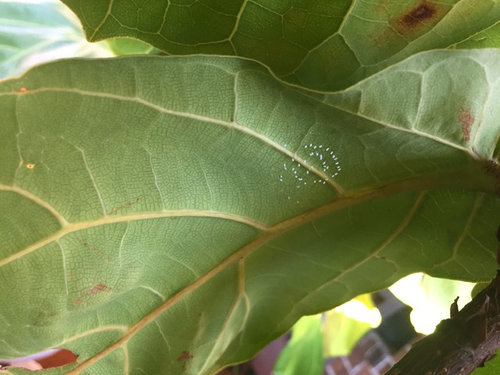
Hi, I have two new issues I've noticed I need help with- if someone could help

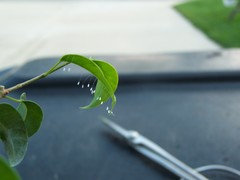
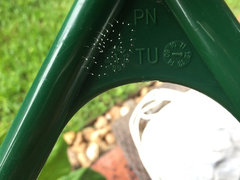
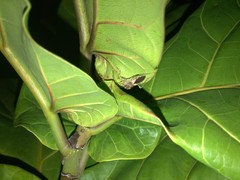
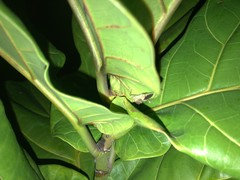
me identify tiny white appendages that are forming groups in a round 3/4 inch diameter? I have noticed white flys and fine spider web like formations on OTHER plants in my backyard( not my focus trees) so I have sprayed with organic fungicide and Insectisides over the past month and have given these trees a few good spray downs with Neem oil as well in late evening to avoid leaf burn ( it is a lime tree of mine that has had leaf mold and the white flys). Anyhow any advice would be appreciated! Also on one tree 2 of the 3 leaves that sprouted this last month have "purple veins/ regions" around the leaf veins- any known cause/ concern? The only thing different has been a slight drop in our Houston Texas temperatures- few (2-3) nights in mid 50's/ 75-85 day time temps. Wind has picked up outside from our stagnant summer air so curious if I need to bring them under the porch more than the 1-3 week they have lived in since April? They are still thriving and sprouting like crazy with all the light however so I am trying to maximize on the growth still while I can! I've tried to keep a close eye on them and thought one was droopy about to drop leaves but was apparently just thirsty:) thanks for all the help!

( yes we experienced a little leaf burn on a few leaves over the hottest summer days but it's been there nothing recent ) Are the white things fungus/ eggs?
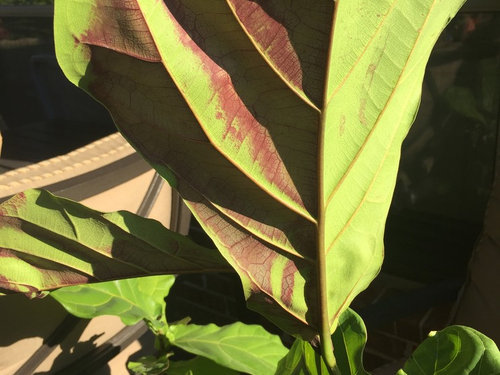
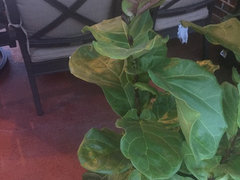
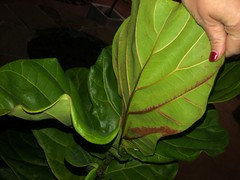
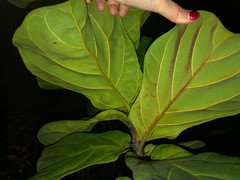
Help! What is the purple? Only one tree out of 4 all treated the same way and located side by side looks like this??


Comments (22)

  • 10 years ago

    Well I'm sure someone who knows more will speak up... but it seems to me, those little white things don't need to be there, and maybe you could just moisten a Q-tip and wipe them off, gently?

  • 10 years ago

    I agree; there's certainly no reason to leave them there.

  • 10 years ago

    Guys, so with more googling after no replies I found out they are definitely lacewing fly eggs... i did see they attack a lot of common other parasites and because of that some sites seemed to hint that you don't need to destroy them with products but rather just take small measures to not let them completely take over. I didn't see anything on if they will themselves damage the plants nor figure out the purple leaf issue?

  • 10 years ago
    last modified: 10 years ago

    First thing I thought of is lacewing eggs, but it looked like they might be attached to the leaf instead of hanging by a thread like they usually do, so I didn't say anything. Please don't do anything to eliminate this valuable and hungry predator.

    On F benjamina:

    About the purple leaves: How about an image of the top of the leaf, and tell us as much about how you fertilize as you can think of. Using any supplements? Unusual purple in ficus leaves means something is suppressing chlorophyll and allowing extraordinary expression of anthocyanin, a purple pigment. The question is 'why'.

    Edited to add something I posted to another thread a few years ago:

    You
    are seeing the magic of plant color expression based on a stress
    factor, which is probably caused by the lack of certain nutrients.
    Many times the coloration you describe is due to the breakdown of
    chloroplasts and the expression of anthocyanin and xanthophyll.
    Anthocyanin is a flavonoid. A major function of anthocyanin is to
    provide color to most flowers and fruits. The colors can help attract
    pollinating animals to the flowers and animals that will help
    disperse the seeds. Anthocyanin also is thought to help protect the
    leaves from ultraviolet radiation, but some botanists think that may
    not be true for all plant species. Anthocyanin also is thought to
    deter herbivores in some species. Xanthophyll is a carotenoid. The
    main xanthophyll in leaves is lutein. Xanthophyll is a structural
    component of the light harvesting antenna in chloroplasts. They
    function as accessory pigments for harvesting light at wavelengths
    that chlorophyll cannot and then transfer the light energy to
    chlorophyll. They also absorb excess light energy and dissipate it to
    avoid damage in what is termed the xanthophyll cycle. The xanthophyll
    zeaxanthin appears to have a role in sensing blue light, which is
    involved in stomata opening and in phototropism. All said, your
    fertilization may “erase” the coloration that you describe. Make
    sure the plant is not too pot bound, which could result in the roots
    not taking up adequate nutrients.


    The
    most common cause of purple leaves (very common at this time of year)
    is a deficiency of phosphorus (P) because P is required to make ATP
    and ATP is needed to turn sugars to starch and to load sugar into
    phloem for transport. No P - no ATP - no move sugars/starches -
    anthocyanin (purple pigment) builds up - plant turns purple. The most
    frequent cause of a P deficiency is cold soils, which is why so many
    plants planted out too early turn purple.

    A
    P deficiency is not the only suspect cause of purple leaves. Nearly
    any environmental condition that puts the brakes on growth and the
    accompanying use of sugars, but does not limit sugar production
    (photosynthesis) can cause anthocyanin buildup and purple leaves.

    If
    only the outer edges of the leaves are purple, it may be a K or Mg
    deficiency. If the center of the leaves are also purple, it could be
    too much Ca in the soil or the result of too much water in the soil
    blocking uptake of P and Mg.

    Do
    not apply a fertilizer with the middle number higher than either of
    the other two numbers (N & K) to container plants. There is never
    a need for that much P (relative to N) in container culture unless
    you're supplying only N in another form. Plants use about 6 times
    more N than P and the massive doses of P in 'bloom-booster
    fertilizers' cannot do any good.

    AL

    Elissa Norris thanked tapla (mid-Michigan, USDA z5b-6a)
  • 10 years ago

    Thanks- I fertilize with the exact foliage pro you recommended for fiddle figs... I definitely don't add it every watering or even every other (mainly bc my preschoolers are always wanting to water for me and I don't want to have fertilizer out around them... they always play in the run off water/ sweep it around, draw in it with chalk and I selfishly chose their chemical exposure over tree nutrients...) anyhow I probably fertilize with the container listed concentration about every month, though I did it more often in the summer when it was pushing out leaves like crazy. The plant did blow over the week prior to me noting the purple hue but was on its side no more than 2 days. It is my only fiddle fig still in its original potting bark mix ( other 2 moved to Gritty in June) but is almost twice as tall now as the others, which is mostly my fault from losing too many roots during the repot. I was spraying organic insecticidal soap on it frequently in the 3 weeks prior to the purple appearing- does that block UV absorption since I leave it on the leaves? The top of the leaf is still green and edges are green underneath, purple is mainly close to/ between veins. I'll send new pictures tomorrow. Update on the eggs- I noticed tons of tiny moth like white flys flying around my back porch this weekend and no sign of any eggs left on the plant (tapla they looked exactly like your pic ;) got worried I was being taken over by lace wings but didn't see any yesterday or today so I think they mostly moved on- hopefully one or two are still around!

  • 10 years ago

    Al, thank you for telling me about the lacewings! I didn't know they were "good" bugs (I guess most bugs are really.) or even that that's what they were.

    And the purple discussion is fascinating.

  • 10 years ago

    Pictures as promised Al:)

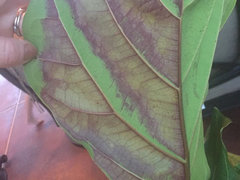
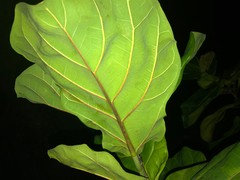
    This was this evening- appears possibly to be improving ( same leaf originally posted) as your discussion on pigment mentioned?!? Pretty cool/ Mind blowing such a large area like that can change back and forth in overall pigment expression!
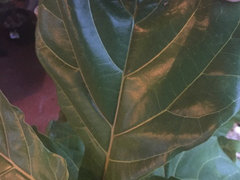
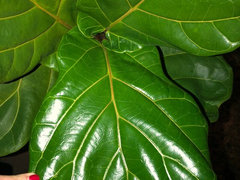
    This is the top of the same leaf- which is beautiful. Interestingly, out of the newest/ top 4 leaves the 2 in the middle had the purple color change and the newest leaf and 4th newest leaf are normal??


    Now that you've educated me on leaf color what exactly causes some leaves on the same plant to be lighter green even if it's getting equal UV exposure to build up chlorophyll ... is it the same type of imbalance in nutrients/ more linked to a specific nutrient deficiency? I have one focus tree that has leaves of varying green shades.

    So other than the foliage pro 9-3-6 ( I usually add a cap full to a 2 gallon watering can and spread over 3 plants) I did forget to mention that when I bought the tree in April the soil of this tree contained unknown green balls of continuous release fertilizer- not sure if that's still doing anything 7 months later. It is critical for me to be fertilizing more often I've become more concerned with over fertilizing as before this it was doing so well on its own and I don't want to "burn" my beautiful leaves. Maybe a slow release fertilizer would be good for me to add to the soil ( I remember you mentioning in previous posts i followed it wasn't something you promoted but can be helpful for some) Do you think the insecticidal soaps were causing a build up that blocked light absorption?

  • 10 years ago

    This pic shows the only two leaves affected better...
    And quickly while I have you @tapla ;) and I will start a new post soon on this with better pictures when I get serious about it but at what " general" tree height should i start considering inducing branching encouragement for an aesthetically pleasing fiddle fig tree? This " bush" which is really just two separate trees in one pot really took off this summer and I hope to leave it outside as long as I can here in Houston ( its still 90 degrees in November here ) And do I have to make the decision one day to remove bottom leaves for a purely aesthetic looking trunk reason or will they fall off naturally one day? There are a few leaves that were very tattered when I bought the plant but I just trimmed the dead part of leaf off and left cracked ones to help it have more surface area for energy/ growing fast but I may be getting to the point the plant has plenty of leaves for its rootball size anyway and can start by removing the slightly damaged but alive leaves.

  • 10 years ago

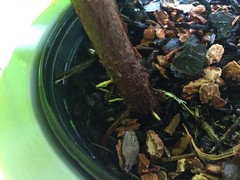
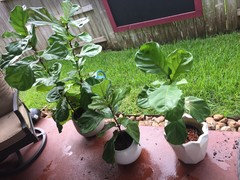
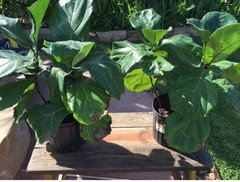
    Same tree's trunk base- could the fact these new roots are shooting above the soil line indicate the plant is becoming too root bound? ( I have moved away for picture sake some of the reptibark that I recently added just to help cover them). When I flawed my repot of a similar 2 tree FLF " bush" in June ( both shown below on right/ now heathy again just were stunted) and noted it wasn't as root bound as I had originally thought I decided to not mess this one up by my novice repotting knowledge, especially when I noted the water drained thru this heavy bark original growing soil nearly as quickly as the others in gritty ( and the inside bark seemed to show signs it was ready to be rewatered around the same time for both soils) aka it appeared to be a soil composition that's was fairly optimal as far as potting soil goes. But this " bush"/ 2 tree trunk FLF that's in a 6L pot has doubled in size since June and is now 2 FLF trees that are around 4 ft tall. Just thought maybe these new root shoots above soil level are helpful in figuring out the purple leaf/ nutrient def mystery??

    And fear not, it appears I was indeed taged as a safe haven for lacewing egg deposits as I found these this morning on my kids trapeze rings


  • 10 years ago

    ( this is what these trees looked like when I purchased them late April of this year )

  • 10 years ago

    Thanks that helps, sounds like next summer will be perfect timing for height anyhow! So in the meantime any advice regarding the new roots I mentioned above your post (I think I posted while you were writing so maybe you missed it)

  • 10 years ago

    The roots you refer to are adventitious roots, aka aerial roots. They're forming because the sides of the nursery can block air movement, which keeps humidity levels near the soil high. If they were occurring higher on the tree, they might be an interesting 'feature', but since they aren't I'd rub them off with my thumb or just cut them off flush to the trunk with something sharp. All they'll do is complicate the chore of getting the root issues straightened out at repot time.

    Al

    Elissa Norris thanked tapla (mid-Michigan, USDA z5b-6a)
  • 8 years ago

    @talpa Al I have good news and bad news that I’m hoping you can help me with. The bad news is that the same problem of purpling leaves from the vein out has began popping up again in my contained FLF trees that i keep outdoors in Houston 95% of the time. Interestingly enough, i have now noted that this “problem” began exactly this time last year as highlighted in this old post I just Pulled back up where you tried to help solve my purple leaf mystery. I never really fixed the issue last winter months as it seemed to continue to some extent until spring and the affected leaves never turned green again on the underside but also never fell off. The good news being that the purple leaf findings did stop occurring this year from about March thru October when it began out of no where just like before. The leaves/ trees do not seem to have any other significant findings other than finding numerous shield bugs in it tonight when I went To take pictures and also just a very fine white residue (almost like hard water deposit) as you can see In some of these pictures- here is no webbing whatsoever and I have Sprayed well with alcohol and neem a few times just Incase ( although I would Dare to say if anything it’s a very mild powdery mildew/ mold issue and we had a very very wet summer and fall here in the midst of our high humidity months so my backyard flower beds contents are laden with the stress of blight and zinnias fallen to powdery mildew) .


    I did did want to note that when I made My gritty mix I did Not incorporate any Dolomite and I’m curious if this could help with a deficiency diagnosis. I have Continued a similar full flush watering schedule as Trees seem ready with no major changes over these two years other than I did Step up my frequency of fertilizing w my 9-3-6 this summer ( to every other watering ) after some advice you gave me and have backed off only slightly since sept/ October ( now using every 3 waterings which are more days apart- probably fertilizing every 2-4 wks right now in fall/ winter. Thank you once more for any advice you could give, and insight on if I need To stop fertilizing/ try something new like Epsom sat/ etc.

    ( and the new stink bug finding I did address in a different post tonight)


    so below are pics taken from different trees (all 4 container trees seem to have some level of this occurring despite all in gritty/ yet different size and make of pot and 2 repotted this year/ 2 last) top of leaf still very green, a few have purple discoloration right at the start of the leaf. This is occurring on leaves anywhere from hallways up the tree to the newest leaves with no discernable pattern


    The very minor “white residue” finding can be seen here above on stem and about as significant as it gets

  • 8 years ago
    last modified: 8 years ago

    One common cause of abnormal anthocyanin (purple pigment) expression is a phosphorous deficiency caused by cold soil. How cold does the soil get while outdoors? If your water has too much Ca in it, it could be blocking uptake of P. Also, anything that limits growth w/o limiting the plant's ability to carry on photosynthesis. I can't be more helpful because here are so many things that CAN cause purple foliage.

    Al

  • 8 years ago

    We do have slightly hard water I believe, the temps outside when this starts in the fall are anywhere from about 60-95 deg, maybe 50 def a few night hours. I never Keep them outside when it gets below 55 for the majority of the day.

  • 8 years ago
    last modified: 8 years ago

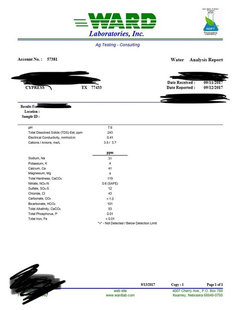
    Does this help or mean anything to you? It’s a report from a direct neighbor that was done about the time of year this seems to begin( fall)... looked up the CaCO3s/ alkalinity and 83ppm fell in the “moderately hard” range (but I have No idea what that really means esp regarding mineral balance;) Also a side note- i do use Dynapro 936 ( only occas in fall/ heavy in spring/ summer) and these trees are also exposed to rain water too if that matters/( i don’t collect it for manual feedings though )Thanks!

  • 8 years ago

    Your carbonate and bicarbonate levels are well within reason for plants. The only think I see is a slightly higher level of Na than ideal, but nothing to worry much about unless you're a fan of misting.

    Did you mention anywhere upthread what you're using for a medium?

    Al

  • 8 years ago

    Everything’s in Your gritty mix. The components are a little poorly mixed though now esp in top half as a lot of the bark has gradually floated to the top (aided by my two 5 yr olds watering technique). What still has me baffled is this being the 2nd year in a row that its started occurring in the fall and that it stopped occurring at some point with me not changing anything (in spring i guess?!)! The purple faded to a kinda rust color on already affected leaves but no new leaves or progression of purple occurred till fall returned.

    I noticed today as i prepped for a hard freeze that A large potted impatient plant I have Also had started expressing the same purple pigment on its leaves ( not realy sure when that exactly started) that plant is in a similar location but is not in gritty and dosent get fertilized much at all.

  • 8 years ago
    last modified: 8 years ago

    Any way it could be from not enough soil mix or not fertilizing enough in fall? Only ask bc I ha e 4 of these trees and all but one have this purple expression- the one that dosent is in a bigger pot and a pot that has a huge reservoir to retain water within the walls of the container. I actually water/ flush that one more though to ensure I am Flushing out even the water in the reservoir at least monthly-

    even though I’m not sure how much the gritty mix would actually pull up water from that retention are being that it’s not going to have the same capillary pull true soil would.

  • 8 years ago

    Compare to this ( yes there is a whole in the pot ;)

    note what last years purple backside of leaves faded to by observing the bottom leaf... compared to the stark purple color on random higher leaves.

  • 8 years ago

    Sounds like Al was saying last year it was most likely P deficiency induced by cold soils, which would fit with it reoccurring at the same time of the year this time around and also with the one ficus in the larger pot not being affected - maybe the larger volume of soil holds its heat better and/or the water reservoir within the containers wall act to insulate it?

Sponsored
High Point Cabinets
Average rating: 5 out of 5 stars21 Reviews
Columbus' Experienced Custom Cabinet Builder | 4x Best of Houzz Winner