Software
Houzz Logo Print
linaria_z7_ch

"hybrid plants useless for insects/bees" facts/ texts anyone please?

9 years ago
Hi there,

working as a landscape architect (in Europe) I`m often confronted with an " native-only"-demand and the big accusation, that "hybrid plants" offer "no food for the bees" when planning with perennials.

---

personally I try to use plants according to site conditions, encourage a wildlife friendly maintenance ( "you don`t need to remove all the leaves in fall...") etc, and use quite a lot of plants that do offer pollen/nectar.

So I ask mainly because I`m interested in the details

Does any of you happen to know of some detailed article or paper that descriebs why/which hybrids offer no "bee food"? I couldn`t find a "bee forum" so I thought, this forum should be ok.


IMO wildlife gardening is a big issue, it is certainly important, but I also get the impression that there are some "urban myths" floting around.


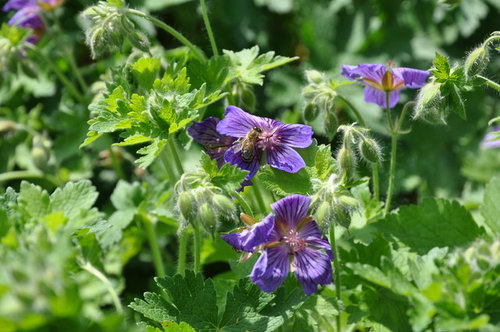
attached is a pic of (cranesbill?) Geraium x magnificum Rosemoore-if my notes are correct. There were quite a lot of bees, and as they seemed to return I assume they found something


thanks for input, I`d be happy to plough through lengthy scientific stuff,

bye, Lin


Comments (17)

  • 9 years ago

    Check out the RHS Plants for Bugs page and the links there.... They've been doing a study for the past few years to address the questions you're dealing with. I think, when climate change really starts to 'bite', the belief that native plants are the ones that are best adapted to local conditions may become increasingly invalid if conditions change such that native plants - and insects, wildlife, etc. - struggle to cope. Highly adaptive local native plants would be the ones to survive while ones with specialized needs would be very vulnerable. The issue will then become how to build a functioning ecosystem with adaptive local plants etc. combined with plants etc. from other areas that can cope with the new local conditions (while the less adaptive local native plants etc. migrate to areas where conditions are more to their liking....)

    linaria_gw thanked woodyoak zone 5 southern Ont., Canada
  • 9 years ago

    Hi gardengal, thanks a lot.

    Hmm, I thought so, had a gut feeling, that "all hybrids" is a wrong generalization.

    No doubt about double flowers, and yes, know about the "neophyte problem".

    interesting to see that people discuss heartily with very little knowledge (dangerouse half-knowledge...) and mix up everything: wild spreaders, neophytes and the real problematic "invasive neophyte species", in our region about 5 actual species.


    just right now I read an very interesting book: No Nettles required, by and British plant ecologist

    https://www.amazon.co.uk/No-Nettles-Required-Reassuring-Gardening/dp/1905811144

    discussing what measures really help wildlife in your garden. Really helpful for me (more or less valid in Germany and Switzerland), perhaps not for the USA.

    I mean, I hate those almost dogmatic "native only"-demands because they result in really ugly plantings. So it is great to read that using North american or Asian Asters that flower late is beneficial for pollinators, we`re talking inner city situation with mean micro climate.

    Did a web search early, using all kind of phrases, but nothing substantial cropped up,

    well, I`ll keep looking, bye, Lin


  • 9 years ago

    Hi Woodyoak,

    funny, I just read the book by the guy who started or worked with the BUG-project.

    You mention a very good point, when discussing my selection of perennials with some folks from administration I pointed out that at least half of a list with recommended native sepcies wouldn`t work as they were not hardy enough for a inner city situation (forget all woodland species and most from meadow societies).

    Well, big issue and lots to learn, bye, Lin

  • 9 years ago
    last modified: 9 years ago

    As a rule, I tend to avoid doubles and the many hybrids which have been bred for long blooming at the expense of fertility. No definitive answer to this though - merely a whole range of pros and cons which we , as gardeners, prioritise according to which criteria we deem most important. Each plant needs to be considered as part of a wider picture, of which a healthy, diverse ecology is surely one of the most important aspects.

    eta - Yep, Ken Thompson is an interesting writer - particularly on plants and adaptation and diversity. He has also been quite scathing about the dogmatic attitudes surrounding the nativist movement.

    On a personal level, I garden in an area where the last remaining British swallowtails are clinging on by a whisker. The sole food plant for caterpillars is the hard to grow (and source) thyselium palustre - also threatened by habitat loss. However, we are seeing occasional migrations (and interbreeding) of the European swallowtail which subsists on a much wider range of umbels, including the common fennel. My solution - grow as many different umbels as possible, including (finally) thyselium...and also milkweeds because....who knows. Life is tenacious and adaptation can occur in just a generation or two.

  • 9 years ago

    It's a very good point that you can't rationally argue that "exotic" species are unattractive to wildlife, while simultaneously noting that such species are spreading (which is largely due to the activity of insects and other wildlife).

    I would have to see solid evidence that hybrids in the garden are starving bees, and I suspect such evidence is minimal to nonexistent.

    One case in point is African blue basil, a sterile hybrid of two other basil varieties which I grow from cuttings every year. It makes a mass of purple flowers to the delight of honeybees which visit en masse. If it offers "no food" then I'm mystified as to why the bees return eagerly to it.

  • 9 years ago

    The Pulmonaria (lungwort) cultivars are very frequently cross-pollinated by the bees that pay particular attention to them in spring.

  • 9 years ago

    I am involved in Landscape restoration for wildlife on acreage. I have this invasive grass called KR Bluestem from Eurasia or China, I forget. It does take over in my area and the control methods for it keep changing as the research changes from Year to year.. I have gone from winter Burning to summer (very scary) burning to no burning and now they are telling me to plant Silver bluestem, another non native because it will compete with the KR BS and then the native BS will compete with the silver BS .. Its all a bunch of BS piled high and thick. I wonder what they will say next year. I did go collect Native BS from my back more pure grassland area and will be digging in patches of it out in the front field where the major part of the KR BS is.Actually one faction of the Landscape restoration society says that KKR BS is good BS for getting the water down to the water table. I just sit on the background and nod my head. By the way, skipper butterflies are very partial to KR BS.

    There are those that think that one should strive for pre-contact ( before white man) look, whatever that is considering , nature is always in a process of change. It is a big controversy among the people here. I do find that those Pragmatist have better grasslands with more wildlife and less loss of soil than the guys that are running restoration program at the Big Bend national park where their soil los is over 2' since they took the cattle off..


  • 9 years ago
    last modified: 9 years ago

    There's been research done on pollinator use of native and non-native plants and from what I've read it seems to come down on it being better for pollinators to have a variety so there's a longer period of bloom, and they do visit many non-native species, so a mix of native and non-native is fine. I didn't bookmark and can't find the specific research article I read on this that had some poor grad students out in the field counting bee visits to particular flowers, and found that the visits to both were statistically pretty much the same. Here's an article from the Lurie garden in Chicago, with an impressive list of research articles at the end. I do think that as Camps mentioned, many of the flowers that have been bred specifically for large size or doubling may not have the same level of pollen or nectar that wild ones have, so sticking closer to wild-type forms may be helpful, though that is probably an overgeneralization. Would your clients respond to research on this topic even though it's in the US?

    Perhaps where the mix-up or misunderstanding comes from is that for many insect larvae, there is a reliance on specific plants' leaves for food, such as monarch butterfly caterpillars eating only milkweeds or spicebush swallowtail caterpillars also having their food limited to a few specific plants, so keeping that in mind might be helpful.

  • 9 years ago

    Honey bees are European so they not particular just natives and mason and sweat bees are more partial to native plants but still not strickly wed to them.

  • 9 years ago

    Though a hybrid may be sterile, it may very produce nectar or even pollen. I don't know by what physiological mechanism causes the African blue basil's lack of seeds, but it is high on the lists of favored bee plants.

  • 9 years ago

    My neighbor (less than 1,000 ft. north of my garden) is a bee keeper. His bees have ample sustenance in his garden of fruit trees and assorted flowers & vegetables. He and his wife are avid gardeners for multiple purposes. Despite their garden offerings, the bees spend quite a bit of time in my garden since I offer plants not growing in either his vegetable garden or his wife's flower beds. Mine offer black snakeroot, ladybells, agastache, balloon flower, anemone, clematis, bleeding heart, cranesbill, hellebore, cushion spurge, lobelia, St. Johns wort, among many others. I designed my garden beds (1) for curb appeal; and (2) to sustain pollinators. I consider it offering "desert" while my neighbors offer breakfast, lunch and dinner.

    My research identified 'The Well-Tended Perennial Garden' as a resource. I had much more fun with 'Sex in your Garden' by Angela Overy since it was more explicit in what drove pollinators to frequent certain plant species.

  • 9 years ago

    Hi there,

    thanks for your great responses.

    @rusty_backhaw: how could I forget African Blue, grow it myself , always teeming with bees

    @wantonamara:

    I would hesitate as well trying to eradicate the devil by planting another satan... kind of

    I think there are enough examples worldwide that are a variation of: introducing organism 1, it spreads, so introduce organism 2, a predator/ competition for Nr. 1 in their original habitat, and lo and behold, they behave different in another landscape/ habitat and organism 2 turns out to be even worse...


    @gardenweed, I will definetely look that book up, sound funny, but espescially interesting, if they discribe different plant groups in detail, regarding der pollen/nectar.


    The more I read your answers and ponder, the more I`m convinced that this "Hybrids are bad..." is an urban myth-garden yarn, well meant perhaps but probably not fact based.


    -double flowers are a different thing

    -so are food plants for (monophag) caterpillars


    I actually sent an email to the researcher asking this question, if he finds the time to write back, I will let you know


    So I keep on composing my invertebrate friendly, wildlife supporting perennial plantings, using Asian, American and European species and hybrids...

    Have a nice weekend, bye,


    Lin

  • 9 years ago

    I got an answer from the university, which, in a nutshell is: hybrids are not a problem, usually flowers in general are useful, just some genera/species are not. The Pelargonium hybrids are mostly useless or just not visited by pollinators.

    so if I figure out how to attach a pdf, I will post that research paper which I got together with the answer, so keep on growing lovely Basil and others,

    bye, Lin

  • 9 years ago

    If bee feeding is a concern (and for this novice beekeeper, it is), they are surprisingly efficient at using a whole range of plants (allowing for tongue shapes etc.)...the most salient fact, I think, is to ensure that the feeding season is extended by growing things like goat willow (salix caprea) for early blooms...with the much maligned english ivy providing the last chance of an autumn bounty to see the colony through winter.

  • 9 years ago

    You may already know, Linaria:

    Some research by Garbuzov & Ratnieks, done at the University of Sussex (UK), on-line in Functional Ecology 28(2), April 2104, pp364-3714. There's something of a bibliography there.

  • 4 years ago

    I planted both hybrid Salvia and old fashioned or non hybrid Salvia right next to each other. My original experiment was to see how they performed. Basically to justify the money for the hybrid Salvia. But what I noticed instead was the bees didn't want anything to do with the hybrid Salvia at all. In fact they wouldn't even land on it. If they did they didn't stay there long at all. So you know you have to trim back your Salvia. So I trimmed back the non hybrid first the bees left started pollinating other non hybrid flowers I had. Still not landing on the hybrid Salvia. Once the non hybrid came back they came back. The hybrid I then cut back. Now this is only my personal experience and my own observations. Buy I did find it extremely weird.

Sponsored
NME Builders LLC
Average rating: 5 out of 5 stars2 Reviews
Remodeling Company in New Albany, Ohio