

Wire basket embedded in tree rootball
This past summer, we planted three large caliper trees in our new landscape including a 2.5" caliper, 12 foot tall Ivory Silk Lilac tree. Of the three trees we planted I was able to remove the wire basket and burlap from two of the trees while planting but the wire basket on the Ivory Silk Lilac was completely imbedded into the rootball. There wasn't a way to cut the wire without damaging the root ball or so I could see at the time. We didn't cut the root ball to loosen any of the roots as we were running out of daylight at that point and we didn't want the rootball to sink from disturbance. Do you think the wire basket could cause an issue for the tree as will the tight root ball? Could I dig out the soil on one side of the tree at the time and try to loosen the roots or will that cause more shock to the tree? Should I just leave the tree as is?
Comments (35)
 9 years ago
Carrie, two things: first, kudos to you for knowing that this hardware should be removed, whenever and wherever possible. You did your best and that Japanese lilac is going to grow slowly. As such, it will be eons before that little plant-lilacs are never large trees-will cause any issues, if ever. True, we-and I especially here-advocate for complete removal of all wire and tying materials, as well as all burlap. Nevertheless, because 'Ivory Silk' is such a non-vigorous plant, I think you will have years of satisfaction, even if the thing was not planted 100% up to spec. IOWs, pick your battles.....this one may not be worth the fight.
Carebear3117
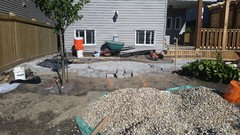
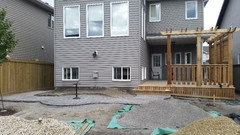
Original Author9 years agoThank you Wisconsitom for replying! I am so happy that I don't need to do any digging. I have one more question for you and I'm not sure if I should start a new post or not. The Ivory Silk Lilac tree is about 5-6 feet away from my paving stone walkway and patio as the tree was put in before the walkway was built. I am thinking I should dig and put a root barrier close to the paving stones but I don't know if the tree could even cause trouble with the patio over time or not. I have seen these trees planted as boulevard trees in my neighbourhood and close to pavement. What do you think? You can see the tree on the left side of the photo below (please excuse the major construction zone in our backyard!)
.Related Professionals
Fort Myers Landscape Architects & Landscape Designers · Ocala Landscape Architects & Landscape Designers · Columbia Landscape Architects & Landscape Designers · Fort Wayne Landscape Architects & Landscape Designers · Saint Marys Landscape Architects & Landscape Designers · Oxnard Landscape Architects & Landscape Designers · Salinas Landscape Architects & Landscape Designers · Las Cruces Landscape Architects & Landscape Designers · Wenatchee Landscape Architects & Landscape Designers · Toronto Landscape Architects & Landscape Designers · Wilmington Landscape Contractors · Saginaw Landscape Contractors · Newark Landscape Contractors · Oshkosh Landscape Contractors · Platteville Home Additions- 9 years ago
wire basket on the Ivory Silk Lilac .......We didn't cut the root ball to loosen any of the roots
==>>> a bit confused here ... i never got a field dug tree.. in a wire basket.. that needed its root ball disturbed due to circling roots .... did you see such.. or are you just worrying about it ??? ... surely this 12 foot tree was not in a pot ...
i wouldnt waste my time with a root barrier ....
is there a potential.. yes.. over time ... on a slow growing tree.. that could be what.. 20.. or 50 years .... is this also something to worry about??? .... i wouldnt ....
just get it done.. do your best.. and stop worrying about it all ... we will fix it all later.. if need be ...
you can not .... and will not.. outguess ... or predict mother nature ... be sure... that if your number is chosen.. and she wants to mess with you ... there is nothing you could have done to prevent it ... lol
please come back.. to a new post.. and show us the end result ... when its all done ...
btw.. the one time i bought large.. and there was a wire basket.. i could not remove it ... so i just cut the top off ... if that tree ever gets 3 feet wide.. so as the trunk might get strangled ... i will be long dead .. lol ... i did the best i could.. and forgot about it.. until you brought up the pain ..... lol .. maybe you could excavate just the top ... few inches.. to cut some of that away??? .. just to assuage your concerns ... [where did that word come from .. lol]
kenCarebear3117 thanked ken_adrian Adrian MI cold Z5 Carebear3117
Original Author9 years agoThank you for taking the time to comment Ken. The tree was dug from the field the year before, put into its wire basket and burlap. When we put the tree in the hole and removed the burlap, the wire basket was embedded in the root ball all the way around the ball. We could only see small portions of the basket on the upper sides of the rootball but we couldn't cut it away. We did cut the very top wire away that was above the root ball or bent it down where we couldn't cut it away close enough. My other two caliper trees didn't have this problem and I was able to easily cut away the wire basket. The root ball on this tree was packed hard with soil though and it was a monster!
I won't waste my time on the root barrier! Thank you for easing my concerns. lol
I tend to worry too much as I don't want to make a major mistake. Since a tree is a big deal, I over think things to make sure I have done the best that I can and hopefully won't regret later like put it in the right spot, planted it correct, etc. I have already lost sleep over some drainage issues in our yard that are partially my fault and can't easily rectify now after the fact. Landscaping is a lot of hard work (since I am doing most of it myself) and I don't know all of the answers so I try to read about the subject the best I can and hopefully not create issues along the way.
Thanks again for your input and I'm sorry for bringing up "the pain" for you again! :)
Carrie
 9 years ago
Good advice from Ken and Tom. To add to this, I see white gravel. DO NOT put this around the tree. The heat reflects off of the white gravel and will burn the leaves, and a few other problems as well that I can't think of off the top of my head.
Carebear3117 thanked Logan L Johnson 9 years ago
Japanese Tree Lilac lifting patio stones isn't something I'd worry about...it's just not that large a tree that the roots should ever get to the size that lift more than a handful of stones. Ditto on the wire basket...the roots will likely never reach a diameter where the wire basket will become an issue.
Carebear3117 thanked Smivies (Ontario - 5b)Carebear3117
Original Author9 years agoLogan, the gravel that is pilled there is for the side yard swale that has yet to be placed. There will be mulch going in the bed where the tree is. I do have a bit of small pea sized gravel mixed in top 4-6 inches of soil to keep the voles from digging. There will be mulch going on top of the soil but of course I will stay well away from the tree trunk.
Thank you,C
Carebear3117
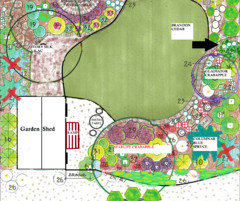
Original Author9 years agoMe again Logan. The light colored gravel you do see in the pile will be kind of close to my other ornamental crabapple though because unfortunately the tree is planted by the city owned easement (drainage swale) and the gravel is there for drainage. There is not a ton of water that goes down the swale but I have been told that I am not allowed to plant any trees or shrubs in the swale itself but I plan to soften the gravel with perennials and grasses. Also, the rock can be pulled back a couple of feet towards the fence from where it is now. The swale runs 6 feet from the back of my fence right across my 40 foot lot unfortunately.
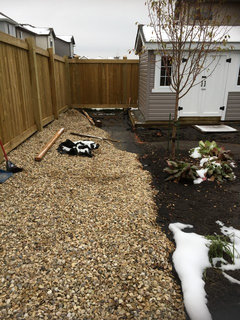
This is a landscape design for my yard. I have made some slight changes but it will give you a better idea of where the swale is in the lower end of the design.
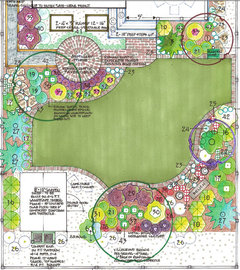
- 9 years ago
I wouldn't worry about the crabapple, they don't last long because of diseases. The others (perennials and grasses) should not be planted in white gravel either. I am sure you can google this and read more on it, no need to write yet another "book" about it.
Carebear3117
Original Author9 years agoIt is a tan rainbow gravel actually. Not white. That's too bad about the crabapples. I have two different avrieties planted in my yard.
- 9 years ago
Well, hopefully they will be ok. Even the "disease resistant" cultivars will only last at most 20 years because the pathogens are always changing.
Carebear3117
Original Author9 years agoDo you have a suggestion about what I could put instead of gravel although my hubby won't want to move the rock again any time soon? There was grass in the swale but we removed it because I didn't want to go behind my flower bed to mow a strip of grass. I am going to plant things along the edge of the gravel and not directly into it. I can't think of a better solution for this easement area other than keep the gravel as a path and then plant some ground covers in the bed next to the easement to avoid soil erosion. I don't really care for gravel mulch because it's a maintenance headache but I already have it and don't see much other choice. Thanks for taking the time to give your thoughts Logan.
- 9 years agolast modified: 9 years ago
I would say mulch, or just scrape the grass of of the area and edge. The only problem is, you say it is to absorb water. I think if you plant enough water-loving plants (maybe willows) with your grasses and perennials they will absorb some of the water.
 9 years agolast modified: 9 years ago
I'd ignore the comments about the crabapple :-) Most varieties on the market these days are very disease resistant and live for years........much longer than you or I!! For some unknown reason, Logan seems to have an aversion to these trees, which are extremely popular small flowering trees and great garden accents. And the gravel is really of no concern either. Unless it is used to mulch plants with very heat sensitive foliage, like laceleaf Japanese maples - perennials and grasses will tolerate it just fine. Its major drawback is that it is extremely time consuming to keep free of debris and weeds. But otherwise, gravel mulch of any color is very common and is used frequently.
- 9 years ago
I'd wash the dirt away or do whatever else I had to get at and remove that wire.
 9 years ago
Carrie, in my experience mulch doesn't work in a swale. Every time the water runs through the swale it will take the mulch away with it. I'd leave the gravel alone; it's going to have a better shot at staying put. If you decide it has to go, I'd figure out what I could plant, instead of mulching.
Carebear3117
Original Author9 years agoHere is my revised design for the swale area. I plan to leave the gravel in the lower end of the swale and along the back of the fence and remove some just where the crabapple apple and columnar spruce is in a circular design as shown and place mulch in that area. I think if I plant perennials along the edge of the swale that have fibrous roots they will help prevent erosion. I can't put shrubs or trees in the swale because of it being an easement and I am not so worried about the perennials being ripped out if the city complains, which is doubtful. Thanks so much for all of your comments and suggestions even though my original post was about my wire tree basket. I really appreciate it!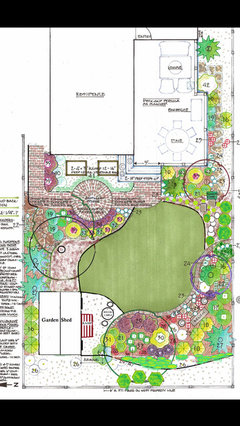
- 9 years ago
Can you plant shrubs along the edge of the swale? You should look at buttonbush and ninebark for erosion control.
Carebear3117
Original Author9 years agoGardengal, I am happy to hear that the more recent crabapple cultivars are usually longer lasting and disease resistant. The tree by the swale is a Starlite crabapple which is supposed to be very good with small persistent apples. I also have two Gladiator crabs which I read are good as well. I had two ornamental crabs in my last yard ( Strathmore and thunderchild) for 8 years before we sold and I didn't have to spray and no diseases. My apple tree in the same yard though had apple maggot due to my neighboyr across the alley not picking up his infected apples. Hopefully these trees last many years. Thank you!Carebear3117
Original Author9 years agoLogan, I can plant shrubs as long as they are not planted in the 6.5 x 40 foot easement. Along the edge by the tree is fine though. Since I'm in zone 3b I was also looking at some smaller Aronia shrubs or even Blue Fox willow shrubs which would love the water but prevent erosion. I also have some Karl Forester grasses that I can plant that also like the same conditions. If there is room on the swale side of the shrubs i could put a ground cover that should help as well. Thanks again!Carebear3117
Original Author9 years agoI needed some small trees for my snall backyard 40' x 40' and I wanted some color and different interest during the seasons. The only trees I had to choose from in my zone were ornamental crabs, ivory silk lilac and serviceberry. My neighbour to the south has a yard full of columnar aspens and I definitely didn't want any of those! 9 years ago
Carrie don't worry about your crabapple trees! They will last for more than 20 years I bet. I planted 2 in 1992 at our old house nearby, and they look great! A number of older homes here have long lived crabs that are gorgeous.
Carebear3117 thanked Dingo2001 - Z5 Chicagoland- 9 years ago
Zone 3b
You want color and interest........
acer platanoides 'royal red'
elaeagnus angtusifolia (this shouldn't be invasive in the OP's climate)
Norway Spruce
Canadian Hemlock
being in zone 3b, you don't have too much to choose from.
Carebear3117 thanked Logan L Johnson  9 years agolast modified: 9 years ago
Hemlock and Norway spruce aren't appropriate for a 40'x40' yard unless they are dwarf varieties. However, if you don't have any evergreens (I can't tell from your drawings) you may want to add a few small, slow-growing ones to provide green in winter. Your crabapples are a great choice in your area: spring flowers and ornamental fruit that attracts birds in late winter. Serviceberry is another lovely small tree, and in my part of the world its really early blooms herald the start of spring while in summer the fruit attracts birds and it usually has nice fall color. Winterberry holly/Ilex verticillata is a large deciduous shrub that produces bright red berries (if there are both a male and a female) that I appreciate at this rather dreary time of year.
As far as the gravel, at your latitude, I can't imagine that reflection from tan gravel will bother any plant - don't worry about it at all; Logan is in the much hotter SE US so it may be of concern there. My biggest question would be that if the gravel is above the grade of the rest of the yard (difficult to tell from photo), it may impede rather than help drainage. If at some point the gravel turns out to be an issue for any reason, you can always remove some of it leaving just a light layer (advertise free clean fill if they remove it) and plant a groundcover other than grass that doesn't need mowing. Possibilities might include a locally hardy Carex/sedge (I like Carex pensylvanica since it stays about 6"-8" tall in my dry yard, but it may grow taller in your wetter area) or whatever Juncus/rushes grow in your area or even Ajuga if the ground doesn't stay saturated for long periods of time. Iris sibirica is a bit taller, but will be happy with wet or average soil. There are also some ferns such as interrupted (Osmunda claytoniana), royal (Osmunda regalis), or Ostrich (Matteuccia struthiopteris) that are happy in damp soil and will spread some. Any of these can be planted with the gravel there, but will be less likely to spread if the gravel is deep. All the plants I've suggested are hardy to z3.
Looks like you and your hubby are working hard to create a little piece of paradise. I'd love to see updates as you go.
Carebear3117 thanked NHBabs z4b-5a NH- 9 years ago
Carrie, I think your plan is marvelous and I hope you'll post more photos as it progresses. I would try to incorporate several dwarf evergreens but... heck... you may get so much snowfall that they would be buried all winter anyway.
Carebear3117 thanked cecily - 9 years ago
Gravel=no problem. Let's quit wasting bandwidth on that. There are situations where white stone can be limiting. This ain't that. Fl. crabs...in Z3...are long-lasting, highly sought-after landscape ornamental trees. They are-overall-the longest-lasting of ornamental tree types for the north. Nuff said? Norway maples-of all stripes, variegations, purple leaves, seeds that explode like fireworks....I don't know...are all highly invasive in N. America. Let's knock it off, knuckleheads. Norway spruce? Hemlock? Two of my very favorite tree types right there, and utterly unsuited for this job.
Carrie, where drainage swales are concerned, one thing that can work out real nice is what we call a vegetated swale, consisting of native, pollinator-friendly grasses, sedges, bulrushes, forbs (flowering plants), etc. which provide beauty, cover, nutrition and reproductive possibilities for pollinators, and will lay down and allow water to pass through when a big rain hits, something woody plants won't do. All while holding the soil in place. This is the reason that stormwaterr management practices in the US are so heavy on non-woody species. A shrub or tree will trap debris, that debris will trap more debris, and eventually water is backing up and flooding some neighborhood somewhere. So it's all grasses and forbs. Just a thought-these plantings can be a delight to behold.
Carebear3117
Original Author9 years agolast modified: 9 years agoWinconsitom, thanks so much for your advice! I am in Alberta, Canada so you are correct in saying that crabapples are a big part of the smaller trees that are grown here. Otherwise, people grow a lot of swedish columnar aspens (don't want!), maples (also don't care for as usually they are weed trees), ivory halo lilacs (I love those), hawthorns, serviceberry's, mountain ash's etc. Norway spruces and hemlocks are nice trees but too large for my yard I have found. I did plant an Picea pungens 'Iseli Fastigiata' which should be nice and narrow for my yard. I think at this point I have enough trees for my landscape as you can see in the plan below (the red x"s are trees I have moved or removed from the plan). My neighbour to the south has so many trees in his yard that is the same size as mine that I hate to see his yard in 5 years!
This is what my city's drainage guidelines state.
"Topsoil and sod should be placed so as to reflect the contour of the Rough Grade. Homeowners are not to change the drainage pattern, make significant changes to the elevations of the lot or block a drainage easement."
So far I haven't blocked the drainage swale but I I already have a couple of trees immediately beside the swale, one of which will drop leaves and tiny crabapples. I also plan to put plants/shrubs next to the swale. If I didn't plants near this area it would be a pretty boring part of my yard that would be mostly unusable. Since my yard isn't very big that would be horrible for me as someone who loves to garden. I would prefer plants any day to expanses of lawn and rock.
My back yard has split drainage. From the middle of the yard, some of it goes to my side swale that drains to the front street and the rest drains into the swale that I posted a photo of. I am also on a hill so neighbouring properties have some of their drainage water pouring into my swale. The water then goes down the hill to the storm pond.
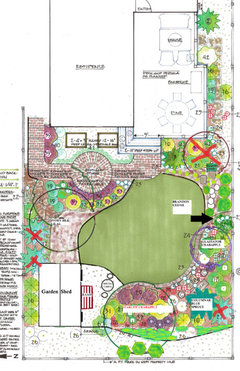
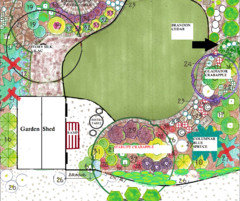
My backyard at this point is heavily compacted silty clay with a small amount of topsoil on top so I will be looking at fixing the drainage in the spring (we didn't get a chance to finish this past summer) because at this point the water just runs down the slope causing erosion and more compaction. I think once I get my grass in, amend the soil some and put my plants and flower beds in there will be way less erosion and run off during a storm.
Drainage pattern (red arrows)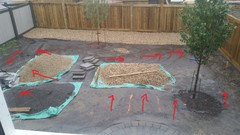
I will look into the plants you mentioned and I also plan to plant some that can take the moist conditions and anchor the slope.
Thanks again for your suggestions!
Carrie
Carebear3117
Original Author9 years agoNHBabs, So far I have a columnar spruce Iseli that I have planted along with a brandon cedar. I also plan to have some lower growing conifers mixed amongst the other shrubs and perennials like nest spruce, dwarf black spruce, little gem cedar etc. to give my yard some more winter interest. The Winterbelly holly you have mentioned would also be wonderful!
The swale grade by my back fence starts high at the top end and as it proceeds to the right the grade gets lower. You can kind of see how it is in the photo below during a rainstorm with the red arrows showing the drainage path.
At this point not a lot of water goes into the swale but drains in front of it so I have had to adjust the drainage as I put my shed right in the actual drainage path and now I have to regrade so the water goes around my shed and down the swale as it should be.
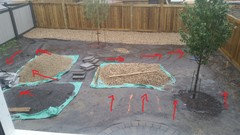
A low spot by the shed that has pooling water as my neighbour's grass just beyond the fence is slightly higher than my low spot. This has to be fixed in the spring. :(
I will look into some of the plants you mentioned for along the edge of the swale. Thank you so much for your recommendations and for taking the time to comment.Carrie
Carebear3117
Original Author9 years agoCecily, I hear you on the snow. Although the last few years have been pretty dry and mild here. We do have years though where we can get two feet of snow and it is bitterly cold. :) I will for sure incorporate some more evergreens. At this time my unfinished back yard is heavy silty clay soil that is compacted with very little organic matter and I rarely see a worm. I have the compost bin going and hopefully after some intervention I can grow conifers with no issues of water logging. So far I have planted a columnar spruce, nest spruces, dwarf black spruce, a brandon cedar and some perennials that are more evergreen such as bearberry. Thanks for your comments. :)
Carrie
- 9 years agolast modified: 9 years ago
Another type of plant I can't tell whether it's specified on your plan is clematis vines; if you don't have any under consideration, you might want to add some in various spots along the fence, though they don't want to be in the drainage swale since they aren't fond of soggy soil and may interfere with drainage. You can run wires or string from the base of the plant up the fence to give them something to cling to to break up the solid look of the fence and to give you some height without the bulk of trees. There are several that will be fully hardy in zone 3; if you do a search at Clearview Horticultural's clematis collection, you can specify hardy to zone 3 over at the left side of the linked page to get a listing. (I am assuming that in zone 3 you are most likely Canadian but Clearview provides plants to the US as well.) They supply many garden centers, or you can order through their retail website. I imagine there may be other suppliers more local to you but in my rural area I mostly have to purchase clematis online.
- 9 years ago
Carrie, I don't want to leave you with the impression that tiny things like individual crabapples, etc. are a problem for drainage swales. I didn't mean that. What I am saying is, woody plants-my favorites-are seldom chosen for stormwater conveyance projects due to their stiffness. They will accumulate debris in a heavy rain event and start to cause the water to back up. Your little bits of things are not to be a problem. I'm talking about full trees and shrubs in the way of the water. Your situation is not of this nature. Good luck!
Carebear3117
Original Author9 years agoThanks so much wisconsitom for clarifying what you had meant. I obviously misunderstood what you were getting at but it is clear to me now. lol. :-)



floral_uk z.8/9 SW UK