Software
Houzz Logo Print
weedyacres

Refinishing reclaimed cargo planks

9 years ago
last modified: 9 years ago

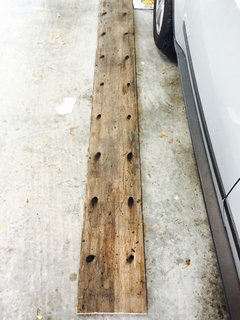
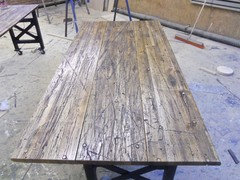
I bought some of these butcher block style oak planks salvaged from the floor of cargo containers

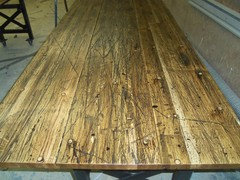
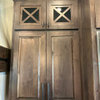
I want to make a desk and credenza top that have a finish similar to this:

I need to clean, but don't know what product would work best.

I need to sand off the rough spots, but not too much so as to remove the scuffing and character.

I need to stain/finish, but am unsure what products would enhance the wood without covering up the character.

I've worked a fair amount with wood, but my finishing experience has all been sand/stain/poly on new wood. I'd appreciate any help you can provide on what would work best with reclaimed wood and how best to go about this restoration process.

Comments (21)

  • 9 years ago

    For the look you are after I believe scrapping is a better choice than sanding. To really accentuate the distressed look,apply a dark oil base wippeing stain that contain's pigments but no dye before sanding or scrapping. Considering the source of material I would expect it to have several different type spill stains. For that reason I would opt for multiple applications of an oil like Watco,wipe on varnish or home brew mix of oil/varnish.

    weedyacres thanked klem1
  • 9 years ago

    Scrapping? Do you mean "scraping"?

    I would scrub it well with a brass or stiff synthetic brush and soap and water to get the dirt off. Then see what it looks like.

    The rough spots -something like this


    https://www.amazon.com/Red-Devil-3002-Carbide-Scraper/dp/B001SBNGDS 

    Followed by fairly coarse sandpaper and sanding blocks until it's "smooth enough", which only you can decide.


    Klem's idea for finishing would work well. With the wiping stain, stir it well and apply it with a cloth dipped in the stain, wiping ON the stain in thin coats. It's easier to control the looks than the usual method of sloshing on a lot of stain and trying to remove it evenly.

    weedyacres thanked User
  • 9 years ago

    Scrape the scrap wood? Yep,that's what I was trying to say. The idea is that pigments will be removed from high spots but remain in low spots similar to the inspiration picture above.

  • 9 years ago

    Klem: so something like tung oil or linseed oil? Would I topcoat it with something to protect or seal it?

    Handymac: I did some more internet research on what you recommended above, and it looks like I'd need to use a dewaxed shellac, correct? Any recommended sources for a newbie looking to pick out the right stuff? And can you really stain over it?

  • 9 years ago

    Tung or linseed might be one of the ingredients in the finishing oil chosen but I wouldn't use the pure form of either. Top coating is optional over most oil finishes (check the label) and unnecessary for wipe on varnish or varnish-oil combo home brew.. If you decide to top coat oil,wait a few days after last coat of oil and be certain coat is compatiable.

  • 9 years ago

    I used a rotary orbital sander on mine (80,120,220 grits) and finished mini wax Spar Urethane clear gloss. Here's the before and after.

    weedyacres thanked Jeff Fantich
  • 9 years ago

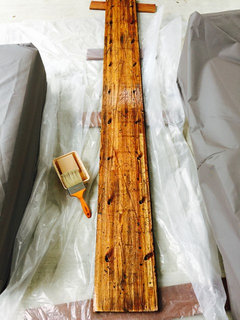
    Clean with a poly brush and bucket of soap. I also used a pressure washer on the lightest setting.

    weedyacres thanked Jeff Fantich
  • 9 years ago

    Jeff: those boards look familiar!

    So far I scrubbed them with soap and water (oh the dirt that came off!) and sanded 40-60-120. I've got some shellac flakes arriving Saturday. Need to glue them together this weekend and then will get to the finishing next week. Still undecided/confused about what to put over top. I'm limited to Lowes and SW for sourcing, so if anyone has specific brands/products to recommend, I'd appreciate it.

  • 9 years ago

    Every finish has strong points and weak points so you must tell me what you want out of a finish before I can reccomend what to use. I already suggested oil simply because you said you are a novice and it's almost impossible to make a mistake that's not easy to reverse. If you insist on "The best",you must assign importance to each of these. Wear,resistance to chemical spills,resistance to water,ease of future damage repair,scratch resistance,ease of application,resistance to sun,resistance to heat,odors while applying and drying,ease of tool clean up,cost,environmentally friendly,desired gloss plus anything else especially important to you. Anyone that recommend's a product without knowing all that shouldn't be taken seriously. I will say you should vote Republican,drive a Honda,eat only veggies,part your hair on the right,wear steel toe boots,attend The Church Of Christ,live in a mixed neighborhood,send your kids to private school and drink RC Cola.

  • 9 years ago
    last modified: 9 years ago

    Scratch resistance and general wear resistance are most important (will be a desk). Repairability in the case of dings would be secondarily important if I can't get (reasonably) bulletproof.

    Look: I want a medium brown, golden, not orangey or reddish. Satin finish.

    It won't have exposure to water, chemicals, heat (other than a laptop), sun.

    Would prefer low odor, but not a big deal if it smells (I can ventilate). Don't care about environmentally friendly. OK to have either water or mineral spirits cleanup.

    BTW, the topography of the material already has darker low spots, because they can be cleaned but not sanded, so a single finish wouldn't eliminate the variegated color.

    And I INSIST on parting my hair on the left.

  • 9 years ago

    If the low spots are a satisfactory color,do all your sanding then use dye stain to color sanded areas. If you want a different color in low spots,do as first suggested with pigment stain before stating to sand. Urethane topcoat will achieve the durability you are wanting but is difficult to repair later. Things will be more predictiable and go along easier if you go with satin oil base urethane. The oil base urethane will add a slightly ember tone to stain color. If you think the wood is contaminated with something that might resist stain or you want to put nessary efforts into achieving exacting results,by all means follow Mac's advice for shellac. Buy your stain and topcoat from SW,making sure they are compatible. Practice is the only way of getting to the point of knowing how it will look before applying anything so try your hand on side of boards that don't show when complete.

    I don't agree with the majority about necessity of sanding between coats but don't usually bring it up simply because it's so widely preached. Since I believe sanding could harm your project,I'm going to present my case then you can do as you please. Sanding dust will lodge in the voids and be difficult to dislodge. Same as painting outdoors in the wind or in a dirty room ,sanding dust can ruin an otherwise good finish. I prefer to recoat soon as last coat is dry enough. You should watch your brushing technique to avoid excess topcoat in voids. I fear the build-up might fail to dry and cause blemishes in the future. I would think keeping brush a little dryer than usual and making additional strokes might help.

  • 9 years ago

    WeedyAcres " I'm limited to Lowes and SW for sourcing, so if anyone has specific brands/products to recommend, I'd appreciate it."


    And everything on Amazon, Rockler.com and the rest of the internet.

  • 9 years ago

    And everything on Amazon, Rockler.com and the rest of the internet.

    True, but I'm working toward a deadline of next Wednesday, else I'll be working off a card table. Which wouldn't be the end of the world, but trying to meet my deadline.

  • 9 years ago

    Well, if it's a deadline ... Lowes carries Minwax and Varathane penetrating stains.

    Here's some I have used for good brown colors:

    Minwax: Jacobean, dark walnut, special walnut and Provincial are all solidly "brown" with minimal red.

    Varathane: Dark Walnut, American Walnut, Mission oak (it's the dark "Craftsman" fumed oak), (the rest of theirs tend to the reddish side).

    If you want it darker than Jacobean or mission oak ... mix in Ebony cautiously.

    Do the "wipe on" method - dampen a staining cloth in mineral spirits and then dip it in the well-mixed stain. Wipe with the grain, in multiple coats. If you apply some mineral spirits immediately before the wipe of the stain rags you can minimize blotching and grabbing - the grabby parts grab the mineral spirits.


    As for the finish, also wipe-on: Minwax Satin Oil-Based 16-fl oz Polyurethane. I used it on a door and a dining table, and it was wonderfully low-gloss

  • 9 years ago

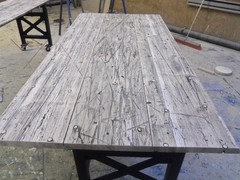
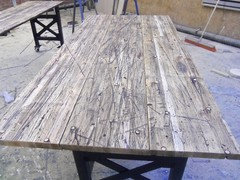
    All right, I'm ready to report progress/completion.

    After gluing the boards together, plugging the holes, and mounting them on legs, I sanded:

    Then I shellacked with unwaxed platinum blonde to seal everything.

    Then a wiped-on coat of Minwax Special Walnut:

    Then 4 coats of clear satin Helmsman spar urethane (the 4th coat because I didn't mix well enough and had a sheen mismatch).

    I'm looking forward to moving them into my new office tomorrow (just a week late) :-/. Very happy with how they turned out, and thanks for all your help!!

  • 9 years ago

    A worth while project i'm sure will be around for a long time.

  • 9 years ago

    Nice! What are the circles? Knot holes? Patched bolt holes?

  • 9 years ago

    Patched bolt holes. They were varying sizes, and tapered, so I took a forstner bit and drilled them out at a uniform diameter and depth to make it simpler to plug them.

  • 9 years ago

    And it turned out looking like vintage construction with wooden dowels. Unless it will fit under drill press, I drill hole in plywood then clamp over hole to be enlarged,what's your method to prevent bit walking?

  • 9 years ago

    Hey klem, sorry I just saw your question. Since there were already holes/dents, the bit was just cleaning them up, so I didn't have a problem with walking.