Software
Houzz Logo Print
callights

Heating a small mudroom addition

9 years ago

Hi all,

Here in Chicago. We are going to be tearing off our dilapidated back porch and rebuilding it into a mudroom. It will end up being about 90sqf of new construction on the back of our house, with a 12' wall of south-facing windows, and a slate tile floor. We will be keeping the existing exterior door into our house, so this mudroom will be totally separate from the house most of the time. It will have a sink, so I need to keep it above freezing.

The heating requirements for this mud room will be very different than the heating requirements of the rest of the house. I imagine we will want to keep the mudroom around 55º–60°F in the winter and we will have no cooling requirement in the summer.

It seems silly to me to build a supply and a return and tie it into our existing 95% efficiency gas forced-air furnace—even though I believe it could probably handle the extra load no problem—since I don't want to heat that space to the same temperature or on the same schedule as the rest of the house.

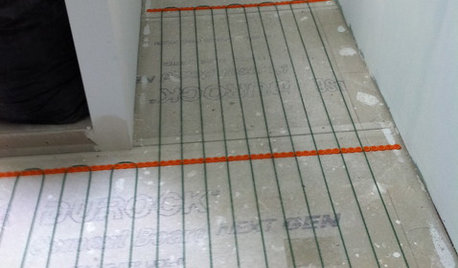
What would you all recommend? I am considering electric in-floor heat, but I'm worried about the running costs. I expect those wall-mounted electric radiators would have the same running cost problems.

I guess we could look at a small gas-fired hydronic radiant floor system, but I don't know if there are systems for such a small space?

Any advice would be greatly appreciated.

Comments (14)

  • 9 years ago

    I suggest running a duct to the mud room if it is not difficult. It would be good to have a return but it is not necessary. The room will probably be colder than the rest of the house since it exposed on three sides, has no attic, and has an external door.

  • 9 years ago

    I agree that your present furnace is probably the best choice as far as installation and operating costs. With a wall of South facing windows I'd consider desighning passive solar heating into the room during construction. It's possible the new room can contribute heat to the rest of house. It's not necessary to heat the room just to protect a sink. Put water lines between adjoining room's drywall and insulation. That will protect them from freezing as long as adjoining room is heated. Wrap a small automatic heat tape around trap.

  • 9 years ago

    It is possiblie that the room can be warm enough with no heat added.. Those calculations can be done. The minimum temp of the house will have to be considered. If you go away for a week, have the temp set back to 55, it its cloudy, and the minimum temp of the region is reached while you are gone. (You could just leave that door open under those conditions I suppose.) If the insullation is removed from the wall, you can get more heat transfer.n It might take an energy expert to help you with the valve, but you might also get an evaluation of the rest of your house at the same time. If duct is added, the room can be cooler than the rest of the house dependent on the size of the duct.


    Mike, how can you have no return in a sealed rooom? A return will have to be provided, or some vent to the rest fo the house made.

    Good point about the room providing passive heat. Heat tape on the trap can keep it from freezing, If gone for an extended period, it could be shut off and RV antifreeze poured in. Supply taps could be a hydrant type, maybe.

    i don't know if wall-hung gas heaters are made small enough for that room and good ones are not cheap,

    I'd make sure the room is well sealed and insulated and investigate what the heat transfer rates will do for you.

  • 9 years ago

    it would seem this is a choice of comfort, control, and cost. Nothing about cooling has been discussed, maybe not an issue. I suspect your least expensive choices would be adding ductwork both correctly sized small supply, and small return. This would also give you AC in the summer. Next would be strip baseboard electric heat. Then comes radiant in floor heat either from boiler or electric. The last 3 choices offer no AC cooling. Mini split HP would be OK but probably overkill and expensive for such a small zone.

    IMO

  • 9 years ago

    I suspect the mudroom is going to have some amount of air leakage that is why I said a return was not necessary. It would depend on how tight the seal is on the door and windows. Also the OP said the mudroom does not have to be at the same temperature as the house and cooling is not required. These are additional reasons for not spending a lot of money installing a return.

    But if the return can be installed at a reasonable cost then by all means install it. You then have figure out how far apart the supply and return will be. In a small room this may be a challenge. Ideally they are at opposites ends of the room with the supply near the floor and the return near the ceiling.

    An electric baseboard may be easier. This would allow you to set the temperature to say 60 degrees to keep the costs down. Then you install some wine racks and have a nice walk in cooler. I am starting to like this approach. :)

  • 9 years ago

    I would want this room to have above average insulation/bldg properties with little to no leakage. Adding return depending on access is cheap, already would be adding a supply. Could use flex for both.

    IMO

  • 9 years ago
    last modified: 9 years ago

    Y'all,

    Thank you so much for all of these suggestions. There's a lot for me to mull over here.

    I am mostly interested in comfort and running costs... less concerned with construction costs (within reason, of course).

    This mudroom area will be very tightly constructed and isolated from the rest of the house. We are keeping the existing exterior door from our kitchen to the existing back porch. I believe I would need a return if we went with forced air.

    The shared wall between the mudroom and the kitchen is already insulated with spray foam. Removing the insulation to try to "heat" this space isn't really an option.

    We do not want AC in this space, specifically because in the summer we will use it as a wet bar for the back yard. I expect the windows and (new) exterior door will be open a lot of the summer.

    It would be physically possible to run a supply and a return to the porch, I'm just not thrilled with that idea. On a cold day, getting kids/strollers/groceries/etc in from the car, I don't want to be sucking dry, 0°F air directly into my HVAC system. I'll do it if I have to, but I'd like to explore other options.

    Electric baseboard is a possibility, but I guess I'm wondering if I'm going to use electric baseboard, why not use electric in-floor heat instead? Not having baseboards will make the cabinet install simpler.

    Using a gas-fired tank-type HWH for in-floor heat seems like a bit of a hack? I wish someone made a really small gas furnace :-/

  • 9 years ago

    If you run the numbers, you will probably find that with such a small, efficient room, operating cost is so low that it does not pay to fret over heat generation efficiency.

  • 9 years ago

    Haha. Well... fair enough.

  • 9 years ago

    ionized-gw has a good point about the size. It also depends on how well insulated and how many days are truly 'risk' level in the sense of being that much colder, and how much it would bother you if it was colder than your ideal (especially, say, at night). You might find that you can keep it at the target temperature most of the year with minimal heating (and electric expense, if used judicioulsy with a timer).

    Put slightly differently, is it a big deal if it hits mid-40s a half-dozen nights a year? Has to be balanced against comfort requirements, cost, construction, etc. If it's well insulated, it might be that leaving the door to the house open from time to time is enough, as well.

  • 9 years ago

    I believe you are over thinking the whole thing. For example,why would you need to "Remove the insulation to try to "heat" this space"? Or, "On a cold day, getting kids/strollers/groceries/etc in from the car, I don't want to be sucking dry, 0°F air directly into my HVAC system." Why would it be that much different than entering most homes and specifically from the present porch? If anything the airlock effect would be quite an improvement.

  • 9 years ago

    My insulation comment was a response to Ionized's suggestion of removing insulation between the new mudroom and the house. I'm not interested in doing that either.

    And our present situation is exactly why we are adding this airlock. I don't want to negate the benefit of the airlock by adding an HVAC return inside the airlock.

  • 9 years ago

    You should not have a room with a supply and no return air path. You either need a return in that room, or you need to provide a way for air to return to rooms that do have a return path. That can be by a real return, undercutting a door, jump ducts or straight grates in a wall.

    The problem with no return path is that pressurization of the room will result in, depending on how well the exterior is sealed, a combination of poor supply air flow or leaks out of the room in random places. If the leaks are to the exterior of the home, makeup air will have to be sucked in in other random places elsewhere in the home (around windows, and doors, from the attic, from the basement,....

    I think that you should first focus on the heat loss for that room. If a couple of 100W incandescent lightbulbs will heat it to the level that you need on the coldest day, it really does not matter what kind of heat you install from an operating cost standpoint. (Err,. make that 3 x 60W since you can't buy 100s anymore.) You are investing in the efficiency on the loss side in your new construction. Good for you, but sometimes it does not pay to "double up" on efficiency measures.

    Your mudroom will not have a thermostat so the main heating system will not be responding to the temperature back there with door openings in cool weather. That fact, coupled to the efficiency of that room will ensure that it does not affect your main heating plant very much at all. It will be the least expensive way to heat the area if supply and return ducts are practical. If not, just install electric heat under the floor if installation and operating cost calculations support that.

    Don't hamstring yourself by saving your HE furnace from battling the elements in your new room. Efficiency is why you bought it. If you don't use it, you'll be like the British with their navy in our revolutionary war. The admirals refused to use the great resource to the maximum advantage in the war for fear of battle losses.

    If you plan to have pets in that room while the heat is running, please check into that. I have no pets and no radiant heat so I have not made myself an expert. In understand that they need to have a way to get off of warm floors for their safety.

Sponsored
Kuhns Contracting, Inc.
Average rating: 5 out of 5 stars26 Reviews
Central Ohio's Trusted Home Remodeler Specializing in Kitchens & Baths