Software
Houzz Logo Print
joey_gibellino

Painted Kitchen Cabinet Nightmare HELP

9 years ago
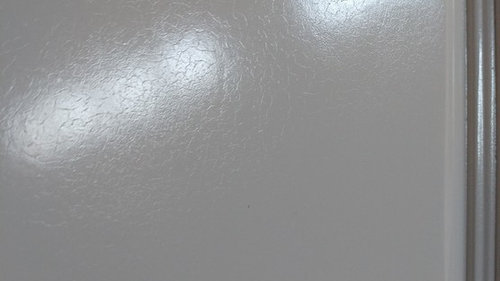

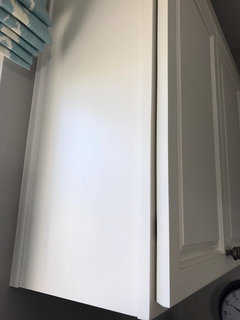
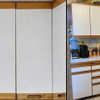
So my DW and I decided to have our kitchen cabinets painted and lets just say we will forever refer to the last SIXTEEN DAYS as the "Nightmare before Christmas!" There is so much wrong, drips/runs, paint chipping, roll marks (from where he tried to correct some drips), the list goes on...
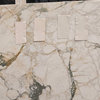
And a few of the cabinet faces have the look of a cracked hard boiled egg shell. I will try to attach a picture, but it like tiny little cracks like aligator print all over. Can anyone tell me what this is from? The painter tried to blame it on the wood...
Thanks for your help

Comments (17)

  • 9 years ago

    The crackling comes when the top surface dries and shrinks before the rest of the paint. (paint too thick, room too dry)

    OR it can be because of contamination on the surface being painted. (if you want to ensure crackle, you paint a thin layer of white glue on the piece, then paint over the dried glue)

    OR it might be because of the oil over latex / latex over oil problem.


    What paint was used?

    What was the prep process?

    Were they stained or painted before this paint?


    Joey Gibellino thanked User
  • 9 years ago

    They were stained first, then primed with BIN (without sanding btw by a "professional" then painted with a industrial grade enamel. Priming on these doors was done a day before and left in a cold garage. Then painted the next morning at 10am and somehow had enough time to dry so they could be flipped over and the other side painted as well in less than 3 hours! I was thinking it had something to do with the cold temperature and maybe he set them by a portable heater to get it to dry so he could paint the other side. But maybe the paint was just too thick. You should see the rest of the cabinets...smh. It is so unbelievably bad. My cabinets are destroyed. He used joint compound on my cabinet face frames! You can imagine how that looks/feels

  • 9 years ago

    This comes up all the time. Doors and drawer fronts need to be removed from the premises and prepped in the shop and sprayed with a catylized lacquer. Anything less results in some variation of this.

    Joey Gibellino thanked User
  • PRO
    9 years ago
    last modified: 9 years ago

    BIN was my primer of preference. However, I would never be spraying in an unheated garage. Cold and damp definitely affect how a paint dries. The relative humidity in an unheated garage can easily be 80% or 90% . I suspect given the environment, that he was rushing the process and that the crackling is due to the primer not being totally dry, even though BIN dries very fast under normal temps and humidity.

    During my contracting days, the doors and drawers were always taken back to the heated shop where they were cleaned and prepped, primed with BIN, and then sprayed horizontally with an alkyd enamel. Runs were impossible as the doors were flat. This of course required that the finish coat be done on two days, but the finish was impeccable.

    What to do: I suspect that a really good sanding, re-priming and painting in a controlled environment, would cure the situation. Hopefully, you have not paid your painter yet! You should not pay him until you are satisfied.

    Joey Gibellino thanked Paint sales at Home Depot
  • 9 years ago

    I know you weren't hoping for it, but that's a darn nice crackle finish.

  • 9 years ago

    If only I wanted a crackle finish! LOL and if it were on all the cabinets then maybe...a few have the crackle, some where he sanded down drips he used a roller, so there is the roll texture, and others where the spray was ok it is smooth (except for the dust that is trapped under the top coat!). Its SoCal so the temp was in the 60's, not sure how humid it was. I have paid them a deposit of $1200 and just had them come over for the "final walk through." They told me there was nothing wrong and you could only see the marks from certain angles and I am just too picky. Didn't have anything to say about the drywall mud that was used at the joints of the face frames. I was told they are done working for me. I said I was done with them as well, I'm going to find a professional and even though I should get a refund of my deposit, I know I won't but I'm not paying another dime. Then they flipped out stormed out and said threatened to blast my companies social media (I'm an HVAC contractor). What a joke! What a nightmare. i'm going to withhold their name for now, but if they go there, everyone with a computer will know about the type of work they do and the kind of professional attitude they have.


    If I have them redone, does it all need to be sanded down to the raw wood? And if so, what are the odds that it looks right after someone sands through 2 layers of paint and a layer of primer?

  • PRO
    9 years ago
    last modified: 9 years ago

    I liked BIN as my primer due to: its speed of drying, terrific adhesion, no "fish eyeing", and its ability to flow out and not need sanding. Should bare wood be present, being non water soluble, it does not lift the grain.

    I think the painter goofed by trying to spray in a bad environment: too cool, too damp.too dusty. I always took doors and drawers back to my shop where I could control the variables.

    I don't know the labor rate in California, but in the Portland area, $1200 would be way on the low side for a quality cabinet paint job. It sounds like they expended a fair amount of labor, but weren't working smart! Also, no way should such a project drag out for 16 days!

  • 9 years ago

    David Jensen, it was 16 days because after the job was completed the first time (in 5 days) all of the paint was flaking off just by me lightly running my fingernail accross it. So the owner said he would redo the entire process and make it right. 9 days later and it is worse than it was to start. $1200 was just the deposit. I still "owe" him $3000 which I am not going to pay until I have a real professional or 2 or 3 come out and tell me how much to make it right. Than I'll give the first painter whatever is left over (if there is any).

  • 9 years ago

    Paintguy,, there is an uneven 2" strip of drywall mud at every face frame joint. It didn't sand smooth AT ALL. He didn't fill any divots in the wood actually. And 3 hours was the TOTAL AMOUNT OF time he was here. It was MAYBE 2 hours between the time he painted the front and then flipped over to the back. Now the guys is already changing his tune and saying he will accept half...he knows he messed up.

  • 9 years ago

    Wow, $4,200 to destroy some cabinets? I need to raise my prices!

  • 9 years ago

    Drywall mud on cabinets? Not wood filler or something meant for cabinets?

    The mud will crumble under impact and fall out.

  • PRO
    9 years ago

    I used drywall easy-sand "hot mud" has my preferred patching material. I dries quickly. Hot mud seems to have better adhesion than regular mud.

    As Paint Guy states, areas subject to stress or movement such as joints, caulk would be better advised.


    As

  • 9 years ago
    last modified: 9 years ago

    I live in Socal and used all kinds of paints in different temps, and never had this problem. I used BIN and BM Advance to paint my previously stained cabinets, and they still look as good as the day I painted them. My thinking is this guy either didn't understand the products he was using or didn't care. Extreme temps in Socal? Maybe twice a year, but I doubt that's the day you choose to have your cabinets painted. I did sand between layers of BIN, caulked, and buffed between layers of Advance. No I didn't use a sprayer, so dripping was not an issue. Just curious, did this guy have any examples to show you or reviews? I'm not a pro and I'm pretty sure you could have done the same yourself, or at least better than this guy.

  • PRO
    9 years ago

    You don't have to have extremes when working in an unheated garage. As the temp goes down, the relative humidity goes up. Cool temps and humidity definitely slow down drying. It may look dry, but internally is still setting up. Rushing drying, where the previous coat is not through drying, encourages cracking or "alligatoring". The two coats are bonded together, but moving at different rates,hence the cracks in the film. Also, the new water based alkyds have a dry / re-coat time more in keeping with real oil alkyd, rather than acrylic based products.

  • 9 years ago
    last modified: 9 years ago

    Perhaps primer was not dry. What type of paint? Did they use spray can anything? Too thick of a coat with spray can will give crackle. Or as others mentioned wet bottom and dry top gives crackle which would make sense as they probably used cold paint and then tried to dry it quickly with heat.

    My condolences for your loss. A complete chemical stripping and redo in a conditioned room (or during summer) is in order.

  • PRO
    9 years ago

    If you read the directions on any RustOleum spray can, it very specifically tells you that a second coat must be done within the first hour, otherwise, you must wait 3 days! This is because of the drying rates of the layers which are bonded together. If you don't follow these directions, wrinkling of the finish can occur. This is an extreme example of what happens with any paint.