Software
Houzz Logo Print
mrshottmiller

Evergreen Privacy Advice

9 years ago

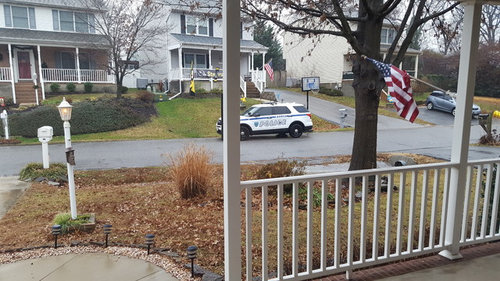
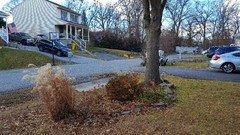
First time homeowner here. I'm far from educated on the gardening front so I'm hoping you guys can help me out. I'm less than thrilled with the appearance of my neighbors homes, especially the one across the street which I stare at through my large living room windows all day. Can anyone recommend a fast growing evergreen that would be most appropriate for a privacy screen to edge my front yard with? I'm located in Maryland. I have two gorgeous Thuja's I planted again at my back fence last September to block out rear neighbors and they've grown from 5' to approx. 7' in 15 months. Are they my best bet? As you can see, I have a drainage ditch in the front and a 20 year old 50' Maple.


Comments (44)

  • 9 years ago

    I think your best chances of blocking the view any time soon is to kill the big maple to eliminate competition for light and water then plant some bad idea hedge or Thujas RIGHT in front of that white banister and walkway.

    Honestly I'm against the idea entirely. It will make your home look like it is encased in some 1960's overgrown foundation plantings and get ride of almost all the benefit of having the big window.

    Another idea I don't support....you could also plant two weeping willows out front after killing the maple. They will grow as fast as anything and hold their leaves for quite some time. At least that way SOME light will get in your house.

    Dottie Miller thanked Toronado3800 Zone 6 St Louis
  • 9 years ago
    last modified: 9 years ago

    Hardy bamboos will be the fastest and do not produce the gloom and heaviness (resulting eventually in the claustrophobic effect) of conifers. And there are densely clumping species on the market that never run (pop up where not wanted). However the tall ones that may be needed to completely block out the houses in this situation are runners. If any of these are brought onto the site serious provision for containment of their vigorous root-stocks will have to be made, in order to prevent the development of a mess.

    Otherwise if it were me - and sufficient funds were available - I would probably want to first meet and continue the neighbor's ~natural finish wood fence out to enclose, screen and secure my front area. From that point planting could proceed in a more leisurely fashion than if the space is still as raw, open and publicly accessible as it is now. (If you have a white fence in the back and do not feel the natural finish would match your house you could of course bring that out to the front instead).

    The best basic arrangement for decorative mixed planting is widely spaced trees used as accent points under-planted primarily with evergreen shrubs, used to produce a year-round appearance of fullness and permanence, with herbaceous plants and other plant growth types used at certain key points to increase interest and generate a finished look.

    As these often do, the existing maple, depending on what kind it is (it sounds like it is quite vigorous) may in fact soon begin to dominate the space physically - resulting in a large percentage of the existing potential bed (or lawn) area being effectively unusable. Also it may soon become too tall for the defined planting area visually, if it isn't already.

    It depends on if you would prefer a more conventional and relaxed scene such as I have begun to describe here or if you really want a jungle style planting, that screens everything around out and gives you your own little thicket to disappear into. If inclined in the latter direction you might want to explore and utilize plants that have a visual character that makes seem tropical in origin. Typical features of these are large leaves, evergreen leaves, bright colors (of both leaves and flowers), rich floral fragrances and so forth. Such plants would also look compatible with the starkness of a white fence and other white architectural features.

    Another involved element to consider is that often partial screening of unwanted views produces a level of relief that was not anticipated beforehand, when the entire view was visible - it may not really be necessary in a particular instance to install large growing, probably soon overwhelming hedge plants or other screening elements tall enough to block the entire view right from the start - or in the near future.

    Finally it is also possible to eliminate unwanted views by screening yourself. That is planting shrubs or installing architectural features near where you are looking from, rather than out on the part of your property nearest to the unwanted view. When approaching the problem from this angle less material is needed to hide the view and a quicker result becomes possible. For purposes of illustration using familiar examples think of blinds or curtains in a window versus a high fence or wall all along one side of a lot.

    Dottie Miller thanked Embothrium
  • 9 years ago

    You don't really have room for anything fast growing. Anything fast growing either gets huge or is weak wooded and dies young...there are a few fast growing things that can be kept small with pruning, but that is a LOT of work.


    I like American Holly (ilex opaca) in your climate. Evergreen, shade tolerant, reasonably tolerant of pruning. NOT fast growing, but anything fast growing will cause problems.

    You could try a magnolia...not so much to completely screen out the yard as distract from it.


    Or you could put in a trellis with vines climbing it. Much faster, but be careful not to chose an invasive species.

  • 9 years ago
    last modified: 9 years ago

    Thank you so much for the responses. We had a magnolia on the other side of the island and it was moved to the backyard as it didnt do well in the front yard. Removing the maple isn't an option as it holds sentimental value to our family (the house has always been in our family, it was planted the day my parents moved in). I have a Holly (unsure of the type) on the corner of my porch which grows quickly. What if I planted Foster Holly's against my porch and just keep them trimmed back from the structure itself and scrap the yard perimeter idea? I really appreciate the help.


  • 9 years ago
    last modified: 9 years ago

    I would use rounded or low shapes rather than pointed ones that would poke up in into the railing and air space above it visually. That is what would look best with the house, viewing from the front.

    If instead you are trying to make a green screen across the front, behind which the porch will disappear your best bet would be clumping bamboos and other soft looking, elegant plants that are not so dense, dark and stiff as something like the existing holly.

    And also not prickly!

    There is even a clumping bamboo on the market being sold using the name Green Screen. Kept mulched, watered and maybe fertilized these should shoot right up.

    Dottie Miller thanked Embothrium
  • 9 years ago

    Thank you! I want to block out being able to see the house across the street if I'm looking through my front windows. I'll check out the bamboo and thank you!

  • 9 years ago

    If you go with the fence as suggested, make sure that it is acceptable both to the city/county and addition/home owner covenants.

    In our addition, fences can come no closer to the road that the front of the house. This would completely rule out a fence to the front lot line


    Dottie Miller thanked krnuttle
  • 9 years ago

    I can't do a fence in the front yard, it's not allowed. I'm thinking I'll just try the bamboo idea mentioned above and see how that works. Thank you!

  • 9 years ago
    last modified: 9 years ago

    The idea of holly near the porch is a good one...you need far fewer or smaller plants to screen the view from the house if the plants are closer to the house.

    If you can't put in a fence...does the anti-fence rule prohibit an arbor or trellis? Ask whoever is in charge (the HOA?) and read the wording of the rule carefully. Perhaps an arbor covered with Gelsemium sempervirens (Carolina jasmine), clematis, Lonicera sempervirens, Bignonia capreolata.

    Dottie Miller thanked edlincoln
  • 9 years ago

    I'm not sure on the Arbor, I just know fences are a no-go. I think one on the side where the private you fences meet would be a lovely way to fill the space.

  • 9 years ago

    Not that it affects your project but in the next to the last picture it looks like a street-side fence is up the road. You're in an H.O.A. neighborhood, and that property isn't?

    Dottie Miller thanked Embothrium
  • 9 years ago
    last modified: 9 years ago

    No HOA, it's odd in the neighborhood we're in. All lots were owned by a company prior to building so they have to approve certain projects, I have no idea why. We don't pay any dues or have meetings so not a traditional HOA (I'm a realtor). The house at the end is not part of the neighborhood and was existing prior to our community being built.

  • 9 years ago
    last modified: 9 years ago

    And of course if you let the existing holly grow up it will screen that corner of the porch. If you do that you should just watch that the now quite a bit taller shrub doesn't become a route for nuisance rodents to get on the roof. Where I am for instance, within view of salt water there are wharf rats (roof rats) in addition to squirrels.

    Dottie Miller thanked Embothrium
  • 9 years ago

    Dottie, you have a good looking place BTW. I wouldn't want to hide it.

    Dottie Miller thanked Toronado3800 Zone 6 St Louis
  • 9 years ago

    Many thanks. It's a lovely home I just wish the neighbors took as much care as us.

  • 9 years ago

    Plants are not your solution. Put up some curtains.

  • 9 years ago

    Ha! Curtains and blinds have been up since moving in

  • 9 years ago

    Then that makes things much easier and less expensive. Lucky you stumbled upon my suggestion so you don't plant a forest of thujas and look worse than the rest of your neighbors.

    Dottie Miller thanked Logan L Johnson
  • 9 years ago

    Much appreciated!!

  • 9 years ago

    I agree with Embo's suggestion to let the holly grow. Next, I'd pull up the ornamental grass and put a spruce there. A decorative trellis with a clematis would go on the end of the porch closest to the garage. And keep the curtains - a tall, green wall around the porch would greatly detract from the appearance of your home.

    Dottie Miller thanked cecily
  • 9 years ago

    Could it be a restrictive covenant? Might be written into the deed or at the county registry of deeds. Might be in the bundle of papers you signed at closing.

    Dottie Miller thanked edlincoln
  • 9 years ago

    You could buy some miscanthus sinensis and use it for a screen. If you don't like the species, there are some cool cultivars.

    Dottie Miller thanked Logan L Johnson
  • 9 years ago

    I love the idea of ornamental grasses. I'm letting the Holly grow, my mother trimmed it when she lived here. I'm thinking the grasses would grow quickly, no?

  • 9 years ago
    last modified: 9 years ago

    A recently planted spruce standing there with the maple would produce a David and Goliath effect initially. And what about later, when both the spruce and maple are bigger, filling up most of the yard (which the maple is already going to do by itself) and conflicting with one another physically? If a dwarf spruce is chosen the difference in scale between the small tree and the tall one will continue indefinitely.

    The existing Miscanthus being a single isolated tuft, appearing perhaps therefore as a weed that popped up can be resolved by merely lifting and dividing it when it starts growing in spring, replanting it as a drift of multiple units.

    Some Fargesia bamboo planted in front of the porch would repeat the shape and character of the grass, resulting in a tying together of different parts of the space. And the arching outlines of both plants would help soften the sharply rectilinear lines of the house.

    Dottie Miller thanked Embothrium
  • 9 years ago

    Thank you! I was wondering if I could split and move the grass. The maple is massive and dominates the space but I've always wondered if a smaller tree would work where the grass already is.

  • 9 years ago
    last modified: 9 years ago

    The grass would grow fast. You should be able to dig it up now and divide the clump. I don't think you have room for another tree, but maybe a larger shrub. Abelia grandiflora and nandina firepower look nice with miscanthus. You could cut down the maple and plant crepe myrtle 'natchez' and it would tie together the landscape nicely. Hollies can be sheared or left to grow into a natural tree form. It depends on location and personal preference.

    Dottie Miller thanked Logan L Johnson
  • 9 years ago
    last modified: 9 years ago

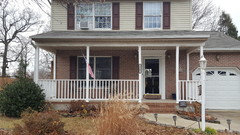
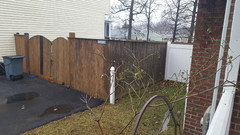
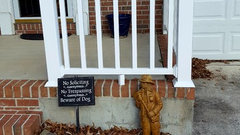
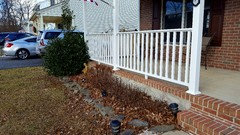
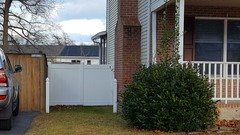
    Removing the maple isn't an option. It's been there since my parents planted it the day we moved in 25 years ago. Attached are better pics of what I'm working with. Also, what about the side of my house? We have that wasted space between the fence and the house. What would you recommend to plant or create there? I cannot build anthing there (The two fence posts will be removed in Spring). Also, what about against the porch and sidewalk in that small spot (firefighter spot) There's nothing there now.


  • 9 years ago
    last modified: 9 years ago

    What about a row of dwarf crepe myrtles such as 'tonto' in the wasted space? Put a dwarf alberta spruce in the small spot beside the steps.

    Dottie Miller thanked Logan L Johnson
  • 9 years ago
    last modified: 9 years ago

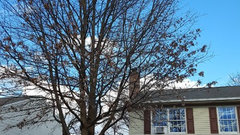
    The shade tree is an oak and if living up to its full potential will get very much larger than it is now, eventually dwarfing the house. However it being an oak means it will be much more suitable for gardening beneath than if it were one of the large growing maple species.

    One designation system considers largeness in a garden tree to start at 60 ft. in height. For a tree to be "massive" it needs to be a lot bigger than this!

    Big Oak Trees

    https://images.search.yahoo.com/yhs/search;_ylt=A86.JyGRuGZY2UwAmrIPxQt.;_ylu=X3oDMTByNWU4cGh1BGNvbG8DZ3ExBHBvcwMxBHZ0aWQDBHNlYwNzYw--?p=Big+Oak+Trees&fr=yhs-avast-brwsr001&hspart=avast&hsimp=yhs-brwsr001

    I would not lift and divide the grass until new shoots start to come up in spring.

    For something other than a chorus of differing opinions you might consider hiring a local consultant or designer to view and discuss your site in person. And maybe draw up a plan or sketch you can follow.

    Dottie Miller thanked Embothrium
  • 9 years ago

    Thanks to you both! I like that idea Logan. Thank you embo, I didn't know it was an oak. I'll wait until spring for the grass.

  • 9 years ago

    The branching looks like a maple to me. Usually oaks are more pyramidal than round when young. I don't see any foliage. Looks like acer saccharum. Embothrium, why do you think it is an oak?

    Dottie Miller thanked Logan L Johnson
  • 9 years ago
    last modified: 9 years ago

    why do you think it is an oak?

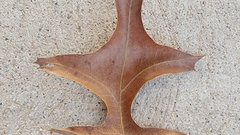
    Look at the leaves.

    Again a dwarf spruce (or any other dwarf conifer with a tree shape) placed within the same setting will create a conflict of scale with the oak. They will look like David and Goliath.

    Dottie Miller thanked Embothrium
  • 9 years ago

    I can't tell anything from the leaves besides the fact that they haven't fallen off yet. A trait that most sugar maples posses.

    Dottie Miller thanked Logan L Johnson
  • 9 years ago


    not sure if this helps.

  • 9 years ago

    Oaks have thick abscission layers and are notorious for hanging onto dead leaves, a trait known as marcescence.

  • 9 years ago

    Certainly an oak. Although it doesn't have the typical branching of a young oak.

  • 9 years ago

    It's 25 years old. We had it trimmed up this summer.

  • 9 years ago

    What exactly do you mean by "trimmed up"? You say you are inexperienced in the field of gardening. Unless you are doing the pruning yourself (and you got advice from here) you should hire an ISA certified arborist to do pruning. Don't just hire any chainsaw monkey off of the street.

  • 9 years ago
    last modified: 9 years ago

    We can see in the pictures some bottom branches were cut off. Probably it is a Pin Oak and had the usual basal skirt of descending branches that these produce, when not heavily shaded from the sides.

    Elsewhere in Maryland a Pin Oak was 92 ft. tall with a trunk 18 ft. 7 in*. around and an average crown spread of 96 ft. during 2008.

    *Approx. 6 ft. in diameter

  • 9 years ago

    Definitely, PIN OAK (Spanish, Swamp Oak).

  • 9 years ago

    I would not put a dwarf alberta spruce in that spot by the steps for a number of reasons. In addition to the problem of being too small in contrast with the large oak, it will need to be removed as it grows and crowds the walkway. Even before it actually encroaches over the walk, it will not feel welcoming since the walk is somewhat narrow and having something tall right next to it will feel crowded. They can over time get to several feet wide, and your spot just doesn't look large enough. Finally, the Missouri Botanical Garden doesn't recommend that it be planted south of zone 6 since it suffers in high heat and humidity; it is quite prone to spider mites among other issues when it isn't happy.

    I'd be more likely to plant a groundcover perennial that won't sprawl over the walk and will flower at some point but remain tidy all season. If you really want something taller, add a vine that isn't large and use a trellis that keeps it close to the porch or even wraps it around the end of the porch so that it doesn't crowd the walkway.

  • 9 years ago
    last modified: 9 years ago

    Thinking back now, I think Rhamnus 'Fine Line' would look good with the pin oak and miscanthus.

  • 9 years ago
    last modified: 9 years ago

    I'd plant a broad-leaved evergreen shrub there. One getting about 1 1/2 times as high as the bed is wide.

    The sign and statue can be moved around to the front.

    I have a dwarf alberta spruce by my entryway that I'll probably need to replace soon

    http://forums2.gardenweb.com/discussions/4357300/replacing-dwarf-alberta-spruce?n=2