Software
Houzz Logo Print
shaxhome

Cornus Capitata

9 years ago
last modified: 9 years ago
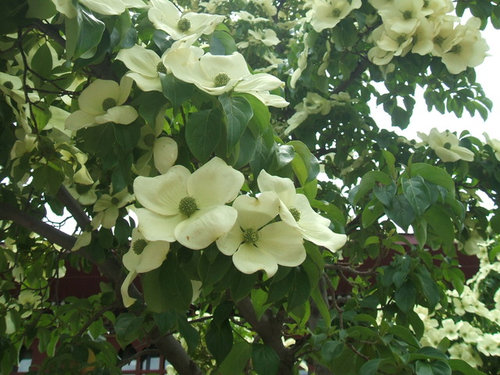
I read here many threads about various Dogwoods in the USA, but haven't heard mention of the Himalayan Dogwood, Cornus (syn Benthamidia) capitata. Is it ever grown there?

I spent 4 years living in Bhutan, the last 2 with my own landscaping business, and planted more than 100 of these beautiful trees. Research tells me that they've even naturalised here in Oz, but I've yet to see one...


Comments (13)

  • 9 years ago

    Lots around here (SF Bay Area). I even have one that I grew from seed.

    shaxhome (Frog Rock, Australia 9b) thanked Sara Malone (Zone 9b)
  • 9 years ago

    Sara...any chance that you could post a pic of yours? Would love to see it!

  • 9 years ago

    Bay Area is probably one of the more ideal locations here for this tree :-)

    shaxhome (Frog Rock, Australia 9b) thanked gardengal48 (PNW Z8/9)
  • 9 years ago
    last modified: 9 years ago
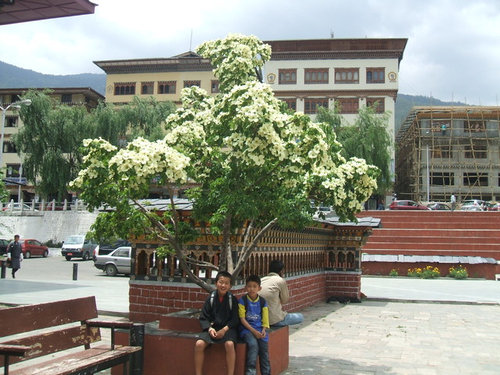
    That's interesting to me, gg, as these pics were taken in Thimphu, at an altitude of around 2300 metres (7000+ ft), with bitterly cold winters, and I didn't see them growing naturally at much lower altitudes...

  • 9 years ago

    Shaxhome mine is only about 5-6' tall and hasn't bloomed yet. I grew it from seed which germinated in 2007. There are many specimens at Quarryhill Botanical Garden nearby here, I just checked their website but only have photos of the fruit. What I like about this tree is that it is just as showy in autumn as it is in spring.

    shaxhome (Frog Rock, Australia 9b) thanked Sara Malone (Zone 9b)
  • 9 years ago

    Often plants with a Himalayan origin have other limitations over and above cold hardiness. I have a feeling mild summers come into play as well. Generally, this dogwood is shown as being limited to zones 8&9 here in the US. But as is often the case with many less common plants, perhaps its true winter hardiness has not been fully tested.

    Just checked the weather for Thimphu and it is hovering just about where we are right now in the Puget Sound area, so maybe not quite as bitterly cold as you think. Or as bitterly cold as compared to just about anywhere in Oz :-)

    shaxhome (Frog Rock, Australia 9b) thanked gardengal48 (PNW Z8/9)
  • 9 years ago
    last modified: 9 years ago
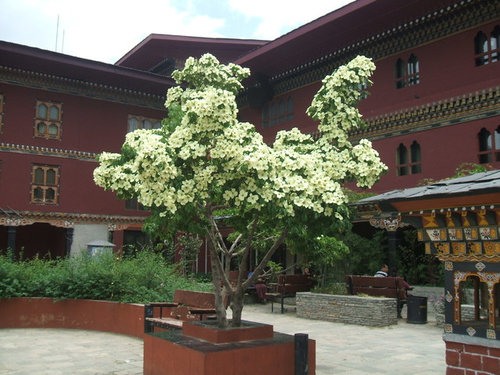
    Ha! Yes, considerably colder than I'm used to in Oz. Winters there only around -5C (23F), but it wouldn't get above 0C (32F) for sometimes weeks on end. And the Bhutanese are hardy folk and quite blase when it comes to heating. I had to wear snow gear inside restaurants on occasion! And I do remember one -18C (0F) night when my plastic bucket of bathwater on the kitchen table froze solid overnight.

  • 9 years ago
    last modified: 9 years ago

    "Five species: from the Himalayas to E Asia; five species (two endemic) in China.

    Species delimitation within this subgenus is controversial. Over 15 new taxa have been published since the 1950s. This treatment follows Xiang (Bull. Bot. Res., Harbin 7(2): 33–52. 1987), who recognized 13 subspecies among four species, i.e., Cornus capitata, C. hongkongensis, C. kousa, and C. multinervosa. However, a preliminary allozyme investigation by Dudley and Santamour (Phytologia 77: 425–430. 1995) suggested that C. capitata subsp. capitata is quite divergent from C. capitata subsp. angustata. Thus, in the present treatment, we recognize C. elliptica as a species separate from C. capitata. Further studies are needed to test the various species delimitations in the group."

    http://www.efloras.org/florataxon.aspx?flora_id=2&taxon_id=316356

    "Plant of the Month: June 2004"

    http://www.arthurleej.com/p-o-m-June04.html

  • 9 years ago

    I often see trees similar to those here in Canada!

  • 9 years ago
    last modified: 9 years ago

    I often see trees similar to those here in Canada!

    Yes: type shown resembles C. kousa in these shots.

  • 9 years ago

    Wow. Those blossoms are incredible.

  • 9 years ago
    last modified: 9 years ago

    Those blossoms are incredible

    Whatever exact species placement of example shown it looks mostly like a typical C. kousa - including the floral effect. However getting one of these to persist outdoors in USDA 4 might be a problem. Also soils and summer climate in WY might be excluding, except perhaps up where the conifer forests are in the mountains (moister and more likely to be acidic than in the lower, less steep areas where people concentrate). This may be why the tree is unfamiliar. Where conditions are generally suitable it is much planted.