

Recessed lights
Phew. I am running out of steam researching and selecting "stuff". Practicality nudged me to change my plans so here I am facing a choice of recessed lights. I did some reading - names like Halo, Juno, and Nora popped up. Our electrician works with Halo. He also mentioned something about some lights can be replaced as bulbs and some only as whole units. So I kinda know that there can be issues there.
Then there are hot debated on the size - 3", 4", or 6". I know in some of my friend's houses cans fall out of the ceiling at times (not sure of the brand). I figured out that I need to pay attention to the temperature of the bulb (2700). LED? Seems the way to go according to many lighting info websites.
As I read through the websites few dedicate any space to details of construction that will affect if they fall out or how easy they are to maintain. I will continue my quest today. In the meantime, what did you learn about recessed lights either before or after you dealt with them? Which brands did you prefer and why? Any articles, sites, links that you found helpful?
Comments (65)
 PRONatalie H. thanked Virgil Carter Fine Art
 9 years ago
I put several recessed lights in my own home a while back. Both the retrofit construction and new construction. My research was all conducted through the internet and going to view the lights in person at the various stores.
If i was going to redo my entire house lighting and had my dream home i would probably get a lighting designer. If it was just a room or two i would do the research myself.
If you could tell us where you want to put recessed lights and what you are hoping to accomplish with them (task/ambient lighting) you may be able to get more help. Hand draw your floor plan to scale as much as possible and post a picture of it. You will get quite a few suggestions.
I have never had a recessed light fall out of my ceiling. If they fall out then something isnt correct.
Before you buy anything i would suggest that you go look at some lights in person and see what color temperature you like. Do you want a slight yellow hue or a bright white or a bright white with a slight blue hue?? I settled on 3000K and am happy with the choice. It is all personal preference. Some like super bright and some dont.As far as brand name i would say stick with the major ones and you would be fine. I Cree and Halo recessed lights. My cans , the housing the light fits in, is a mixture of Halo and Juno brand. I bought the cans at Lowe's but ordered my lights online. I would also pay attention to the quality of light switch/dimmer you use. To make it simple for you i would only use the Lutron brand.
The size is preference as well. I used 4 inch. I will add that you can usually find more lights in 4" and 6" then other sizes. I have not seen a 3" light that i liked the look of yet. The size of fixture you have typically determines the spacing of the lights and the quantity. Ceiling height is a big part of that as well.
My opinions on recessed lighting have changed. When i first started renovating i wanted recessed lights everywhere. Now i prefer not to use them unless i want to accent something. Recessed lights arent for ambient lighting. I recently redid my living room and decided the only recessed lights i would want are two 4" cans that will be used to highlight some artwork on a wall.Natalie H. thanked mrroarkeRelated Professionals
Frederick Architects & Building Designers · Enfield Architects & Building Designers · Gloucester Architects & Building Designers · Altoona Architects & Building Designers · Odessa Architects & Building Designers · Hannibal Design-Build Firms · Wichita Falls Design-Build Firms · Enfield Design-Build Firms · Milwaukee Design-Build Firms · Sacramento Design-Build Firms · Hagerstown Home Builders · Marietta Home Builders · Roanoke Home Builders · Newburyport Home Builders · Mesquite Home BuildersNatalie H.
Original Author9 years agoWOW! So much info! I may need to go back and talk to the electrician one more time. When I played around with Halo housing, it felt flimsy-ish. Not that I have much experience with other light or know if this "feel" makes any difference.
What is the measure of quality in recessed lights?
The fact that recessed lights aren't for ambient light really made me think again about lights that I don't need.
The only area where I struggle is the dining - living area. It's quite large. I plan to have an over the table light in the dining room. Beyond that it's a mystery. A couple to light the bookcases? One in front of a fireplace?
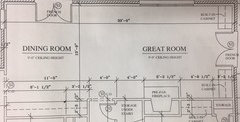
- 9 years ago
JDS, how do your clients remember which switch turns on the lights they want to use? I'd be flipping 5 switches every time I wanted to turn a light on I'm afraid!
Natalie H.
Original Author9 years agolast modified: 9 years agoThat was the product I got to look at.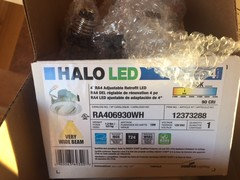
I went and looked and for some reason the electrician showed me retrofit trim (?!). I would think I should be getting something along these lines, right? http://www.cooperindustries.com/content/public/en/lighting/products/recessed_general_purpose_downlighting/led/_4_inch_led_adjustable_gimbals/_853537.brands.lighting!halo!led.html
Natalie H.
Original Author9 years agoWell, the electrician suggested what's in the box. In my mind I thought I'd be using what you called expensive something. I see that I am very confused and prime target to be fooled. I will look into what you recommended. Can't believe lights are so complicated.
Natalie H.
Original Author9 years agoWhat is a good place to look for to look at several brands of recessed lights? I figured it's not Lowe's or Home Depot. Do I look for some specialty store?
Natalie H.
Original Author9 years agoI saw the retrofit in person and it was powered up so I could see what's going on. Yet it wasn't too dark at that time so not telling. 4" is not terribly large. It's quite compact in person. It does not look as sleek as Gen2 adjustable though.
Natalie H.
Original Author9 years agoI wonder which housing will be compatible with a wide variety of trims across different manufacturers. Or does each company forces you to go with their bulbs or trim?
 9 years ago
JDS, I am curious....I use Halo LED recessed and really like them. They are bright but don't seem to fan out because you are limited to the 'tunnel' the light source comes from. It typically takes twice as many recessed to light the same surface area of one flush-mount light in my experience. I am looking at going with all flush-mount leds for the future. Besides glare, which seems to depend on brand and also the style of cover, what else is wrong with this option? Aside from "the light is visible"? We hear that lighting a wall should be #1 priority a lot, but this means with a gimbal or with a wall sconce, both of which are typically visible. It doesn't seem to make a lot of sense to me.
- 9 years ago
JDS when you say new construction fixture do you mean the brand specific trim kits? Then use a 13ish watt LED par20 in that to get the 840 lumens?
As to the Halo retro kits, they make them in the flood like the picture shown but also a focused beam version as well. The house that I'm building this year will most likely use Juno can's and this retrofit LED in the 900 lumens. I don't need directional can/trim and a standard airloc can with the retrofit LED is loads cheaper than a can with the LED built in. 150ish total to 50ish total, and that is buying them as an electrical contractor(which I am).
If I were to lay out the lighting for you rooms Natalie, this would be my first shot without seeing the rest of the prints or discussing with you the plans/intentions/furniture layout of the rooms. Green are standard overhead opening with chandelier/standard lights. Blue are cans and the purple is a directional can.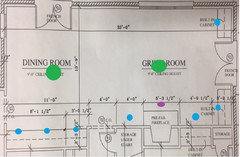
I might put more can up top on the picture depending on your intentions for the space between the door and window.
Natalie H.
Original Author9 years agoThank you SOOO much! It actually very closely mimics what we have come up with so far but I did not fine tune the types of lights with this level of precision and detail. Last night I dreamed lights and lighting plans. I was adding here, removing them there. Well, this suggested plan make me more confident that at least I am on the right track.
- PRO9 years ago
To properly and successfully design and place lighting, one must first know the furniture arrangement, the location and arrangement of all work areas, and locations for books, art, pottery, plants and the like. There are three categories of interior lighting: ambient, task and accent. The types of lighting and the purpose of the lighting is different in each category.
Trying to use recessed fixtures, including "cans" for all three categories of lighting is a foolish mistake and simply not possible, just as it's a mistake to simply put a ceiling mounted fixture in the center of each room and call it quits.
Lighting design takes an experienced and creative individual, just as does any other creative aspect of a custom designed home.
- 9 years ago
JDS,
You did answer my question about what fixture your meant by new construction. I now understand you meant the can with the LED built in. I get what you are doing with the extra lights throughout the room but she may have nothing there to highlight. That is why I wouldn't include them right off the bat.I do think that she would be better off not using a directional can/trim above the cabinets in the dining area. I think that 3 straight down can will highlight the built in and the counter in a functional and pleasing manner.
The other thought is you only need the one/two in front of the fireplace if you have something on there to highlight. If it were to be stone the whole way up the goals would be different.
I agree that Halo isn't my first choice but the are not terrible either. I also think that these particular retro trims are plan and plasticity in look. Lithonia makes one that I really like the look of and they are aluminum trim if I remember correctly.It really depends what she is trying to accomplish in the room and that is hard to know without more q&a with her.
- PRO9 years ago
As I recall, the optimal spacing from the wall for wall washers was about 4-feet from the wall to be illuminated, and spaced in the ceiling so as to evenly wash the desired wall.
- 9 years agolast modified: 9 years ago
Wall washer as in a gimbal light? To me a gimbal light is any light that has the ability to tilt. A wall washer is a mop made for washing the walls. :P If the light does not protrude, aren't you wasting the light that hits the interior space of the can itself?
- PRO9 years ago
When it comes to wall washer fixtures, there are a great many types from which to choose--fully recessed, partially recessed, surface and track mounted. There are single lamp and multi-lamp models. There are commercial and residential models. For recessed and partially recessed models one should check the cut-off angles possible for each individual fixture. Typically, cut off angles are between 30- and 40- degrees. Mounted 4-feet from the wall, a 30-degree fixture will illuminate up to within about 2.3 feet of the ceiling. A 40-degree fixture will illuminate up to about 3.4 feet of the ceiling. Mounting closer to the wall will raise the top of the illuminated area. Use and placement depend on the height of the items on the wall to be illuminated. Artwork, for example, is seldom mounted on the wall within inches of the ceiling (but it's possible for very large works)!
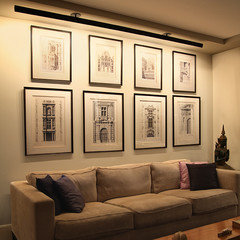
Here's a surface mounted, multi-lamp fixture designed specifically for this particular art installation. It provides a continuous illuminated area, but if the photo is accurate, it's placed rather too closely to the wall and aimed too high, creating a "hot" spot along the top of the upper lithographs, and a dimmer area along the bottom ones. Moving the fixture a bit further from the wall may help improve the overall illumination.
Natalie H. thanked Virgil Carter Fine Art - PRO9 years ago
An important element overlooked in this discussion of wall washers is the lamp itself. Besides the wattage and lumens produced by a lamp, just as important is the type of light throw. There are a full range of lamps from narrow spot to wide spot to narrow flood to wide flood; different lamps for just about every sort of application and desired design. When designing lighting to actually illuminate specific areas and items, it's important to not only consider the fixture, but the actual lamp. It's the lamp and its lighting characteristics which will govern the design, selection and placement of fixtures. All the information is on the carton of the lamp and also found in the manufacturer's web site.
- PRO9 years ago
Actually, there are two common categories of "wall washer" fixtures. One type, "wall accent" lights are designed to be placed close to the featured wall and highlight the textural or other special effects of the wall itself. The other type, commonly called "wall washers" are actually designed to be used to highlight "things" on the wall, such as art, etc., and/or the wall itself. These are mounted further away from the wall where they may be "aimed" at what is to be highlighted. In some builder's houses and "featured models", these types of fixtures are often used to "wash" a wall with light simply as a means of ambient lighting--a use for which the fixtures were not designed.
- PRO9 years ago
Yes, wall washers, especially multiple ones located together, do throw enough illumination for the light to "bounce" and provide a certain degree of ambient lighting. Whether or not that is enough ambient lighting for a given space depends on the situation, but usually not. As a result, most often other lights are needed to either increase the overall ambient lighting level and/or to balance it throughout a space.
The wall washers do nothing for needed task lighting, such as counter tops, kitchen islands, work areas, desks, etc. They are worthless for any work area which requires carefully seeing what one is doing.
And they do nothing in the way of feature or accent lighting, i.e., giving the eye a visual focus on a strategically placed light fixture as an inviting design feature, such as a decorative fixture over a dining table, or an engaging lamp in a living space.
This is why the three categories of lighting--ambient, task and feature/accent--are all important and should be part of any creative lighting design. That's not academic.
- PRO9 years agolast modified: 9 years ago
It's easy to misunderstand the distinctions between ambient, task and feature/accent lighting...a common issue when one hasn't studied lighting and illumination.
- PRO9 years ago
It's silly of you to think in terms of "academic" about lighting or anything else...can we now rejoin the discussion about recessed lighting and its pros and cons?
- 9 years agolast modified: 9 years ago
Was it in your formal study of lighting that you learned to put a wall washer 4ft from a wall?
This thread is not about the pros and cons of recessed lighting; its about which recessed fixtures are best for the OP and, as an extension of that, where they should be placed.
- PRO9 years ago
One cannot pick a "best" type of wall-washer fixture without understanding the characteristics of the particular type of lamp which will be used. It's the lamp which provides the illumination, not the fixture or housing.
Would you like me to post the illumination data of MR-16 series lamps to show you not only the versatility they have, but also why they are typically not mounted closer than 4-feet or so from the wall, or wall mounted items, they are illuminating?
Hint: "Google MR-16 lamp data"
Natalie H. thanked Virgil Carter Fine Art - 9 years agolast modified: 9 years ago
Lamp data means nothing if the fixture only allows the lamp to tilt 35 degrees. A fixture is not a wall-washer if the light can't illuminate the wall at eye level.
The OP was asking specifically about LED recessed fixtures in a 9 ft high ceiling. The fixture she was considering had a 35 degree maximum tilt.
A 4 foot distance for a 9ft high ceiling would require a fixture with a much greater lamp tilt like an eyeball, elbow or a track light fixture where the lamp is below rather than above the ceiling.
For a typical recessed wall washer fixture with a 35 degree tilt, 4 ft from the wall would be appropriate for a 12 ft. or higher ceiling not a 9 ft. ceiling.
Eyelid or scoop wall washers could be farther away but are usually limited to 40 to 60w. A lamps and need to be closer to produce enough light.
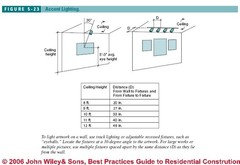
[Here are two excellent references.[(https://www.houzz.com/discussions/ceiling-downlight-placement-for-wall-pictures-artwork-dsvw-vd~853866) They recommend the distance of the OP's wall washers be 24 or 27 inches from the wall.
Go find Mark and Fred S and argue with them.
Mark:
This is a general rule of thumb I use.
LIGHTING ARTWORK:
8' ceiling - 18" off the wall (not moulding)
9' ceiling - 24" off the wall
10' ceiling - 30" off the wallFred S.:
I usually end up somewhere between these and Mark's measurements
- PRO9 years ago
We keep talking past one another.
You are approaching the issue by first considering the type of fixture or housing. I am approaching the issue by first considering the type of lamp which may be best suited for the purpose.
The OP is asking for information about lights--recessed (or some other option), what type of lamp, size, temperature--all of the normal consumer oriented questions without focusing on the purpose and use of the light fixture in a given location.
For the benefit of anyone still reading this post and curious about whether to use recessed lights, what type, etc., the first decision to make is what is the desired function of the light? Is it to illuminate objects on the wall? Is it to illuminate the floor or something on the floor, i.e., a table? Is it to illuminate some specific work area, i.e., a counter top? Is it to just provide an overall, ambient general lighting for a space? What's the purpose of the light? It's the purpose which should guide selection comparisons and decisions, beginning with the lamp.
There are many types of lamps: incandescent, fluorescent, CFL, low voltage, LED, etc. Each lamp has individual strengths and weaknesses.
For example, here are two photos which compare the luminace of a CFL and a low voltage lamp in a wall washing application, ie, illumination of an artwork:
20 W R40 Compact Fluorescent Lamp:
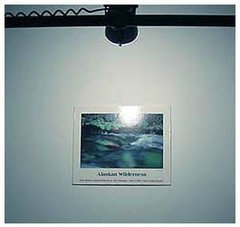
By comparison, here's a 20W MR-16 Lamp (I'm guessing a spot):
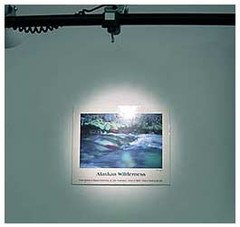
Do you see the difference? The DFL is a good lamp for simply putting some light on the wall. On the other hand, the MR-16 is a very good lamp for illuminating something specific on the wall--in this case an artwork.
Here's the measured illuminance levels of both lamps for comparison:
20W CFL:
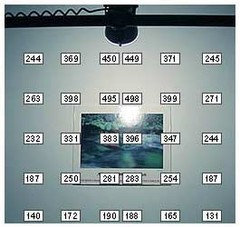
20W MR-16:
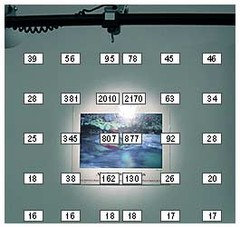
The differing characteristics of the two lamps now become obvious: the CFL distributes a relatively constant illuminance level over a relatively wide area, while the MR-16 packs a much higher level of illuminance in a much more concentrated area, with considerable fall-off outside the area of concentration.
In the case of the MR-16, the lamp comes in a wide range of wattages, throw angles and illuminance levels:
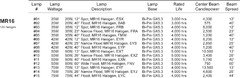
What do these choices mean for wall illumination? Here's the data:
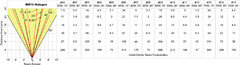
The chart above provides the illuminance data for each of the types of MR-16 lamp, and shows the variations for mounting distance to the wall to be illuminated.
By studying the chart, JDS will find that mounting this lamp closer than 4-feet to the desired wall to be illuminated is generally not recommended. Mounting from four-feet to 24-feet is recommended.
Of course, this is likely to be far beyond what many consumers want to know about lighting in a custom home (and many professionals as well). That's why it may be important to have an architect or other person of talent who does know about lighting and illumination.
The question shouldn't be what type of recessed lighting should I have? The question should be what do I want my lighting to do? And where do I want it to do it?
Natalie H. thanked Virgil Carter Fine Art - 9 years agolast modified: 9 years ago
Beam spread is relevant to the spacing of fixtures horizontally but not the distance from the wall.
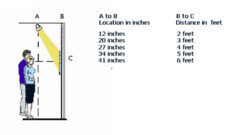
Here is the chart you should be looking at:
In the BEAM CENTER LOCATION chart,
D = the fixture distance from the wall.
If you subtract distance C from the given ceiling height (9-0), the results are:
for D = 2-0, the beam center is 5.5 ft above the floor (eye level)
for D = 4-0, the beam center is 2.1 ft above the floor (knee level )
In the 30 deg. AIMING ANGLE chart, for a medium 50wPAR20 lamp
the foot-candle level at 2-0 is 39 and the beam H & W is 6.1 x 1.3 ft.
the foot-candle level at 4-0 is 10 and the beam H x W is 12.2 x 4.6 ft.
More importantly, when someone stands 3-0from a painting, a fixture 4-0from the wall would shine on the back of their head and throw a shadow on the floor.
All you really need to know is the aiming angle and the ceiling height so you can draw a section. Beam spread is helpful for choosing the distance between fixtures but it is still an estimate and if you are similar with the usual lamps used in wall washer fixtures you know what works.
Natalie H.
Original Author9 years agoI am very much reading and appreciating every comment to help me make sense of this.
- 9 years ago
This is a classic thread, in both the good and bad sense. OP is asking basic questions about recessed lighting, and ends up with "dueling experts" debating the fine technical points, replete w/charts and calculations!
Halo and June are both good choices for the overwhelming majority of homeowners. If you have a particularly large budget, or if lighting is of particular concern to you (nice art to display, just into lighting), yes go for a higher end brand and/or a designer. But (particularly in the latter case), that is money you will never see back.
I see this so many times - if you went for 'the best' that people here tell you is necessary, your house will be 3X the cost vs what's typical, but worth maybe 1.1X that typical build.
Natalie H. thanked freeoscar - PRO9 years agolast modified: 9 years ago
Allow me to introduce to you some MR-16 4" recessed fixture trim kits which are not limited to a 30-degree light angle:

 I really like the flexibility of this last trim kit. It can be used for almost anything anywhere. Very flexible and easy to change lamps.

Pick the type of MR16 lamp wattage and beam spread desired from my first chart above, and install a distance from my second chart above to achieve the desired illuminance. For continuuous wall washing, use the charts above to determine fixture spacing based on the wattage, beam spread and desired illuminance.
- PRO9 years agolast modified: 9 years ago
Freeoscar wrote, "...I see this so many times - if you went for 'the best' that people here tell you is necessary, your house will be 3X the cost vs what's typical, but worth maybe 1.1X that typical build..."
Excuse me, but I think you miss the point. Neither JDS, nor I, are advocating for what may be "best". What we are talking about is what may be "appropriate" and reasonable for a given use or purpose. And to determine that, one must first determine what is the use or purpose intended.
The OP hasn't really said, other than saying her electrician wants to know what recessed lights she wants. And like lots of consumers, she's not certain, given the wide range of confusing information and products which characterize the lighting world.
There are different tools for different jobs. The challenge in picking tools is to pick one appropriate for the purpose or the task. Different purposes or tasks require different tools. Whether it's cabinet making (or lighting), there is no single "universal" tool (or lighting fixture).
If the task is to simply throw some light into an interior space and/or on an empty wall, then the most economical Halo fixture and trim kit will work just fine. Any lamp, any fixture and any trim kit. JDS is advocating this approach.
Contrastingly, if the task is to highlight some treasured and important items on a wall--an antique quilt, a family vase, a sculpture, book collection, or artwork--then a more careful selection process is appropriate. For these, the MR-16 lamp(s), 4" fixture(s) and trim kits will work just fine. This is what I am advocating.
It's possible to spend more--lots and lots more--but, once the task is identified either of these approaches will work. And they are economical! Rest easy, freeoscar! :-)
- 9 years ago
@Virgil - actually, the discussion you and JDS are having fell into the 'good sense' category. If interested, it provides an education far beyond what most of understand. The 'bad sense' was the post (seemingly now deleted) which trashed Halo/Juno and recommended lightolier and maybe other high end brands.
The reason OP says that she has a hard time finding reviews is that for most people it just works (with exceptions for dimmer/bulb incompatibility, which is a separate issue), so they go with the brand/type the installer recommends as, similar to something like drywall, a good installation is more important than the brand of the equipment.
Natalie H. thanked freeoscar - 9 years agolast modified: 9 years ago
Well that was predictable: pretending lamps exposed below the ceiling are "wall washers". You really have no practical knowledge of architectural lighting.
Two of the gimbal fixtures you showed are, in fact, limited to 30/35 degrees. They all produce a strong scalloped accent light and are not wall washer fixtures.
Here's an introduction to recessed lighting terms:
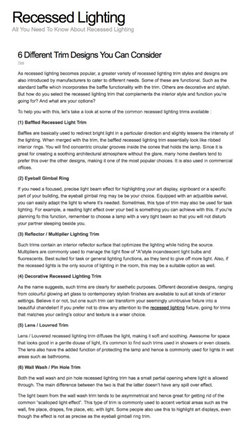 Natalie H. thanked User
- PRO9 years ago
JDS wrote, "...Well that's predictable; pretending lamps exposed below the ceiling are "wall washers". You really have no practical knowledge of architectural lighting..."
That's the funniest thing you've written so far...I like it!
Post some more Lightolier marketing materials...mebbe some photos of what they think "wall washers" are limited to being?
- 9 years agolast modified: 9 years ago
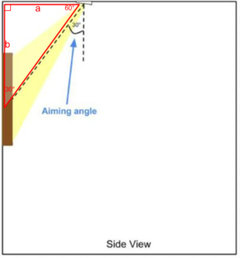
It is a serious mistake to ignore the location and aiming angle of a wall washer fixture in a residence and I will expelain why. I expect Virgil Carter to belittle this effort but anyone interested in designing lighting for their home should take it seriously.
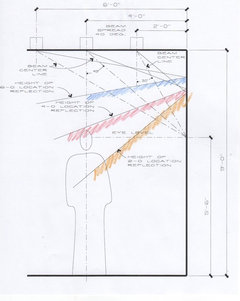
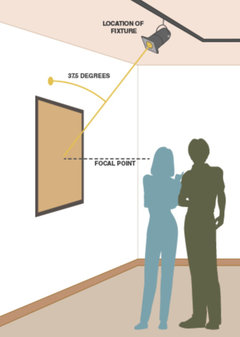
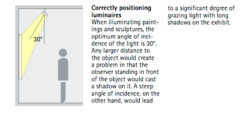
Wall washer fixtures typically have a 30 to 35 deg. internal tilt because 30 deg. is the preferred angle for lighting objects on a wall. The reason for that is easy to demonstrate by drawing a 30 deg. line from eye level on a wall up to the ceiling. For a 9-0 ceiling the line will intersect the ceiling at 2-0 from the wall where a recessed fixture with a 40 deg. beam medium spot lamp is located. Locating the fixture at 4-0 or 6-0 from the wall would require a fixture with a 49 and 60 deg. tilt respectively. That would require an elbow/retractable fixture or a track light.
You can see on the drawing below that the reflection of the light beams from the fixture located 2-0 from the wall is not in the eyes of the observer but it is for the 4-0 and 6-0 fixture locations (the colors highlight the highest part of the reflected light for each fixture). This reflected light is seen as glare and will make it difficult to see what is on the wall. Oil paintings and art behind glass would be virtually impossible to see.
I once used MR16 halogen fixtures exclusively. The reason I rarely use them anymore is that my clients hate to replace lamps and have fully accepted the move to LED. At this time there are too many problems with using replacement LED lamps in the old MR16 fixtures and the new integral driver LED fixtures are still too expensive even for wealthy clients. Until the transformer and fire safety issues get resolved I can't afford to take the additional risk of specifying them.
 Natalie H. thanked User
- PRO9 years ago
"...Wall washer fixtures typically have a 30 to 35 deg. internal tilt because 30 deg. is the preferred angle for lighting objects on a wall..."
Brother JDS, if the only light fixtures you specify are the standard Lightolier can fixtures with a limit of 30-35-degrees for light direction you should simply say so. It will save everyone a lot of reading and head-scratching to know that you approach wall washing design one way with one light fixture manufacturer.
Certainly, if the art or other displayed material(s) has a strongly reflective surface, a 30-degree angle for lighting can be a good one. A larger angle, however, permits less distortion of the light cone as it strikes the artwork. Sculptural objects are often best illuminated using three fixtures, all at different angles to the sculpture.
Frankly, for folks with substantial art to display, or other similar objects to display, for a future custom home, track or cable lighting is much more flexible and easily permits using multiple fixtures for illuminating art, sculpture or what-have-you, which can be quickly and easily moved, relocated or even changed.
Here's a good, easy-read article on lighting artwork: http://www.architecturaldigest.com/story/how-to-light-art
- PRO9 years ago
Well, we're getting a bit defensive here aren't we...? After all the comments already made in this thread (for example, who said..."You really have no practical knowledge of architectural lighting...?)
But no matter. It's clear that any reasonable sharing of knowledge and experience is pretty much over on this subject.
So, I'll bail and leave it for whomever wants to take the OP's question any further...
- 9 years ago
I just wanted to note that I have learned a bunch from this discussion. Thank you all for continuing to participate! I knew lighting was kinda, sorta important and difficult to get right..... But I didn't realize how much. If nothing else I now know I need to figure out more about what I intend to light on the walls.
Also, if I can ask a question.... What do you do when the walls are mostly windows? I'm assuming a wall washing fixture/lamp doesn't make sense. And you certainly want light for the evenings, but does glare back into the room from the windows become an issue to be designed around? And, how does one do that?
Thanks!
- PRO9 years ago
Doc, it's really impossible to design an intelligent lighting plan until one has a finished architectural design, plus a furnishings plan. After all, interior lighting is about how to creatively light a furnished space isn't it?
As I've said before, a lighting designer brings into play a variety of lighting tools--ambient lighting, task lighting and feature/accent lighting as the means to make each individual space work and be as special as it may be in the day time.
So, no, wall washers and displaying art, sculpture, quilts, books, etc., on largely window-clad walls is not a workable solution.
One of the challenges with large window walls at night is how are they handled? Do they remain large "black holes"? Will slat blinds, or other window coverings be in use? Is there planned exterior lighting to showcase what's beyond the windows on the exterior? Exterior low voltage lighting on timers can transform an exterior for outdoor use in the evenings, and make wonderful interior vistas as well.
There are many good ways for creative lighting in large spaces which include exterior glazed walls. But it's almost impossible to generalize without a specific floor plan to use for examples.
Hope this helps!
- 9 years ago
Floor plan is almost set, we are still tweaking with our architect. I'm anxiously awaiting the newest renderings.
This was helpful, yes. As I hadn't really thought of them as black holes. The house is being designed to take advantage of 270 degrees of views, so there are a lot of windowed areas. I'm not sure what DW is thinking, but I would bet not much in the way of blinds. We really want the views to be the art work. But what then when it is dark. Hmmmmm. now you have my brain going.
- PRO9 years ago
Doc, if there are any distant illuminated views, that will make a great sight. And nights with strong moonlight will be wonderful as well.
If it was my house, I'd be creating a design, based on the landscape (plants and hardscape) using low voltage landscape lights, including a series of tree mounted down lights, some ground mounted up lights at the base of selected trees and a few strategically placed down lights on the house itself.
If this is appealing, try to avoid the Home Depot parade of cheap solar path lights which make every night look like Christmas and whose solar cells fail after 9 months.
Wired low voltage lights on timers are the only way to go. You won't regret it!
- 9 years agolast modified: 9 years ago
From Virgil Carter's recommended lighting design article in Architectural Digest "Five Tips for Lighting Art":
Its not a matter of having a "strongly reflective surface". Any art work or even a blank wall can be improved by reducing glare.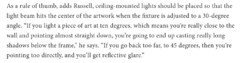
Other sources:
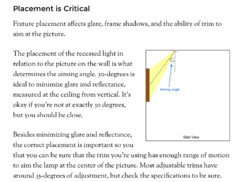
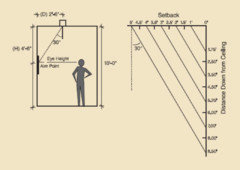
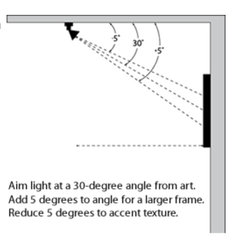
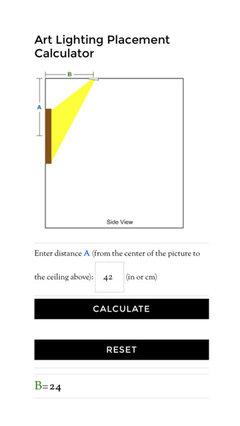
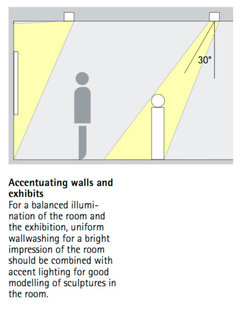
- 9 years agolast modified: 9 years ago
As a postmortem to the thread I would like to point out that it started with a request for suggestions for LED recessed fixtures for a dining room and living room with a 9 ft ceiling. I recommended the distance from the wall be 2 ft (30 deg. aiming angle) and Virgil Carter said it should be 4 ft. (50 deg. aiming angle) which is an issue that is too well documented in lighting design literature and too easily verifiable in the field to be worthy of derailing an otherwise useful discussion.
It makes no difference to me if he lights his projects in this manner but I hope the OP and other readers will use the information posted here to make the right choice for their homes.
I would also hope the past 12 years of helping homeowners would buy be some respect if not credibility.
Natalie H. thanked User Natalie H.
Original Author9 years agolast modified: 9 years agoI actually appreciated all the information and the debate between people who understand more. Bringing in even conflicting info is very helpful as well - it shows different approaches and ways of doing things and looking at things. Going back to - what is the purpose of the this particular type of lighting was a helpful re-framing of the question. I am sure many appreciate the additional info.
I did not get the answer per se what makes a certain housing - "quality" and worth the money. My prior experience with lights amounted to the fact - they all work, some look better than others. That is not to say there is no difference. I may not be either aware of it or never experienced "better" options.
- 9 years agolast modified: 9 years ago
The two major quality issues in recessed fixtures (assuming they are appropriate for your needs) are materials and resistance to heat.
If the visible parts are PVC they can discolor and even break if hit (probably the cause of things dropping out of your friends' ceilings - hockey sticks are the usual cause) so look for cast aluminum trim.
All recessed lighting fixtures get hot and the more enclosed they are the hotter they get. When they overheat the fixture will shut off and will restart when it cools. One indication of a lack of resistance to heat is a requirement to reduce the wattage or the depth of recess of the lamp so pay attention to the lamps that are allowed and if an extension socket is required to lower the lamp in the housing.
Last week I specified 51 Halo recessed fixtures in a renovation but could not match the downlight and wall washer trim rings because the downlight required the lamp to be lowered an inch which looked awful. But the owner/developer would not spend the additional $1,000 to upgrade. I don't dislike Halo but I do dislike developers and have renewed my commitment to avoid them.
The 4" Halo LED gimbals your electrician recommended look fine and are a bargain. It has the advantage of being able to light the floor or a wall but it is not recessed much so they will look very bright in the ceiling. Not everyone thinks that is a bad thing so go look at them in a lighting store. To me they look like the R30 flood lamps that were too low in 5" housings in the 80's and that get torn out of renovation projects.
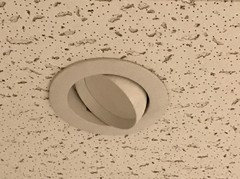
The one on the left is the Wide beam and it creates a hot spot on the front edge of the trim ring because the lamp is so close to it. the other one is the narrow beam and it has less brightness at the trim ring and but the light on the wall is stronger (exaggerated by the digital camera).
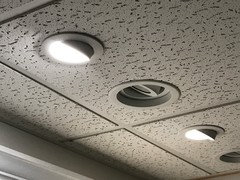
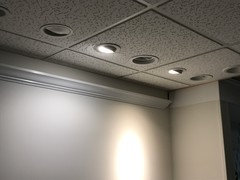 The spec sheet says it is cast aluminum but I don't if all of it is. If you want something with a smaller lamp higher in the fixture message me with a budget. I won't be making any more recommendations on the GW forum.
 Natalie H. thanked User
- PRO9 years ago
Well, it look like this thread is on its way to the archives, so before it sinks out of sight I want to thank Natalie H. as the OP for starting the thread, and to all who contributed. And thanks to all those folks who checked in and followed the discussions as they evolved.
As the thread drifted to and fro, it must have been frustrating to Natalie, and seemingly uncaring about why she posted it in the first place.
But that's often the way of extended discussion threads here and elsewhere on the Internet--they often evolve in unexpected discussions.
I especially want to thank JDS for sharing his professional experience and knowledge. I wish he hadn't deleted many of his posts which contained good information, but those posts which remain exemplify an enviable degree of professional knowledge and experience.
The fact that we disagreed on many points in no way takes away from the importance of creative lighting design or the importance of professional experience and perspectives on the subject, or on any subject related to custom home design.
To the contrary, the exchanges and differences of opinion in this post simply point out that there is almost always more than one creative way to solve a seemingly difficult challenge when it comes to custom home design. Hopefully, the lesson gained by those who followed this post from beginning to end is that, indeed, there's more than one way to bake a cake.
There really is no one "right" way or "best" way when it comes to lighting design (or architectural design); there are simply a range of good and workable options to explore. At the end of the day if it works it's a good solution!
Thanks to all who contributed to and viewed this discussion. My hope is that there was new and useful information here which made the discussion worthwhile and a useful learning experience. To my colleague (and hopefully, friend) JDS, there was nothing ever personally intended or taken. I hope you can say the same.
Onward to new and more exciting adventures!
Natalie H. thanked Virgil Carter Fine Art - 9 years agolast modified: 9 years ago
When faced with presumptuous, condescending and patronizing responses I delete my comments. I think that's fair since respect is the only price I have ever asked for participating in the forum. I am 75 but still need to work to get my daughter through design school without selling my house so it is getting more and more difficult to justify the time and the stress of the forum.
Natalie H. thanked User



Pinebaron