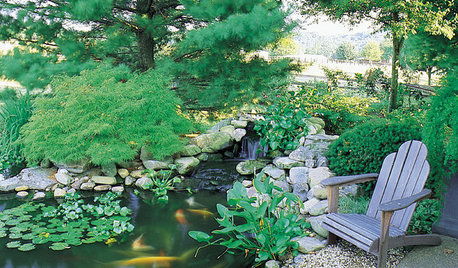
Water, gravity and nature in one's yard interact in some amazing and often creative ways. Anyone who has installed and thus been owned by a pond knows exactly what I mean.
It be great to learn about challenges and learnings of others before I get to make all the mistakes myself.
Some of my learnings and thoughts for pond operation, protection and fauna and flora interactions are below.
How about yours?
_______
How water temperature regulation works in winter
Our pond maintains min 40 F fairly uniform temperarure due to 50-55 F ground temp at depth, the most dense water being 40 F, and waterfall water mixing. Natural convection from 41-55 F bottom water rising and top 40 F surface cold weather water falling would likely have the same effect.
My fish all hover in winter 2' below the surface in the pond center. This likely is the warmest and least raccoon susceptible position.
Avoiding disasters
An empty pond can not protect temperature sensitive plants or animals. Seek leakage area (notes) below. If sufficiently exposed, pond hoses might freeze and burst or plug. Faster water flow helps, burying them in the ground helps more, and electric hesting tape helps the most until you power goes out. So bury hoses and expose as little as possible.
Waterfalls sound great and aerate water to keep things happy. But unless you live on a hillside by a stream, you must pump water. If a pond hose breaks, it pumps the pond down to the water intake level. This knowlwdge was gained from personal experience one surprizing 18 F winter morning. I found the pond with only 5" of water in the bottom, and 2" of ice, right over the fish backfins! Lucky the fish still fit. A few more hours and they would have been part of an ice bottom sculpture. We lost none. Fish are amazing!
Thus, consider a simple electric sump pump switch to shut off the pump should the water level to fall below a critical level. And even though it gives less perfect total pond water mixing, I tend to put the lowest pump intake pipe a foot above the pond bottom. I also place some drainage pipe habitat in the pond bottom so that fish can escape animals should the pond drain to that deep. This is because we are gifted with raccoons.
Leakage Repair
Most obvious, if your pond is water proofed with a plastic liner don't poke a hole in it. If for instance pesky a clawed animal assists you with this on a side wall, partially drain the pond and use a commercial quality patch weld kit. Duct tape doesn't succeed at everything, no matter how tempting it seems.
If the hole is in the bottom try bentonite clay powder to seal it. Also hide sticks from kids and/or don't wear spiked golf shoes next time while servicing the pond. Just walk carefully.
If pond liner leaks again do as above and consider one of the automatic animal/human control options outlined below.
If your pond has a concrete bottom, consider cement pond sealing compounds or bentonite, as appropriate. However, DO NOT not document the leak yet. First buy insurance ASAP. Then monitor for sinkhole development, even if a sinkhole is not obvious yet
Flora Fauna Safety Protection Systems
Pond water in spring summer sponteously forms biting mosquitos. It is not if but is when. Fish or tapoles are needed to eat them. Fish eat tapoles. Really big frogs eat fish (do not plant bullfrogs). Frogs of any size sing at times. Make sure you like frog songs (we do). A swarm of even little frogs can deafening at times. Frog and fish also attract some neat mammals and birds.
Furing the summer, Raccoon bandits visit our pond almost nightly and late in the summer you might get to see a family. If up at 4 AM, or at least before it gets light, shine a flashlight out towards the pond zone. Those glowing yellow green eyes staring back at you, on the ground or in trees, that are too wide set for a house cat, are usually raccoons.
If they are reddish or not otherwise raccoons there are some feline possibilities. If they look really big and further off the ground reminding you of a tiger, keep your cool. They are almost always deer. Although we live not that distant to Cougar and Tiger mountain. The first settlers didn't know what to call our big northern cats. Lucky we have internet now. Take home lesson is that a pond water, flora and fauna can gift you nee experiences. Lucky we have no big water reptiles here.
In contrast to Racoons, Giant Blue Herons have not yet found our pond. Rather than invest prolonged hours patrolling, be more cleverm. There's maybe a limited chance that you might outsmart the animal. Perhaps a protective system may be warranted?
Rather than a fully loaded dog house, which on the positive side gifts fertilizer, I've been eyeing those motion detector rainbird style sprinkler systems*. This was first considered to combat our pesky racoons toppling over and tearing up pond and marginal plants. Herons however would be THE decision tipping point to get more serious about it.
Guess I sort of earned it. I test stocked our newly dug and lined pond with a dozen small "feeder fish" (Comets) plus a couple Shubunkin Koi. We incessantly pointed at Comets to gain the most striking markings possible. Netting little Koi-like want-to-bes at 49 cents each about drove the PetSmart girl crazy. We made "money" growing the Comets to the 1.99 to 3.99 size by winter! One Shubunkin seriously is already good frying pan sized. But I've not had the heart to do it. And besides she's just under one pound in weight. So, I'd lose $12.99+ value. Fresh salmon here is often sold than less than that per pound. If it goes higher, fish beware.
All 2016 fish have grown so fast that I might just stick with those Comets, unless a Heron finds us. Wouldn't it be payback to watch a big Heron drooling over, but not able to lift, a big Koi? With Koi we'd hope that we don't attract Eagles. They might be tough on free range neighborhood cats.
* Hum, rather than noisy sprinkler system, I could try a stealthy little wire ringing the pond, electric fence shocker armed. But I like seeing the neighors' cat drinking from the pond, staring deeper than clawed arm depth, dreaming of a fish dinner. No matter how much they try, no cat can drink down our pond fast enough before it rains again. Maybe fishy water just tastes better?
If approching a well wired electrified pond zone I might forget the e-wire and fall into the pond while wriggling around uncontrollably. I should tether my defense tactic to re-bar so that the wire doesn't fall into the water with me. Best to protect that fish investment.
However, an electronic sprinkler or e-wire system costs $50 - 100 to install. Unless I find a used one on Craigslist that failed in the task already. But would I then want it**?
** Plan B Alternative Consideration
Decision factors: (A) Can we attract a Bobcat? (B) Do they swim for fish? (C) Do they eat smaller cats? (D) Do they tend to avoid human contact?
I for sure need (A) and at least one other of these questions answered "yes" to even consider Plan B. At least limited performance standards need to be met!
If Plan B is a "no go" then please answer, as in Plan B above, but with Plan C or Plan D optiobs using alternative "active ingredient" being either "Lynx" or "Cougar / Puma / Mountain Lion (latter name depending on where you live or personal preference). For clarity sake, "Cougar" is not the leopard spotted animal preying after dark, within human drinking establishments, even if they appear as effective.
Finally, if it you do not know it, is over 80 lbs, furry, and drinking out of your pond, consider avoiding contact, no matter how neat the animal looks. I'm just saying.





garyz8bpnwOriginal Author
garyz8bpnwOriginal Author
Related Professionals
Crestview Landscape Architects & Landscape Designers · Fort Myers Landscape Architects & Landscape Designers · Bainbridge Landscape Architects & Landscape Designers · Fayetteville Landscape Architects & Landscape Designers · Edison Landscape Architects & Landscape Designers · Oxnard Landscape Architects & Landscape Designers · Riverside Landscape Architects & Landscape Designers · Detroit Landscape Contractors · Albert Lea Landscape Contractors · Potsdam Landscape Contractors · Oshkosh Landscape Contractors · Yuba City Landscape Contractors · Potsdam Design-Build Firms · Evanston Design-Build Firms · Kahului Design-Build FirmsPKponder TX Z7B
garyz8bpnwOriginal Author