Software
Houzz Logo Print
ontario_canada5a_usda4b

Size vs Zone correlation

If Missouri
Botanical Garden, which is in zone 6, says that a plant X will grow to 6' tall,
how tall will plant X grow in zone 4?

Comments (37)

  • 9 years ago
    last modified: 9 years ago

    That depends on the type of plant and LOTS of other factors. It's just nowhere near that simple!

  • 9 years ago

    Agree with the above. But if planted under conditions the shrub favors and not subject to excessive cold damage, in theory it should grow to at least the same size as spec'd in the warmer zone.

  • 9 years ago

    Someone
    'saw 100 year old Black spruce trees that were only 8-12 feet tall and
    2-3" dia' in Alaska. Supports the general correlation that specimens grow smaller in
    colder areas of its range. The question is how much smaller per zone?

  • 9 years ago

    LOL!! Those specimens were likely not the norm. Black spruce are very common in AK and get significantly larger than that.....depends on where (and on what) they are planted. Black spruce grow in the Alaskan taiga on pretty shallow permafrost soils, which could certainly slow growth and stunt size. And they also grow in many other, non-permafrost parts of the state to a much more typical size. So not convinced at all it is just a coldness issue - as Brandon alluded to. btw, AK offers a pretty broad range of climate/hardiness zones and the spruce will grow in most of them

    Even if there were a direct correlation between zones and size - and I'm not convinced there is - there is no way you could get precise about the size reduction per zone reduction. As stated previously, it is just not that simple!

  • 9 years ago
    last modified: 9 years ago

    Well, there is no
    reason to LOL.

    Anyway, if there were no such correlation, then there would be an equal
    number of counter-examples where specimens would grow taller in colder areas of
    its range.

    In this specific
    case, there would be an equal number of Black spruce trees growing taller in
    Alaska than further South in its range. I doubt very much that that can be shown.

    If anything, it will be mostly smaller in the North and mostly taller in the South. That is quite simple. What is not so simple is how much smaller in the North and how much taller in the South, which is the subject of this thread.

  • 9 years ago

    If plant X is listed as hardy to zone 3, it will grow to the same 6 ft in zone 4 as it does in zone 6. It will just take longer.

    As for counter examples, virgin white pine forests probably fit the bill.

    Ontario_Canada5a_USDA4b thanked mad_gallica (z5 Eastern NY)
  • 9 years ago

    Thanks! Did you list
    plant X as hardy to zone 3 to avoid the effect of winter dieback in zone 4? If
    plant X were listed as hardy to zone 4, then the occasional cold winter may
    prevent some specimens to grow to 6' eventually, is that the underlying thought?

    I googled 'virgin
    white pine forests' and found them in Michigan and Wisconsin, not sure how that supports a
    counter-example, do you have a link?

  • 9 years ago

    There is little to no correlation in your original question. Some plants probably will be happier and grow larger in the north than farther south. It's almost like asking if seawood could grow in Lake Superior, how much smaller would it be than in the Pacific Ocean.

  • 9 years ago
    last modified: 9 years ago

    Examples and counter-examples would help to show if there is correlation or not. If you have any species of seawood [sic] in mind that could grow in Lake Superior and in the Pacific Ocean, we could check.

    Although, my and most folks' main interest is land garden plants, it would be better to take the examples and counter-examples from there.

  • 9 years ago
    last modified: 9 years ago

    Using cold hardiness zones does not take into account the conditions during the growing season which, along with other variables, is going to have more of an effect on the growth rate the winter minimum temperatures. Thinking of all the climates the make up zone 4 across the North American continent, not all plants would grow equally well in them despite being cold hardy enough.

    Using North and South does not always hold true. Cold Zones are not always north of warmer zones. Some parts of the PNW are north of Minneapolis.

  • 9 years ago
    last modified: 9 years ago

    Yeah, sure, Canadian
    plant hardiness takes 7 climate variables into account, for example, but nobody
    knows about it. USDA plant hardiness is still the best to discuss the
    issue.

    FWIW, this topic has
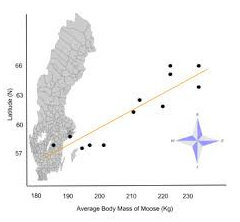
    an analogy with the Bergmann's Rule that says that animals grow bigger in
    colder areas, e.g. moose, see graph below. Like any rule in nature there are
    always exceptions, and part of the exceptions of Bergmann's Rule seems to originate with
    the dependency from a single variable (latitude) like the USDA plant hardiness
    depends from a single variable (average annual minimum winter temperature).

    Disclaimer: I am not an expert in Bergmann's Rule, but I am a birdwatcher. Non-migratory garden birds are bigger up here in Canada than down there in the US, that's how I first encountered Bergmann's Rule.

    From https://en.wikipedia.org/wiki/Bergmann%27s_rule

  • 9 years ago

    Thanks for writing
    this all up, but I bet that animal life is much more complex than plant life, and
    yet, it is possible to establish an animal rule based on a single variable
    (latitude), hence it should be possible to establish a plant rule based on a
    single variable too (USDA zone).

    Simplest is to
    continue discuss examples and counter-examples, perhaps we are on to something.

  • 9 years ago

    "OC said: Someone 'saw 100 year old Black spruce trees that were only 8-12 feet tall and 2-3" dia' in Alaska." and "GG said: Black spruce grow in the Alaskan taiga on pretty shallow permafrost soils, which could certainly slow growth and stunt size."

    Yes this was extreme conditions on the way to the Artic Circle where there was still frost 8" deep at the beginning of July. A few miles further north there was no trees at all. Just lichen on the rocks. So yes, extremely short to near absent growth.

  • 9 years ago

    i didnt read all the replies .. and that isnt going to stop me,,, lol ...


    some plants like many pines.. conifers.. have one annual growth spurt per year ... one might reason.. that where it is... leaving out all the other variables [like water..soil..etc.] .... shouldnt greatly impact that genetic annual growth .... it will have that growth rate in may in my MI and maybe the same rate in TX in march .... regardless of how long the remainder of the growing season is ... [spoiler alert,...lol]


    however ....plants that grow all season long ... one would think.. will grow much smaller.. annually .. in my 4 month summer growing season in my MI .. as compared to say in TX where there might be an 8 month growing season ...


    think of my premise.. without arguing specifics , please ... it would have to presume the same plant.. in the same soil with the same microclimate... same everything.. and that just isnt ever going to happen ... i know that ... [most of what babs talks of]


    the bottom line.. is if you are trying/hoping to jam something in what you think is a spot too small ... sooner or later ... years/decades.. its going to outgrow it ... in other words.. you arent going to outwit ma nature ... over years or decades ...


    ken


    Ontario_Canada5a_USDA4b thanked ken_adrian Adrian MI cold Z5
  • 9 years ago

    It will appear to me
    that what happens to the Black spruces in Alaska happens to plants elsewhere
    too, from growing well within the zone, to getting stunted as they approach
    their zone boundary (due to partial dieback or whatever mechanism) to no grow
    at all beyond their zone boundary > plant size thus slopes down to zero.

    Maybe this sloping
    down to zero has not been studied for the various species...

  • 9 years ago

    "Well, there is no reason to LOL."

    Oh please excuse me!! I didn't realize I needed your permission to laugh at a comment I found to be humorous.

    And here is a 'counter-example' that disproves your plant 'rule'. The largest black spruce in Alaska is located on the U of A campus in Fairbanks - a zone 1 climate. It is recorded at 71 feet. According to the US Forest Service, at "normal unmanaged conditions', black spruce at maturity averages 40-65', so this tree is obviously above average in size. And measures up pretty favorably in size with the continental US champion black spruce, a 78 footer located in Wisconsin in a comparatively balmy zone 4.


  • 9 years ago

    Interesting
    observation with regard to 'growth spurt' vs 'season-long growth'. Plant sizes
    of the former ('growth spurt') are not dependent on zone unless they hit their
    zone boundary (either too cold or too hot) where they then get stunted to
    zero.

    Plant sizes of the
    latter ('season-long growth') are dependent on zone, are there any examples, though?
    Plants are usually rated over 5 zones, e.g. zone 3-7, the zone dependent plant
    sizes should be observable in this case.

  • 9 years ago

    How
    many of those champion trees are there, GG? One in all Alaska? To disprove a
    correlation, equal numbers for and against are needed. One proves nothing, LOL,
    humorous comment.

  • 9 years ago

    Maybe
    Black spruces follow the 'growth spurt' that Ken observed, leading to uniform
    size within the range. Black spruces may also follow the stunted sizes at zone
    boundary down to zero beyond zone boundary, that Bill observed.

  • 9 years ago

    100 year old black spruce 8-12' tall could also be the impact of altitude, couldn't it? So to reiterate the first comment, there are likely LOTS of factors.

  • 9 years ago

    Ontario, by definition "champion" tree designates the largest of its species in that locale. Since I haven't personally counted them, I have no idea how many more at least full sized (according to sourced average mature sizes) black spruces are present in AK but I'd be willing to bet a decent number.

    I don't know how to say it any more clearly but your correlation of zone to size is based on a fallacious theory. It IS that simple.

    btw, there is very little purpose to zone designations for plants presented in a range and many sources will just list the minimum zone a plant will tolerate. That is really all these hardiness zones are intended to do - indicate the lowest/coldest zone a plant can be expected to survive. Theoretically, there should be no upper limit - a plant that is winter hardy in zone 3 will of course be winter hardy in zones 6, 7 &8. The upper "limit" (and I use that term loosely as there really isn't a limit in many cases) is likely given to indicate a situation unrelated to winter hardiness that may affect growth, like excessive summer heat or humidity or a frost free winter climate that could impact proper dormancy. But these situations have nothing to do with the cold tolerance that zonal designations indicate and are therefore, more often than not, inaccurate.

  • 9 years ago

    There are myriads more factors going into animal size than there are for plant size, and yet simple rules have been established even for animal size.

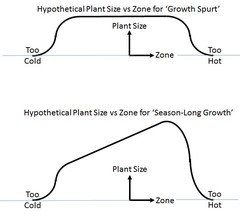
    Anyway, I drew the following charts based on constructive discussions in the above :-) These Bergmann's Charts for plants are up for enjoyable discussion :-)

  • 9 years ago

    Perhaps I should add
    a few words explaining the charts rather than letting people read the whole
    thread. The top chart is for a plant like a conifer that has a 'growth spurt'
    at the beginning of the season. Plant size in the middle of the chart is thus flat,
    i.e. not zone dependent. To the left, it gets colder and colder and the plant
    gets stunted more and more until it is too cold to grow beyond the range.
    Similar to the right because of heat.

    The bottom chart is
    for a plant that has 'season-long growth' with more growing months in the
    warmer zones, hence the increasing plant size in the middle of the chart. To
    the left and to the right are the same stunted growths as in the previous
    paragraph until out of range.

    Canadian plant
    hardiness zones takes into account 7 climate variables, including heat,
    (compared to 1 climate variable of USDA plant hardiness zones) so it is a more
    accurate zone reference (even going way up to the tundra and beyond if you like
    to garden for Santa Claus :-)) but it is also more complex to use http://www.planthardiness.gc.ca/index.pl?m=15&lang=en

    We need examples and
    counter-examples for the charts, just use simple USDA zones for simplicity
    sake. The top chart seems to apply to Black spruces already.

  • 9 years ago

    '100 year old black spruce 8-12' tall could also be the impact of altitude, couldn't it? '

    I'll try to clarify my observations on Picea mariana (black spruce) in Alaska.

    I don't believe elevation was a factor. The elevation was 329 ft at Stevens village AK.(this side of the A.C. by Yukon river) and coldfoot AK 1014 ft. (other side of A.C. start of the Brooks Mtn. range). So while we were gaining in elevation after crossing the Yukon river, we were not by any means that high in altitude to affect growth.

    The Taiga (Russian for Boreal forest) has some unique conditions of which Black spruce is among the few conifers that will tolerate it. That is, ground permanently frozen all year long. It only thaws at the top, down to about 36" during the short summers, with the ground underneath remaining icy. reference: usda

    So a black spruce putting forth an inch or so of new growth annually could easily be less than 10 ft. tall in 100 yrs. Again, in an area where conditions excluded most other types of vegetation from existing.

    These trees appeared in areas of permafrost that was comprised of black organic matter (peat?) covered with sphagnum moss., the other areas of permafrost were gravelly/rocky composition with little or no vegetation.

  • 9 years ago
    last modified: 9 years ago

    Bill, Canadian plant hardiness that I linked to in my previous post covers the boreal forest, the tundra and beyond, you may want to look at it.

    It is nice that you observed the stunted Black spruce trees in the boreal forest to beyond the treeline in the tundra, it is on the left side of the top chart in the above :-)

  • 9 years ago

    Oh, sorry, not trying to hijack any ones thread. Just saw the confusion over what I said about the Picea mariana in a different thread so thought I'd try to fill in the blanks. :-)

    Ontario_Canada5a_USDA4b thanked User
  • 9 years ago

    Huh? Your comments are right on here!

  • 9 years ago

    hmm, yeah, I guess I wasn't following the thread that closely but saw the comments about the stunted black spruce and jumped in (as I'm quick to do). Then when I looked at the formulas you suggested, I misunderstood as it was a bit over my head.

    I will say , that length of season doesn't necessarily make a difference in how much a certain species grows. There are variables to consider but If a tree puts out a certain amount of new growth in the spring, sometimes that is all for the summer, even though there is a month+ of season left, one reason it may be too dry for the tree to attempt further growth. But if that same tree has late rains and warmth, it may put out a second flush and harden off before freeze up, making for more total growth during the same length of season.

    Another thought is Norway pine. I've had plantings that have flushed out 6-8" of new growth at about year 3. Then the next year flushed near 3 ft., only produce 12-16" the following year. Seemingly without any significant difference in the length or the growing conditions of those 3 seasons.

    Now even in my short usda 3b season, there are fewer days for things to grow, but I have longer days (more hours of sun during each day) then places further south of me do, for plants to photosynthesize. So even though my last frost comes later in spring and first frost comes earlier in the fall, my tree (plant or whatever) has built up food and roots almost equivalent to a tree in a longer growing period that has shorter days. So my tree (sometimes) can produce growth on par with a longer season, because it appears to me that maximum seasonal growth usually happens in the first month or two of the growing season and the plant spends the rest of it's time using that new growth to manufacture food for the roots.

    So we may not see a significant differences reliably between zones.

    Ontario_Canada5a_USDA4b thanked User
  • 9 years ago

    Thanks for writing this all up! Essentially, they are examples for the top chart and counter-examples against the bottom chart, VERY good :-)

    What is the '2b' in your name, it looks like a zone but your zone is 3b.

  • 9 years ago

    2b =Typo. Now it won't let me change it. :(

  • 9 years ago
    last modified: 9 years ago

    Thank you for your concern, cecily, but I am doing well. Hope you are doing well, too!

    Edit: Don't delete your post, it says a lot about you.

  • 9 years ago

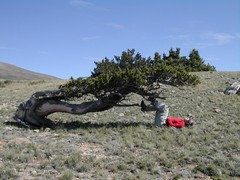
    Stunted and windswept bristlecone pine tree, apparently at its zone boundary, there is nothing else around. Would make for a very nice garden specimen...

  • 9 years ago
    last modified: 9 years ago

    From a parallel thread http://forums2.gardenweb.com/discussions/4437794/tree-varieties-for-zone-4?n=13 "...I might buy katsura as a z 4, but it's not
    going to get as large and you'll see die back from time to time...Golden rain
    (koulreteria) as a z4, again with reduced size and die back...You're going to
    see themes emerging. it'll live, but will suffer periodic die back, won't get
    as large as farther south, every few years will die back to snow line..."

    These are examples
    for the bottom chart, i.e. plant sizes decrease in colder zones.

    I would surmise that individual plant species would follow size vs zone Bergmann's charts that lie anywhere between the top and bottom charts in the above posting.

  • 9 years ago

    Updated
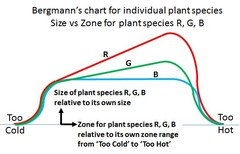
    and consolidated the two graphs in the above into a single graphic.

    Graph R may be
    representative of the Golden Rain Tree Koelreuteria paniculata where size
    decreases in colder areas until it peters out at the 'Too Cold' (and 'Too Hot')
    zone extremes. Graph B may be representative of the Black Spruce Picea mariana
    where size is not zone dependent until it peters out at the zone extremes.
    Graph G may be representative of a plant species G with intermediate behavior.

    Plant species R, G,
    B will generally have different sizes, so each species is shown relative
    ('normalized') to its own size. Plant species R, G, B will generally have
    different zone ranges, so each species is shown relative ('normalized') to its
    own zone range from 'Too Cold' to 'To Hot'. (The pertinent term of art is
    'normalize', google the term)

    Ideally, the zone
    reference has both hot and cold like the Canadian zones, but it is much simpler
    to use USDA zones (nothing is perfect).

    Like the original
    Bergmann's chart for animals, this will always be a 'work in progress', so
    examples and counter-examples for individual plant species are welcome (both
    contribute to their individual graphs in the chart)

  • 9 years ago

    This seems to be a pretty solo discussion since you are disinclined to accept any feedback from any of the very experienced members that have responded and overlooked the input from others that does not support your assumptions.

    But feel free to continue the discussion on your own. You seem very intent to prove something that cannot necessarily be proven.

  • 9 years ago

    You overlook that I
    incorporated examples and counter-examples from within and from outside the
    thread.

    Sure, you feel free
    to continue your counter-productive comments too, LOL

Sponsored
Wannemacher Interiors
Average rating: 5 out of 5 stars26 Reviews
Customized Award-Winning Interior Design Solutions in Franklin Cnty OH