Software
Houzz Logo Print
writersblock_gw

Stupid fireplace question

9 years ago
last modified: 9 years ago
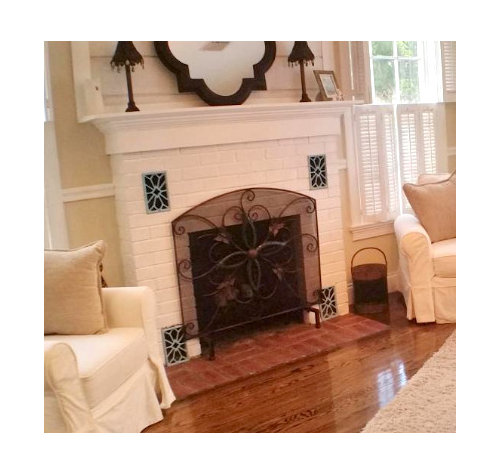
Can someone please tell me the official name of the blue things in this photo? I understand their function and how they are supposed to work, but are they registers? returns? something else?

Thanks. We've been looking at houses in an area where everything was built in the 20s and 30s and they all have these and I'm tired of having to point and say, "those!"

Comments (10)

  • 9 years ago
    last modified: 9 years ago

    Thank you, Sombreuil. We see them in many different configurations and some very disastrous past attempts to remove them and fill in with something else. Particularly painful when the facing is rough coral rock. And I think it's dangerous if the whole firebox isn't replaced, isn't it?

    This is in S FL so any fireplace isn't likely to be used more than a couple of days a year, but still…

  • PRO
    9 years ago

    You should be able to safely obliterate those grilles, but there would not be as much heat output. Heatilators are prefab unit fireplaces made from thick sheet metal. The grilles let a convection current form using the warm outer surface of the firebox as a heat exchanger.

    Casey

    writersblock (9b/10a) thanked Sombreuil
  • 9 years ago

    Thanks, Casey. I was wondering about that. I can see that in the configuration shown in the pic I included you could do it as long as you made sure the intake was blocked, but a lot of them also have a center upper grille and I think you'd need to rejigger the firebox to safely eliminate that one, wouldn't you, since it appears the intake is the firebox itself?

    Not that I would--I love the grilles; I'm just wondering about safety in the ones where it was done, like this mess where you can see they removed the center grille and filled it with plaster or something:

    I'm guessing you'd be best off totally replacing everything, including the guts of the firebox and the chimney in a case like that.

  • PRO
    9 years ago

    It's pretty hard to take out a heatilator and retrofit a masonry firebox, smoke shelf and a damper.

    writersblock (9b/10a) thanked Sombreuil
  • 9 years ago

    Thanks, Casey. I know, but I've also always heard that it was dangerous if the outflow was blocked but the intake wasn't, and AFAICT you can't find replacement grills at all anymore. I've seen a couple of fireplaces with hideous HVAC grill covers stuck on them, and I'd spend plenty to avoid that, even though we'd really only use the fireplace a couple of times a year.

  • 9 years ago

    A true "Heatilator" has a double-walled metal firebox.

    What you are seeing if there is a solid masonry fireplace is a fireplace with a flow-through chamber at each side. Cool air enters the bottom, goes through a serpentine brick tunnel and picks up heat from the fire-warmed bricks, and warmed air comes out the top opening. It increases the heat transfer from the fire to the room.

    It's similar to the European "tile stove" design, but it doesn't run the hot combustion gases through the masonry mass, just room air.


    Those grills would be easy to replicate with a CNC plasma cutter, or aluminum casting.

    writersblock (9b/10a) thanked User
  • 9 years ago
    last modified: 9 years ago

    Those grills would be easy to replicate with a CNC plasma cutter, or aluminum casting.

    That's a good idea, thanks.

    Would you say that's the same construction used here, though, with the center grill?

    And there are others that have small grills on the side rather than on the front.

    I would agree that if there's a non-patented way to do this it would have been used for these since this was a fairly low-end area initially, and if they could have avoided paying a premium for anything, they did. Also, fireplaces were only needed a few weeks a year, if that.

  • 9 years ago

    I don't think there's any danger from blocking those vents. Their purpose isn't to cool something so that it doesn't overheat. Their purpose is to extract more heat and put it into the room. If they aren't there, then the excess heat just basically goes up the chimney.

    writersblock (9b/10a) thanked greg_2015
  • 9 years ago

    Thanks, greg.