Software
Houzz Logo Print
k9_dopedog

Need info, im confused

9 years ago

Good evening

I am extremely new to growing tomatoes for the most part. I've recently became very interested in breeding them. I will be growing about 300 plants of different cultivars this year. My first question is this. If saved hybrid seeds do not grow true, how can I order hybrid seeds that grow true? Is it because they( better boy) have been stabilized? How many generations is usually required to stabilize a cross bred tomato. Pardon my inexperience. Any help would be greatly appreciated.

Comments (13)

  • 9 years ago

    When saving your own seeds, put a fine mesh bag (like the toe from a pantyhose) over the blossoms. That will help to keep out random pollen and give you a better chance of avoiding cross pollination. Do this early, before the blossoms bloom.

    k9_dopedog thanked qaguy
  • 9 years ago

    So I should be able to breed a better boy and say a big zac, save the seeds that are produced, plant them and get a cross between the two on next planting. Is that what is considered F1 and the seeds from that are F2 and so on? I want to thank you Dave and qaguy very much for the information. you have been most helpful.

  • 9 years ago

    When you cross a Big Boy with Big Zac and save seeds from the cross fruit and plant it next time it will be Big Boy x Big Zak (F1). You can give it you own name, for example "Boyzac F1". But in order to grow more of "Boyzac F1".( share it, sell it ) you have to repeat the crossing process and do more than just one flower so the you will have an inventory of it.

    Of course this make sense IFF your "Boyzac F1". has a worthwhile features. But if it turns out to be lousy why one would one keep/grow that.

    Sey

  • 9 years ago
    last modified: 9 years ago

    For an F1 hybrid to have much traditional commercial value for seed catalogs to home gardeners, you'll want both of its parents to be varieties that breed true (neither should be an F1 hybrid). I mean, if you cross Black Plum with Brandywine, that will give you a predictable F1 hybrid (the same F1 hybrid every time you make the same cross). If, however, you cross Big Boy F1 with Big Zac F1, the resulting tomato will not be predictable (and for that reason, a lot of people won't buy it). Each seed will produce a new kind of tomato plant (even more so than if you just grew Big Boy F2 seeds).

    However, this isn't to say you shouldn't cross two F1 hybrids. It's a good way to get lots of genetic diversity, in order to breed lots of new and unique varieties from the same set of seeds. However, there's a problem with using commercial F1 hybrids in your breeding: you generally don't know what the parent plants were in the first place (so, you don't know what kinds of genes are going to show up). If you make your own F1 hybrids to use in breeding, you're more likely to be able to target the sort of thing you're looking for (if you're looking for something specific: e.g. early maturity). Just for the record, Husky Cherry Red F2s can be extremely late or quite early, depending on the seed. (FYI: The F1 was early.) I'm guessing one of the parents wasn't early (I could be wrong). It's probably possible to get a late tomato with two earlies as its ancestors, but probably much less likely than if one of them were late.

    If you advertise an unstabilized tomato the right way, then you may still be able to sell it. For instance, if you target breeders, and people who like surprises, they may actually buy your seeds. If you target home gardeners who just garden and want predictable results, then probably not so much.

  • 9 years ago
    last modified: 9 years ago

    However, of course, you don't need to cross two F1 hybrids with each other to breed new varieties. Just grow any F2 seeds (seeds of an F1 tomato), and select for what you like over the generations. Each seed will produce a new variety (although the diversity may be somewhat less than with two F1s crossed together).

    It's a lot easier to breed entirely new varieties than it is to stabilize an F1 hybrid. You may even prefer them to the F1 hybrid.

  • 9 years ago
    last modified: 9 years ago

    You can order OP (open-pollinated) versions of a lot of hybrids out there. These should breed true. These are hybrids that people have spent years stabilizing. They may not be exactly like the F1s, but they may be pretty close.

    I'm not sure that it's possible to get them exactly like the F1s, because when you have a dominant and recessive allele together, you may not have the exact same traits manifest as if you had two dominant alleles (which can express the dominant trait somewhat more prominently than if you have a dominant and a recessive). Sometimes, the recessive allele shows through some (even though there is a dominant allele), which shouldn't be able to happen with a stabilized plant (since they either have two dominants or two recessives—not one of each). These are likely to be pretty minor differences, though (but it's possible you might notice).

    You might try crossing very similar varieties together to make stabilizing your F1 hybrid easy. For instance, you might try Zapotec, Pink Stuffer, and/or Pink Accordian. They all look pretty much the same; so, you probably won't have to stabilize the appearance at all (just the flavor, days to maturity, productivity and such, pretty much).

    It's important to realize, however, that changes between generations aren't always particular genetic differences. Even varieties that breed true can have significant differences between generations (based on the climate, soil, how acclimatized they are to the growing conditions, and such, it seems to me). So, to ensure the changes are genetic, you may want to get familiar with how the variety grows for you before you breed with it (particularly with open-pollinated varieties—be sure to save your own seeds instead of buying them again every year, if you really want to get to know them).

  • 9 years ago

    I thank you so very much shule, that really did explain a lot. I will start with the OP varieties and see what happens.

  • 9 years ago

    You're welcome! Do you mean trying OP varieties generally (and making hybrids from those), OP versions of hybrids (stabilized hybrids), both, or something else?

    k9_dopedog thanked Mokinu
  • 9 years ago

    Using OP varieties in general

  • 9 years ago

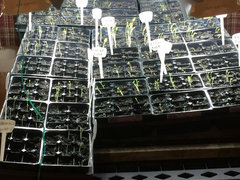
    These are my plants so far. It's kinda a crude light system but it's all I could do at the moment.

  • 9 years ago

    Your seedlings are looking very leggy from stretching for light. Your lights need to be much closer to the plants, no more than 2" above them. Either lower the lights or raise the plant trays.

    When you pot up those leggy plants be sure to bury all that stretched stem deeply.

    Dave

    k9_dopedog thanked digdirt2
  • 9 years ago

    Ok, thanks Dave. I will lower the lights and repost.