

Quit It!
I've only been a Houz member a couple of months and a visitor to the Lawn Care forum for a few weeks. I've read very useful posts here by a number of contributors regarding lawn maintenance, grass selection, herbicides etc., etc., etc. I have also seen a number of people, who give the above great advice, like jc11? dhall? and daniel? recommend that a person get a soil test. EXCELLENT advice in my opinion. But why do you keep recommending Logan? They are a reputable lab, but they only provide raw data in their basic test. There doesn't seem to be any analysis provided by those who recommend Logan. Why is that? Do you expect people to be able to do their own analysis?
If you aren't willing to do a Logan analysis, why don't you recommend a lab that does provide analysis as part of their service? --and likely for less money. You could still always help people understand or adjust the soil test report.
Hell, if a person lives in the NE send them to U of Delaware or Umass, If they live in the SE send them to Clemson. If they live in the NW send them to Western or the U of Oregon, If they live in the SW send them to...err, well if they live anywhere you could send them To Brookside, I think they provide recommendations.
Point is if you aren't going to do the analysis, quit recommending Logan.!!!
Comments (44)
 9 years ago
I'm not much of a soil test enthusiast, but I believe the reason they want all Logan is for consistency in method & format. Plus an actual professional runs the test, instead of some hungover/half baked college kid taking soil test 101
- 9 years ago
You make a fair point, but I'm not familiar with the other labs to be comfortable recommending them to anyone.
Based on the way you write I get the distinct feeling you've been here before.
Related Professionals
Rome Landscape Architects & Landscape Designers · Spartanburg Landscape Architects & Landscape Designers · Waco Landscape Architects & Landscape Designers · Farmington Landscape Architects & Landscape Designers · Lafayette Landscape Contractors · Aiken Landscape Contractors · New York City Landscape Contractors · Oshkosh Landscape Contractors · Grand Rapids Home Builders · Brattleboro Home Builders · Chico Home Builders · Merced Home Builders · Yuba City Home Builders · Dodge City Home Builders · Juneau Home BuildersUser
Original Author9 years agoBased on the way you write I get the distinct feeling you've been here before.
yardtractor1?
User
Original Author9 years agoyardtractor1 lost his account. Unknown whether this was through his own stupidity or he was banned, as no response from Houzz. If banned, it would probably be a violation to create an alternate and he likely wouldn't want to divulge that. That's my take.
 9 years ago
WA state no longer offers soil tests through their extension service (and hasn't for as long as I've known) so we use only professional testing labs. California is the same. Oregon State (not U of O) does through a professional testing lab they run and operate. Any students working the lab are grad students.
Personally, I tend to encourage my clients to use a very local lab for soil tests as I believe them to be more familiar with local growing and soil conditions than a lab located across the country and therefore better able to make more appropriate recommendations.
- 9 years ago
@ridgerunner:
Why Logan Labs? My understanding is that a nationwide test of soil testing services was undertaken, and Logan came out on top. Multiple samples of the same soil were sent in, and they were the best. Some places gave very different results even with the same sample. UMass, I think, was also up there high on the list of good test results. Of course, I've learned this second hand in this forum, so I hesitate to say more than that about what actually happened.
Beyond that, morpheuspa has been a mainstay of this particular forum for a long time and he is the top dog when it comes to analyzing soil samples. Morpheus likes Logan Labs and that's good enough for me. Unfortunately he has taken a (hopefully) temporary hiatus from the forum. I think he got burnt out. I'm hoping he'll return in the spring like the forsythia, only not as yellow.
Did you post a Logan test and not get any feedback? If so, post it again and I'm sure among the various people in this forum we can provide enough input to get you going in the right direction, absent morpheus for the moment. Another thing you can do is search this forum for "Logan Labs Results" and you'll see dozens of threads, mostly answered by morpheus. If you have the time and patience to read through them, you may well find one very similar to yours. I've seen it happen before. You may well be able to use the same recommendations. Just share what you want to do with this forum as a double check.
Oh, to your other point about getting analysis from the testing lab, for one the recommendations are suspect if the analysis can't be trusted. Also, a guy like morpheus takes more interest in your lawn than the lab does. We are all here because we enjoy the hobby, not because we need college credits. I think you'll get better analysis here.
- 9 years ago
@ridgerunner: OK, let's try this again. I'm confused. I just happened across a very recent request for Logan labs analysis and you were all over it making amendment recommendations. Can you be a little more clear about what the purpose of this thread is?
- 9 years ago
I was the person that ran the "nationwide test" in May/June, 2010 where Logan Labs came out on top. It was done after many of the university-run soil test programs were outsourced to people that can run the test machines, but don't have the inclination or background to respond to queries by homeowners. Also, there were other problems with long waiting-times at many labs in busy-season, and recommendations that were crude low/med/high stuff, instead of recommendations based upon the entire set of results.
All (finalist) labs that were considered received soil samples from the same bags of purchased topsoil, and no lab was aware that they were being tested. I paid for the lab tests out of my own pocket. The process was documented on another website in June, 2010 -- and is still posted there.
I tried to find a place that (a) had a good suite of tests that are part of the testing they provide, (b) turned tests around inside of a week 90%+ of the time, (c) had people that had training in soil test interpretation who actually would speak to a homeowner that had a question, (d) could handle the soil tests of Canadian members, and (e) participated in the standardized North America Proficiency Testing Program. A pretty tall list of requirements!
Logan Labs came out first, and not by a small margin. In the eight seasons during which I have interpreted thousands of soil tests, I have made two or three calls to Logan to question weird results that have occurred, and only once did it turn out to be a lab error.
The other lawn forum site (where Logan was selected) also utilized UMASS until two years ago, but we gave up on them when turnaround time, CEC tests were dropped and nobody ever got a callback. At some point this year, another lab may be added to offer folks a choice - but it will be almost certainly be another high-quality commercial lab that treats homeowners well.
PS: I have no relationship with Logan Labs in any way, and myself and my sons' lab tests are paid for at the same price as any forum members here or on other sites. Like Morph, I no longer do soil test interpretations on this site, but have more than 23,000 posts on another site -- the majority of which are soil-quality postings.
- 9 years agolast modified: 9 years ago
Nice job, Andy. That took a lot of initiative and I'm sure $$ to pull off. Fantastic idea. Did you ever present the results to the various labs (just curious)?
- 9 years agolast modified: 9 years ago
No. Great customer service and turnaround time come from running a business properly, and not getting a few notes from some forum moderator. Most business owners know how to run a top-notch business for the long-term, but the majority of them choose the short-term extra dollar in their pocket. BTW, a couple of the labs were completely wrong in their results - even though they were all sourced from the same bags of topsoil.
- 9 years ago
@Andy: I run my own business as well. I maintain that half the battle is simply doing the basic things properly.
Are you a SLAN, BCSR or little of both practitioner?
- 9 years ago
Mostly BCSR. While I understand the need for cost containment when managing golf courses, etc, I see no need to minimize inputs on much-smaller homeowner lawns. I have written regimens that include things like weekly Nitrogen (Urea) apps in Fall, double-dosing Milorganite in Spring and paying attention to secondary and micronutrients. Much of my approach is based on "how far can we take things" rather than "how low can we go without disease or visible quality loss". But to each his own -- as long as you're willing to show your end results in pictures. I also experiment heavily with natural auxins, phytohormones, etc on my own lawn trying to manage the very shady lawns I maintain (many areas of only 2 hrs or so of direct sunlight and the rest being traveling dappled light).
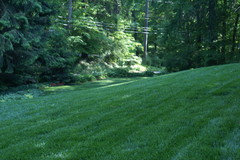
- 9 years ago
OK, Andy, you're hired. Report at 9:00 am Monday for your first Logan analysis. I'm sure you know morpheus and based on your comments above it sounds like your approach isn't all that different. I do realize there are a lot of competing opinions and sometimes some heated arguments, so I guess I shouldn't guess one way or the other.
Anyway, I haven't pm'ed morpheus but I am hoping he comes back from his lawn forum break over the winter. He's been a terrific resource. If not, then I'm sure you'd be very welcome here, or maybe we have to find where you hang out. :)
- 9 years ago
Thanks, but I have all the Logan soil tests I can handle over at the other place. I was just here to explain how the Logan stuff happened. Best wishes to all here...
User
Original Author9 years agolast modified: 9 years agodaniel,
This was the only thing I could find:
but it gives less detail than what was given above.It's my understanding from what has been said by you and other members of this forum, that the labs were subjected to sampling to determine their accuracy and repeatability of analysis. I'd be interested in seeing which labs were tested and the criteria and results of the test if they were posted somewhere and you can find and link to them.
Thanks.
To be clear, I don't dispute the quality of LL analysis. The only things that I don't like about Logan is that they don't provide buffer pH or recommendations (as rudimentary as other soil test lab's recs. might be) as part of their $25 package. $25 plus $20 for recommendations plus another $10 for a buffer pH or ammonium acetate test seems pretty rich when the same can be had for $35 or less at many other labs. But that's still missing the heart of my original post.
- 9 years agolast modified: 9 years ago
@ridge: Thanks, just read it. Andy doesn't seem to be too upset about no reporting of the buffer pH. Maybe you can take that up with him if you are interested [edit: regarding the lab testing study], and see if he has any data. I don't know if they still do the discount, but that would help with the cost issue.
User
Original Author9 years agolast modified: 9 years agoAndy doesn't seem to be too upset about no reporting of the buffer pH.
That can be marked up to a difference in analysis and recommendation philosophies. There are arguments to be made on both sides.
I don't
know if they still do the discount, but that would help with the cost
issue.You have got to read more carefully. Whatever, if any, discount is available is/was for members (with a minimum of 5 posts) on the other site.
 9 years ago
I'm not sure we'll see morpheuspa with the same frequency as we did the past couple of years. His credentials have been restored on that other site Andy mentioned, so he might be here less often. We'll see. Hope he can get back here.
Glad you're hear Ridgerunner. Yardtractor1 might have been booted for posting direct links to other lawn care forums. That used to be a violation of the TOS. Not sure what it is now. Generally a forum that carries advertising will make that a term to help the advertisers out. They don't want someone creating links to the competition where they might not advertise.
I agree that the LL results are deficient in the analysis. If you have seen any of their analysis, you would find it fairly worthless compared to the helpful advice you and others on this forum can provide. There are professional soil test consultants who do what you, andy, and morpheus do. They charge $200 or more to do that. I know because we had one on the forum for a few weeks.
- 9 years ago
@ridge: We were talking about Andy on the other forum. I thought it was obvious that you had to be a member there for the discount. Like I said, "I don't know if they still to the discount." "The discount" being the one offered on that site. I'll spell everything out in excruciating detail for you next time. When I say "next time" I am referring to any future conversations we might have in this forum. OK? :o)
- 9 years ago
There is no discount on the other forum. We would have had to be a consolidator, multiple shipments, ugh. Not worth the loss of time to save $2. The idea was dropped.
User
Original Author9 years agolast modified: 9 years agoNM. Post Deleted as andy10917's post made it moot.
- 9 years ago
I would like to point out something I learned when calling Logan Labs. It was recommended that I get the Ammonium Acetate test. I expected to pay $25 for the standard test + an additional $10 for the AA test. When I called to confirm the price, I was told I could do the standard test "using ammonium acetate" for and additional $3. So instead of the test costing $35 it cost $28.
- 9 years ago
Not as simple as it sounds on the surface. If everything is done with Ammonium Acetate, a number of nutrients will appear to be deficient that are not really deficient. Many of us that do interpretations want to see the cations only done with Ammonium Acetate, to avoid the scenario where extremely high Calcium makes all the other numbers skewed. That can't be done for the $3 upcharge. You can do what you want as long as the interpreter is comfortable with it, but I need people to specify "Ammonium Acetate extraction for cations only".
- 9 years ago
Andy are you saying that the ammonium acetate should be used in high calcium situations? Or suspected high calcium?
- 9 years ago
I hate answering this question, because it leads to 10 more questions that each lead to 10 more questions. So, I'll say this and (fair warning!) refuse to answer any follow-up questions: Ammonium Acetate tests are helpful in situations that involve calcareous soils.
- 9 years ago
@andy: OK, let's find out if this qualifies as a follow up question :o): Is there any technical paper or FAQ that covers the major testing methods, what their strengths and weaknesses are, how they work, etc.? I'm thinking something for a person versed in lab chemistry, not necessarily a layman's article.
User
Original Author9 years agolast modified: 9 years agoLook what they done to my thread ma
Look what they done to my thread
Well it's the only thing
That I wanted half right
And it's turning out all wrong ma
Look what they done to my threadWhat have they done to my thread?
La la la la la la la la la
La la la la la la la la la
La la la la la la la la laLook what they done to my thread
But maybe it'll all be alright ma
Maybe it'll all be okay
Well if the people are buying tears
I'll be rich someday ma
Look what they done to my threadapologies to M. Safka
User
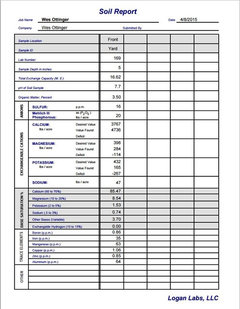
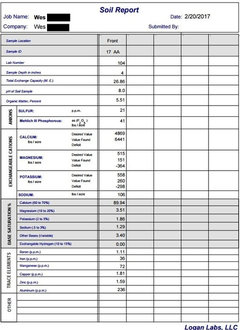
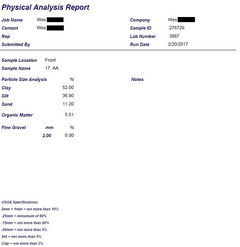
Original Author9 years agolast modified: 9 years agoTest done by Mehlich III extraction:
Test done by ammonium acetate extraction:
To be honest my itty bitty little brain is a little on tilt.
Some very (read: over simplified) simplified background information:
Point #1: In soil analysis, the goal is to find out the quantity of nutrients that a soil sample holds that are available for plant use. This is done by adding a liquid extractant to the soil, filtering the extractant back out and using a spectrometer to measure the amounts of each nutrient in the extractant. Logan Labs' default extractant is the Mehlich III (M3). It is very acidic cocktail of chemicals with a pH of 2.4 that has been found to be very useful and accurate for measuring all of the major and secondary nutrients (Ca, Mg, P, K, Na) AND the trace elements (Fe, Mn, Cu, etc.) in soils that range in pH from acidic, to neutral and is even pretty reliable for soil up to pH 7.2.
In regard to the Base cations (Ca, Mg, K and Na) which are held on clay and OM cation sites, the extractant knocks them off and into the extractant solution. Once the solution is filtered, the amount of the base cations can be determined/measured and reported on the test in parts per million (ppm).
Point#2: The cation sites (on clay and OM particles) in the soil represent the soil's nutrient holding capacity and is reported on the soil test as Total Exchange Capacity (TEC) or Cation Exchange Capacity (CEC). Every cation site reported as TEC/CEC is filled by some combination of the most common cations Ca, Mg, K, Na, a small amount of other bases/cations (e.g. other positively charged elements found in small amounts in the soil) and in acidic soils, aluminum and increasingly larger quantities of Hydrogen as pH decreases. By far, the greatest proportion of TEC/CEC sites are held by Ca, Mg, and K (base cations) and soil scientists have determined a direct relationship between the soils capacity to hold those base cations (amount and their proportions) and improved soil fertility and crop production. Consequently, the TEC/CEC, the amount of Ca., Mg, and K that either the soil does hold or can hold, has become a significant yardstick for measuring a soil's potential and in determining the quantities of amendments and fertilizers to be added to "balance" the soil.
Point #3: TEC/CEC: Although more accurate method exists to measure TEC/CEC, most labs calculate, rather than measure. For acid and neutral pH soils using M3 extractants, calculation has proven to be pretty accurate and at a significant cost saving (measurement runs about $50). Calculation of TEC/CEC simply involves converting all of the extractant measured quantities of Ca, Mg, K and Na, plus an estimated amount for Hydrogen based on the soil pH into milliequivalents, total them and report them as a number- TEC/CEC.
Point #4: This works great for everything but calcerous soils. Calcerous soils contain large amounts of calcium carbonate. The calcium bonded to carbonate does not hold a position on a cation TEC/CEC site. Nor is it available for plant use. The calcium carbonate is just present in the soil and is classified as "free calcium". Useless. It's presence makes for high soil pH. When calcium carbonate comes into contact with acid, there is a reaction between the carbonate and the acid and the calcium becomes separated/"freed". Upon the calcium atom becoming freed from the calcium carbonate molecule, it is able to attach to a soil cation site, but in calcerous soils all the sites are already taken, or more commonly, its fate is to either bond with an other element (like phosphorous) or just leach out of the root zone. Using M3 extractant, which is very acidic, reacts with the carbonate and releases/frees the calcium atom that was bound. Now when we measure for calcium in the extractant solution, we have all of this extra calcium. This skews and inflates the amount of calcium that is actually held on the cation sites, expected to be available to the plant and used to determine desired soil balance calculations. It also gets added in when calculating TEC/CEC and inflates that number.
Point #5: To avoid this problem, a neutral or base (pH @ or >7) extractant is used, ammonium acetate. Ammonium acetate does a great job of knocking Ca, Mg. K and Na off cation sites and into the extractant solution for accurate measurement and it does not react with calcium carbonate, so there is no inflation in calcium reported or in TEC/CEC calculations. The problem is that because it has a high pH, it under-reports the quantity of many of the trace elements (micronutrients).
So why the TILT? As Wes' first test was done with M3, and his pH is 7.7-8, his Ca. and TEC/CEC numbers are presumed inflated. (his BS % and "shortages/excesses" will also be affected) His second test, using ammonium acetate should show a reduction in both reported calcium and TEC/CEC.
I have my guess/opinions, but I just don't know for sure why the results are not what was expected.
I'd be interested in what others have to say.
Thanks again Wes, I did find this very interesting.
User
Original Author9 years agoThat would/should have no effect on the base cations Ca, Mg K Na. It would/could skew the traces in under-reporting some of them.
Hate to ask, but when you get the new one, particularly if they can use the same sample... well, would you, please? :)
- 9 years ago
@ridgerunner: Good summary of the reasoning behind the M3 vs ammonium tests. My itty brain has a thought for your itty brain. If your intent is to confirm the stated relationship between the M3 test and inflated Ca vs the ammonium test in wes' soil, I can think of better ways to do it. In this case, we have two samples taken two years apart. One at 4 inches, one at 5, with two years worth of soil amendments thrown in. I understand that if you have a calcareous soil that boils when you add vinegar, you would still expect to see a drop in the Ca numbers with the ammonium test.
Bottom line is I personally wouldn't hang my hat on these results. The only way to do it right is to take one set of samples and ask to have the tests done twice, one with M3 and the other with ammonium. You just have too many variables for my liking in the mix.
Is that retest going to be done with ammonium acetate or by M3? My bet is that the retest, if ammonium acetate, is going to give you the same results. It is always easier to attribute confusion to lab or sample error rather than something we haven't figured out yet.
User
Original Author9 years agodanielj,
You've identified some potentially relevant observations.
I can't say, but I would expect that the re-test for traces would be performed using M3. Whether or not LL will report the Ca, Mg, K, and Na results or just the results for traces is unknown to me. That would basically be a run of their standard M3 test and I would imagine it would be at full ($25) fee.
Do we even know for sure that the traces reported in the second test were not analyzed using M3?
A M3 retest and report of Ca, Mg, K, and Na, may or may not clear anything up.
- 9 years ago
According to the office manager at LL, the AA test "is always only used for the four cations." So the good news is I don't need a retest. Also, I must say that their customer service definitely seems solid. They have been quick to respond to any questions I've had via phone or email.
I'm just guessing, but it appears that they charge $25 for the M3 test, and then retested the cations using the AA method for an additional $3.
There price page doesn't actually state the additional charge for the AA test, so I called before sending in the sample. They quoted me $28 for the soil test with AA.
User
Original Author9 years agoAccording to the office manager at LL, the AA test "is always only used
for the four cations." So the good news is I don't need a retest.I was beginning to suspect that for a couple of reasons. The most obvious being that it would be really bad for customer relations to do otherwise.
Wes, was there anything different in the way you took the soil samples in 2015 and 2017? Any chance you did the side slice method recommended by LL in 2015 and sampled the soil between just the 3 and 4" depth for 2017?
User
Original Author9 years agoMaybe Logan can answer some of your questions:
888-494-7645
If I ever can't find my arse, you'll be the first one I call for help.
- 9 years ago
lol. Sometimes all it takes is a phone number in front of one's nose to prompt action.
- 9 years ago
Wes, was there anything different in the way you took the soil samples in 2015 and 2017? Any chance you did the side slice method recommended by LL in 2015 and sampled the soil between just the 3 and 4" depth for 2017?
Yes, there were quite a few differences. The samples taken in 2015 were the slice method as indicated by LL at an average depth of 5".
The 2017 samples were taken using a pro-plugger with a depth stop at 4" (although all 4" were submitted). So essentially, the 2017 samples were 1" shallower. I think this explains the jump in OM - more OM at shallower depths.
User thanked Wes User
Original Author9 years agoThanks for sharing Wes.
I agree with your OM assessment.
Much appreciated.








Wes