Software
Houzz Logo Print
danwyns

Soil Test Results Question

9 years ago
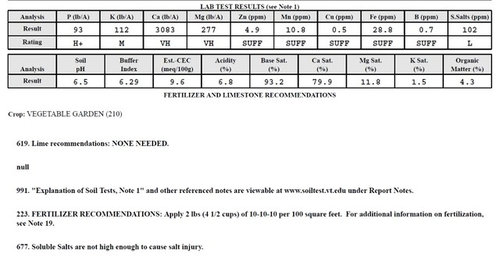
Could someone familiar with soil test results take a look at my report, and see if everything looks in order, or needs attention?

Vegetable garden, will be planting strawberries (for the first time), and the regular staples of tomatoes, squash, and cukes.


Comments (31)

  • 9 years ago

    Here's the fun part. you're going to get a thousand answers...ok, not really, but a lot. And half of them are going to be saying different things and a third of them are going to be contradictory. It's almost enough to make you think that plants succeed no matter people think or do. make sense? no?

    here's my takeaway: fertilizer will help. you have a recommendation from the lab for 2 1/2 lbs of fertilizer (based on a certain percentage of n-p-k per 100 ft. that's a pretty high rate for a lab to recommend, so I'm going to guess you're going to want to pay attention to fertilizer. At the very least, this means a quick lesson in nutrient deficiency symptoms, and just paying attention to how things are growing. there's no substitute for simply paying attention.

  • 9 years ago

    Congratulations. The test shows that nothing is low in your soil except salt, and that is a good thing. The pH is 6..5 which is perfect except for things that like acid soil such as blueberries. I really don't understand a recommendation of 10-10-10 when it shows that P (phosphorous) is high and K (potassium) is medium. It did not check for nitrogen. Some labs do not check for nitrogen because it various from month to month. I would use a fertilizer with a 3-1-2 ratio such as 15-5-10. That is what most plants use and since there is no real problem that should work.

    The first number on a bag of fertilizer is N-Nitrogen, The second is P (phosphorous) and the third is K (potash or potassium).

  • 9 years ago
    last modified: 9 years ago

    +1 to what Wayne said - adding that anytime you ask a gardening question you will get mixed answers.

    So here's my take...

    Wish I knew what part of the world this soil was taken from and the lab that tested it? And if this is the first time gardening in this soil? How much sunlight (hrs/day) does this garden spot get?

    I'm gonna guess that some fertilizer or compost has been added before the test? I didn't see any results for N. But I don't think I would add any more fert - maybe compost in the planting hole but I think your results look good unless you just have money you want to spend.

    Everything shown was above "Suff" except Salts which is what you want.

    Now to say I know nothing about how the soil sample was meaning was it just one spot or several locations dug down and mixed together?

    Is this a bed or in ground soil? I'm now thinking it is likely a bed with store bought soil added?

    Now if you plan on growing things like potatoes, blueberries, etc. you will want another area with a lower pH.

    afaik - testing for lead is a separate test and may require a different lab. But I think you must also tell what chemicals you want tested for.

  • 9 years ago

    Many labs do not test for N. It almost always needs to be supplemented because it is the most mobile of the primary plant nutrients, varies widely from day to day and season to season and also the one most in demand. I also agree with wayne that the test looks pretty darn good and support his fert recs as well. In fact, they make way more sense than the lab recs!

    Testing for soil contaminates is an entirely different testing process, has a significant added expense and YOU need to specify what contaminates to test for. That is NOT a standard soil test.

  • 9 years ago
    last modified: 9 years ago

    gumby_ct

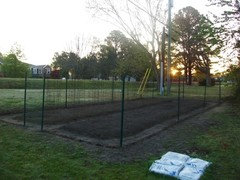
    This garden is located in Williamsburg, VA., and the soil test was done by VA Tech. It has been used for growing vegetables (and the occasional flower :-) for the past 15 years. It receives good sun all day, except for a three hour mid day shading from a nearby tall tree. No fertilizer has been added since last summer (which was whatever individual plants received). For the soil sample, I collected about 10 different samples from various spots, from the crust to about 8" deep, and mixed it all together. It is in ground, but I've added so many tons of amendments over the years that it looks like a raised bed.

    When I first started it was almost entirely clay, but now (to the depth of about a foot) it looks and feels like black potting soil. To grab a handful you'd think "how could anything not thrive in this?". But last year was almost a total bust, and nothing grew worth a darn.

  • 9 years ago
    last modified: 9 years ago

    the site (last April)

  • 9 years ago
    last modified: 9 years ago

    Very nice...

    what do you mean by "nothing grew worth a darn"?

    btw - we just came back from Va. Very nice area.

  • 9 years ago

    The left side (all tomatoes) did OK, but production was way down from previous years, and blight eventually did them in. The right side, squash, cukes, watermelon, were very unhappy all year (I don't know why), and just didn't produce well at all.

  • 9 years ago
    last modified: 9 years ago

    By unhappy do you mean watermelons and cukes did not grow? If so the most likely cause was lack of nitrogen. The pH was good so that would not be the problem. If nitrogen is ok maybe disease or other harder to diagnose problem.

    Tomatoes can vary on production. High temperatures can also cause a lack of production.

  • 9 years ago
    last modified: 9 years ago

    Looking at the pic I take it there are trees on the RH side and that is where the sun is most of the day?

    I am convinced that blight can be a roll of the dice since it is wind born and can be blown in from the neighbors or where you bought your plants.

  • 9 years ago
    last modified: 9 years ago

    It would be helpful to know the test methods used to extract the nutrients or maybe the name of the lab would help in finding out.

    Overall, other than K, there is nothing that the test shows that is so deficient that it should cause a poor yield. Could have been disease, lack of N or water.

    I agree that phosphorous doesn't need massive increases but a nudge up by 10- 20 (15) lbs per acre would do no harm even if the M3 test was not the one employed. That should raise your level ppm to the M3 optimum of 50 to 55 ppm. (the one I commonly use for turf--but this isn't turf) Your current level is 46.5 ppm

    I definitely would raise K to at least 220 lbs per acre. That would bring you up to the low end of optimum ppm of 110. Your current level is 56 ppm. Very low.

    The lab's recommendations of 2 lbs of 10-10-10 per 100 sq ft would bring your P level up to a M3 tested 65 ppm (some soil scientists do recommend optimum levels fall between 60-80ppm for crops). It would also raise your K level to 79 ppm. (many soil scientists recommend 180 to 240 depending on CEC. Your soil's ideal optimum appears to be 180-200ppm).
    Hope that helps. Good luck.

  • 9 years ago
    last modified: 9 years ago

    <It receives good sun all day, except for a three hour mid day shading from a nearby tall tree.>

    I wonder if those trees have grown over the years and now are part of your problem. I think it is time to check to see and calculate just how long the direct sunlight is hitting on the beds in question. Don't forget to check when the trees have leafed out.

    Do you have any previous soil test results to compare to?

  • 9 years ago
    last modified: 9 years ago

    I think you'll need to be more specific about your problems. Unhappy? (As in, teary eyes?) Didn't produce well? (As in lots of foliage but no fruit?). Nothing grew worth a darn? (As in, everything stayed small?) A proper diagnosis really requires understanding the symptoms. I agree that from the perspective of soil nutrients, it looks pretty good. So there is something else going on. Do you know anything about the history of this bed? Did it ever grow things well? Are you applying gardening experience from some other bed or perhaps are a gardening novice? If you're going to get wisdom as to whether everything looks in order, you really have to consider everything. Not just soil chemistry. We're all trying to help.

  • 9 years ago
    last modified: 9 years ago

    First of all, thanks for all of the replies, they are much appreciated.

    I think we've gotten a little sidetracked in talking about last years problems though, there are so many possible reasons that could have caused the crop not to have performed well, and it would be difficult to diagnose now. Although, I did use fresh wood chippings (mostly pine) for mulch last year, and maybe that was a mistake.

    But I'm looking forward to this year now (which is why I had the soil test done to start).

  • 9 years ago
    last modified: 9 years ago

    >I wonder if those trees have grown over the years and now are part of your problem. I think it is time to check to see and calculate just how long the direct sunlight is hitting on the beds in question. Don't forget to check when the trees have leafed out.

    Do you have any previous soil test results to compare to?<

    This spot is the best I have, so I'm committed to it for as long as I live here. I also have a nice area set up out back with large containers, and that gets all sun, every day, and that performs well every year, so no worries.

    But yeah, there is a huge Poplar tree not that far away from the garden, and I wish a storm would bring it down sometime (but that's a different story ;-)

    Last year I got the brainstorm to investigate the extent of that Poplar's roots encroachment into my garden area, so I dug a trench 3' deep along the side near the tree. Sure enough, there were several decent sized roots, so I chopped them all in half. (I don't know if that makes any difference or not, but it can't hurt I guess (except to the tree ;-)

    I did have a soil test done about 10 years ago, but the only copy I had was stored on a computer that fried, so that's lost I guess.

  • 9 years ago

    >Ridgerunner

    It would be helpful to know the test methods used to extract the nutrients or maybe the name of the lab would help in finding out.<

    Virginia Polytechnic Institute and State University (VA Tech) ran the test, but I don't know anything about their methods.

    And yes, your post did help. Thanks

  • 9 years ago

    Organic matter is a bit low, 4.3 percent, while optimum is In the 6 to 8 percent range. Soil pH, 6.5, is very good. Phosphorus levels (50 to 170 pounds per acre) is acceptable at 93 ppa, although Potash ( 400 to 800 pounds per acre) ia a bit low at 112 ppa. Calcium (3,000 to 8,000 pounds per acre) at 3083 ppa and Magnesium (600 to 1,600 pounds per acre) at 227 ppa seem a bit low and the ratio (5 to 1) seems to be out of whack.

    Perhaps getting the amount of organic matter up would be sufficient to get those nutrient in balance.

    kimmq I kimmsr

  • 9 years ago
    last modified: 9 years ago

    >Perhaps getting the amount of organic matter up would be sufficient to get those nutrient in balance.<

    The grow zone is about 300 sq ft. Twice I've had 3 yards of compost delivered, and the other years I usually incorporate 30-40 bags of the cow manure compost that you can get from Lowes. I have one of those tumbler composters for kitchen scraps and whatnot, so whatever that churns out gets added. I'm making an effort man! ;-)

    But yes, you are right, more organic material would be beneficial.

    Most years I'm seeing good production, but last year was a fluke and a bust. I'll add the fertilizer recommendations, go back to straw mulch, and I'm optimistic this year will get me back on track. Thanks

  • 9 years ago
    last modified: 9 years ago

    waynedanielson

    >It's almost enough to make you think that plants succeed no matter people think or do. make sense? no?<

    Plants want to live and make seed, so their biggest worry is for a bumbling gardener to come along and ass things up somehow. ;-)

    The biggest thing seems to be water and good drainage, and I think I'm a-ok on that front.


    (well.. water, drainage, and sun, food, protection from the elements, pests and disease :)

  • 9 years ago

    <(well.. water, drainage, and sun, food, protection from the elements, pests and disease :)>

    Me thinks in this case it is sun that is lacking. I really don't think adding organic matter or fertilizer or dollar bills will help if the sun light is not adequate for your sun loving plants.

    Ever seen plants and trees growing out of rocks? Ever wonder how much organic matter they have? But they are getting what they need and want somehow.

    Me also thinks the soil test shows things are adequate so if you have plants that do not need as much sun grow them there and the sun lovers in your other spot.

    Growing the right plants in the right location is the #1 key to success.

  • 9 years ago

    Do you have tree roots getting in? Poplar is shallow rooted and tree roots can easily grow 50 ft from the tree. They love rich moist garden soil. If you don't do much digging and tilling (which is generally smart in a clay soil) you might consider digging a trench along one side of a bed (on the side where there are trees) down about a foot and check for roots. Although you'd probably see fibrous ones up in the shallow soil if they were getting in. I've found roots as big as my wrist a foot down under my beds. They will suck out food and water and your garden suffers.

  • 9 years ago

    Tree roots are BAD news. The test and the picture look pretty good.

    As dan said, it would be helpful to know better what "didn't do well" really means...small plants. disease ...vine crops are VERY disease prone, too much rain, too little rain, or whatever.

    I suspect you need more nitrogen.

  • 9 years ago

    gumby! One year the tomatoes grew 8' tall and we must have canned fifty quarts of them, and the shade situation is the same now as it was then. (After the Spring equinox, when the sun begins getting high in the sky) they get full sun from dawn till about 11, then about a 2 hour shady break, and full sun until sundown. It may not be ideal, but I don't think it's a dealbreaker.

    I'd be willing to bet last years problem was due to a lack of fert or something, and not because of a light deficiency.

    Anyways, I will see how well this year fares soon enough.


  • 9 years ago

    Yea, it sounds like a lack of nitrogen. You are getting way more sun than what I have for tomatoes and mine have done fine. Tomatoes can tolerate a little shade. And the tree roots are only a problem if you are not watering enough. In my area of the world we have tree roots in every hole we dig. But with 60 inches of rainfall each year they do not seem to hurt much.

    Wayne was right, you are getting many opinions and many are contradictory,

  • 9 years ago
    last modified: 9 years ago

    It's all good Gary.

    Last year I dug thirty feet of a 3' deep trench to combat my encroaching roots problem (as I've said before). I hadn't wanted to go that deep, but I had some old tin wall partitions laying around, and I buried them in the trench before refilling, so the roots will have to take the long way around to get back in!

  • 9 years ago

    "Tomatoes can tolerate a little shade."

    Maybe they can in TX but I would not make that generalization elsewhere! In my climate they need uninterrupted sun for 8 hours, minimum!! And even with that, only the short harvest varieties will ripen reliably.

    I assume dan's zone 7 is in VA, as that's where the test was done. And it sounds like his sun exposure is decent for growing toms. I'd just add some organic matter (compost) before planting and keep an eye on plant development for any nutrient deficiencies and supplement with a fertilizer if necessary.

  • 9 years ago
    last modified: 9 years ago

    As the saying goes all gardening is local, what works in the PNW may not work in the south. That is why I put TX beside my login name. If I was just talking Texas, I would have said they can take a fair amount of shade. I also think having 8 hours of sunlight would qualify as a little shade. The sun shines for 12 to 14 hours in the summer here I live. But I do not try to advise people in the PNW. You are much more qualified than me.

  • 9 years ago

    In gardening terms, 'full sun' is described as 8 (or more) hours. Tomatoes are considered full sun plants but they dislike intense heat so that may be why the need for more shade in TX. We are far enough north that sun in summer here is present for almost 18 hours daily but still we require uninterrupted sun for at least 8 hours for good tomato production.

  • 9 years ago

    I guess it is just a difference in terms. To me, a little shade means that the plants are shaded during part of the day.

    I have the same problem with a light frost. In my area, a frost is what occurs on a still, clear night when the temperatures are between 32 and 38 degrees. I have noticed other people farther north call frost when temperatures fall below 32 degrees. To me that is a freeze.

    The sun is more intense the further south you go. I remember in college that people from up north would go out to get a tan. When they would just start to turn a little red they would go inside, where they would continue to cook and turn deep red, and even blister.

    People will say that Texas has a long growing season, when in reality we have 2 short ones, spring and fall. With tomatoes some gardeners plant a late winter crop that ripens in June and July and set out another set of plants in mid July and early August for a fall crop.

  • 9 years ago

    There is such thing as too much nitrogen as well. A over abundance of nitrogen can cause overly leafy plants that has much less flowering and fruiting. The fruit that does survive tends to be larger than average in size. This can lead to other problems like splitting which makes the fruits more vulnerable to pests and disease.