Software
Houzz Logo Print
ontario_canada5a_usda4b

Heaven-Hell Trees hardy to USDA zone 4

The wood of the tree
below is used for building temples, a cultural nexus to Heaven https://en.wikipedia.org/wiki/Chamaecyparis_obtusa

Maybe there is a favorite wood for making a Dracula stake, a cultural nexus to
Hell.

Are there any other
Heaven-Hell trees? Hardy to USDA zone 4?

Chamaecypares obtusa
Hinoki Cypress

Comments (45)

  • 9 years ago

    Trees favored for stakes to stab vampires (and therefore 'kill' them) are traditionally ash, oak or hawthorn. Not because these offer a conduit to hell but because they are considered sacred (Celtic sacred trinity). Also popular with Druids and the Norse.

    Arborvitae translates to "tree of life" and that common name has been linked with the age these trees can assume, the fact that their wood is very rot resistant and that Thuja occidentalis is a very popular and useful homeopathic remedy.

  • 9 years ago
    last modified: 9 years ago

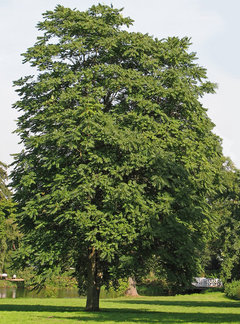
    Ailanthus
    altissima
    ... host tree for the silkworm important for silk production ...
    suckers and stinks though ... has been named 'Tree of Heaven' and nicknamed 'Tree of Hell'
    ... great cultural significance ... great looking tree if you ask me .... https://en.wikipedia.org/wiki/Ailanthus_altissima

  • 9 years ago

    The problem isn't the way it looks; it can be quite pretty, as you note. It's that once you have one, you will never be lonely...

    Ontario_Canada5a_USDA4b thanked Sara Malone (Zone 9b)
  • 9 years ago
    last modified: 9 years ago

    Well understood,
    Wikipedia says '... the city of Basel, Switzerland has an eradication program
    ... very difficult to eradicate ...' No, I won't be growing the tree ... I am
    not lonely :-)

    BTW, I can recommend reading the Wikipedia article that I linked to in my previous post, it is one of the
    longest Wikipedia articles on a single tree species. The section on the cultural
    significance of the tree is particularly interesting.

  • 9 years ago

    Maybe my imagination, but I think I recall Ailanthus being even more ubiquitious a few decades ago (wonder it's the hotter/drier summers nowadays). I grew up in Queens, NY. This species and Mimosa (both non-natives) seemed to be the dominant trees in the urban jungle. They both really, really excelled in dense, urban conditions where nothing else survived. In fact, Ailanthus (a.ka., the 'Tree of Brooklyn') produces toxins that kills other species so they can colonize in a monoculture. Mimosa were equally as prominent. Before I became aware of their weedy potential, I really loved to see canopies of Mimosa tree covered in pink blossoms growing in the concrete.

    These days, I don't live far from NYC out in suburbia (Zone 7a), but it doesn't seem either species has gone on to conquer the earth..., other than roadside, otherwise dead zones.

    Ontario_Canada5a_USDA4b thanked User
  • 9 years ago
    last modified: 9 years ago

    "The problem isn't the way it looks; it can be quite pretty, as you note. It's that once you have one, you will never be lonely..."

    Yeah, my neighbor has a whole grove behind her house. If I'm not mistaken, they are closely related to sumac, often called "stinking sumac", which may explain some of their suckering habits. I think they look weedy anyway and can't really understand why they were ever cultivated in the United States.

    "Mimosa were equally as prominent. Before I became aware of their weedy potential, I really loved to see canopies of Mimosa tree covered in pink blossoms growing in the concrete."

    Here mimosa (albizia julibrissin) are nowhere near as common or weedy as ailanthus. I am aware of their invasive tendencies, but I still love the sight of those light, fluffy pink blooms. Not to mention the delicate fern-like foliage. They are beautiful when they are pruned to a single trunk.

    "Trees favored for stakes to stab vampires (and therefore 'kill' them) are traditionally ash, oak or hawthorn. Not because these offer a conduit to hell but because they are considered sacred (Celtic sacred trinity). Also popular with Druids and the Norse."

    That's some interesting, yet very weird information. Now I just need to meet a vampire so I can put this technique to a test Lol.

  • 9 years ago

    Ailanthus is not closely related to sumac. They are in two different families.

  • 9 years ago
    last modified: 9 years ago

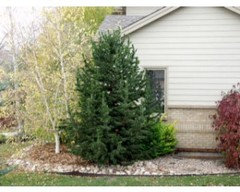
    My
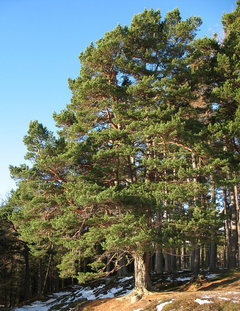
    little Pinus sylvestris standard tree is said to produce oleoresins for making
    incense. Maybe I could burn shed needles to send my wishes to Heaven :-)

    Pinus sylvestris species tree - a Tree of Heaven ?

  • 9 years ago

    subtropix, at least in MD an eradication program started maybe 20 yrs ago and ailanthus numbers along roads have decreased considerably.

    Ontario_Canada5a_USDA4b thanked bengz6westmd
  • 9 years ago

    "subtropix, at least in MD an eradication program started maybe 20 yrs ago and ailanthus numbers along roads have decreased considerably."

    The 3 most prominent roadside plants here are ailanthus, chinese privet, and callery pear.

  • 9 years ago
    last modified: 9 years ago

    Mimosa, I was once told, were hit by some viral pathogen in the East and suffered big declines. I have seen "Chocolate Mimosa" being sold but I prefer the plain green of the species.

    Ailanthus was first thought to a terrific shade tree for urban environments. I wonder if it may have come into Europe first (think I read that). Well, in America the torrid and wet summers seemed more to its likely and the rest is history. Which apparently includes..., the Gold Rush, the westward expansion of the railroad, and Chinese laborers who brought the tree out west due to its revered state in Chinese medicine. Curiously, the tree is known for it alleopathic inhibition of other species, so it is mighty potent chemically. Maybe if it were found to cure cancer, the species could redeem itself in the West. In the meantime, I notice another East Asian tree has replaced the much maligned Ailanthus in eastern urban areas....the mighty Ginkgo (another tree revered in the Far East). Have anecdotally heard that the elderly Chinese women in NYC know exactly where to go for the harvest of female Ginkgo nuts (which, as most people here know, is not knowingly planted in western yards and streets due to the stench of the female fruit), but is also important in Chinese medicine. I myself have a male, but I guess time will tell.

    Ontario_Canada5a_USDA4b thanked User
  • 9 years ago

    Yeah, the
    Ginkgo has been planted in temple gardens in the Far East, some of those trees
    are believed to be 1500+ years old. So, there is a cultural nexus to Heaven.

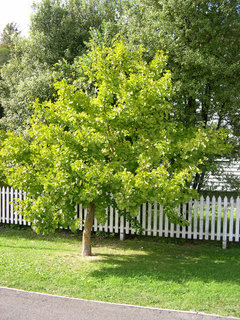
    Ginkgo
    biloba
    'Jade Butterflies' dwarf cultivar grows to 6'-12' x 3'-9'

  • 9 years ago
    last modified: 9 years ago

    "Ailanthus altissima ... host tree for the silkworm important for silk production ..."

    Actually, the silkworm most important for silk production would be Bombyx mori , which feeds on mulberry. But Ailanthus was apparently imported along with the Ailanthus silkmoth (Samia cynthia) in an early attempt to produce silk here in the U.S.

    "The 3 most prominent roadside plants here are ailanthus, chinese privet, and callery pear." Sounds like it should be describing somewhere in China rather than NC ;)

    Ontario_Canada5a_USDA4b thanked arbordave (SE MI)
  • 9 years ago

    For comparison,
    Wikipedia has this to say: "Ailanthus altissima...a host plant to feed
    silkworms of the moth Samia cynthia, which produces silk that is stronger and
    cheaper than mulberry silk, although with inferior gloss and texture. It is
    also unable to take dye. This type of silk is known under various names:
    "pongee", "eri silk" and "Shantung silk", the
    last name being derived from Shandong Province in China where this silk is
    often produced. Its production is particularly well known in the Yantai region
    of that province. The moth has also been introduced in the United States."

    Don't you know that
    NC is a Chinese province?

  • 9 years ago
    last modified: 9 years ago

    It's true that a number of moth species can be used to produce silk (including Samia cynthia), but Bombyx mori (the mulberry silkworm) is by far the most important. See http://inserco.org/en/types_of_silk "... mulberry silk is the most important and contributes as much as 90 per cent of world production, therefore, the term "silk" in general refers to the silk of the mulberry silkworm".

    Back on topic, I'm surprised no one has mentioned Aralia spinosa , Devil's Walking Stick.

    Ontario_Canada5a_USDA4b thanked arbordave (SE MI)
  • 9 years ago
    last modified: 9 years ago

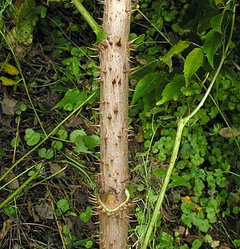
    Aralia spinosa
    'Devil's walking stick' ... viciously sharp, spiny stems, petioles, and even
    leaf midribs ... curiously aka 'Angelica tree' ... I don't see an angel, only the devil ... https://en.wikipedia.org/wiki/Aralia_spinosa

    Trunk of Aralia
    spinosa

  • 9 years ago

    'Anglelica tree' is the common name applied to Japanese aralia, Aralia elata. An entirely different species. It does have some thorns on the stems but not quite so vicious.

  • 9 years ago
    last modified: 9 years ago

    There is an Ailanthus vilmoriniana 'Downy Tree of Heaven' https://en.wikipedia.org/wiki/Ailanthus_vilmoriniana which is related to the Ailanthus altissima 'Tree of Heaven' that we discussed extensively in the above, but the A vilmoriniana is not hardy to USDA zone 4, so no pic.

  • 9 years ago
    last modified: 9 years ago

    A vilmoriniana doesn't appear to be quite as thorny as "Devil's Walking Stick", but would probably still make a good substitute:

    https://hackfalls.files.wordpress.com/2010/02/20100203ailanthus-vilmoriniana-c.jpg

    Ontario_Canada5a_USDA4b thanked arbordave (SE MI)
  • 9 years ago

    I wonder if these thorny plants can be planted as a hedge to ward off deer. Put a black chain link fence in front of the hedge that will visually disappear in the green, to prevent your squirrel-chasing dog from running into the thorny hedge.

  • 9 years ago
    last modified: 9 years ago

    The tree in 'A Tree Grows in Brooklyn' was an Ailanthus altissima (why not altissimus?):

    There's a tree that grows in Brooklyn. Some people call it the Tree of Heaven. No matter where its seed falls, it makes a tree which struggles to reach the sky. It grows in boarded up lots and out of neglected rubbish heaps. It grows up out of cellar gratings. It is the only tree that grows out of cement. It grows lushly...survives without sun, water, and seemingly earth. It would be considered beautiful except that there are too many of it.

    — A Tree Grows in Brooklyn, Introduction

    Ontario_Canada5a_USDA4b thanked Sara Malone (Zone 9b)
  • 9 years ago
    last modified: 9 years ago

    Ailanthus altissima
    is correct, Ailanthus altissimus is incorrect, since botanical, like Classical
    Latin, treats most tree names as feminine https://en.wikipedia.org/wiki/Ailanthus_altissima

    The book intro is
    also quoted in the Wikipedia link (which contains much more), it is a remarkable article on a
    remarkable tree, worth reading.

  • 9 years ago

    I thought that the genus and species were supposed to agree? Or maybe it's just the species and cultivar? E.g. Sequoiadendron giganteum 'Pendulum', Cedrus atlantica 'Pendula'. I think that's why I thought that g & s were supposed to agree, too. Thx.

    Ontario_Canada5a_USDA4b thanked Sara Malone (Zone 9b)
  • 9 years ago
    last modified: 9 years ago

    My Latin is worse than my Esperanto, so I just copy and paste :-) ... including the section of the Wikipedia article that explains the feminine gender of Latin tree names.

    Edit: subtropix's suggestion below is a good one!

  • 9 years ago

    "I thought that the genus and species were supposed to agree? Or maybe it's just the species and cultivar? E.g. Sequoiadendron giganteum 'Pendulum', Cedrus atlantica 'Pendula'. I think that's why I thought that g & s were supposed to agree, too. Thx."

    Post your question on the Botany forum (one of the many "fora"), if you want a concise explanation.

    Ontario_Canada5a_USDA4b thanked User
  • 9 years ago

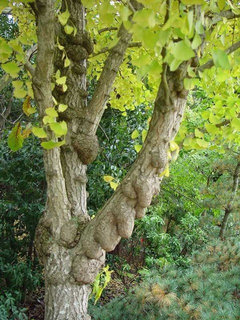
    Further to the Ginkgo
    as temple garden trees, there is a dwarf cultivar with odd growths that
    usually appear after a decade. Imagine your surprise, not everyone will like
    it. It is a male clone, BTW. http://www.missouribotanicalgarden.org/PlantFinder/PlantFinderDetails.aspx?taxonid=257111&isprofile=0&

    Ginkgo biloba 'Chi-Chi' dwarf cultivar that grows to 4'-5' tall and wide

  • 9 years ago
    last modified: 9 years ago

    "My Latin is worse than my Esperanto, so I just copy and paste :-)"

    Lol you'll get used to using it in the future. It took me awhile to stop copying and pasting from google. I think all of us have to at some point, though.

    The ginkgo is a much nicer tree than ailanthus, though I'm not exactly sure what I am making suggestions for. Are you considering planting one of these or are we just suggesting trees that are used in old superstitious beliefs?

    Reason for edit: corrected a typo

  • 9 years ago
    last modified: 9 years ago

    It's GinK-Go, just to be clear. And the cultivar in the photo is called 'Chi-Chi' or Tschi-Tschi'. The former reflects Mexican slang, a diminutive of 'teta' (that ought to give everyone a clue) and the latter is supposedly Japanese for the same thing but I can't verify it. I can verify the former because a Mexican born, native Spanish speaker helped me plant mine!

  • 9 years ago

    Oh, sorry about that. It's a typo. My fingers are trying to work faster than my brain.

  • 9 years ago
    last modified: 9 years ago

    'Chi-chi' means nipple in Japanese and most older ginkgos will develop these growths, which can extend down from the trunk and branches and root in the ground. The cultivar 'Chi chi' just forms these protuberances at a very early age comparatively.

  • 9 years ago
    last modified: 9 years ago

    Long-lived
    bristlecone pines may qualify as a cultural nexus to Heaven, divine beings are supposed
    to be long-lived too, but so are devils, for that matter, ouch

    Pinus aristata the
    most common bristlecone pine cultivated in gardens

  • 9 years ago
    last modified: 9 years ago

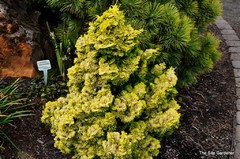
    Back to wood for building temples, the straight species
    tree grows too big for me, but what a beautiful dwarf cultivar! Grows slowly,
    though, 7' tall in 20 years.

    Chamaecyparis obtusa
    'Nana Lutea' ... wood for building small temples...

  • 9 years ago

    Can someone explain more about the eradication program of Ailanthus in MD?

    How exactly do they eradicate them? Are there any programs to get rid of the wild Callery Pears that plague so many towns?

  • 9 years ago

    tlbean, from what I remember, they actually inject a potent poison into the root zones of the ailanthuses. The poison breaks down pretty quick, so doesn't really affect anything nearby.

  • 9 years ago

    Yggdrasil, the World ash...but the most 'ecclesiastical' tree in the UK would be that ubiquitous graveyard sentinel - the yew.

    Celtic tree mythology lists the sacred and profane qualities of various trees - I have an especial affinity with the rowan...a highly magical tree.

    Ontario_Canada5a_USDA4b thanked User
  • 9 years ago
    last modified: 9 years ago

    I
    had a dwarf Japanese yew at my previous place (which was not a graveyard BTW :-)) that was already
    shaped into an upstanding egg on a short stick when I bought it. It grew so very
    slowly, it never lost that exact shape until I moved out of the place without me ever doing any trimming.

  • 9 years ago
    last modified: 9 years ago

    Depending on the tradition, you are supposed to use White Ash, Oak, hawthorn, apple, or rowan to make stakes to kill vampires.

    Rowan is supposed to offer protection from fairies and the supernatural.

    Frankinsence comes from trees in the genus of Boswellia. Palm fronds are used on Palm Sunday and their ashes are burned for Ash Wednesday. Alas, neither is Zone 4 hardy.

    I'm not sure if there is a mythological basis, but I read a fantasy series that linked mistletoe to Hel because it was used to kill Baldur.

    Ontario_Canada5a_USDA4b thanked edlincoln
  • 9 years ago

    Campanula UK Z8 Yggdrasil, the World ash...but the most 'ecclesiastical' tree in the UK would be that ubiquitous graveyard sentinel - the yew.

    Some researchers actually believe Yggdrasil to be a yew and not an ash. I don't remember the details but the tree is supposed to be winter green and have deers browsing from its foliage. Yew is poisonous to most animals, but not deers. There are also a special rune for yew, and it's the same as for Yggdrasil.

    Ontario_Canada5a_USDA4b thanked Huggorm
  • 9 years ago

    As an interesting aside, apparently raccoons were a popular pet in Japan for a while, and have become an invasive species. There is a problem with escaped American raccoons eating temples. When I heard about it I thought it was odd because I cab't recall anyone having a problem in the US with raccoons eating houses. Have you noticed if raccoons are particularly fond of this tree for some reason?

    Ontario_Canada5a_USDA4b thanked edlincoln
  • 9 years ago

    "Eating" temples sounds like a translation error. In their search for cozy places to sleep and find food, they are prying, chewing, and scratching their way into those temples. They do much the same in North America with garages and houses.

    Ontario_Canada5a_USDA4b thanked Smivies (Ontario - 5b)
  • 9 years ago

    Eating temple trees?

    Ontario_Canada5a_USDA4b thanked Huggorm
  • 9 years ago
    last modified: 9 years ago

    Eating trees for self-mummification https://en.wikipedia.org/wiki/Sokushinbutsu

    Edit: It is not on my bucket list, BTW.

  • 9 years ago
    last modified: 9 years ago

    BTW, here is another
    interesting Latin naming issue, although there appears to be an explanation for
    it (?) Anyway, according to the ACS database:

    1. Pinus sylvestris 'Glauca Nana'
    http://conifersociety.org/conifers/conifer/pinus/sylvestris/glauca-nana/

    is a different plant
    from (note that the two words in the cultivar name are transposed)

    2. Pinus sylvestris 'Nana Glauca'
    http://conifersociety.org/conifers/conifer/pinus/sylvestris/nana-glauca/

    Although, in this
    case, the naming of plant 2 appears to have been necessitated to differentiate it
    from yet another different plant

    3. Pinus sylvestris 'Nana' http://conifersociety.org/conifers/conifer/pinus/sylvestris/nana/

    When plant hunting,
    make sure whether it is plant 1 or plant 2 that you are bringing home. Plant 1 is hardy to
    USDA zone 3, whereas plant 2 is hardy to USDA zone 5. It is all according to the ACS database, I am innocent :-)