Software
Houzz Logo Print
deannatoby

Confused about winters heaths

Winter heaths (Erica carnea) are on my list for a garden area that needs to have a great deal of winter/off-season interest. I'm pretty confused, however. General information on them says they begin blooming in maybe November and continue though winter, or something similar. In New England? I have a sneaky suspicion that might be for warmer zones, but I'm having a hard time finding New England specific information on them. How do they behave in New England zone 5, and are there any varieties you'd recommend?

Comments (8)

  • 9 years ago

    I had Erica carnea 'Vivelli' in a previous garden about 20 years ago. I chose it because of all the heaths, it had the reputation for being the hardiest. It bloomed in early spring, often as it was emerging from the snow, and in a winter like this and in a sheltered area might be blooming around now, though most years it would be later. In one winter it was killed back a fair amount due to particularly cold weather along with a lack of snow, so I might cover loosely with evergreen boughs to help it out in exposed winters. Nice fine dark green foliage and deep pink flowers. I would have replaced it after we moved if the heather nursery on Cape Cod where I bought it hadn't gone out of business. There is a west coast mail order heather nursery that might have it.

    My inlaws have Springwood White and/or S. Pink and they show damage most winters and seem to bloom about the time of some of the mid-early spring bulbs. We are both just north of Concord, NH. I think in the milder area of southern NH or the seacoast they might be fine most winters, especially in areas with some winter shade so that snow cover remains longer.

  • 9 years ago

    Snow coverage is your friend :-) Otherwise, winter blooming heaths are rather Mediterranean in origin and not well suited to cold winter climates. Calluna vulgaris (heather) is a better choice for cold areas but blooms in summer and fall, not winter. This link on heaths and heathers for cold climates may be helpful.

    In my climate, winter heaths start blooming in late October or early November and will continue on into March and April. Not necessarily the same single plant - usually one selects several varieties for a full winter of bloom.

  • 9 years ago

    I live along the CT shoreline in a milder zone. I have one white and one pink heath that I planted many years ago. Both have been blooming of and on throughout the winter. We did get snow cover this year, but because we live along a river, it's the wind that does the most damage to my plants.

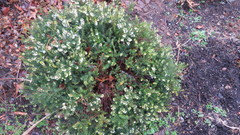
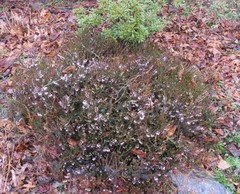
    I took these two photos this morning. The white Heath is planted in a more protected area; the pink one is planted on an open slope in strong sun. Generally, the white one looks much better, keeping a nice shape and showing less winter burn, which is probably due to the fact that it's protected from the winds by a nearby garden shed.


    The pink heath, below, always looks a bit ratty. You can see the wind burn on its leaves. Poor thing. I never do much with my plants and so it is doing the best that it can. I think if you have a good spot for them, heaths should do very well in your zone.


  • 9 years ago

    Thanks for the great information. Yes, NHBabs, I had certainly given up on winter interest beyond structure. Right now I have the red-twigged dogwoods and a Harry Louder walking stick planned. I think I'm on the boundary of where Harry Louder will live. When I began to read about Heaths/Heathers I began to get excited, until I became suspicious of that whole blooms-in-November thing. Based on what you all have said, I'll probably buy a couple varieties, only one plant per variety, and see how they do before making a big commitment to them. I have no idea how protected or exposed this area will be as it's been scrub until now. It seems more exposed, but based on the slope it could also be spared bad winds, as long as they're the traditional winter north winds. Once the winds switch to the south in April/May I think I could put a sail on all the plants and watch them fly away.

    I also want to try fothergilla, which is in the same family as witch hazel, but I'm getting it for fall color and not bloom. I think I'm barely in a decent zone for that plant, as well, but I'm going to try. I can't remember if fothergilla does anything noteworthy for blooming in spring.

    It seems that bittersweet it another good winter interest plant. I know the one at the office, which I think might be the pesky asian variety, still had beautiful berries last time I checked in January. That's pretty good interest! Will investigate those, too. Just not sure where to put it!

    Thanks everybody for all the great information!

  • 9 years ago
    last modified: 9 years ago

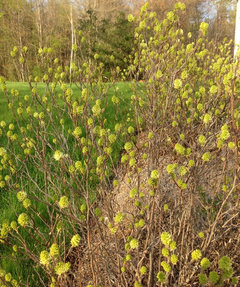
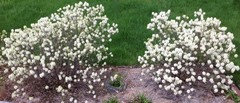
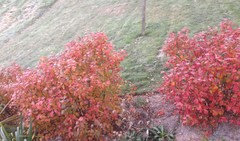
    Fothergilla is a great plant and fully hardy for me, having survived a couple of winters where it reached -23 and had a week or so of top temperatures in the single digits. Here's my Fothergilla 'Mount Airy' in a couple of seasons. The buds are a bright chartreuse as they swell, followed by bottle brush white flowers. If the weather stays cool, they are of interest for perhaps 3 weeks. I find them a bit homely in the summer due to the seed heads, but they are on a SW facing patio which gets little use then, so not a problem for me. I guess you could do a quick shear after bloom to remove them if wanted. I do grow clematis that in summer spill from short trellises onto them along with perennials around their feet for summer interest.

    Here it is in the first week of November. It is one of the last shrubs to turn color here, about the time the oaks are ending their color.

    Please, I beg of you, don't plant Asian bittersweet! I know that you didn't ask for input on this, but your neighbors near and far will curse you. It's a disaster that isn't like goutweed that stays on the originator's property, but gets spread when birds eat the fruit and then deposit the seeds elsewhere with a dose of fertilizer. I am constantly pulling it from my own property and my in-laws'. (My MIL planted it unknowingly years ago, and though the original is long gone, the progeny continues. The farm next door to me contributes seeds to my property.) I have seen the weight of the vines pull down full grown trees in badly infested areas. The Asian version has berry clusters scattered along the stem in the leaf axils rather than a single larger clump at the end like the American (which I haven't seen trying to take over the world around here). Perhaps native insects or diseases keep it in check. According to the link above, even the native does seem to hybridize some in this part of the world, so even it might not be a great choice. Alternative sources of winter berries: Hawthornes or Ilex verticillata/winterberry holly have bright red berries usually until some time well after the holidays, and we usually had crabapples get eaten by the birds in February-April as they started to thaw when we had one at our former home. Jane has photos of the chokeberries getting eaten throughout February on the Birds and other Mobile Features thread (nice red buds as well), and mentions that her crabapples will be next. So there are berried alternatives. Or just string around some plastic bittersweet. I've seen some quite convincing ones.

  • 9 years ago

    Those fothergilla blooms look MUCH better than I expected! Very exciting! How tall did yours get? I'm wondering if our harder winters keep it shorter than in other places. Mt Airy is the one on my list because of it's hardiness and dwarf height, but I thought I might be pushing it for hardiness. If it can survive for you I know it will do well here!

    I don't plan on planting Asian bittersweet, but given the number of berries on the twigs I'm assuming the one that was already in place when we bought the office here is the Asian variety. I've heard it is very invasive, but I didn't realize it could take down entire trees! I'll check into the other berries as well. I must admit, seeing those red holly berries lining the roads here in December and January was a TREAT!! So beautiful!

    When you are saying the native bittersweet hybridizes, are you saying the native hybridizes with the Asian variety and creates a pesky hybrid?

  • 9 years ago
    last modified: 9 years ago

    Deannatoby, from the article that I linked from the USFS above, it appears that the Asian and American species hybridize, but I haven't done any further research into it.

    My Mt. Airy seem to have topped out around 4' or a bit taller. The ones above do fine in sun from mid-morning until sunset, but I have some in almost full shade that are less dense and turn more gold-orange rather than the red-orange of those in more sun, so I'd try to give them at least a half day of sun. They do sucker some in sun, but the ones in shade don't seem to be doing that. I am not sure if the suckering is in response to vole damage to the roots (there are an overwhelming number of voles in the field behind the row in the photos above) or they are just more energetic in sun. Certainly they have survived the increasing infestation of voles which has killed some other shrubs, including most of my dogwoods and Viburnums.