

Lawn help for 2017
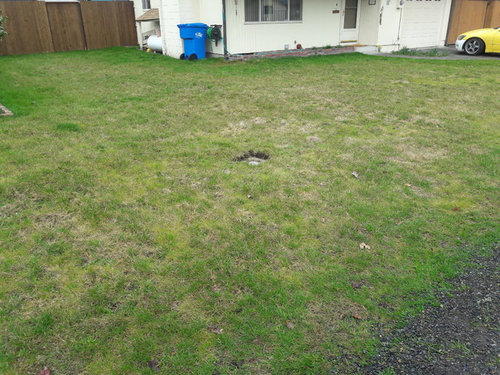
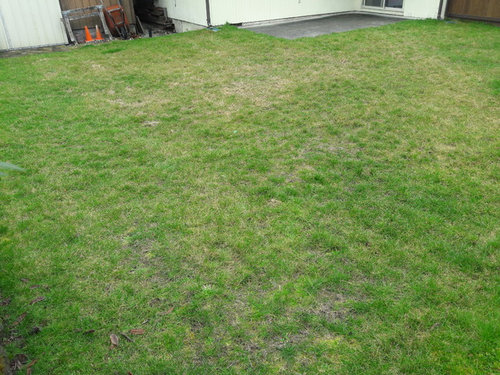
It's getting close to spring here in WA. My lawn isnt looking happy and would like some advice on how to repair the damage you see in the pics.
I have been using Lowe's organic fert (8 4 2) mix 2-3 times a year. I plan to go with Milorganite this year. I use Fast Acting lime to increase ph since it was really low in sept 2015.
I been using pre-emergent crabgrass killer in spring. I want to use something for the summer, but havent found anything to use for post-emergent that has no fertilizer. I havent been looking real hard either. Any suggestions?
I use Bayer broadleaf and weed killer but havent had good results. Just read up about surfactant and plan to mix it with the Bayer liquid. Will that be ok and will I get better results on the death of weeds?
Front Yard
Back Yard
Comments (26)
 9 years ago
What kind of grass is it? Fescue? KBG?
Get a good pre-emergent down in the spring and you won't have to worry about weeds much through the summer. That's the foundation of any weed prevention program, without it you are doomed to fail. I recommend a jug of Prodiamine 65 WDG from Amazon, it has to be sprayed but it will give you up to 6 months of coverage. Stuff found at big box stores is wimpy. Get this part right and it will take care of 98% of your weed problems.
As far as post-emergent, depends on the weeds. Different herbicides for different weeds. Post pictures as they come up and we can help with selecting the right herbicide for control. There's no one size fits all, at least not in cool season lawn. If you get a good pre-emergent barrier down it will only leave perennials to deal with, but some are tough bastards.
 9 years ago
One of the gurus at Gardenweb is gardengal(with some numbers). She's from the PNW and is not shy to tell you that I don't know what I'm talking about with lawns in her neighborhood. Had you put WA or PNW in your subject, she would have been here already. I think she'll find you or else we can go hunt her down.
Generally the idea is to develop the most dense turf you can before the crabgrass sprouts, which is about now. Fall is the best time to make it more dense. Hopefully gardengal will be able to help with that and more.
Related Professionals
Lawrence Landscape Architects & Landscape Designers · Lebanon Landscape Architects & Landscape Designers · Yakima Landscape Architects & Landscape Designers · Palm Bay Landscape Contractors · Cumberland Landscape Contractors · Hagerstown Landscape Contractors · Tyler Landscape Contractors · Mason City Landscape Contractors · Grand Junction Landscape Contractors · Jackson Home Builders · Dubuque Home Builders · Allentown Home Builders · Bridgeport Home Builders · Tucson Home Builders · Yakima Home Builders 9 years ago
Generally, the Bayer Advanced Weed and Crabgrass Killer works very well, provided you follow the directions. IME spot spraying often has a more rapid and obvious response than broadcast spraying. - I have found that homeowners often don't apply a sufficient quantity of the product when doing a broadcast spray. btw, this is the same combination of ingredients that professional lawn care companies use, although slightly less potent in its concentration. A second application is often necessary to effect complete control. Quinclorac is one of the best crabgrass controls on the market so you should get good results, if you follow the label instructions.
You can thank dchall for reaching out to me but this is where my advice will differ from his :-) Are you in western WA? Our conditions are rather unique here so if that is the case, spring is a great time to address lawn renovation. If you don't work on it now, you will have the same situation - and probably in worse condition - in fall. If you are in eastern WA, the situation is somewhat different.
Take the next month to get rid of the weeds and the moss. You don't need to use a 'moss killer' - just raking will remove it and you would have to rake it out anyway if you used some substance to kill it off first.
Then you want to address why the moss was there in the first place. I realize you didn't mention moss specifically but if you are in western WA, moss is a fact of life and is one of the reasons weeds are hard to control. Moss grows under conditions turf grass doesn't like; the moss out-competes the lawn, it becomes sparse and the weeds flourish. Moss prefers compacted soils with low fertility. It also favors damp soils but PNW soils are always damp in winter, when moss takes over. It doesn't look like poor drainage or shade are issues in your lawn - those are the other two common causes of moss.
You can address the compaction and fertility by first aerating, then spreading a layer of compost over the surface. After about a week and a good rainfall, you shouldn't see any sign of this activity and are ready to overseed. The spring window for this is midApril to midMay. Overseed with seed blend formulated for this area - unless sodded, all PNW lawns are blends. They will have these at the box stores but I prefer a higher quality mix found at most area nurseries. I also recommend a thin layer of compost spread over the seed - holds in the moisture for good germination, keeps the birds out and adds organic matter/low nutrient source.
I would also strongly urge you to look at a mulching mower if you don't already have one. You greatly reduce the need for any fertilizer and recycling the clipped weeds back into the lawn extends the effectiveness of the herbicide. You can supplement with a fertilizer if you choose, but I would stick as close as you can to just an N source - no P and very little K. I never suggest applying fertilizer after the end of May..........you will be stimulating the lawn to grow just as it starts to enter dormancy and as we hit our dry period. It's a big strain on both the lawn and our water supply. The best time to fertilize is in early fall and again just before winter sets in.
If the lawn is really bare and sparse after the weed and moss removal, you may want to do a second overseed in early fall. You want the lawn to become thick and maintain it at a 3" height to deter any new weeds or moss (moss will always try to reappear - it's the nature of our climate. Just keep the conditions it prefers under control and the lawn in good condition and you should win the battle!)
As an aside, unless your soil is quite acidic - not usually the case in western WA - you don't need routine applications of lime. Unless your pH is below 5.5, you are fine. The cool season seed blends we use here are perfectly happy in - and actually prefer - a slight to moderately acidic soil.....which is what we have.
- PRO9 years ago
General overseeding and feeding should help. Like stated above though, soil health does play a big role. Putting down some lime should help balance highly acidic soil. Careful though, too much can cause your soil to become too basic which is not ideal for grass growth.
If the pH is fine, you might consider aeration. Check out more about summer lawn care, and the best remedies for summertime at Lawn Care Augusta.
sphynx2716
Original Author9 years agoI live in Tacoma (Western WA). Seeding is ok to do in Spring? I follow the instructions on the bottle and bag when I apply. Is there a better amount that I should try that goes beyond the label?
I use liquid Bayer broadleaf killer, and dry scotts crabgrass killer with a mini broadcast spreader. Im still learning on how and when to apply this stuff. Last year, I only put down 2 apps of lime in Spring and Fall, 8lbs total. Epsom Salt in Spring and Fall, 2lbs total. I add about 3-4lbs of N per year. I applied organic fert 8-4-2 in March and June just before summer hit. Another app in Sept, then again in Nov. I have a total of 2k sq ft of lawn.
Thank you for some tips on the lawn maintenance that I will try this year. I plan to do a soil test at the end of summer to see where the soil is at.
- 9 years ago
Yes, in the PNW seeding/overseeding is recommended in spring (April/May).
Skip the lime and skip the Epsom salts. You don't need either one. And most certainly not the twice yearly liming!
No summer fertilizing of PNW lawns - you are wasting ferts and stressing out the lawn. The standard recommendation is to allow it to go summer dormant as it wants to. If you do not care for the dormant appearance, you can water but do so infrequently and very slowly and deeply.
This is the product I recommend you using - Bayer Advanced All-in-One Lawn Weed and Crabgrass Killer. It should address ALL your weed and crabgrass issues (no need for the Scotts). Rather than a broadcast spray of the entire lawn (which seldom achieves the proper coverage), try direct or spot spraying the individual weeds and clumps of crabgrass.
And while Lawn Car Augusta's general comments are appreciated, what one does for summer care of a lawn in Georgia are not the slightest bit appropriate for the care of a PNW lawn in summer :-) These are apples and oranges!!
- 9 years ago
j4c11 - have you ever lived or gardened or tended to lawns in the PNW? If not, please keep your sarcasm to yourself!! Under no circumstance I can think of would it ever be necessary to water 3 times a day here in May. Stating that is just a clear indication that you have no idea of what our climate is like. And yes, spring seeding or overseeding is a recommended practice by all lawn care professionals in this area. Not the only time it can be done but certainly a recommended time frame for this area.
- 9 years ago
Seeding grass at or just before a time when weeds are actively germinating is a silly idea in any area.
"Lawn care professionals", with exceptions, typically make recommendations based on what's best for their cash flow, not on what's best for your lawn. They have to make payroll and boat payments.
- 9 years ago
Although I am sure this is beating a dead horse, weed seeds are germinating and growing NOW!! As they do in here in the fall as well as through most winter. When they are less inclined to germinate and grow is in summer. Location does make a huge difference!!
And by lawn care professionals I do not mean the mow, blow and go guys, which by any argument are hardly considered 'professionals' - I mean turf management professionals, like those who manage golf courses, public parks, extension specialists and other horticultural professionals. Their 'cash flow' is not determined by the advice they give but their advice IS based on sound scientific and regionally appropriate practices.
- 9 years ago
Thanks gardengal. When I saw that post from Augusta I had to laugh. I knew you'd be back to explain how the cow ate the cabbage.
Lawn care is usually easy when you get advice from an expert in your area. That's the problem with almost everything you read is that they fail to recognize that someone outside their specific area might be reading it. For example there's a guy with several YouTube videos explaining that you should let your lawn grow, unmowed, all summer to make it through the summer heat. He's talking about this killer summer heat getting up into the high 70s. There is some truth to leaving the grass long in the summer, but the grass he has is clearly fescue, flopped over, and about 9 inches long. What I try to do here in this global atmosphere is to adapt to the writer's local conditions. I've been here since 2002 learning what the locals know. Unfortunately for me and the PNW there has never been a local expert...like gardengal, for me to learn from. So when I offer advice that works for the upper midwest or northeast, she often comes to repair the damage I've done. gg said they were like apples and oranges. They might be as different as steam shovels and mayonnaise.
- 9 years ago
@gardengal48
I'm looking forward to a picture of your PNW lawn so we can see how your advice and methods pan out in real life.
 9 years ago
i have no idea when the best time to seed is over there but do know perennial ryegrass is highly favored. if any cool season grass is going to do well with a spring seeding, PRG would be it.
sphynx2716
Original Author9 years agoIs Bayer Advanced All-in-One Lawn Weed and Crabgrass Killer a pre-emergent or post-emergent? From what I have read in the link, it looks like it is post-emergent. What pre-emergent would be best to fight off the weed seeds before they germinate? I would luv to mix the liquids together to try to prevent seeds from germinating while killing the weeds. In theory, it should work since the label suggest to not seed in 4-6 weeks.
Not to be the newbie here trying to prove anyone wrong. Just learning over the 2 years from reading inside and out of everything related to over seeding cool season grass in the late spring for the PNW. The roots wont be deep enough to survive the summer heat. Not the outside temp, but the ground temp, which bakes the roots and kills them before they mature. GG is right about watering isn't necessary for us PNW, since it rains 9 months out of the year. That being said, I appreciate the feedback, especially from GG
Since I will be finishing up my bag of crabgrass pebbles, i will not be over seeding this spring. While we are on the subject of grass seeds. I use the Scotts PNW seeds that has Rye and Fescue mix. The seeds are local from OR, WA, BC. When I over seed, how much should I lay down. I lay down 12 lbs per 1000 sq ft, or should I do double that at 24 lbs per 1000 sq ft? I have read and heard that it is better to add more, than not enough due to germination being about 60-70% successful.- 9 years ago
@sphynx2716
We got way off track. Go back to the first reply, it contains an answer to the pre-emergent question. I don't necessarily recommend you spray the pre and post together, mostly because the post needs to dry on the leaves and stay on there for a while (it also benefits from the addition of a surfactant) whereas the pre-emergent is the opposite, you want to water that into the soil right away. Also, unless your lawn is full of weeds, you should spot spray rather than blanket spray the post-emergent.
In regards to seed, Scott's seed is not always the latest and greatest. Check out NTEP tests and SeedSuperStore for elite cultivars. Seed quality makes a big difference in terms of final quality, but it depends on what your goals are.
Spring seeding has many disadvatages:
- You cannot apply pre-emergent before seeding
- You cannot apply pre-emergent for 60 days after germination
- You cannot spray post-emergent until 30-45 days after germination
- You cannot properly fertilize since you're moving into summer
- You go into warm weather with shallow weak roots
- Young grass is very susceptible to fungus in warm weather
Typically what you end up with is a weedy mess.
- 9 years ago
I would also soil test if you haven't done so already. My lawn is deficient in potassium and i need to supplement milorganite with potash applicatios.
- 9 years ago
It is always interesting to see how many out of the area responders can give advice on growing conditions they know nothing about!
Spring overseeding and the installation of new lawns in spring is very common here, primarily because spring offers ideal conditions to do so. It does not get hot here - ever! A few days now and again in late July or August might hit the 90's but temps in May and June seldom exceed 75F.........and that is still the rainy season. Soil temperature never get overly warm and in fact, it is not suggested to plant out hot season crops like tomatoes or peppers until June 1, as the soil is not yet warm enough until then to encourage any sort of growth.
Golly, if spring seeding was such a bad thing, you'd have to wonder why so many commercial sod farms in the area observe this practice...........
- 9 years ago
So I get the distinct impression your knowledge is purely theoretical and you haven't actually done any of this, otherwise you wouldn't be citing what you see others do. Beyond the average temperature and precipitation data, how many times have you personally seeded a lawn and then cared for it through maturity?
What sod farms do is irrelevant, they have access to herbicides and fungicides that the average homeowner does not. Also, their timing is dictated by when they need to have the sod ready for sale, not by when it's the best time to seed.
- 9 years ago
j4, I don't need to defend gardengal, but allow me to warn you of the impending onslaught of credentials and experience coming your way. I once tried to take gardengal on in a different forum. I'd say the best I could do was scrape together a position where I didn't feel totally humiliated. I've lived in nine houses yet never seeded a lawn. Still I feel competent enough to have garnered the best practices from various experts, including you, from around the country. I consider gardengal to be one of those experts. Over the years here I have come to respect her ideas without question. If I have any questions of her, it is only to pick her brain. I can promise you she will not stick her nose into North Carolina issues. She seems to have plenty on her plate without getting into bermuda and St Augustine.
It may be true in other parts of the country that seeding after March is a slow march to disappointment, but in the PNW, as GG says, it never gets warm enough for the bad things to happen. I can say the same things about the coastal region of SoCal. It is possible to be successful with fescue and KBG but only along the beach. Having lived in SoCal for 25 years, I have a real good feel for where the coastal influence fades away to a more arid and warm influence. GG has that same feel for the PNW. In order to give good advice along the Pacific coast you have to be familiar with the concepts of coastal lowlands, escarpments, wet/dry adiabatic cooling, and rain shadow deserts. She's got all that stuff down.
- 9 years ago
Haha thanks for the heads up dchall. I'm sorry, I just don't buy the narrative, regardless of location. You go into 75+ degree weather and high humidity with 1 month old grass you're going to get decimated by fungus and summer weeds. Can it be done? Sure. I don't think it's ideal.
- 9 years ago
"So I get the distinct impression your knowledge is purely theoretical and you haven't actually done any of this, otherwise you wouldn't be citing what you see others do."
Theoretical?? Not at all - I do this for a living, not just spouting off know-it all advice from some online forum!!. At least the teaching, advising and consulting part - others do the actual manual labor. I only used the citations to reinforce the contention that this is a common and accepted practice in this area. While I realize this is out of your realm of experience, it is NOT out of mine! I wouldn't attempt or presume to advise on the practices for your area (wherever that may be), so if you do not have first hand experience here, don't presume to advise about mine.
And just what is your experience level and background, that you are so hasty to denigrate others? All I can determine from your profile and your posts is a superior attitude.........not much more.
- 9 years ago
That's what I thought. You know what they say, those who can, do.
So why don't you get yourself a small patch of dirt, say 1,000 sq ft, seed it in May like you advised the OP to do, let it go dormant in the summer so you don't put pressure on the water system and then come back say late August with a picture of your results? If you have a nice lawn I'll eat crow.
- 9 years ago
j4c11, I hate to say it but you are already eating crow just by the superior and rudely condescending tone of your responses. You are coming across as a know it all without any basis for your adamant statements "that it can't be done". And where is your support for these unfounded contentions? How many new lawns have YOU seeded or overseeded in the PNW? Anyone can post a photo of any lawn so I don't see how that is any proof of anything other than knowing how to post a photo. But I do have a very happy client base and enough satisfied customers so that I am able to make a successful living doing this and that is really all the proof that is necessary.
btw, you haven't provided us with any of your credentials or level of experience.........got any? Or do you just like to read your own comments online?
sphynx2716
Original Author9 years agoI had done a soil test in aug 2015. Im going to do it again this aug. Soil will be dry, fertilizer will be diminished and should give me better results to know what i need to do. I shouldve done a soil test last year, but found a new job and forgot to do it.
I will eliminate the use of lime and salt for now. Spot spraying will be done when the weather here dries up and lack of rain in sight. I dont water the grass in the summer so the grass goes dormant. I let mother nature do my watering, unless i overseed.
Just to confirm, pre emergent and water in, and post emergent on dry days. Thats all i need to do to eliminate 90% of the weeds?What abouy creeping charlie?
- 9 years ago
Yes, a good pre-emergent barrier will take care of 99% of annuals like crabgrass. Perennials like dandelions or dallisgrass will not be affected by pre-emergent so you will have to spot spray as they pop up.
For Creeping Charlie you will need a triclopyr based herbicide. Weed-B-Gon Chickweed, Clover and Oxalis will do the job, keep in mind it may take 2-3 applications for it to finally die. Add a few drops of dish soap to the sprayer mix, it will help the liquid stick to leaf instead of beading up and rolling off.







User