Software
Houzz Logo Print
jscotland6

Recommendation for a friendly 'shade' tree

9 years ago

I'm short a good friendly tree that can lend a comforting embrace with its shade and under which I can sit. My vision is of something that can develop into a leafy, spreading giant with strong limbs that tend to be low slung rather than high and vertical, and can be climbed.

My location is South West Scotland, so the conditions in which the tree would be set are:

  • Coastal (so some salt tolerance required)
  • Somewhat windy (the occasional storm once or twice a year and the particular nature of my local topography means exposure to strong gusts of up to 80mph is inevitable), therefore the candidate should be sturdy enough to handle winds - deep roots, strong limbs etc.
  • Minimum temperatures of -5 celsius, and even then only rarely and overnight, with minimal snowfall. Summers get up to high 20s on occasion but are generally mid to low 20s celsius.
  • Wet. Year round rainfall totals vary but are generally around 1400mm I believe, with absolutely no issues of drought (I'm not sure there's a Scots word for this concept).
  • Acidic soils.
  • There is all round space, so the bigger the better.

There are many varieties of oak that immediately spring to mind and I've got a tentative list, but I'd love to hear any specific suggestions of varieties that you have found memorable.

Thanks in advance

J

Comments (11)

  • 9 years ago

    Like you my first thought would be oak, white specifically. For me in Tennessee it would be Quercus alba, for you Quercus robur. Of course we would be planting those species for our great grandchildren rather than for ourselves.

  • 9 years ago

    one thing i learned... 17 years ago ... the kids are long gone.. now that the trees are climbable ...


    high or low branching ... is more of a pruning issue ... in most circumstances ... but for the few you note that are mostly fastigate .... branches tending upwards ...


    cant help you with your location or salt tolerance.. so our friends will help with that ...


    planting guide below ...


    ken

    https://sites.google.com/site/tnarboretum/Home/planting-a-tree-or-shrub

  • 9 years ago
    last modified: 9 years ago

    I've been researching trees for coastal areas recently.

    I agree with kentrees12. White Oak (Quercus alba) has fairly low spreading branches for a oak, decent salt tolerance, and good wind tolerance. It also has the same last name as you. Your area might be warmer then it likes.

    Tupelo (Nyssa sylvatica) has unusually horizontal branches, great wind tolerance, and some salt tolerance. Also great tolerance of wet soil. Both are a bit slow growing.

    Baldcypress (Taxodium distichum) is faster growing, salt tolerant, wind tolerant, very tolerant of wet conditions, and keeps low branches. It's a conifer, so a whole different look.

    On paper not ideal for a coastal area, but I know the tree my siblings liked to climb was a linden, and it tolerated coastal conditions for decades. Smaller then the other trees I've suggested.

    Few trees really object to acidic soil.

    How is the drainage? Is the soil sand, clay, or compacted? How long does it take for puddles to drain away on the spot? Most trees don't mind a lot of rain if the soil drains quickly.

    Of course, your climate is milder then mine, so you'll have lots of almost tropical options that I'm not familiar with.

  • 9 years ago

    One of the most beautiful trees that I have ever seen was at Inverewe Gardens - a variegated Turkey oak (Quercus cerris 'Argenteovariegata'.) I lay on the ground under that tree for a good part of my visit. But, as Ken says, it won't make much shade for quite a while!

    Inverewe Gardens

  • 9 years ago

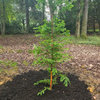
    If Taxodium works, will Metasequoia? Neither are the typical shade tree shape but especially Metasequoia gives you fast growth, good wind resistance and longevity.

  • 9 years ago

    Lucombe oaks are available in the UK and are reported to grow very quickly. Of course, they are sombre and evergreen, so that might be taken as a warning in a dreary climate with low sun levels for much of the year.

  • 9 years ago

    We have several sycamores (Acer pseudoplatanus) at maturity and they seem to have adapted to the conditions though they sometimes tend to show signs of burn from the sea air. I'm not really happy with them, so something that can develop into an alternative would be nice.

    Quercus ilex is an option I like and I know it does well in the area, but I also like the idea of a red leaf option such as Quercus rubra or coccinea (these are off the top of my head so further research needed into conditions). Any strong opinions about Quercus macrocarpa (Bur Oak)?

    I don't mind waiting so much. I'm 26 so there is a chance I'll see it reach some size

    I suppose the climate does seem dreary to an American used to sunny days and extremes of temperature. Ach. We don't take such things for granted, but the growing season is fierce around here when it is on.

    I would say the ground is well drained as I've never noticed any problems with water logging at the site

  • 9 years ago
    last modified: 9 years ago

    Quercus coccinea and Quercus rubra are red in the Fall, not all year. Fall color in oaks varies a lot from individual to individual. If you want Fall color, buy your tree in the Fall and look at it. Quercus coccinea is the oak with the best chance of having good red Fall color. It is short lived...for an oak. (It will still likely outlive you). Likes dry sandy soil, hard to transplant. Fairly salt tolerant. Doesn't like wet feet. Reports differ as to whether the number two spot for Fall color in an oak goes to Northern Red Oak (Quercus rubra) or white oak (Quercus alba). Both pretty salt tolerant, red oak probably more so. Red oak transplants more easily and grows faster, white oak is longer lived and more disease resistant. Occasionally has red leaves briefly in Sprng.
    Tupelo (Nyssa sylvatica) also has great red Fall color and is known for having Fall color in areas that are usually too warm for fall color. Should tolerate any conditions a sycamore can.

    Bur Oak (Quercus macrocarpa) tends not to have good Fall color but tolerates alkaline soil.

    I will agree with floral_uk z.8/9...beeches in general are among my favorite trees. Copper ones are awesome.

    Out of curiosity, what didn't you like about sycamore?

  • 9 years ago

    Sycamore in the U.K. refers to Acer pseudoplatanus, rather than a Platanus species as in the US. They are not highly regarderd here. Probably because of their tendency to self seed liberally. Pretty much regarded as a weed tree in the British isles. That said there are a few variegated specimens in my local park. Although the variegation does tend to disappear over the years.

  • 9 years ago
    last modified: 9 years ago

    Well, I did say "might" be taken as a warning. I love an overcast day myself, but they are the exception here. Mature Lucombe oaks do have an impressive branching structure, that almost seems like welcoming arms, thus meeting your "friendly" requirement!