Software
Houzz Logo Print
mistakemaker

Rookie Needs Help with Western WA/PNW Lawn

9 years ago
Afternoon folks -

First time owning a home with a lawn and really struggling with what are probably lawn care basics. The good news is that I'm eager, open minded and willing to learn.

Lawn Background & Care So Far

  • western Washington lawn
  • new construction with sod laid in May 2016
  • regular watering in summer
  • fertilized with Scotts fall lawn food
  • sprinkled Pacific Northwest Mix grass seed in patchy areas in the fall
  • regular mowing when it needed it - bagged, not mulched
  • does not appear to have weeds or moss (yet)
  • unsure what type of grass this is
  • I have no idea what I am doing as you will see soon

Front Yard

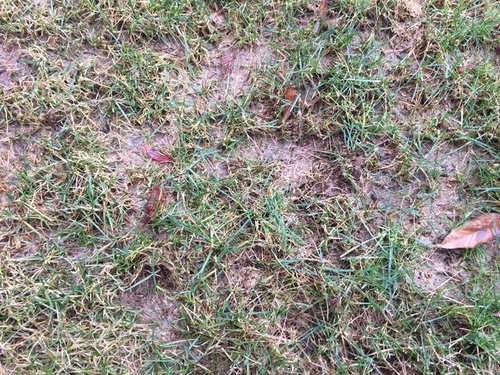
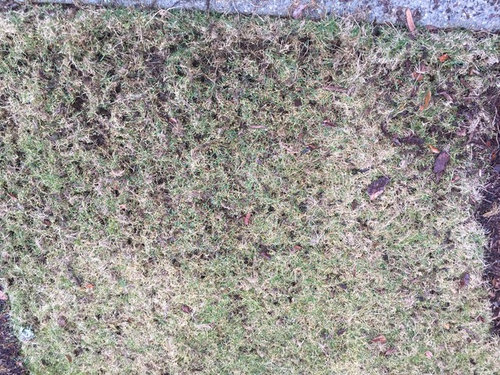
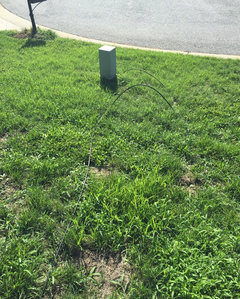
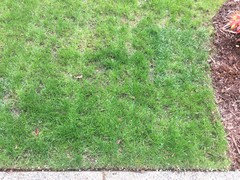
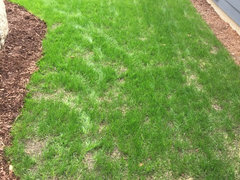
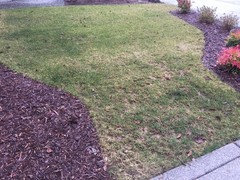
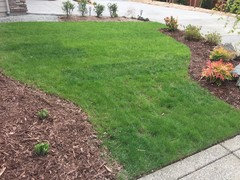
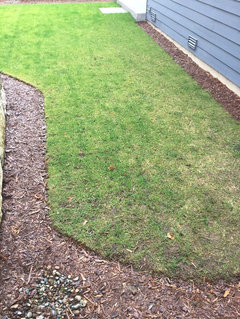
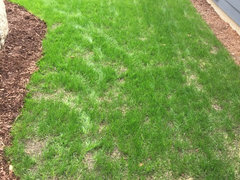
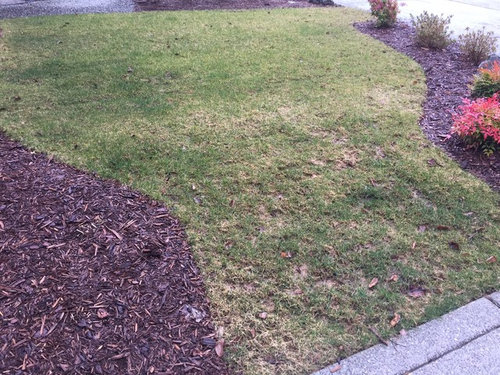
Patchy coverage, uneven color and overall, very wet. West facing, gets lots of sun in the summer. There are areas that are matted down and clumped up. It looks like the birds got into one section and ripped the lawn apart.

Backyard

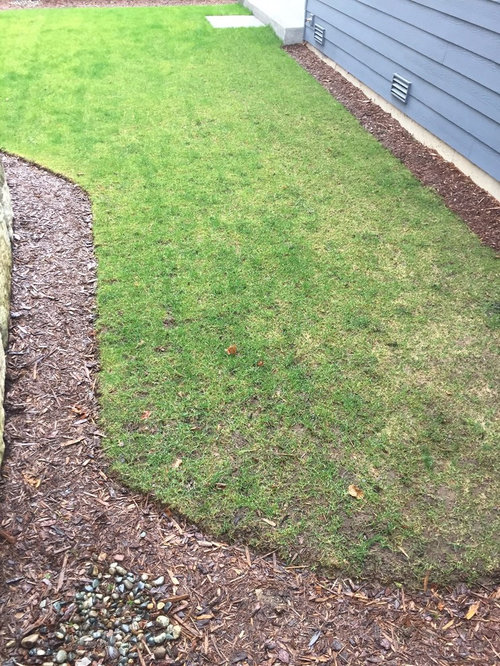
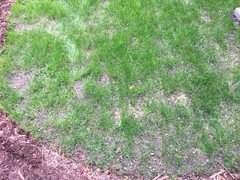
This side of the house is shadier. Better color but still very patchy coverage in areas, almost muddy. In better shape than the front but not by much.

Questions

  1. It's early March. What should I be doing right now for a lawn in this condition?

  2. I burned my lawn last time with Scotts in some areas. I want to go organic. Is Espoma lawn food a good start?

  3. I think I should have aerated in the fall but have no idea. Is it worth doing now when the ground dries up?

I do not think I am doing everything I can to help my lawn. Time to get educated. Any advice you can pass this lawn care rookie would be greatly appreciated. Thank you!

Comments (42)

  • 9 years ago

    The person you really need to answer you is gardengal. If she doesn't find this on her own, I'll ping her for you.

    1. Not watering that's for sure. Ideally you would let the soil dry out pretty well at the surface before watering again. Deep and infrequent is the mantra for watering. You already have deep. Mother Nature usually comes through for you on that. I'll describe deep and infrequent at the bottom of this.

    2. You can use Espoma, but you can save a bundle by using generic organic materials like soybean meal, alfalfa pellets or meal, cottonseed meal, cornmeal, or whatever ground up nut, bean, or seed you can find cheap at your local feed store. You save because while these are the main ingredients for most organic fertilizers, these materials have not been approved as lawn fertilizers. That costs money. But they are the ingredients of organics. The application rate is 15 pounds per 1,000 square feet for just about all organic fertilizers.

    3. I'm not big on aeration. I did it once and saw no change/improvement. Your mileage may vary. If you have hard soil you can spray shampoo on it and that will soften it for the next many years. There are other reasons to aerate, but honestly I don't see the value.

    You very likely have a mix of rye grasses. Rye seems to be the go-to grass for the PNW. Rye is a bunch grass that does not spread quickly. When it gets thin it must be reseeded to make it more dense.

    It's okay, in fact preferred, to mulch mow the lawn. Bagging removes that good organic material that you're just about to go out and buy.

    Lawn care very basics

    Watering: Deep and infrequent is the mantra for watering. This is for all turf grass all over the place. Deep means 1 inch all at one time. Put some cat food or tuna cans around the yard, and time how long it takes your sprinkler(s) to fill all the cans. Memorize that time. That will be the time you water from now on. My hose, sprinkler and water pressure takes 8 full hours to fill the cans. Your time will likely be less. I like gentle watering. As for watering frequency, that depends on the daytime air temperature. With temps in the 90s, deep water once per week. With temps in the 80s, deep water once every 2 weeks. With temps in the 70s, deep water once every 3 weeks. With temps below 70, deep water once a month. Note that you have to keep up with quickly changing temps in the spring and fall. This deep and infrequent schedule works in Phoenix and in Vermont, so it should work for you. The reason for deep and infrequent is to grow deeper, more drought resistant roots and to allow the soil to dry completely at the surface for several days before watering again. If it rains, reset your calendar to account for the rainfall.

    Mowing: Mulch mow rye at the mower's highest setting. If you don't like that height, drop it one notch at a time. Lowest setting is not where you want to be for rye. Taller is better.

    Fertilizer: Memorial Day, Labor Day, and Thanksgiving.

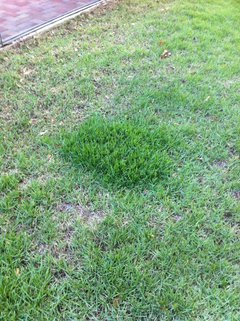
    Here's a picture of alfalfa fertilizer at work.

    Thanks to mrmumbles for posting his pictures. This is zoysia grass. Alfalfa pellets were dropped in mid May. Picture was taken in mid June. You can see the improved density, color, and growth. This photo has sold literally tons of alfalfa pellets. My local feed stores even ask me if I'm buying it for my lawn (I am).

  • 9 years ago

    Hey there, really appreciate the feedback and advice, thank you. Tips on type of grass, watering and mowing are great.

    Did some research on alfalfa - sounds good to me. It's the rainy season in the PNW right now. Memorial Day is 2+ months out and it sounds like this method takes about a month to work.

    Any drawbacks to applying now? Similar question for overseeding - now or later?

  • 9 years ago

    No drawbacks to alfalfa any day of the year.

    Similarly for western WA, no drawbacks to overseeding now. Outsiders reading this should note that this applies only to the non desert areas of the PNW. Spring seeding will only work in areas where the summer temps rarely get above the low 80s.

  • 9 years ago

    @Sam Nunn

    We have a small debate going here on the forum on whether spring seeding is a good idea in your region. One side claims that due to the milder climate, spring seeding can be done successfully. The other side claims that due to weed pressure caused by the inability to apply pre-emergent and post-emergent herbicides in a timely manner, fungus and heat, it's not going to turn out that great at the end of the summer. Ultimately the proof is in pudding. If you decide to go ahead and seed this spring, would you mind posting updates every now and then on how your project is going and a few pictures beginning of September?

  • 9 years ago

    Yep, summer temps above low 80s would be pretty rare in this part of WA.

    Not really sure what weed pressure refers to or why seeding would cause it. Sounds bad? More weeds?

    Unless someone raises the alarm, I think my plan will be to lay down some alfalfa and overseed. Will absolutely post progress pics as I go.

    Anything else I should be doing in the immediate future?

  • 9 years ago

    Sam Numm ... "Not really sure what weed pressure refers to or why seeding would cause it. Sounds bad? More weeds?"

    Weed pressure: the competition from weeds

    Normally you apply a pre-emergent in the spring and kill the weeds. But if you have spread grass seed, that also kills the grass seed, so you have more weeds surviving.

  • 9 years ago

    When you put new seed down, you typically water it lightly 3x per day for several weeks. That is exactly the same conditions that weed seeds like. If you seed in the spring you should see the summer weeds begin to sprout at the same time (or faster) than your grass seed.


    Ultimately the proof is in pudding. The proof is not in the pudding. The saying goes like this...The proof of the pudding is in the eating. It's a pet peeve of mine. Otherwise, as j4 said, we would like to learn more from your spring seeding project. Pictures would be a great help. These first pictures are a great start.

  • 9 years ago
    last modified: 9 years ago

    Sam, the program dchall has outlined should work very well for you. I would follow his instructions pretty much as written except I do believe aeration is helpful. Our rainy season is long and intense enough that it typically results in annual compaction unless routinely (annually) core aerated. I also like to spread a 1/2" layer of screened compost over the lawn after aerating - this should help to delay further compaction for the rest of the season.

    Seeded lawns here tend to be blends; sodded lawns usually just a single species. So overseeding is likely to produce an appearance somewhat unlike what you currently have. But a couple of seasons of overseeding should result in a very uniform appearance. Make sure your grass seed is a blend of rye grasses and fescues - no KBG or bentgrass. KGB is not recommended for areas west of the Cascades and bentgrass is more or less a weed grass (unless you are intending putting greens :-)) Fescues have increased shade and drought tolerance; the ryes put up with heavy foot traffic and full sun.

    if you cover your newly overseeded lawn with another thin layer of screened compost, it is highly unlikely you will have to water 3x a day!! Three times a week is more typical given our cool, damp springs and the layer of compost will keep the seed moist. But that is very weather dependent - usually hot and dry conditions could alter that, although that is unlikely to be a concern. I also don't see much sign of a weed issue now (when we would expect to see many annual weeds appearing), so I would play it by ear with those. Grass seeds germinate very rapidly in our area and couple of weeks after seeding could make all the difference in your lawn's appearance and produce enough growth to choke out weed seedlings.

    And I would strongly encourage you to consider mulch mowing. It reduces fertilizing needs significantly and also helps to control disease issues. Most mowers can be refitted to a mulching blade.

    Also pay close attention to dchall's advice to mow high and often and water deeply but infrequently. Typically western WA lawns only need irrigation in our driest months......late July through September. Or you have an option to let the lawn go dormant during this period as it is inclined to do - your choice ;-))

  • 9 years ago

    It's a pet peeve of mine.

    I know it is :-)

  • 9 years ago

    gardengal thank you for the details here, really appreciate it. Where do you buy your screened compost? I'm in the Seattle area on the eastside. The reviews from products at the big box stores are not great.

  • 9 years ago

    Pacific Topsoils would be my first choice but there are other sources available. If you go there, ask for their lawn top dressing mix.

  • 9 years ago

    Awesome! Thank you for the speedy reply, that helps a ton.

  • 9 years ago

    3/20/2017 Update

    Over the last couple of days I have:

    • dethatched

    • aerated

    • pulled a few weeds out

    • overseeded with a rye/fescue mix

    • put down 1/4-1/3" of top dressing

    • put down alfalfa meal

    I went to the feed store and they convinced me not to buy alfalfa in pellet form but shredded meal instead. Picked up the alfalfa meal from Keep It Simple Farm in Redmond WA.

    Followed gardengal's advice and got a cubic yard of top dressing from Pacific Topsoils. Pretty tired after moving that pile twice - once out of the truck and another time over the lawn. Was careful to rake it around enough so it would not smother the grass.

    If I'm being honest, the lawn looks a bit like a disaster zone at the moment.

  • 9 years ago
    last modified: 9 years ago

    So how deep below all that would you guess the seed is?

  • 9 years ago

    have no idea where application of a pre-emergent has become law. maybe in the south. up north, with a dense lawn or several years of pre-emergent use, you really don't need it. and tenacity is a perfectly good post emergent when seeding.

  • 9 years ago

    Ridgerunner - not too deep. I put the seed down over the top dress and then very lightly raked it just so the seed would be covered. Then I put alfalfa on last. No idea if that's the right idea - what I did.

  • 9 years ago

    I may have misunderstood your order of application with seed, topdress and compost. If the seed is no more than 1/4" below the top surface, you should be fine.

  • 9 years ago
    last modified: 9 years ago

    @mishmosh

    Where are you located? I lived in Upstate NY 30 miles from the Canadian border for 6 years before moving down to NC. The climate is perfect for cool season grasses and so something like KBG, being in its perfect environment, will easily outcompete weeds and other summer weeds. The situation changes south of the Mason-Dixon line where it starts to get a little warmer in the summer and stuff like crabgrass can take hold and cool season grasses start to suffer due to heat. You are right that 3-4 years of pre-emergent apps will deplete a good amount of weed seed from the seed bank, but if your neighbors aren't doing the same some seed will always blow in.

    Overall, pre-emergent has little downside, is cheap and is tremendously effective. I look at things from a cost-benefit perspective: is it worth $1.00 worth of prodiamine and 10 minutes of time for 6 months of complete annual weed control? Yes. Is there anything gained by not applying it? Not really. Your perspective may be different if weed pressure is low in the summer.

  • 9 years ago

    j4c11, I am thinking that could very well be the case. i am along the Canadian border. You may say there is no penalty but I feel without pre-emergent, the lawn seems to handle summer conditions better. of course that could also be maturity as i only used spring pre-emergent for 4 years after renovation and none since.

  • 9 years ago

    I don't like top dressing with sand or topsoil unless the surface is uneven or drainage is poor. This is from the website for the place gardengal recommended.

    LAWN TOP DRESSING
    MIX:

    80% sand and 20% Screened Comp Mulch processed through a 1/2"
    screen. Created specifically for top dressing lawns. Use after
    thatching and/or aerating.

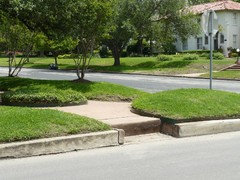
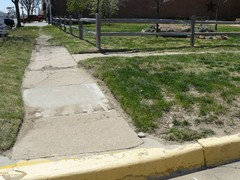
    At first she said compost and then updated to direct you to this sand product. Now that it's done, I would suggest you avoid the habit of annual topdressing. I have plenty of pictures of lawns where the owner topdressed with 1/4" of topsoil or sand...for 40 years. That accumulates to 10 inches of too much soil. When the lawn is 10 inches taller than the sidewalk, you can imagine what it looks like. If not I'll add a few pics. The main problem with that is the possibility of damming rainfall back so that it comes into the house or basement.

    Those people had to put in a fence to keep the topdressing from spilling out onto the sidewalk.
    These people should have put in a fence. In the distance you can see the soil is thick enough over the sidewalk that grass is growing all the way across. What you can't see from that angle is the sidewalk on this side. That's because there is an 8-inch hump of soil between me and the sidewalk.

  • 9 years ago

    I would only use the top dressing when overseeding or now and again after core aerating - usually just allowing the plugs/core to breakdown is sufficient. It is not something you do on an annual or routine basis and at a scant 1/4-1/3 inch, it would take decades to build up the soil level (and thus lawn) to any significant degree.

    I suggested screened compost because that is what I use but it is not always available without the need for hand screening, which many are not inclined to bother with. The Pacific Topsoils mix works just as well. btw, this application is used by golf courses all over the area, who overseed on a very routine basis. They tend not to aerate - too much disruption to the property - and the sand helps with drainage and compaction issues.

    Sam, it is no surprise the lawn looks a disaster at the moment - after two months of record breaking rains, NO PNW lawn looks good :-) It is also difficult to tell in mid-renovation what the final outcome will be - at this stage, it will very much look like a work in progress.....which it is!!

  • 9 years ago

    I agree with dchall, applying all the top dressing is/was un-necessary. But I guess the nurseries have to stay in business too.

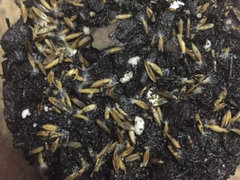
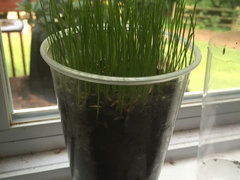
    Seed germinates just fine sitting on the surface:


    Germination rate increases by about 10% when covered, but you can make up for that by increasing the seeding rate. Much easier than breaking your back with top dressing.

  • 9 years ago
    last modified: 9 years ago

    Wow that looks awesome! Your before pictures look a lot like my yard now. Would be very happy with results even remotely close to this.

    From the time you overseeded in April, how long was it before you saw tangible results? I'm following a near exact process you performed.

  • 9 years ago
    last modified: 9 years ago

    It had filled in enough to be visually bearable in about 3 weeks and got nice and dense by end of May. I work from home so was able to get it going nicely with regular light watering as it established.

  • 9 years ago

    Guess it's a matter of perspective. If my lawn looked like that I'd kill it and start over. Which I just did haha.


  • 9 years ago
    last modified: 9 years ago

    I'd rather work with what I have than having to resort to roundup. I don't see the advantage. It's not like killing your original lawn guarantees you will not still be battling weeds and issues with the newly seeded lawn. Aren't you on your second shot at an overhaul j4c11, or do I mistake you for someone else? It's still the same soil with the same fertility and the same weed seeds are still lurking in it. : )

  • 9 years ago

    Yep, it's me. I'm redoing my back lawn. I wouldn't tell you to do something I wouldn't do myself to my own lawn.

    It's still the same soil with the same fertility and the same weed seeds are still lurking in it.

    Don't believe that for a second. Success is in the proper establishment and care. These are the same soil with the same fertility and the same weed seeds lurking.


  • 9 years ago

    Just sharing with the PacNW lawn nuts...


    Gardengal mentioned to avoid Kentucky Bluegrass in the Seattle area and I will also add to avoid Turf Type Tall Fescue at this time. One lawn guy I know is trying out TTTF this year due to the hotter weather we've been having (the TTTF has increased heat and drought tolerance) but I have yet to hear his results and honestly I'm quite skeptical.


    Past NTEP TTTF trials in Puyallup, WA have not been good. It has a lot to do with our mild winters being a haven for fungal infection in the TTTF.

    For anyone wanting to read about TTTF in PacNW check out the .pdf pg 73: http://horticulture.oregonstate.edu/content/2009-wsu-and-osu-turfgrass-field-day

    Most NTEP scores for NTEP in Puyallup have been 4.0 and under out of 9.0 (7.0 is considered acceptable)


    So to make a short story long, I will be planting the typical PacNW mix of perennial ryegrass/fine fescue in my front yard this year.

  • 9 years ago
    last modified: 9 years ago

    They are plugging TTTF up here as well, primarily for resistance to European chafer beetle damage which is seriously affecting lawns in my area.

    I added it to my blend last year, and it seems to be very "durable" but is not as attractive to me as the typical fescue/ryegrass. Blades are much thicker and tend to shoot up in tufts and then flop over. Still it came through our unusually snowy winter like a champ while the areas I have more ryegrass/fine fescue were slower to get going.

  • 9 years ago

    Read this.

    http://cru.cahe.wsu.edu/CEPublications/PNW299/PNW299.pdf

    I may or may not add more. There are some posters on this forum that can provide useful advice but just as often you can get suspect advice that is a disservice to the less experienced that believe everything they read on the internet.

    I live in Seattle and have a bit of practical experience.


  • 9 years ago

    Cool lawn bro.

  • 9 years ago

    4/22/2017 Update

    It's been more than a month since I started. Mid-March this is what I did to kick start my lawn rehabilitation project:

    • dethatched
    • aerated
    • pulled a few weeds out
    • overseeded with a rye/fescue mix
    • put down 1/4-1/3" of top dressing
    • put down alfalfa meal

    Front Lawn

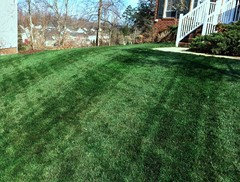
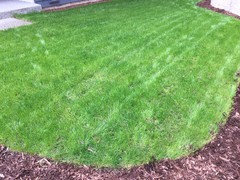
    Color is improving. The lawn is greening up at different rates, almost following the strips of sod that were laid down when the lawn was put down last year.

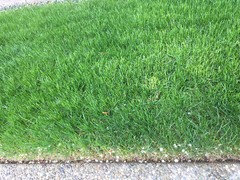
    Still patchy in in areas, certainly more than the backyard. Lawn lacks that thick, healthy look. Not sure if the seed I bought was good, if I have not waited long enough or if the birds ate it all. Plenty of rain the last 30 days. Lawn seems to be draining better and is not as boggy. Very few weeds, I pulled maybe 2-3 in this area. White flecks in the pictures are cherry blossom petals.


    This is probably the best part of the front lawn. Really greened-up well and is very thick and healthy looking. You can see how different strips of original sod are greening at different rates.

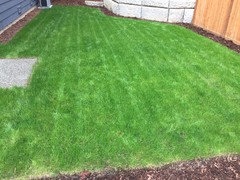
    Backyard

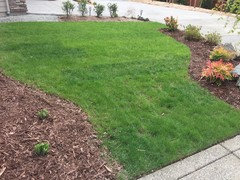
    Color has improved here too, better than front yard. Still patchy in an area that is typically shady. Seed seemed to take better here and I see lots of new grass sprouting up. Drainage seems to have improved but that's only after 1 month of observation. More weeds in this area, pulled perhaps 10-15 by hand.

    Questions

    1. Aside from cutting and weeding, anything I should be doing at this time?
    2. The patchy areas - reseed those or just be more patient?
  • 9 years ago
    last modified: 9 years ago

    4/22 - Before / Progress So Far

  • 9 years ago

    Did you fertilize at all yet?

  • 9 years ago
    last modified: 9 years ago

    I put down a layer of shredded alfalfa mulch about a month ago. When should I fertilize again?

  • 9 years ago

    Young grass at this stage is hungry for Nitrogen, it really helps with establishment. My recommendation would be to get a bag of Lesco 21-4-11 from SiteOne and apply at a rate of 4 lbs/thousand sq ft.

  • 9 years ago

    Looking good! I did use some starter fertilizer on mine last spring to get it going. Organics have kept it in nice shape since. Wouldn't do any harm to toss some more seed out in the sparse patches at the same time.

  • 9 years ago

    @Sam Nunn

    How is your spring renovation progressing?

  • PRO
    8 years ago

    Great article.

  • 2 years ago

    Sam, I know this post is from 6 years ago, however I am in a similar situation as you were in. In fact my law looks exactly like yours did in. With the exception on the side of my house, it is pretty shady and the grass just looks bare. Was thinking about over seeding and then i stumbled across your blog. Did the process work well for you?

  • 2 years ago

    No turf grasses grow well in much shade. You might try a blend that is heavier on the fine fescue and perennial ryegrass but if very much shade, you might be better off with some type of shade tolerant groundcover.