Software
Houzz Logo Print
esmith713

Thoughts on using rock for ground cover?

9 years ago
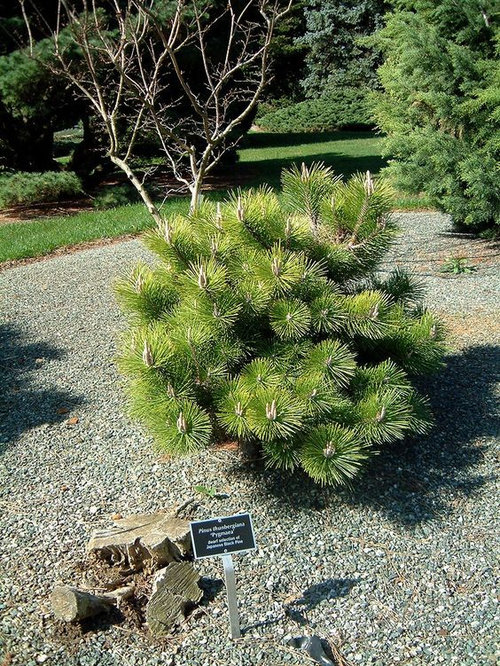
I'm a fan of the Gotelli Collection at the National Arboretum and was wanting to recreate that look, to some extent, using crushed rock ground cover.

My issues are concerning how the rock might, or might not, effect my soil properties over time. I'm growing in clay and I live in GA where we see 50" a year in rainfall, so drainage and proper nutrient uptake are a top priority, right? I like the idea of using pine bark mulch thinking it will improve my soil texture over time as it breaks down allowing for better drainage, but I also really like the look of rock.

Does anyone know the maintenance and cost involved with applying crushed rock or pebbles vs. mulch? Is the rock applied directly to the soil or on top of a fabric? Do the rocks stay in place and are weeds typically an issue? Do the rocks heat up and raise soil temperatures? What type of rock is seen in the picture below and where is it typically sold?

Might an appropriate solution be to apply several inches of a compost and soil conditioner mix first, then a fabric weed barrier, followed by crushed rock? Thanks in advance!


Gotelli Collection at the US National Arboretum

Comments (13)

  • 9 years ago

    NEVER USE A FABRIC BARRIER ....i cant be any more direct ....


    you continue to be fixated on nutrients ... clay can be one of the best soils to grow in.. IF you learn how to plant in it properly ... have a soil test done.. to determine the fertility of your soil ...


    rock is a horrible product to work with.. in terms of shear weight itself ... unless you have a bobcat or some such ... or just want some very serious exercise ... there are much better products in this regard ... like lightweight mulch ... there is a reason you mostly see this.. i professional gardens.. who have teams of worker bees ..... otherwise.. it might be called checkbook gardening ...


    also ... if you decide at some later time.. that you dont want the rock.. the only thing worse than applying it.. is removing it ...


    ken

  • 9 years ago
    last modified: 9 years ago

    I wouldn't use what is sold as crushed rock here as that has rock dust in it, enabling it to knit up into a crust like surface and function therefore as paving for access routes like garden paths. Where I was mulching plants I would buy something that had been screened or washed, or already came without a lot of fine material in it already.

    Since many wild conifers grow natively on mountain peaks or other open places where there may be a lot of geology visible garden conifers do look quite natural mulched with rock products. (Except for conspicuously horticultural colored foliage variants and other quite apparent abnormalities, which aren't visually compatible with any settings that are intended to appear naturalistic). If you do this it will result in your soil being cooled, but won't as you say result in the mulch adding significant organic matter. However with conifers the latter may not be much of a requirement anyway. And an organic mulch that was constantly melting into your soil would therefore have to be replaced every year in order to maintain an adequate depth.

  • 9 years ago

    I use as my basic planting mix 60% amended loam (the lowest organic component I can buy) and 40% 14" lava pebbles, no fines. Fines are 'rock dust' in the trade parlance. I then often top it off with a very light layer of the lava pebbles. Lava is way lighter weight than most other rock products, which, as Ken notes, are generally pretty miserable to handle. I'm planting mostly succulents, conifers, Australians and South Africans, so the more desert-like look works here and none are heavy feeders. Won't work in a lot of settings, though. I really like the look of pebbles, and might be willing to bite the bullet and do the initial installation if I were you. It will be way lower maintenance going forward than most anything else. If you use some boulders of various sizes as well you will create a mountain scene. I've always thought that that collection at the NA is very attractive. Another conifer garden that uses a lot of rocks and scree is the conifer garden at South Seattle College.

  • 9 years ago

    A big problem with rock is it heats up in the sun and can cook your plants in some climates. Over time it works it's way into the soil...which doesn't necessarily harm the plants but makes the soil much harder to work with down the road.

  • 9 years ago
    last modified: 9 years ago

    in my neighborhood where the homeowners use rock as mulch it's full of weeds, debris, lumpy, landscape fabric shows in spots, and it's hot..just my opinion but I don't care for rock as "groundcover"..love well arranged boulders, stone walls, stone paths, stone edging etc..but I have to admit their work was sloppy..most or maybe all of them used river rock instead of a cut angular gravel..which rolls and doesn't settle and pack down..your pic is much more attractive than their results..

  • 9 years ago
    last modified: 9 years ago

    I don't think it's a bad idea at all. However, be careful what rock you use -- don't use crushed limestone as that will increase the soil pH & would not be good for most conifers other than some junipers.

  • 9 years ago

    Rather than gravel or crushed rock, I prefer something with a larger texture, like small diameter river rock. Walking on it is difficult but in a planted area with mostly conifers, walking through it is not a huge necessity!! Add some larger rocks and few boulders well embedded in the ground and you have a ready-made design!

    A couple of thoughts - IMO, this looks best if on a mounded bed or sloped area - a perfectly flat surface just doesn't quite make the cut :-) Also, if you are restricting the plantings to primarily conifers and minimal use of other smaller spreading or groundcover type plants, this IS a situation where I would use a landscape fabric under the rock (and you will NOT find me stating that often :-)) It is far too easy for the rock to become incorporated into the underlying soil, making future amending difficult, should it ever be necessary. It will also help to deter weed growth from underneath but debris will always accumulate on top and that can encourage weed growth in the rocks themselves. But that should be easy to remove. Just keep the fabric away from the base of the conifers to allow for good water penetration. A larger rock diameter makes blowing easier as well.

    Any heat generated from a rock mulch will be easily tolerated by most conifers - that should not be a concern.

    One of the best examples of this technique I have seen is in a semi-shaded area in plantswoman Helen Dillon's garden. The trees were birch, not conifers (as more suited to the partial shade) but the rock mulch was small, 1-2" or so diameter river rock. A really stunning effect. Blown clear of leaves and other debris as necessary.

  • 9 years ago

    I think a bed with rocks can be quite nice, but I find they require a decent amount of maintenance. If leaves fall on your pine straw or pine bark mulch, they don't appear out of place. If they fall on your bed of pebbles, the scene begins to look "messy." And, as others have noted, rocks tend to settle into the earth, which can be problematic for many reasons (i.e., they end up being covered with dirt, they become very difficult to remove, the plants the rocks surround are correspondingly difficult to dig up and move around, etc., etc.).


    Some of those issues can be mitigated with the landscape fabric, which I learned to use after dealing with some of the frustrations above. But at the end of the day, I only have one small bed that has the rock mulch (and I don't even have a conifer planted in that bed!). I just overall prefer the mini-nuggets, and I save the pebbles for my container plants.

  • 9 years ago

    Fabric under the rock isn't going to have any effect on litter falling on the rock. Including material that decomposes over time to become a soil-like layer that sits between the rocks, on top of the fabric.

    Fabric will become an additional nuisance element (in addition to the rock product) that is present and in the way should any re-planting, transplanting or any other operations involving getting at the soil, beneath the fabric and rocks be undertaken at some point.

  • 9 years ago

    "Fabric under the rock isn't going to have any effect on litter falling on the rock. Including material that decomposes over time to become a soil-like layer that sits between the rocks, on top of the fabric."

    I had hoped I had made that abundantly clear in my post. Blowing off the debris as it accumulates and promptly removing any weeds that may sprout will be an ongoing maintenance aspect any rock mulch.

  • 9 years ago

    would you say this a true statement?..rock "mulch" is higher maintenance than wood mulch..I say yes..

  • 9 years ago

    It depends!