Software
Houzz Logo Print
mtz96

Shredded leaves

9 years ago

I just shredded many leaves with a leaf shredder. They are almost as fine as soil. Can I put this on my lawn. I have clay soil and the grass is very sparse with lots and lots of weeds

Comments (38)

  • 9 years ago

    Sure thing. You can always save yourself a step and just spread them out on the lawn and mow them in. I snagged 20 some bags in the fall from neighbors that I'm going to mow in at some point here. It's suppose to help with some weed suppression too.

    Mitzi Zimmer thanked Nevermore44 - 6a
  • 9 years ago

    Shredded leaves that fine will blow away with a light breeze.

    Mitzi Zimmer thanked John Donovan
  • 9 years ago

    Those shredded leaves will be a very good addition to the soil the grass is trying to grow in and will provide needed organic matter that will help the grass grow. Spread them around and you will see earthworm activity aplenty as those wee buggers move the leaf bits into the soil.

    I have not had a problem with wind blowing shredded leaves away.

    Mitzi Zimmer thanked kimmq
  • 9 years ago

    mtz96: What type/brand of leaf shredder do you have, and would you recommend the brand? TY.

  • 9 years ago

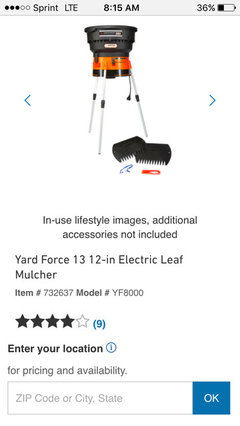
    I purchased a Yard Force late in the season last year at one of our local building supply box stores. I just used it for the first time this weekend. I was super impressed! What would have probably filled 3-4 bags was reduced to about 8" in 1 bag! This has 3 settings and I used the "fine" setting. It reduced the leaves down to almost dirt! I have leaves that were wet in the bottom of the pile and they somewhat clogged up the machine. I would recommend doing dry leaves only. Like I said I have only used it once and very impressed! Just hoping I can get several years out of it

  • 9 years ago

    TY, mtz! We're in a 25-y/o neighborhood, so all of the many live oak trees are quite mature and drop a ton of leaves. DH and I work several weekends filling entire huge/bin waste containers -- and that's just what's on the sidewalk and street gutters. We have a mulching mower to hopefully handle any leaves in the lawn, but however it is the oak leaves are configured, many are left whole after a mow. Now, where to store this sucker, should we buy one! :D

  • 9 years ago
    last modified: 9 years ago

    I think that you can take apart & store in the origional box. Ours will go into a corner of the garage...we have 2 garages tho. It really isnt that big

  • 9 years ago

    Be aware that uncomposted fallen leaf debris will suck nitrates out of the soil, and it is precisely those nitrates that are important for lawn greenery. If you do this, you might throw on some plain old ammonium nitrate lawn fertilizer. That will help decompose the leaf debris efficiently and give a springtime boost to the lawn. So in the long term, the addition of uncomposted leaf debris can be a good thing to loosen up clay soil and fertilize the lawn. In the short term, it mainly helps the lawn retain moisture but is not particularly advantageous nutritionally for the lawn. Once the grass starts to grow, when you mow, the grass clippings will supply that nitrogen, but early in the season before that happens you'll be net nitrogen deficient.

  • 9 years ago

    My mulch is practically dirt! I figured I would basically toss it in the wind to land on the yard. Fhat way it wouldnt be too heavy. We have 1/2 acre! I googled about it & Read where it is beneficial???

  • 9 years ago

    No, your mulch is chopped up hydrocarbon. Chemically, it is quite different than dirt. No one is saying it will be too heavy. In fact some are saying it would be too light. Once it dries out, it's pretty much dust. As long as it is kept moist, it won't blow away. There is no question that chopped up leaves are beneficial to lawns. My point was in the near term, it isn't nutritionally beneficial to lawns, though in the long term it will be.

    Mitzi Zimmer thanked daninthedirt (USDA 9a, HZ9, CentTX, Sunset z30, Cfa)
  • 9 years ago

    Thanks for your input. I figured that if I threw this out onto the lawn which is basically weeds in clay soil that it would be better than going to the landfill. I also have a new neighbor that is going to start a new garden. I may offer my leaf mulch for them to till into this "not so good" soil

  • 9 years ago

    Both options are excellent ones. DO NOT send fallen leaves to the landfill!

  • 9 years ago

    I've never seen shredded leaves blown by the wind in a residential setting. I've shredded/vacuumed them and shredded/left them. Depends on the mood I'm in and timing. Never had an issue with nitrogen deficiency when they were shredded and left on top. IMO, there is no better material than leaves for the average soil.

  • 9 years ago

    If the plan was to put leaves on lawn, why to do too much extra work by shredding them through a shredder ? Wouldn't it be easier just to mow them in place?

    If leaves are shredded anyway, I would put them in compost or flower/veggie beds, or under trees. Grass will grow without that precious stuff.

  • 9 years ago

    Well, I shred piled leaves by repeated passes with a mower, and I repile them up in compost piles and yes, when the wind blows, the stuff easily blows off the pile if it isn't wet. Now, of course, stuff that blows off a piece of lawn will most likely end up on another piece of lawn. Our experiences may differ, but if I don't do a top dressing of ammonium nitrate on my lawn in the spring, it doesn't green up as much, and I routinely mow my leaves into the lawn. Just dumping shredded leaves on a lawn certainly won't green it up, in my experience. It's a long-term amendment.

  • 9 years ago

    Shredding these leaves is the fastest way for us to clean up our lawn. This is a 2nd home so we aren't around for very long at one time. I appreciate all the comments

  • 9 years ago

    Numerous studies have shown that high Carbon material (shredded leaves) laid on top of soil will not "suck nitrates out of the soil", mixed into the soil they will. I have mulch mowed the leaves that fall from the trees in my yard for years, to the point that the lawn looks more brown than green and have seen in about 2 or 3 weeks will see a lot of worm castings there and in the spring the grass grows greener, thicker, faster than in areas that did not get the shredded leaves.

    Mitzi Zimmer thanked kimmq
  • 9 years ago

    That's a fair point. Shredded leaves on top of soil won't suck nitrates out of it. But as the shredded leaves get incorporated in the soil, as they gradually do, they will. Sounds like there is some disagreement about whether leaf mulch in the fall will provide for nitrogen nutrition in the spring. Just try it and see, It will certainly help water retention, and that will help promote lawn growth.

  • 9 years ago
    last modified: 9 years ago

    Not to cause controversy, but leaves don't really 'suck nitrates out' of soil. I think it might be better to use the term 'tie up'. Especially in the case of VERY finely shredded leaves, N compounds will only be unavailable for a very short time while the soil fauna/flora use the N as they work to decompose the shredded leaves. The finer the leaves are shredded, the shorter the time period that the N will be unavailable. As the leaves are consumed and 'processed', the N once again becomes available. The larger the grains of the shredded material, the longer it takes.

    To hasten the process, especially with larger pieces of material, some people do add a little N to help things along. Assuming the area has a relatively healthy supply of N, the finer the shred, the less it's necessary to add more.

    Mitzi Zimmer thanked rgreen48
  • 9 years ago
    last modified: 9 years ago

    When I said "suck up", I meant that the degradation of the leaves consumes soil nitrogen, and converts it fairly rapidly into ammonia, which is mostly released. Yep, it sucks it up and spits it out. Nope, it's not "tying" anything up. It's GONE. But also, as I said, the nitrogen degradation is short term. In the long term, as the proteins in the more indigestable parts of the leaves are consumed slowly by nitrogen fixing bacteria, nitrogen is slowly released into the soil where it can be effectively assimilated into the soil by gradual mineralization. The distinction is the rate of ammonia release. When ammonia is released fast, most of it escapes. When it is released slowly, much of the nitrogen can be retained in plant-usable form.

  • 9 years ago
    last modified: 9 years ago

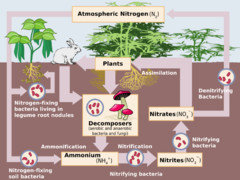
    Maybe this image is wrong, but it shows that few of the N compounds are 'gone'. The wider the 'arrow pathways' the greater the distribution share. The vast majority of N compounds remain in the soil biosphere. The image is from Wikipedia, and who knows, I may just misunderstand.

  • 9 years ago

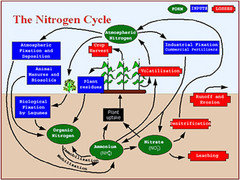
    Yes, the nitrogen cycle presented there simplistically presumes that all ammonia produced is retained in the soil. One would like it to be, but it isn't. Here's a more thorough diagram of the nitrogen cycle from UMn extension.

    (Sorry for the crappy copy. That's what they put on their website.)

    See the red box labelled "volatilization" of ammonium? That's what I'm talking about. It seems to show volatilization of the ammonium cation, but it's really ammonia that is being released. That ammonium cation isn't a gas, but it forms ammonia readily.

    Yes, in slow composting, ammonia is mineralized in the soil it is well buried in. In fast composting exposed to the air, most of it is simply lost. A thin layer of leaves lying on the surface simply can't retain ammonia that is produced as it decomposes. The ammonia produced can easily escape.

  • 9 years ago
    last modified: 9 years ago

    Wouldn't it be nice if that image had ratios? The one from wiki had ratios built into the width of the arrow pathways. While there's no doubt that some N compounds become volatile, much of it becomes part of the soil web. It is in the bodies of the soil biology. It is in the fungi, the insects, the invertebrates, the microorganisms, and the plants. And, just as some is 'gassing off', rain - and especially thunder storms - is bringing it back down. If there was more volatilization than retention, there would be no plant life. Not all retention comes from fixation via legumes. And although it is on the surface, not only are the creatures mobile, so are the mycelia of the fungi that do a fair share of decomposing. They carry (perhaps 'extend' is a better word) organic molecules, as well as elemental compounds, down into the soil depths as they grow.

    I don't say that all of the N is retained, nor that volatization is something to ignore, but not all N is 'gone'. The majority is in the biosphere. The healthier the biological activity, the more N available to the plants. Where does it begin? On the surface with decomposing organic matter.

    Take pure sand. VERY little available N. How to fix the problem? Add OM. The soil biology increases as organisms move in to digest the amendments. The resulting cycle begins to retain the material necessary for establishing a healthier biosphere, and the available N begins to increase. Will it go from zero to 100 in a day? Nope, but the accumulation tends to lean toward retention.

  • 9 years ago

    I just stopped in to give kimmsr credit where credit is due for use of the term "wee buggers". :-D

  • 9 years ago

    "simplistically presumes that all ammonia produced is retained in the soil."


    No it doesn't. It clearly shows N being cycled to the atmosphere. This is why it's called a "cycle".

  • 9 years ago
    last modified: 9 years ago

    I never said all N was gone to the biome. I said that what gets sucked up and converted into ammonia largely departs the site. It's gone from the site. Now, where does that ammonia go in the atmosphere? Well, it mostly finds itself in a solution with water and it gets rained on somewhere. So yes, it's still nitrogen fertilizer, just not your nitrogen fertilizer.

    The way it is described is that the nitrogen cycle is "leaky". It isn't a perfectly closed loop. There are various exits around the path.

    "simplistically presumes that all ammonia produced is retained in the soil."

    Yes, because that figure shows denitrifying bacteria producing specifically N2. That's the only path it shows back into the atmosphere for nitrogen. Ammonia isn't shown as being volatilized. That's erroneous. Your compost pile produces VASTLY more ammonia than it does molecular nitrogen. My cycle diagram carefully calls it "atmospheric nitrogen", which can include ammonia.

    This is a good discussion as it covers things that are routinely neglected.

  • 9 years ago

    "Your compost pile produces..."

    Now you're talking compost piles.

  • 9 years ago

    When you have a thin layer of leaves lying on the ground, you got yourself a thin compost pile. Composting is what is happening to those leaves. When we talk about organic degradation we're always talking about composting. We like to do it in piles because it saves space, but the same processes are going on. A pile doesn't make bacteria and fungi happen where they can't happen elsewhere.

  • 9 years ago

    Not the same from what I've read and I've never seen a thin layer of leaves on the ground get up to 150 F so it must be different. Furthermore, I do not consider natural decomposition to be composting but whatever floats your boat.

  • 9 years ago
    last modified: 9 years ago

    You should know well that composting doesn't need to be hot. Composting isn't defined by temperature. It's defined by decomposition, and the mechanisms whereby that happens. We like to do our decomposition in piles because, as I said, it saves loads of space, but it's also far easier to keep the material moist. To the extent the bacteria thrive in warmth, a pile offers thermal insulation that makes it so. Piles will certainly decompose faster than sheets.

    You do not consider natural decomposition to be composting? So what exactly is the difference? Different bacteria? Different fungi? Geometry, maybe? Like a cubic compost pile makes different stuff than a pyrimidal one does?

    I look forward to getting references to what you've read.

    My boat does float.

  • 9 years ago
    last modified: 9 years ago

    Unfortunately you do see these myths about wood chip mulch on the surface "depleting nitrogen" from the soil circulating around fairly often. It's one of those things people hear somewhere and then repeat as if they knew it to be true. However, shredded leaf mulch on the soil surface "depleting nitrogen from the soil" is a new one on me. Such a claim can be safely ignored.

    The nice thing about earthworms doing the work for you, in this case, is that earthworm castings are higher in nitrates than other types of compost; they come ready-packaged in pellets of mucus (yum!) which slows and regulates the rate at which the nitrates are released into the soil to become available to plants; and they are delivered directly into the root zone by a diversity of worm species, some of which travel more horizontally throughout the upper layers of soil and some of which come up vertically in more permanent burrows to drag leaf bits down into the soil - as observed long ago by Charles Darwin in his treatise on earthworms. Another bonus of worm presence in the soil is that castings, because of all that beneficial mucus (yum!) also improve the structure and water-holding capacity of the soil over the long term.

    Earthworm poop, overall, is an efficient source of plant nutrients and it delivers those nutrients in a form that is highly plant-available and less of a salinity stressor than chemical fertilizers. All you have to do is keep feeding the little buggers and not chop up their home.

    Mitzi Zimmer thanked theparsley
  • 9 years ago

    "You do not consider natural decomposition to be composting?"

    No. But I recognize that laymen often use the terms interchangeably.

    "So what exactly is the difference?"

    Main one is management.

    "Like a cubic compost pile makes different stuff than a pyrimidal one does?"

    Now you're being an ass. Are you like this all the time or just on here?

    "I look forward to getting references to what you've read."


    There are many that have definitions of composting. I'll include this one that pertains to Canadian rules.

    http://www.ccme.ca/files/Resources/waste/compost_quality/compostgdlns_1340_e.pdf


  • 9 years ago

    It's an interesting discussion, but I really did not intend to cause controversy.

  • 9 years ago
    last modified: 9 years ago

    No controversy. Just separating myths from facts.

    I'm not talking about "management". I'm talking about biochemistry, and exactly what happens in the process of organic degradation. We're talking about release of ammonia by degraded organics, and that release of ammonia has nothing to do with whether the organics were in a pile or put that way with a shovel or a pitchfork. That process is the same in a sheet on the ground as in a pile. No doubt composting is often defined as a "pile" because as I said, a pile is the most convenient way for humans to make it happen. But we're not talking about convenience here. We're talking about ammonia generation. I'm not going to compost in a sheet, but I'm not going to pretend it doesn't happen in a sheet.

    I won't throw silly insults around, but I do find it amusing that composting here is defined as a human activity rather than a biochemical process. That's simply a different way of looking at things. That's like defining getting drunk as drinking lots of alcohol. To a layperson, that's perhaps defensible. But we're smarter than that here.

    Yes, when it comes to facts and science, I'm like this all the time. You're welcome.

  • 9 years ago

    You said ...

    "Unfortunately you do see these myths about wood chip mulch on the
    surface "depleting nitrogen" from the soil circulating around fairly
    often. It's one of those things people hear somewhere and then repeat as
    if they knew it to be true. However, shredded leaf mulch on the soil
    surface "depleting nitrogen from the soil" is a new one on me. Such a
    claim can be safely ignored."

    Perhaps ignoring what I said ...

    "That's a fair point. Shredded leaves on top of soil won't suck nitrates
    out of it. But as the shredded leaves get incorporated in the soil, as
    they gradually do, they will."

    If you want to argue, let's at least argue about the same thing.

  • 9 years ago

    I have no dog in this fight. But I would like to understand the difference in the biochemistry between a "compost" pile and sheet mulch decomposition, whether human made or deposited naturally. I see folks more and more drawing a sharp distinction between the two without any backup or explanation. This exchange is a case in point. Is it simply nomenclature? a distinction without a difference?

  • 9 years ago
    last modified: 9 years ago

    I think that's exactly my point. It is just nomenclature. The biome that is doing the degradation has to be the same in both cases. If you're running your pile hot, it may be a bit different, because sheet mulch is not hot, but many people don't run their piles hot, and still call them compost piles. A cold compost pile is degrading in exactly the same way that sheet mulch is degrading. But perhaps the extra aeration in sheet mulch makes a difference? I doubt it. If you were a leaf sitting on a sheet of mulch, you wouldn't know the difference if you were instead in a pile, except in the way the gardener looks at you.

    Mulching is pretty much just slow composting.

    The verb "to compost" can apply to the organic material being degraded or to the gardener doing a task. Take your pick. But if you're talking about ammonia emission, it's the former that counts.

    This discussion has veered rather violently from the question originally posted, but these discussions tend to do that.