

Soil Test Results
I mow at 1" every week and water infrequently at 1" as well. I have only fertilized this year by putting down pre-emergent 0-0-8 (dimension) at bag rate down in mid February.
Type of Grass is hybrid Bermuda
Location is East Texas
Any help would be greatly appreciated.
Comments (28)
 9 years ago
As further background...
Where are you in East Texas? I would have expected different chemistry in bayou country.
Are you having issues with the lawn?
How would you describe the soil (hard? sticky when wet? sandy?, etc.)? It would appear you have mostly crushed limestone for soil.
I can't give specifics, but in general, the organic matter level is very low. With that in mind always mulch mow, collect all the live oak leaves you can in the fall and spring and mulch mow them into the lawn. You might have to go over it several times to turn the leaves into dust. Also make at least one of your monthly fertilizer apps an organic one.
 9 years agolast modified: 9 years ago
Ok. Interesting.
Because this soil is so unusual, I'm not going to use my standard boiler plate for the analysis.
Assuming that you sampled reasonably correctly.
A few things that stand out like a sore thumb.
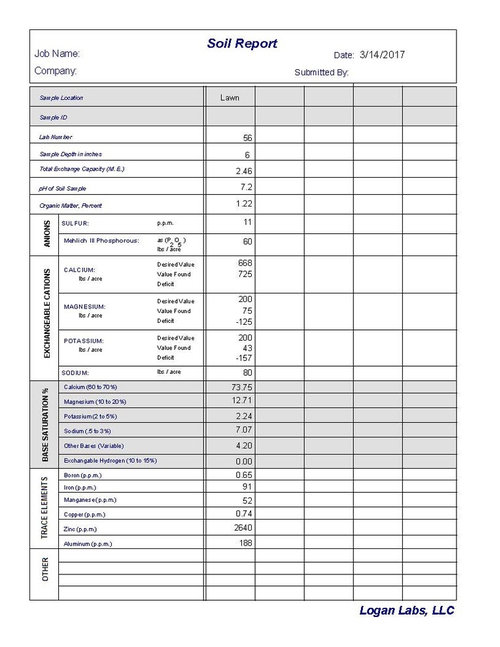
Zinc: 2640ppm. I'm not buying. Any chance you used galvanized metal tools or bucket when taking or mixing the soil samples?
TEC: 2.46 meq: Very very low. Practically no ability to hold sufficient levels of basic cations. May barely be able to hold minimum levels. You can't put a gallon of marbles into a half pint jar. pH can/will fluctuate quickly and rather dramatically. Increased leaching of nutrients and water. All of which is of major consideration when developing a plan.
Sodium: 80lbs/acre: High. i.e >5% Base Saturation, but not yet excessive/detrimental >15%. This will contribute to higher pH and can destroy soil structure with hydrophobic tendencies.. Is your water softened? Does your soil get crusty? Does water tend to run off at first or do you have areas of standing water? Although if your soil is a coarse sand as the TEC could indicate, this may not be the case.
An EC test is recommended to determine salinity of the soil.
The rest:
Magnesium: 75lbs/acre. Low/Deficient. This should be at 120 lbs/acre. That's a lot of Epsom Salt and increasing it is not going to help in lowering the pH or increasing the potassium held in buffer. or the availability of phosphorous.
Potassium: 43lbs/acre. Low/Deficient. At a minimum, this should be 80lbs.
Calcium: 725lbs/acre. Just minimally adequate. It would be advantageous
to increase this to reduce the Sodium by adding gypsum, but the conflict
with Mg, K and P just isn't worth it in my opinion.Cards on the table:
IMO It's unrealistic to concentrate on balancing this soil. I'm not saying not to test and keep an eye on it. Nor am I suggesting that you disregard it completely. I'm saying that your turf will be better served if you address its needs with a nutrient maintenance program rather than focusing on adjusting Base Saturation levels as the margins are just too small and unpredictable due to the low TEC and nutrient/soil interactions.
I recommend that you:
Apply a triple NPK (10-10-10 or 12-12-12) monthly at the rate of one pound of N/k through the growing season for Bermuda grass.
Reasoning: This will supply the turf with sufficient NPK nutrients for healthy growth and appearance throughout the growing season. The chemical N will tend to lower (or hopefully at least maintain pH). The chemical N acidity will help dislodge Na from the TEC sites making room for Mg and K. The regular application of K should also help remove Na from the Base Saturation in TEC and slightly increase K BS. Regular P applications will allow P to be continuously available to the turf, offset P binding and if pH can be maintained between 6 and 7.2, should maximize liable and readily available P levels.
Apply 2lbs/k of Epsom Salts ASAP and again late Fall at the end of the growing season.
Reasoning: This is a very conservative rate. It will raise Mg only very slightly but applying at this low rate and at both ends of the growing season should reduce some of the adverse reactions between nutrients when the turf is actively growing. Mg will also tend to remove Na from the TEC sites. I doubt that any timing of Mg application can avoid competition between H+, K and Mg for TEC sites. Testing each year will guide you in what adjustments can be made in the future.
Add OM. It will be a small sink of slow release P and help water retention and soil structure. I usually recommend Milorganite for the P sink, but in your case, one of the grains, like Alfalfa would be far superior for your soil.
This is a long term plan. Primarily, as I said, a regular maintenance plan that may have some soil balancing side affects. (Any change subject only to a drastic change in a future soil test.)
Good luck.
Related Professionals
Augusta Landscape Architects & Landscape Designers · Cherry Hill Landscape Architects & Landscape Designers · Minneapolis Landscape Architects & Landscape Designers · Albuquerque Landscape Architects & Landscape Designers · Salisbury Landscape Contractors · Oxford Landscape Contractors · Columbia Landscape Contractors · Middletown Landscape Contractors · Greenfield Landscape Contractors · New Bedford Landscape Contractors · Pittsfield Landscape Contractors · Clearlake Landscape Contractors · Baltimore Home Builders · Hempstead Home Builders · Pittsburgh Home Builderstexas_tifway
Original Author9 years agodchall,
im in tyler, tx to be exact.
Iv'e had some issues with dry spots and water has a slight tendency to shed at the surface.
I would consider the soil type to be a sandy loam.
I'm been considering an application of milo every month to boost OM levels.
texas_tifway
Original Author9 years agoridgerunner,
I did notice that the zinc levels were off the chart when i got the results back and this was due to using a zinc plated pipe.
The water is not softened. The soil does have a tendency to get crusty when dry and water does have a tendency to runoff at first. I do not have a problem with standing water.
The triple N-P-K at the bag rate would be needed now through august, correct?
At that rate i'll need almost 50lbs of Epsom salt, is there any where you might recommend on find large bags and does the size of the salt pellets really matter?
Could you recommend the use of milo every 30 days during the growing season or stick the recommended 4 apps per season to help boost OM levels? Along side with the triple N-P-K.
- 9 years agolast modified: 9 years ago
The triple N-P-K at the bag rate would be needed now through august, correct?
The primary goal of this plan is to keep the turf supplied with the major nutrients needed for healthy growth throughout the growing season, so yes, through August or even September or October. Whatever is the usual recommended N application schedule might be for Bermuda in your region.
At that rate i'll need almost 50lbs of Epsom salt, is there any where
you might recommend on find large bags and does the size of the salt
pellets really matter?Your lawn is about 12k sq ft? Truth be told, I'd rather not even mess with the Mg due to the conflicting interactions it brings with it. However, it is pretty deficient in your soil and IMO should be addressed. Consider applying it to only part of the lawn (front or back) and observe how great the difference is this year and adjust accordingly next year. In fact, I would would prefer to go a little more conservative anyway (better to be cautious), apply at 1# rather than 2#. It is, after all, a maintenance plan intended to supply the turf annual needs. Sorry, I know of nowhere that has larger than the 5-10# bags to be found at local stores. I can't vouch for this supplier but a google came up with: http://www.7springsfarm.com/epsom-salt-usp-grade-50-lb-sale/
IMO, Size does mater. For any soil amendment. The smaller the size (or the greater the number of prills needed to apply the same amount of any amendment), the more even the coverage. That's an important consideration.
Could you recommend the use of milo every 30 days during the growing
season or stick the recommended 4 apps per season to help boost OM
levels? Along side with the triple N-P-K.Surface application of OM is very inefficient for increasing OM% through the root zone. It takes anywhere from 2-10 years for fresh OM to decay into humus, but it can have an affect on the top inch of soil which can have an advantageous impact on soil water retention. Milo is unfortunately not a very good source of OM when compared to fresh sources like grains. More importantly, the OM in the form of grains etc. are a near 100% source of slow release nutrients like phosphorous. They are a sink of organic P that can only be released over time through the action of microbes. Milo, at best contain only 20-30% organic P. The rest is inorganic (readily available). Advantage to the grains for slow release. Synthetic (chemical) fertilizers contain 100% inorganic (readily available) P and on a lb per lb basis are much less cost than Milo. Advantage to synthetics for inorganic P. In addition, Milo has No K, so you will need to supplement SOP for the needed K if you want to substitute monthly synthetic triple NPK with Milo. Otherwise, I see no advantage to Milo as an addition to the triple NPK. Your turf doesn't need the extra (40%) fast release N. Up to you.
If you want to apply Milo (the new 5-4-0, if you can't find that, you'll need to supplement P) monthly instead of T-NPK, Apply it at 20#/k and you can apply SOP at 1#/k monthly (which, yes, is a drop in K monthly app, but should be adequate for maintenance-apply it at 2#/k if you wish to take an aggressive shot at balancing the BS).
Did I answer your questions?
- 9 years agolast modified: 9 years ago
Becky,
Ridgerunner, what would think about him doing half rate applications twice as often?
Sure, but few people want to apply fertilizer every week or two. Also, each app will not be as even in coverage as the amounts applied get smaller.
I think I addressed your other points in my response to the OP. Hopefully :)
- 9 years ago
I imagine applying 240 pounds of Milorganite every month would not be very cost effective and would be labor intensive.
Wouldn't it be easier and cheaper to simply apply triple NPK at half bag rate every 2 weeks to maintain a steady stream of nutrients?
- 9 years ago
With a synthetic fertilizer, either the soil holds onto the nutrients
applied or they leech away.Well, what doesn't get taken up by the plant. P can take anywhere from a few days to a couple of weeks to get tied up and unavailable. Some amount will be available until the next synthetic dose. :)
Texas-tifway, your goal should be to have slowly available nutrients, a
little at a time.
Organic matter is always good.PLUS plant OM sources contain fiber-great for water retention and tilth. Thanks for the reminder Becky.
- 9 years agolast modified: 9 years ago
j4c11,
Wouldn't it be easier and cheaper to simply apply triple NPK at half bag
rate every 2 weeks to maintain a steady stream of nutrients?Cheaper, yes. easier, not so much if you're talking effort. :) But would be ideal except for the caveat I previously mentioned.
- 9 years ago
I've never used Milorganite, but it seems like it would be a chore, especially on large lawns like OP has. I don't think standard size spreaders will hold a whole bag, and so you'd have to go back to your garage every ~1500 sq ft and refill? I'm just guessing. Depending on your lawn layout that could be a lot of walking. I imagine it's worse with grain/alfalfa which is even less dense.
- 9 years ago
Lol. After a while you get good at it. I set bags (using a cart) out strategically before I start. ;P
- 9 years ago
Here is a FAQ on organic lawn care (written by dchall). I will copy one section: "Chemical fertilizers provide an "empty" type of food directly to the plants. This is like the empty calories we get from eating pure refined sugar. Microbes provide full service to the plants. They decompose dead plant and animal residues to humus; combine nitrogen and carbon to prevent nutrient loss; suppress disease; produce plant growth regulators; develop soil structure, tilth, and water penetration/retention; clean up chemical residues; shift soil pH toward neutral; retrieve nutrients from distant parts of the soil; decompose thatch; and control nitrogen supply to the plants according to need. Besides that, if a chemical fertilizer contains NPK of 10-10-10, nobody knows what the 70% of unlisted stuff is in the chemical bag that is not fertilizer." (In another section about timing he seems to be gearing his answer to cool season grass which should be left alone in summer. Bermuda should be fertilized during the summer.)
As for ease of application, I never had a problem with Milorganite, alfalfa pellets, or cracked corn. Cornmeal sometimes clumped but if I shook the spreader it would unclog. 12K of lawn is only about 1/4 acre. Some people deal with much larger areas.
- 9 years agolast modified: 9 years ago
Chemical fertilizers provide an "empty" type of food directly to the plants. This is like the empty calories we get from eating pure refined sugar.
I think dchall's article appeals more to the heart than the mind. We see this kind of anthropomorphization in many areas, including for example pet food. There's a number of statements in there which, in my opinion, do no stand up to scrutiny. I'll make a few observations:
- Applying granular fertilizer and having a healthy soil flora are not dichotomous. Pastures have been doing just fine for a billion years without anyone throwing corn on them. Bacteria feeds on thatch and dead old blades of grass etc. It's no different in a lawn, especially if you mulch mow.
- Nitrate and/or amonium resulting from decomposition of organic matter is in no way different than that resulting from nitrification of urea.
- I'm not aware of any mechanism by which the bacteria is aware of or responds to the plant's N needs.
- Plants grow just fine and often times better hydroponically in distilled or otherwise sterile water.
- There's no research that evaluates the impact of creating an artificial bloom of certain bacteria on the overall health of the system. How does creating a massive population of milorganite-decomposing bacteria affect populations of bacteria which normally feed on cellulose or other life normally/naturally found in pastures/prairies? What about fungi? No one knows.
- There's no research that would indicate the positive impact of bacteria on soil grows proportionally with the amount of bacteria in the soil. It could taper off.
- Bacteria are not fusion reactors - they do not create carbon or nutrients out of thin air. You still get what you put in, with losses.
As for ease of application, I never had a problem with Milorganite, alfalfa pellets, or cracked corn
Sure, it's not a problem, it can be done and people do it, it's just more work and more money.
- 9 years ago
Texas-tifway's soil cannot hold onto nutrients. If he had a thriving soil life web (bacteria, fungi, nematodes, earthworms, etc.) those organisms could supply nutrients slowly, as needed (the plant roots initiating the feeding), from the nutrients in the food they had eaten (grass blades, grains, etc.). The organisms would act as the holders for nutrients since his soil cations aren't adequate to hang onto them.
- 9 years ago
I don't disagree with you on that, I just look at it from a cost-benefit perspective. You're paying significantly more, working significantly harder, and achieving the same thing you would achieve with bi-weekly half-apps of triple NPK. Possibly less since with Milorganite you'd still need a source of K. You can buy yourself a real nice greens mower with the savings over just one season.
texas_tifway
Original Author9 years agoThanks for the advice everyone, the lawn is more like 24,000 sq ft. Ridge I think that you have answered most of my questions that I had. What would you consider to be a better source of P corn meal vs soybean meal. I would assume that a smaller size of pellets would be better ie. 1/4". I'm guessing a feed store would be the best source on find the right product. I would like to boost the soil OM as much as possible but I understand that this will take some time.
- 9 years ago
I would like to boost the soil OM as much as possible but I understand that this will take some time
The soil OM you will get from applying organic matter on the surface is going to be negligible to non-existent. 20 year studies on wheat fields where the straw was reclaimed found little to no impact on soil OM. The number one way to increase soil OM is to grow healthy grass with deep healthy roots- it is estimated that grass adds an yearly amount of organic matter equal to the total amount of root biomass. Depleted agricultural fields converted to pasture increased their OM percentage by about 0.33%/year simply by putting roots in the ground. Do what needs to be done to help the grass thrive and it will improve the soil for you. That's not to say organic fertilizer won't help the grass the thrive - just that the fertilizer itself is not where your OM improvements will come from.
- 9 years agolast modified: 9 years ago
What would you consider to be a better source of P corn meal vs soybean meal.
I would look for the lowest N (first number), highest P (second number) that I could find available at a price I want to pay. Soybean meal is about 6-1.5-2. I prefer to avoid high N values when combining with synthetics, but that's me and many people don't bother and claim no ill affects. I do not know what the NPK of cornmeal is, sorry. Alfalfa is about 3-1-2. Steamed bonemeal is about 3-21-0.2. Milo (new version) is 5-4-0, about 20% is organic so about 5-0.8-0, but consider the other 3.2 that is inorganic.
Maybe dchall can better help with the numbers, he's the organic guy.
- 9 years ago
I assume you're going with the monthly balanced NPK fertilizer (during the growing season) with an organic feeding thrown in (or substituted for a monthly feeding) and Epsom salts now and in the fall. If you have trouble finding big bags of Epsom salts, an alternative product is langbeinite, which might be sold under the names Sul Po Mag or K Mag. It is a natural product (mined) which supplies potassium, magnesium, and sulphur and it, like Epsom salts, does not raise pH (you do not want to raise pH). If you used that monthly to supply K and Mg, you would use a starter fertilizer instead of a balanced one for N and P (starter fertilizer is high in phosphorus, low in potassium). Phosphorus is an anion, not a cation, and is generally immobile, so it is not as vulnerable to leaching as your other nutrients. It often gets bound up with other substances and becomes unavailable, so when soil tests indicate a need, it's good to add it. Organically feeding half an acre could be expensive. Your soil needs all the help it can get, so do what you can. A couple of organic feedings isn't going to produce miracles, though. You are stuck with a low cation exchange capacity for the indefinite future. Add free organic matter (clippings, leaves) whenever possible.
- 9 years agolast modified: 9 years ago
Good alternatives from Becky, but I can see the next question coming, "If i go with K mag, how much should I apply and how much starter?" ;/
T_T,
I should have addressed this before, but when it is necessary to employ a maintenance program for soils that subject to continuing problems with nutrient availability, to calculate and adjust for decently accurate applications and results, saturated paste tests should be employed.
Otherwise, we can only make recommendations on our best judgment and adjust yearly by observation of the previous years results. It therefor goes without saying that the recommended rates are my best guesstimate and not written in stone.
EDIT: With that in mind, and considering the costs associated with 24k sq ft of lawn.
See if you can find triple super phosphate, potasium sulfate (SOP), Urea, Starter fertilizer, Milorganite (and what formulation, 6-2-0, 5-2-0, 5-4-0) and the items Becky has suggested. If you can find them available, get prices and we can try to mix and match and adjust to make the best low cost recs available to you.
texas_tifway
Original Author9 years agoUpdate: I went to the local Lesco store and they said that they were out of 13-13-13 (or any 1-1-1 ratio) fertilizer but the closest thing they had was 18-24-10. So i snagged up a few bags and applied it at the bag rate back around the 10th. Then i went ahead and applied the Epsom salt that ridgerunner talked about and then I went ahead and applied the milo on Easter weekend at 1.25X the bag rate. Just within the almost 2 week period the bermuda has taken off like a rocket. Iv'e kept the watering schedule at the recommended 1" per week, as well as mowing about every 5 days and its really starting to look like its on it way to where it should be. The only thing that im concerned about is that there are a couple of dry spots in the yard and i will hit them with the water hose by hand watering and it seems that the soil is having a hard time absorbing the water. So it seems that the soil is slightly hydrophobic and think this could be remedied by using the baby shampoo method to lower the soil's surface tension so that the water could drain better into the soil. Is there any specific one that anyone might recommend?
- 9 years ago
I buy the cheapest baby soap I can find. Local Dollar General sells 15 oz bottle for a $1.
- 9 years ago
Cheap. No or few additives. Certainly no conditioners, special oils or softeners etc. I've used White Rain (hydrated?-NP that it has sea algae and aloe), about $1 for 18 oz.
- 9 years ago
I like jet dry. It's available at any local grocery store & it doesn't foam up when you spray it











beckyinrichmond