Software
Houzz Logo Print
timothyflynn

Lawn in its Death Throws?

9 years ago
last modified: 9 years ago
Okay - death throws may have been pretty dramatic.. But I take a lot of pride in the way a lawn looks! :)

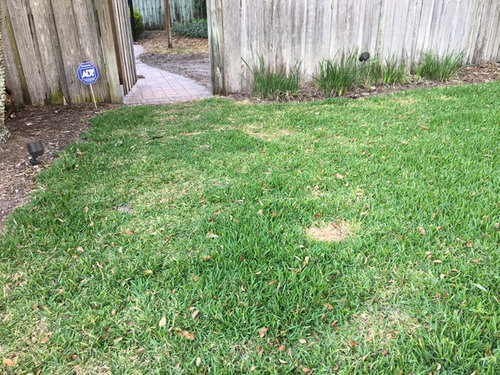
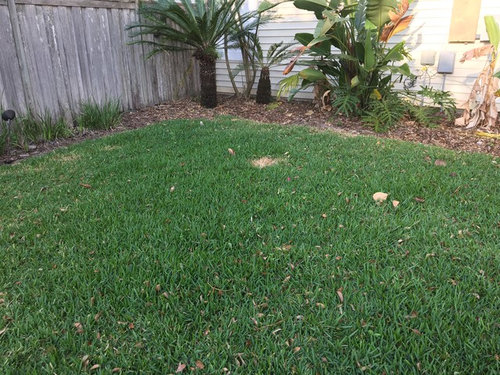
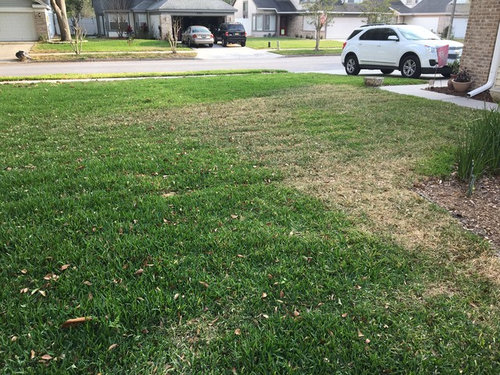
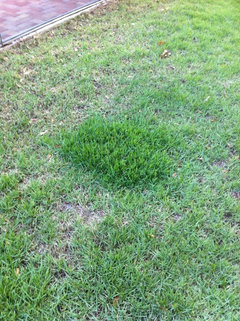
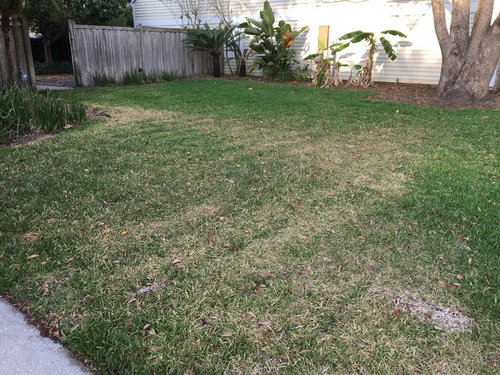
My wife and I recently bought a home in Central Florida (Zone 7 I think?) and we have a rather large patch of St Augustine grass that appears to be dying on us. At first, I thought it was weak due to not being watered while the house was on the market. We have been watering it consistently (within regulation) and I spread Scott's Turf Builder fertilizer about two weeks ago. I haven't seen any improvement. Suggestions based on the pictures?

Comments (10)

  • 9 years ago

    Does that last picture show a shortcut through the grass?

    If so you have compacted soil, which means less water absorbed, less grass growth.

    If so, stepping stones or a path to whatever is off to the right would fix the problem.

    Timothy Flynn thanked User
  • 9 years ago
    @lazy_gardens If it is a shortcut, it's not one that we use often or at all. I'd prefer not to resuscitate the grass if possible. Thoughts on bringing back compacted soil?

    @dschall The cans are a great idea. I was worried about fungus due to the spottiness (spelling?) of the dying grass. Right now I just have the zone set to 30 minutes of watering. I will look into how long it takes to reach one inch. I'll also look into the alfalfa pellets.

    Thanks for the ideas!
  • 9 years ago

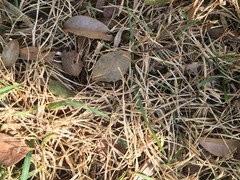
    Find a spot where you think you might have disease, take a picture from 3 inches away, and post it.

    For hard soil spray it with 3 ounces of shampoo per 1,000 square feet. Follow that with 1/2 to 1 inch of water to get the shampoo down deep. In 3 weeks you should notice that the soil is almost uncomfortably soft to walk on after it rains or when you water. If you want it softer, reapply the shampoo. You cannot overdo the shampoo. People have tried.

    Timothy Flynn thanked dchall_san_antonio
  • 9 years ago
    Here is a picture of the area I think might be sick
  • 9 years ago

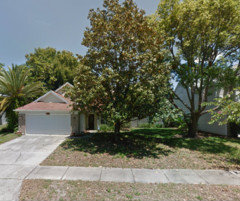
    So I was poking around the internet and read about decomposing roots sucking nutrients from surrounding vegetation, specifically turf grass. I decided to head over to Google Street View and VOILA! It looks like the previous owners had a rather large tree removed from the front yard. I'm wondering if the decomposing root system could be causing the decay? If so, how do I remedy this?

    It could be this.. or have I fallen victim to reading it on the internet and assuming it is true..?

  • 9 years ago

    Tough to ignore that coincidence

  • 9 years ago

    You do have a disease problem. I'm kind of surprised. Seems too early but I guess if you're in FL the grass has been growing awhile now.

    I have been successful using a mythological cure for lawn disease every year since 2002. I say it is mythological because the universities tell me it's a myth. Well, it works for me and many (MANY) others who have used it. The solution for me has been ordinary whole ground corn meal (available in 50-pound bags at the feed store for under $10). Spread it at 20 pounds per 1,000 square feet and wash it down to the soil. Give it 3 weeks to work. After that you should see new grass coming in without the lesions. This will not work if you apply any other chemical fungicide first. The myth calls for the corn meal to attract a predatory fungus called Trichoderma (try ko DERM a). The Trichoderma populates itself on the fungi that decompose the corn. Once those fungi are gone, the high population of Trichoderma wipes out the disease fungi. Again, others poo poo me, but it has worked every time I tried it.

    Corn meal is also an organic fertilizer. It is not the best, in fact it is one of the worst, but still if you use it at 20 pounds per 1,000 you will see a greening effect and the grass will become more dense. If you cannot find it at a feed store you can find corn flour at grocery stores catering to Hispanic shoppers. Maseca is one brand. There are two products that look almost identical in 25 pound bags. One is plain corn flour and the other is corn mixed with baking soda and baking powder for making tortillas. You want the plain corn. Price for the 25-pound bag is also under $10, so about 2x what a bag costs at the feed store. This is food quality corn meal. The other is feed quality.

    Over the long haul if you water as I described above you should very rarely see fungal disease again. I got it from leaving yard clippings or other stuff on the grass overnight cutting off the flow of air. Rarely I would get it from too much rain not allowing the soil to dry out for a couple weeks.

    Timothy Flynn thanked dchall_san_antonio
  • 9 years ago

    @dchall_san_antonio I really appreciate your help. I will head to a feed store today. I have a couple of questions that may reveal my novice.

    1: When you say organic fertilizer, are we talking about something like Milogranite? Is there another product that would fit this category? I'm used to just purchasing Scott's Turf Builder and the vibe I have been getting the more I read is that there are far better options out there.

    2: I read a lot about spreading at XX lbs per 1,000 feet. I have (by have, I mean I ordered it today via Amazon Prime) a Scotts Mini Broadcast Spreader. Will there be instructions as to how to set it the spreader to meet the specific lbs per feet ratio or will I need to know something else?

    3: After the application of this mythological remedy, should I expect to see it get better, worse, or largely stay the same during the three week interim?

  • 9 years ago

    It will stay exactly the same for the 3 weeks. The return can be subtle, but in 4 weeks you will have forgotten about it when SUDDENLY you'll remember and notice that is looks much better.

    Milorganite is one organic fertilizer. If you look at the ingredients of other organic fertilizers you'll see they contain corn, alfalfa, soybean meal, cottonseed meal, and animal byproducts. The animal byproducts could be blood meal, bone meal, poultry litter, feather meal, fish meal, or any of a number of slaughterhouse left overs. But anyway if you simply use alfalfa pellets/meal, soybean meal, cottonseed meal, or corn meal, you will get the same benefit for about 1/6 the cost of the commercially bagged organic fertilizers. Here is a picture from mrmumbles, a former poster to this forum.

    He applied a handful of alfalfa pellets in mid May and took the picture in mid June. You can see the improvement in color, density, and growth. The grass type was zoysia, but the results are typical. The results are usually much more dramatic the very first time you use it after not having used any fertilizer or after years of using only chemical fertilizers.

    If your Scott's spreader is like mine, you will have to open it all the way and still go over everything at least twice to get 15 pounds per 1,000 square feet. I estimated 5 pounds of corn, opened the spreader all the way, and walked until it was gone from the spreader. I had nearly covered my entire 1,000 square feet. So I needed to go over it 2 more times. One more thing to know, organic fertilizers absorb humidity and clump together. As long as you don't live in a humid climate you won't notice it (Bwahahahahaha - you'll notice it in FL). At any rate I have gone to throwing it by hand from a 2-pound coffee can. Fill the can and you have about 2 pounds of organic anything. Then eyeball off about 100 square feet and apply it all. That gives 20 pounds per 1,000 in that area. Side note that I use more than I probably need to. Again, using more is not a problem for organics. You could apply 50 pounds per 1,000 without overdoing it. Once you get up to about 80 pounds per 1,000 you are smothering the lawn and that will have consequences.

    Organic fertilizers are not as concentrated as chemical. That's why we use 15 pounds while the chemical ferts use only a few pounds to cover the same area. Chemical fertilizers feed the plants directly by osmosis (salt imbalance forcing chemicals into the roots). Organic fertilizer feed the soil microbes which, in turn, create a natural plant food that feeds the plants on demand. Due to these differences, you can use organic and chemical fertilizer at the same time and have no fear of overdoing it. Because organics are a biological process of releasing nitrogen from food, you will detect the faint aroma of spoiled milk. If you use too much (50 pounds) it will stink pretty badly because the beneficial microbes cannot process it all before the stinky microbes do. The first time you use it is the worst because the microbe populations are not all there. Once they are reestablished, they process the fertilizer faster.